The federal government is one of the largest buyers of cloud services in the world, representing a massive opportunity for Cloud Service Providers (CSPs). But to do business with federal agencies, you need to meet their stringent security standards. Enter FedRAMP.
If you are a cloud provider looking to unlock unprecedented growth, achieving FedRAMP compliance is your golden ticket. However, the framework is known for being complex, rigorous, and ever-evolving with the highly anticipated rollout of the FedRAMP 20x modernization initiative.
Here is your modern guide to understanding exactly what is FedRAMP, navigating its requirements, and preparing your business for the sweeping FedRAMP 20x changes on the horizon.
What is FedRAMP?
The Federal Risk and Authorization Management Program (FedRAMP) is a United States federal government-wide compliance program. It provides a standardized approach to security assessment, authorization, and continuous monitoring for cloud products and services.
Instead of agencies conducting redundant, individual security assessments for the same cloud product, FedRAMP establishes a "do once, use many times" framework. Once your cloud service is certified, any federal agency can leverage your solution with confidence, saving time and resources for both the government and your business.
How FedRAMP Authorization Works
At Rhymetec, we know firsthand that the road to FedRAMP can feel overwhelming. We streamline each phase to reduce friction and accelerate your journey to compliance. Typically, the authorization process involves:
- Scope Assessment: Defining your system boundaries and determining the exact scope of your cloud environment.
- Gap Assessment & Planning: Assessing your current controls against FedRAMP requirements and building a project plan to close any gaps.
- Policy & Control Implementation: Creating and operationalizing all required FedRAMP-aligned policies, procedures, documentation, and technical safeguards.
- Audit Preparation & Authorization: Coordinating with a Third-Party Assessment Organization (3PAO) to complete the formal assessment and achieve your certification.
What are the FedRAMP Requirements?
FedRAMP requirements are based on the National Institute of Standards and Technology (NIST) Special Publication 800-53. To meet these requirements, organizations must develop comprehensive documentation and implement strict technical controls.
Key deliverables include:
- A complete System Security Plan (SSP) detailing how every control is implemented.
- A Security Assessment Plan (SAP) and Security Assessment Report (SAR) generated during the 3PAO audit.
- A Plan of Action and Milestones (POA&M) to track and remediate any vulnerabilities.
- Policy and procedure development across all NIST control families.
- A robust continuous monitoring framework to maintain compliance post-certification.
CMMC vs. FedRAMP: What’s the Difference?
If your organization is navigating the federal compliance landscape, you’ve likely heard of CMMC (Cybersecurity Maturity Model Certification) alongside FedRAMP. While both frameworks are rooted in NIST standards and share the goal of protecting government data, they apply to very different types of businesses:
- FedRAMP applies to Cloud Service Providers (CSPs) that want to sell their cloud software or infrastructure to federal agencies.
- CMMC applies to defense contractors and subcontractors within the Department of Defense (DoD) supply chain to ensure they are protecting Controlled Unclassified Information (CUI).
The two frameworks collide when a defense contractor uses a cloud service to store or process CUI. Under CMMC mandates, that contractor can only use a cloud service if the CSP is either fully FedRAMP Moderate Certified or has achieved 100% FedRAMP Moderate Equivalency (which requires a rigorous 3PAO assessment of its own).
In short: If you provide cloud services, you need FedRAMP. If you provide goods, services, or research to the DoD, you need CMMC.
Check out our complete guide on CMMC vs. FedRAMP here.
Understanding FedRAMP Levels (and New Naming Conventions)
FedRAMP categorizes cloud systems based on the potential impact of a security breach.
Important Update: If you haven't been following the latest FedRAMP updates, the terminology is shifting. To align with other industry frameworks and reduce market confusion, the term FedRAMP "Authorized" is changing to FedRAMP "Certified." Furthermore, the traditional impact levels are transitioning to a streamlined Class-based system.
Here is how the new naming conventions break down:
- Class A (Formerly FedRAMP Ready): Indicates that a 3PAO has attested to your readiness and you are listed on the FedRAMP Marketplace, making it easier for an agency to sponsor you.
- Class B (Formerly FedRAMP Low): Designed for systems where the loss of confidentiality, integrity, or availability would have a limited adverse effect on an agency.
- Class C (Formerly FedRAMP Moderate): The most common level. This applies to systems where a breach would have a serious adverse effect on an agency's operations or assets.
- Class D (Formerly FedRAMP High): Reserved for the government’s most sensitive, unclassified data (e.g., law enforcement, emergency services, financial systems) where a breach could have severe or catastrophic consequences.
How Long Does FedRAMP Certification Take?
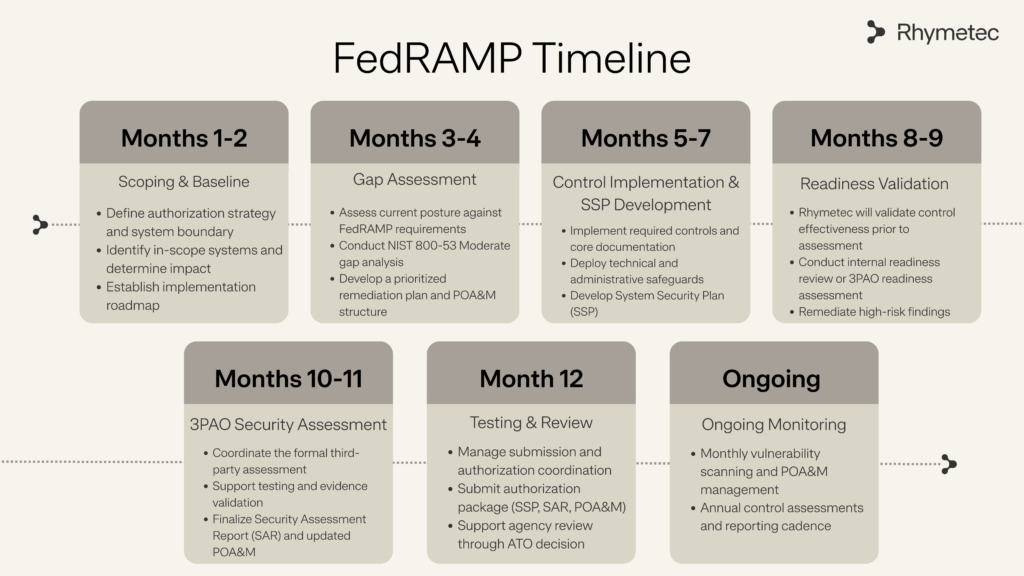
The timeline to achieve FedRAMP certification varies significantly depending on your organization's current security posture, the complexity of your system, and the Class (A-D) you are pursuing. Generally, the entire process, from initial scoping to final certification, can take anywhere from 9 to 12+ months.
A note on existing frameworks: If you already hold a SOC 2 or ISO 27001 certification, you have a great foundation. There is notable overlap in governance and basic security policies. However, FedRAMP requires a much more rigorous, technical implementation of controls. Having SOC 2 will speed up your gap analysis, but expect to invest significant engineering time to meet FedRAMP’s exacting architectural and technical standards.
How Does FedRAMP Pricing Work?
Achieving FedRAMP certification is a strategic investment. Costs are typically broken down into three buckets:
- Engineering & Infrastructure: Upgrading your cloud environment to meet stringent federal standards (e.g., dedicated GovCloud environments, FIPS-validated encryption).
- Consulting & Preparation: Partnering with experts to handle gap assessments, policy creation, and SSP development.
- 3PAO Audit Fees: Paying the accredited third-party auditor to conduct the official assessment.
While the upfront cost is higher than commercial certifications, the ROI is substantial. A FedRAMP certification essentially unlocks the entire federal marketplace for your sales team.
What's Changing: FedRAMP 20x
As the cyber landscape evolves, so does FedRAMP. The upcoming "FedRAMP 20x" updates focus on modernizing the framework, improving automation, and accelerating the authorization timeline.
Here is what the FedRAMP 20x modernization means for cloud providers today:
A Shift to "FedRAMP Validated”
While legacy authorizations are shifting to the "FedRAMP Certified" label, 20x introduces the new FedRAMP Validated designation. This proves to agencies that your security isn't just a point-in-time audit, but a continuously monitored and automatically enforced reality.
No Agency Sponsor Required
Traditionally, CSPs had to secure a federal agency sponsor before beginning the authorization process, a massive hurdle. FedRAMP 20x opens a direct-to-PMO authorization path, removing the sponsor bottleneck.
Automation Replaces Prose
Instead of writing hundreds of pages explaining your security controls, 20x focuses on machine-readable data and automated continuous monitoring feeds. If you already have a strong commercial security framework in place, you can inherit many of those policies to reduce redundant documentation.
Unprecedented Speed to Market
By removing the red tape and relying on automated validation, the 20x initiative has slashed approval times during its pilot phases. What once took well over a year is actively being streamlined down to a matter of months or even weeks. These changes aim to get secure, commercial cloud technologies into the hands of federal agencies faster than ever. However, making the leap to a fully automated, machine-readable compliance posture requires serious technical maturity.
What This Means for Your Strategy
For cloud service providers, these changes mean that getting FedRAMP Certified is becoming a more structured, logical process, but the technical bar remains as high as ever.
Your strategy should focus on proactive preparation. Don't wait for a federal agency sponsor to ask for your SSP to start building it. Begin your scoping and gap assessment now. Determine whether your target market requires Class B, C, or D certification, and build a roadmap to close those technical gaps.
Most importantly, don't do it alone. Navigating the transition from commercial security to federal compliance requires specialized expertise.
Ready to Speak to a FedRAMP Consultant?
At Rhymetec, we deliver the clarity, documentation, and expertise needed for successful certification. With a decade of trusted delivery and a 100% in-house team (never outsourced), we help you every step of the way, making an otherwise complex process clear, structured, and achievable.
From gap assessment and policy development to control implementation and 3PAO audit coordination, we simplify the journey so you can focus on unlocking new growth.
Contact us today to speak with one of our compliance experts.