While approximately 88% of organizations have deployed artificial intelligence within at least one business function, only 8% maintain a comprehensive framework to oversee it. As organizations scale their artificial intelligence capabilities, traditional information security paradigms must adapt to meet new architectural demands. When product teams embed large language models (LLMs), pull data through dynamic retrieval pipelines, or deploy autonomous workflows, they inherit entirely new operational liabilities.
Securing modern AI applications extends far beyond protecting static codebases. It involves managing systems defined by non-deterministic behavior, where a model can return variant outputs to the exact same prompt, alongside unique challenges like input logic vulnerabilities, unintended data exposure, and unconstrained API interactions.
Rather than serving as an administrative constraint, robust compliance functions operate as a critical commercial accelerator. Implementing practical AI governance solutions builds the institutional trust required to unlock enterprise revenue, clear complex procurement hurdles, and expand operations with complete confidence. Brakes don't exist to slow you down; they exist so you can take tight corners faster and with complete control.
To expand into enterprise markets without the guesswork, organizations need proactive AI compliance solutions that translate complex global regulations into clean, rapid development workflows.
The New Operational Reality: Defining AI Governance
Effectively implementing these frameworks requires a clear understanding of what modern governance entails and how the baseline for system risk has transformed.
What Is AI Governance?
At its core, AI governance is the proactive framework of corporate policies, internal accountability, and active validation mechanics that keep your AI systems predictable and secure. It isn’t a passive paper drill or a legal checkbox; it’s a living operational system designed to ensure your models perform strictly within your business parameters.
Why the Urgency Has Accelerated
The transition from legacy software infrastructure to generative architectures has completely redrawn the standard security perimeter.
- The Non-Deterministic Shift: Legacy information security was built to protect deterministic code, systems where explicit logic reliably yields the same output every time. Generative AI changes the rules. Because models respond dynamically to natural language, they are vulnerable to input manipulation and data exposure that classic firewalls simply cannot catch.
- Autonomous Authority and Agentic Risk: Teams are rapidly moving past simple chatbots into complex, agentic ecosystems. When you give non-human actors the autonomy to ingest data, query internal databases, and execute tool calls across your production environment, you inherit an entirely new tier of liability.
- The Commercial Demand for Trust: Enterprise buyers, general counsels, and institutional investors are no longer checking boxes based on verbal assurances. Globally, four out of five organizations now face direct customer inquiries regarding their AI risk management practices. Demonstrating structured, verifiable oversight has become the absolute baseline requirement for closing high-value commercial contracts.
Velocity Meets Verification: Mapping the Modern AI Risk Surface
True oversight requires balancing top-down organizational governance (the policies) with proactive technical validation and testing. When executed properly, these elements unify into complete AI security solutions that safeguard your intellectual property while accelerating your engineering timeline.
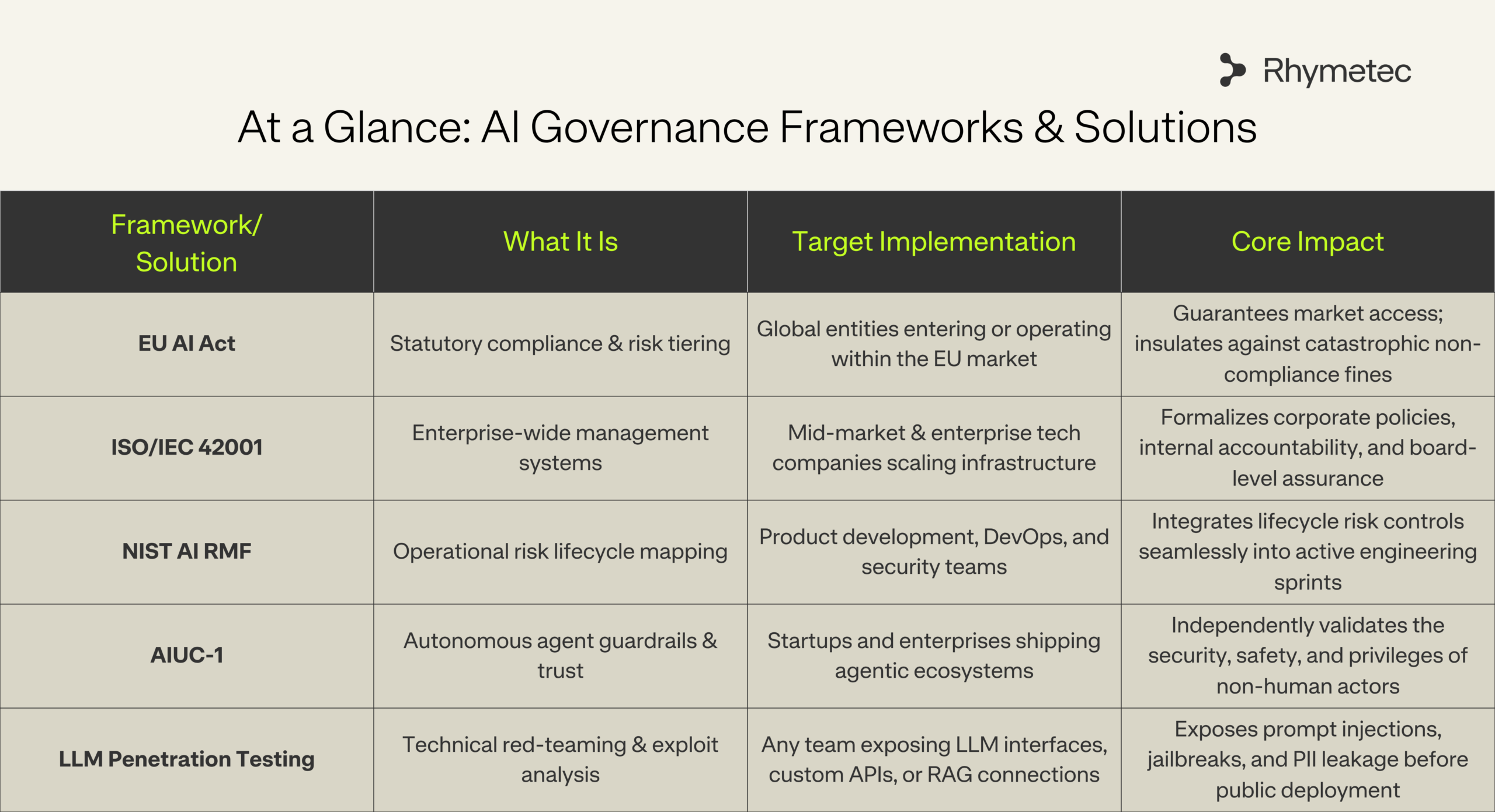
Here is how the leading frameworks, compliance standards, and testing methodologies map out for your business:
EU AI Act: Securing Global Market Access
The EU AI Act enforces a strict, risk-based classification system that groups artificial intelligence applications into four tiers: unacceptable, high, limited, and minimal risk. Applications that cross the line into unacceptable risk are banned entirely, while high-risk setups are subject to deep transparency mandates, incident logging, and continuous data management.
A Critical Distinction on Scope: Similar to the EU’s General Data Protection Regulation (GDPR), the EU AI Act applies to any organization globally if their AI system is deployed within the EU, supplied to the EU market, or leverages data that impacts individuals living inside the EU, whether or not that organization is in the EU. If your product has a global footprint, you are within its jurisdiction.
Turning Regulatory Pressure into a Commercial Engine
Adhering to the EU AI Act is a core requirement for operating in global economic hubs. Non-compliance carries severe financial exposure, with penalties reaching up to €35 million or 7% of a company’s global annual turnover (whichever is higher).
Provisions prohibiting unacceptable AI practices are already in effect, and the remaining requirements continue to take effect on a phased timeline. While certain high-risk AI deadlines have been extended, transparency obligations remain scheduled for August 2, 2026. Enterprise buyers are actively purging vendors who cannot provide definitive proof of compliance. Meeting these criteria means your organization can bypass complex legal questionnaires, outpace legacy competitors, and win enterprise contracts faster.
Structural Architecture: ISO 42001 and the NIST AI RMF
Scaling modern software platforms requires flexible, elite frameworks that provide organizational structure without adding administrative friction.
- ISO/IEC 42001: As the world’s first formal international standard for artificial intelligence management, ISO 42001 provides the blueprint for an Artificial Intelligence Management System (AIMS). It defines structural accountability, continuous oversight, and data control policies, proving to investors and enterprise boards that your infrastructure is highly disciplined.
- NIST AI RMF: While ISO/IEC 42001 establishes the overarching management system for organizational accountability, the National Institute of Standards and Technology’s framework provides the granular, tactical blueprint needed to operationalize risk management across the daily development lifecycle. Structured around four continuous functions, Govern, Map, Measure, and Manage, it translates abstract risk concepts into practical, daily engineering checkpoints that map to standard workflows.
AIUC-1: The New Frontier for Agentic AI Systems
As artificial intelligence moves rapidly from passive chat boxes to autonomous, agentic systems capable of executing multi-step workflows, traditional security benchmarks drop away. This operational shift demands AIUC-1 (Artificial Intelligence Unified Controls), the definitive compliance standard engineered specifically for autonomous AI agents that interact with core enterprise databases, application layers, and software integrations.
Understanding Agentic Risk
When an autonomous agent experiences logic manipulation, inherits broad API access, or triggers cascading downstream automated actions without a human-in-the-loop, it introduces significant data and corporate liabilities.
"Traditional firewalls protect static code, but they are entirely blind to the non-deterministic logic of an autonomous AI agent.
The moment you grant a non-human actor the authority to query enterprise databases and execute workflows, your risk surface shifts from predictable vulnerabilities to dynamic liabilities. If your compliance framework hasn't evolved to match that autonomy, you're flying blind."
— Kyle Jones, Chief AI Officer, Rhymetec
AIUC-1 targets this specific exposure layer through 51 comprehensive controls distributed across 6 core pillars:
- Data & Privacy: Preventing unauthorized retraining loops, PII exposure, and IP leakage.
- Security: Implementing continuous execution logging, explicit access parameters, and active defenses against jailbreaks.
- Safety: Mandating independent validation and strict human-in-the-loop overrides for high-consequence agent actions.
- Reliability: Stress-testing against hallucinated data outputs and unconstrained third-party tool executions.
- Accountability: Establishing undeniable lines of operational ownership for every autonomous system action.
- Societal Impact: Actively monitoring and identifying algorithmic or behavioral bias within deployed models.
Because agentic ecosystems evolve rapidly alongside fast-paced release cycles, AIUC-1 moves away from traditional annual audits in favor of a continuous validation model. Achieving and maintaining certification requires independent penetration testing and technical review conducted at least once every quarter.
This rolling cadence ensures that model guardrails, retrieval pipelines, and third-party tool access remain secure against changing adversarial threats.
Where high-level standards like ISO 42001 evaluate company-wide management procedures, AIUC-1 operates at the use-case execution level to deliver the ongoing technical validation required by legal and procurement teams.
LLM Penetration Testing: Translating Governance into Technical Validation
Policies, procedures, and documentation establish your structural defense, but LLM penetration testing is what proves whether your actual code and system guardrails stand up to active, malicious pressure. True governance requires continuous real-world validation; you cannot responsibly claim to govern an AI system if you lack clear visibility into how it handles a deliberate attack.
Traditional web application security focuses on infrastructure flaws like cross-site scripting (XSS) or SQL injection. Modern AI cybersecurity solutions focus entirely on the non-deterministic logic of the model, conversational routing, prompt structure, vector databases, and retrieval-augmented generation (RAG) connections.
Adversarial Validation Phases
A premium testing engagement maps directly to the OWASP Top 10 for Large Language Model Applications, broken down into four execution phases:
- Planning and Preparation: Mapping your specific deployment landscape, defining foundational base models (e.g., GPT, Gemini, Claude), system prompts, authentication barriers, plugin permissions, and data-use boundaries.
- Discovery and Enumeration: Tracing internal data pipelines, conversational routing, API endpoints, and vector database structures to map exactly how contextual data is ingested, retrieved, and processed.
- Exploitation and Validation: Utilizing automated red-teaming scripts paired with expert manual jailbreaking to push for prompt injection, sensitive data/PII extraction, insecure output handling, and model denial of service (DoS).
- Reporting and Remediation Guidance: Delivering a clean, executive-ready breakdown of validated exploits, clear severity ratings, and prescriptive code adjustments to permanently secure your application guardrails.
Do you need independent testing if you use an enterprise foundational model? Yes. While the base infrastructure of models provided by providers like OpenAI or Anthropic is highly secure, your unique implementation layer, your custom instructions, RAG parsing architecture, system plug-ins, and data access workflows, creates entirely new vulnerabilities. If a malicious input can force your custom application to execute unauthorized actions, the base model’s default safety parameters cannot protect your environment.
Move Forward with Assurance
Whether your company is a SaaS platform embedding AI features into an existing application, a startup scaling an LLM prototype into rapid production, or an enterprise expanding into highly regulated markets, implementing modern AI security solutions shouldn't come at the cost of your development velocity.
By pairing proactive technical testing with robust, practical corporate frameworks, you eliminate the guesswork from AI adoption. Rhymetec helps you build the safety guardrails you need to push boundaries safely, satisfy regulators efficiently, and prove to your customers that you take responsibility as seriously as speed.
Ready to validate your security posture and streamline your path to compliance? Contact us today.