In 2025, more companies than ever before are budgeting for ISO 27001 certification costs. In a recent ISO survey, the global number of ISO 27001 certificates reached over 70,000 certificates and were reported in 150 countries and across a range of economic sectors.
Many of these certifications are driven by customer demand and procurement requirements, in particular in fields such as B2B SaaS.
Understandably, cost is often one of the most important questions companies exploring their compliance options have. ISO 27001 is a bit more involved than other frameworks in this space, such as SOC 2, as it requires a broader set of security controls and third-party requirements.
External audit costs, internal resource time, implementing technology changes at your organization, and ongoing maintenance all factor into ISO 27001 certification costs. Without a clear breakdown, it can be easy to underestimate both the initial investment and the ongoing effort.
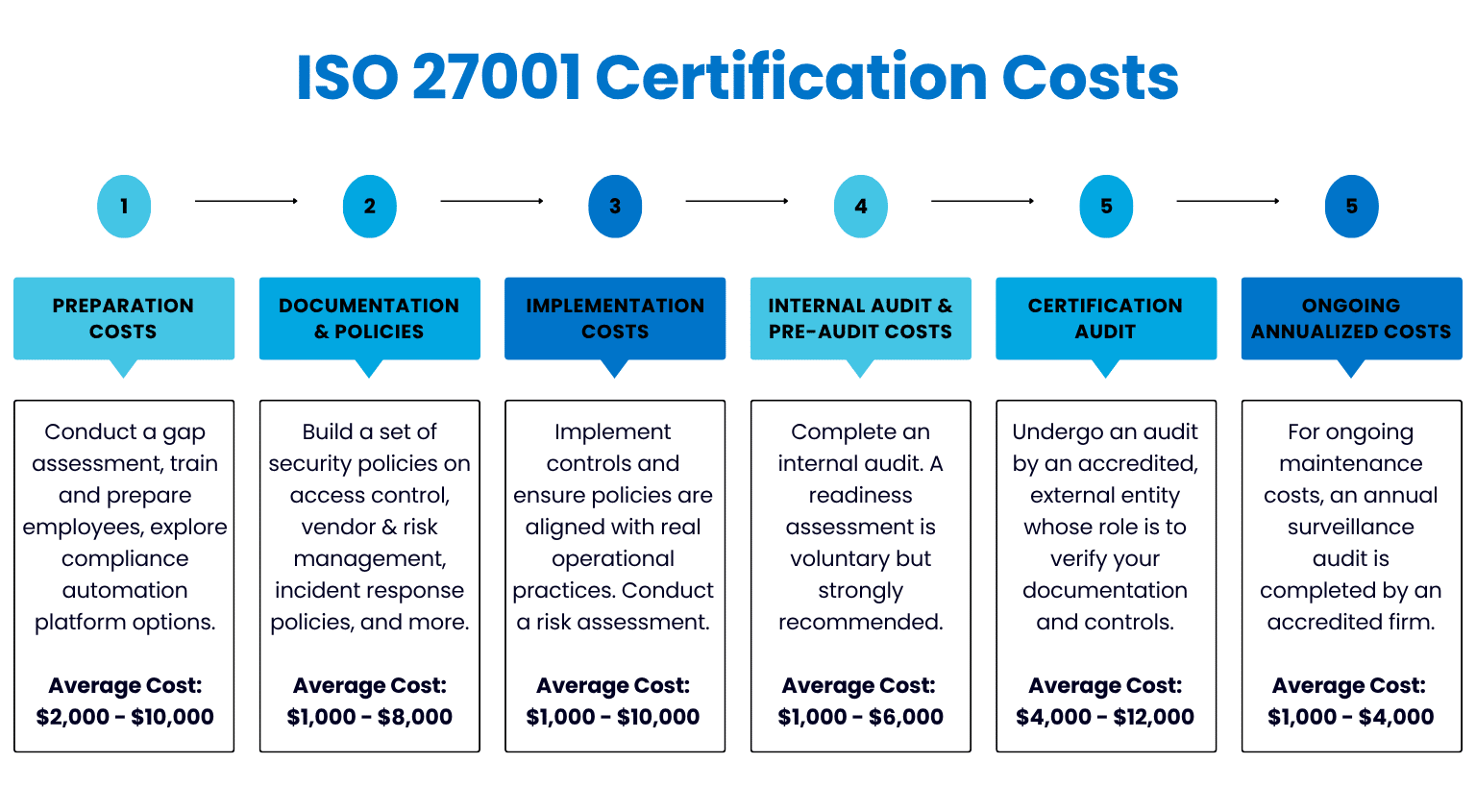
This blog outlines what to expect for ISO 27001 certification costs, based on current market data, our team’s firsthand experience working with SaaS startups, and input from certified auditors we work closely with.
Preparation Costs
Preparation costs for ISO 27001 represent a substantial part of the overall investment. Before engaging a registrar (an accredited certification body), your organization must complete a range of activities that require time, resources, investing in new technologies, and, in many cases, external support.
Typically, the first step of an ISO 27001 engagement is a gap assessment. A gap assessment shows where you are versus where you need to be by identifying missing controls and policy gaps in comparison to the ISO 27001 standard. Companies may complete this assessment internally or work with a third-party consultant for greater objectivity and expertise (if you don’t have in-house personnel with compliance experience).
Following the gap assessment, staff training and security awareness are typically the next steps.
Every employee needs to understand their role in protecting both company and customer data. Your organization will likely need to develop new onboarding materials, invest in employee training sessions, and plan targeted training sessions for engineers and leadership.
The adoption of new software for compliance is often included in the preparation phase. Startups in rapid phases of growth typically select to use tools like Drata or Vanta to automate the pieces of compliance that can be automated, and keep track of their progress in one central place.
These tools support policy management, control tracking, evidence collection, audit preparation, and more. These platforms can vastly simplify the compliance process, but they do entail an investment. Check out our blog post on compliance automation platforms for more information on how these tools work and how they accelerate compliance.
Each one of these preparation activities helps to create a foundation for a successful certification process. Companies that invest early on in assessments, training, and new technologies tend to move through the audit with greater efficiency and fewer surprises. While the cost ranges vary, the effort spent up front directly impacts how much time and work will be needed later on.
Estimated Total Cost of Preparation: $2,000 - $10,000
ISO 27001 Certification Cost: Documentation and Policy Development
ISO 27001 requires formal documentation of the Information Security Management System (ISMS), including your policies and procedures. Documents are reviewed during the audit and must align with how your organization operates in practice.
For this step, most companies begin by building out a core set of policies around access control, vendor management, risk management, acceptable use policies, incident response policies, and asset management. Policies must reflect actual practices and responsibilities that are implemented.
While templates can be used to accelerate this step, customization specific to your organization is important. This is a good example of where using a compliance automation tool (such as Vanta or Drata) in combination with working with an expert security and compliance professional (such as our vCISOs at Rhymetec) can be extremely helpful:
The compliance automation tool provides an excellent baseline, while a dedicated team can customize documentation and policy development to your organization in a way that will pass scrutiny during your audit.
Some companies choose to adopt a full ISMS documentation toolkit or policy automation platform. Although optional, these tools simplify everything from version control to auditor access and stakeholder review, but they do come with additional software costs.
Your documentation will be one of the most scrutinized aspects of your ISO 27001 audit. It’s critical to adequately plan out enough time and resources to draft, review, and align policies with actual practices. Building out your policies with day-to-day operations in mind can help streamline the audit process while supporting long-term security and compliance.
Estimated Cost of Documentation and Policy Development: $1,000 - $8,000
Implementation Costs: Building The Framework
Once documentation is drafted, the next step is to begin actually implementing the controls required by ISO 27001.
The most critical piece of this phase is making sure your policies are aligned with real operational practices. Additionally, at this stage, you will assign responsibilities and validate that controls work as they are meant to. Costs can also add up during the implementation phase from technology upgrades you may need.
Conducting a risk assessment and documenting a plan to mitigate any identified risks is also a key part of this stage. Many companies choose to circumvent the need to acquire new technologies and dedicate internal resources by engaging a vCISO (Virtual CISO). At Rhymetec, our vCISOs take the implementation work off your plate and accomplish these items for you.
Estimated Implementation Costs: $1,000 - $10,000
Internal Audit and Pre-Audit Expenses
Before undergoing your certification audit, you’ll need to complete an internal audit.
In many cases, organizations will outsource this step to a firm specializing in pre-audit assessments (or, if you are already working with a vCISO, they will do this work for you!). Organizations with internal teams can manage this on their own, but many choose to work with outside consultants to speed things up and ensure objectivity. It’s important to note that it’s encouraged to find internal auditors who are PECB-accredited.
The pre-audit, or readiness assessment, is a voluntary but highly recommended assessment typically carried out by a consultant (such as a vCISO) or the certification entity. This serves to mimic your official audit, identifying areas of weakness and reducing the risk of non-conformity during your real audit. Costs during this stage also reflect the need to revise any discovered gaps, finalize your evidence collection, and coordinate between teams.
Estimated Internal Audit & Pre-Audit Costs: $1,000 - $6,000
Certification Audit Costs
After you’ve completed your ISO 27001 readiness work, the ISO 27001 certification audit is conducted by an accredited, external entity. The process is divided into two phases:
Phase 1 - Verifies your documentation.
Phase 2 - Verifies that controls are working as intended.
Costs depend primarily on organizational size, which region you are in, how complex your infrastructure is, and the level of risk associated with your operations. The total cost of the audit covers both of these phases. For startups or for SMBs with less than 100 employees, the audit typically takes anywhere from a few days to two weeks.
If areas of non-conformity are discovered during the audit, it may be necessary to undergo a follow-up audit after making changes. This can cost extra as well. Some auditing firms also tack on administrative costs, in addition to the baseline cost of the audit.
Estimated Cost For Accredited ISO 27001 Audit: $4,000 - $12,000
Ongoing Costs: Maintaining Your Certification
Once certification has been obtained, your organization must maintain the ISMS and undergo annual surveillance audits. This requirement generates a recurring set of compliance activities to be completed every year:
The annual surveillance audit is completed by an accredited firm. While less demanding compared to the original audit, it’s still an obligatory step. Your internal team or vCISO will manage updating documentation, risk remediation where needed, technical control updates, and more.
Additionally, every three years your organization will need to undergo a recertification audit, with costs similar to the initial audit. This is built into the overall ISO 27001 certification costs for ongoing maintenance.
Estimated Ongoing Costs (Annualized): $1,000 - $4,000
Additional Factors That May Influence Your ISO 27001 Certification Cost
While most organizations follow a similar certification process, a number of variables can influence total cost. The following factors will affect the duration of your audit, internal preparation effort, and the level of external support needed:
Company Size and Structure
Larger teams, companies with multiple office locations, or hybrid work environments tend to increase both the number of controls and the audit scope. Costs due to these factors add up in terms of time spent on audit activities, documentation, and coordinating with internal teams.
Level of Technical Complexity
Companies with custom infrastructure, multi-cloud environments, or proprietary platforms often require additional effort in terms of documentation and control verification. Auditors also need to spend more time reviewing technical evidence in these cases.
Systems and Vendors That Are In-Scope
The number of systems and third-party services included in the ISMS directly affects the depth and length of your audit. Most companies include at least a dozen vendors in their initial ISO 27001 scope.
Internal Experience Level
Companies without prior compliance experience will require a greater level of external guidance. Meanwhile, teams that are already familiar with SOC 2 or similar frameworks tend to move faster and are able to reduce external costs.
The controls required for ISO 27001 overlap with several other popular frameworks in this space. If you already have SOC 2, for example, your organization can leverage some of those requirements to meet some of the ISO 27001 requirements.
Auditing Body Selection
Certification bodies charge different rates and employ slightly different methodologies. Regional pricing differences, travel costs, and preferred audit partners can influence the final quote.
Total ISO 27001 Certification Cost
For most startups and SMBs, the full cost of ISO 27001 certification falls between $10,000 - $50,000. This covers everything from preparation, implementation, internal and external readiness assessments, the official audit, and the first year of ongoing expenses.
Companies building from scratch and managing the process on their own will fall toward the higher range, while companies that opt to engage external support (such as a vCISO) will see lower overall bundled costs, even if they are starting from scratch.
This cost is front-loaded in year one, with most of the budget being allocated before and during the initial audit. After certification, annual maintenance costs are typically much lower.
In Conclusion: Planning For ISO 27001 Certification Cost
ISO 27001 certification is a multi-phase effort that touches nearly every part of a company’s operations. The audit itself is just one part of the full cost. Preparation work, implementation of the ISMS, internal (and external) testing, and ongoing maintenance all contribute to the total budget.
Companies that plan early on and understand their internal capacity are better positioned to keep costs under control. For early-stage teams, the main drivers of cost are scope, control maturity, and whether you’re handling the work internally or bringing in outside help.
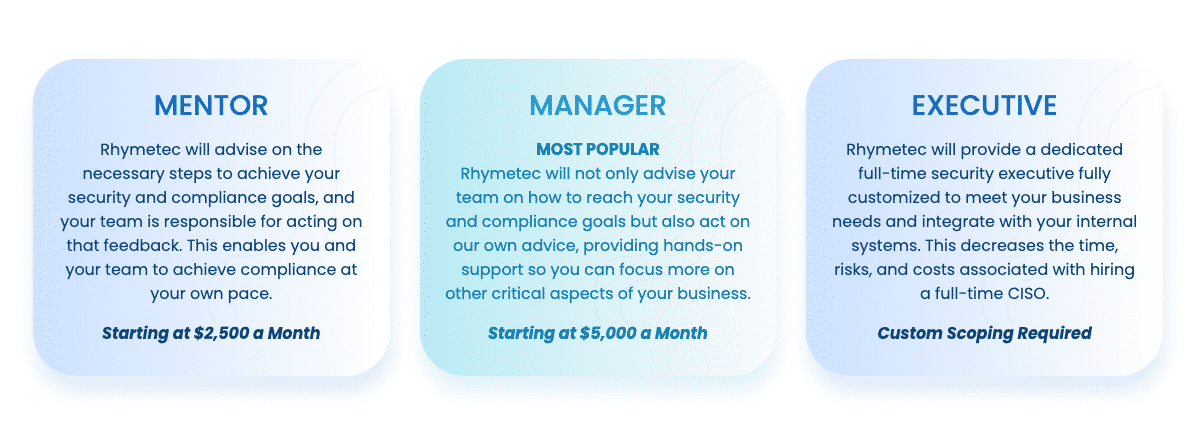
Most startups and small to mid-sized companies spend between $10,000 - $50,000, depending on how much needs to be built from scratch. Large corporations may spend over $100,000, depending on their industry and the complexity of their operations. At Rhymetec, our vCISO pricing depends on which tier of support you select:
Properly budgeting for ISO 27001 certification costs enables organizations to get certified while building sustainable security practices that scale as the business grows. Whether you are in the early stages of building your compliance program or if you have already started the work and feel stuck, our experts can assist. Contact us today to get started.
Meet Sam!
I grew up in Charlotte, North Carolina, and later moved to Charleston, South Carolina for college, where I earned my Master of Science in Information and Computer Sciences. My career began in IT support, where I worked in both the banking and healthcare industries.
Over time, I transitioned into cybersecurity, and for several years I’ve worked as an Information Security Analyst with a strong focus in the healthcare sector. About a year ago, I joined Rhymetec, where I continue to build on my cybersecurity expertise. Outside of work, I enjoy reading, gaming (both video and board games), working out, and relaxing at the beach.

Tell us a surprising fact about yourself…
Despite growing up biking, skateboarding, and playing sports like basketball and soccer, I’ve never broken a bone or been admitted to a hospital. Knock on wood.
If you could have any superpower, what would it be?
If I could have any superpower, it would be time travel. I’ve always had an interest in history, and the idea of being able to witness significant events or explore different eras firsthand really fascinates me.
What are some things you enjoy doing outside of work?
Spending time at the beach with my fiance, traveling any chance I can, staying active, and enjoying get togethers with my close friends, and family.
Tell us about your role at Rhymetec…
I’ve been with Rhymetec for a year, working as a Cyber Security Analyst. In my role, I support our clients in achieving and maintaining compliance with various frameworks such as SOC 2, ISO 27001, HIPAA, GDPR, and others. My day-to-day responsibilities involve managing project tasks related to audit preparedness, conducting audits for both internal and external clients, and responding to a wide
range of cybersecurity-related client needs.

Why did you pursue a career in the cybersecurity industry?
Ironically, my academic path began with a Bachelor’s in Psychology, but I’ve always had a strong interest in computers and technology. That interest led me to take computer science courses and eventually pursue a graduate degree in Information and Computer Sciences. I started my career in IT support, working in both the banking and healthcare sectors, where I gained hands-on technical experience and a solid foundation in the IT field.
From the beginning, my goal was to transition into cybersecurity. I saw it as a field that was rapidly evolving, full of complex challenges, and deeply connected to real-world outcomes. What fascinates me most about cybersecurity is the pace of change, the constant need to adapt and learn, and the critical role it plays in protecting people, organizations, and data. It’s a career that keeps me engaged, challenged, and continuously growing.
What is your favorite part about working at Rhymetec, or in the cybersecurity industry?
What I love most about working at Rhymetec is the culture and the team. I’m surrounded by dedicated and talented professionals who not only support one another and our clients but also create an environment where growth and development are encouraged. The company has given me the tools and opportunities to grow in this role and continue maturing as a cybersecurity analyst.

What is your favorite quote or the best advice you have ever received?
One of the best pieces of advice I’ve ever received was: “You don’t have to know everything, just be willing to learn.” It came from a mentor early in my career, and it resonates, especially in a field like cybersecurity, where things are constantly evolving. It’s easy to feel like you’re always trying to catch up, but curiosity, adaptability, and a willingness to grow are often more valuable than having all the answers upfront. It’s shaped how I approach challenges, new roles, and even how I support others on my team.
From a security or compliance perspective, what advice would you give to a potential client or SaaS business?
The best advice I would give to a potential client is to build security and compliance into your processes early, not as an afterthought. It’s far more efficient and cost effective to design your systems, policies, and workflows with frameworks like SOC 2 or ISO 27001, in mind from the start, rather than retrofitting them later.
Also, don’t treat compliance as a checkbox exercise. The goal should be to create a security-first culture where protecting data and earning user trust are prioritized. This means investing in monitoring, documentation, employee training, and proactive risk management—not just preparing for the next audit.
Rhymetec can help clients achieve these goals by providing guidance tailored to your specific compliance needs, whether it's SOC 2, ISO 27001, HIPAA, or others. We work closely with clients to build sustainable security programs, prepare for audits, and implement best practices that align with both regulatory requirements and business objectives.
Connect with Sam Brokaw
The federal government spends more than $100 billion annually on IT services, much of it through contracts with private companies. That level of investment brings strict cybersecurity expectations, especially for contractors that handle government data.
Two frameworks frequently encountered in this space are the Cybersecurity Maturity Model Certification (CMMC) and the Federal Risk and Authorization Management Program (FedRAMP). Both programs share the same goal of protecting sensitive information. However, they serve slightly different purposes and apply to different types of vendors.
CMMC is designed for companies working with the Department of Defense, in particular for those that handle Controlled Unclassified Information (CUI). Over 100,000 companies are part of the Defense Industrial Base. Any of them that handle CUI will eventually need to meet CMMC Level 2 or 3.
Meanwhile, FedRAMP applies to cloud service providers working with civilian federal agencies. If you are a defense contractor, a SaaS provider, or if your organization supports both civilian and DoD programs, it's important to understand how CMMC and FedRAMP compare.
This article outlines the main differences between CMMC and FedRAMP, including which types of organizations they apply to, the requirements of each framework, and how to handle certification.

Who Needs CMMC and Who Needs FedRAMP?
CMMC and FedRAMP apply to different groups of contractors and vendors based on two factors:
- The agencies they serve, and
- The type of data they handle.
In short, if you're in the DoD supply chain, you may need to meet CMMC. If you're a cloud provider for civilian agencies, you may need FedRAMP authorization. Some organizations may need to pursue both if they serve both sides of the government in these capacities.
Below is a non-exhaustive list of a few common types of companies to which CMMC would apply. Remember that CMMC applies to companies that do business with the Department of Defense (DoD) and process, store, or transmit Controlled Unclassified Information (CUI) or Federal Contract Information (FCI):
- Defense manufacturers that produce components for aircrafts, vehicles, or weapons systems.
- Managed IT providers that support DoD facilities or systems.
- Staffing firms placing personnel in DoD programs (that involve access to CUI).
- R&D firms involved in any military-related developments or prototypes under DoD contracts.
- SaaS companies providing support to DoD missions.
- …and more.
Basically, if a company touches DoD contract information in any way (and in particular if it involves CUI), it will most likely fall under CMMC.
FedRAMP, on the other hand, applies to cloud service providers that want to sell their platforms or applications to civilian federal agencies (non-DoD). The types of companies this would include are:
- SaaS, IaaS, and PaaS vendors offering cloud-based products to agencies like the Department of Energy, the Department of the Treasury, or the Environmental Protection Agency.
- Data analytics platforms with cloud infrastructure that hosts government data.
- Project management or HR platforms that are seeking to be used across multiple federal departments.
- File storage, communications, or productivity tools that may process or store government records.
- Software vendors selling through government marketplaces like FedRAMP.gov or GSA Advantage.
For more information on what you will need to plan for to meet CMMC requirements specifically - and depending on which level of CMMC you need - check out our CMMC Level 1 Checklist and our CMMC Level 2 Checklist.
Security Requirements Compared
While CMMC and FedRAMP indeed share some overlap given their common goal to protect sensitive government data, they are built on different baseline requirements, and their approaches to security controls differ.
CMMC is based on the NIST SP 800-171 framework. It requires organizations to implement 110 security controls across 14 control families if they handle CUI and need to meet Level 2 certification. For organizations handling only FCI (Federal Contract Information), Level 1 requires 15 controls focused on basic security hygiene. CMMC's overall requirements are structured around the following security considerations:
- Access control
- Incident response
- Configuration management
- Personnel and physical security
- System and communications protection (measures such as encryption and traffic monitoring).
Additionally, organizations must also produce documentation, including System Security Plans (SSPs) and Plans of Action and Milestones (POA&Ms), and be ready for assessment by a third-party assessment organization (C3PAO) at Level 2 or 3. Lastly, it's important to note that CMMC 2.0 is not a point-in-time audit. Contractors are required to maintain compliance continuously. For Levels 2 and 3, assessment will lapse upon failure to annually affirm, according to the DoD's CMMC Guidance.

FedRAMP, by contrast, is based largely on NIST SP 800-53 controls, which are a bit more complex in scope. A Moderate FedRAMP authorization requires over 300 controls across a wide range of domains, including:
- Continuous monitoring of systems and data.
- Incident response procedures and breach notification timelines.
- Risk assessment processes and security authorization packages.
- Documentation of how systems are interconnected/dependent on each other.
- Penetration testing and vulnerability scanning.
- Independent third-party assessments.
FedRAMP places more emphasis on supply chain risk management, cloud architecture documentation, and the remediation of vulnerabilities. Cloud service providers must show that they have a set of documents to pass the Joint Authorization Board or agency review.
Documentation and Assessment Differences To Be Aware Of: CMMC vs. FedRAMP
The goal of documentation for CMMC (at Level 2) is to show that your organization meets the 110 controls from NIST SP 800-171. This includes documentation of:
- How controls are being implemented, and the plan for how they will be maintained. This documentation is your System Security Plan (SSP).
- A Plan of Action and Milestones (POA&M) - A list of gaps and a plan for remediation, with specific steps.
- A list of policies and procedures, showing how your organization covers access control, incident response, configuration management, and other security controls.
- Evidence of implementation (such as user logs, training records, configuration screenshots, etc) also must be included in your documentation.
Finally, assessment is conducted by a C3PAO (Certified Third-Party Assessment Organization) for Level 2. Self-assessment is allowed at Level 1 (and in some cases, for Level 2), but must still be documented in SPRS (Supplier Performance Risk System) and affirmed by a senior official.
*It's important to note that if you need CMMC Level 3, you will still need C3PAO affirmation completed on an annual basis, according to the DoD's updated overview of CMMC. For CMMC Level 3, the ongoing C3PAO assessments are in addition to undergoing an assessment every 3 years by the Defense Contract Management Agency's Defense Industrial Base Cybersecurity Assessment Center (DIBCAC).
FedRAMP documentation, meanwhile, is part of a full authorization package submitted to either a sponsoring agency or the Joint Authorization Board. Required documents include:
- System Security Plan (SSP) - this can often reach over 600 pages for Moderate-level systems!
- A Privacy Impact Assessment that identifies how personal data is being collected, used, and protected.
- A Continuous Monitoring Plan detailing how your organization will monitor system changes, incidents, and vulnerabilities.
- An Incident Response Plan, showing how incidents will be reported and handled.
- Documentation showing how system changes are approved and tracked (also known as a Configuration Management Plan).
Assessment is carried out by a third-party assessment organization that has been recognized by the FedRAMP PMO (Program Management Office). FedRAMP requires ongoing authorization maintenance, which takes the form of monthly vulnerability scans, incident reporting, and annual reassessments.
How Certification Works: CMMC vs. FedRAMP
CMMC 2.0 certification is tied to a company's eligibility for Department of Defense contracts. Depending on the sensitivity of the data involved, contractors must meet either Level 1 (self-assessed) Level 2 (typically third-party assessed) requirements, or Level 3 (third-party assessed). As discussed in greater detail in the previous sections, the process entails the following steps:
The first step is to conduct an internal NIST 800-171 gap assessment to compare where you are versus where you need to be. The next step is to document your System Security Plan and Plan of Action and Milestones, followed by finally engaging a certified third-party assessment organization (for Level 2 and 3).

There is no central approval body, and certification is granted per contract, with the assessment scope being based on the environment that contains CUI.
FedRAMP follows a centralized authorization process managed by the FedRAMP Program Management Office. There are two paths:
- Agency Authorization. For this option, a single agency sponsors the cloud service provider and reviews the authorization package.
- Joint Authorization Board. Authorization via a Joint Authorization Board (which comprises the DHS, GSA, and the DoD) involves a higher bar of scrutiny.
For the FedRAMP process, your organization will work with a Third-Party Assessment Organization to complete your Security Assessment Plan and Security Assessment Report. You'll then need to submit a full authorization package through FedRAMP's secure repository, and finally, undergo ongoing monitoring after approval.
Can You Be Compliant With Both?
The short answer is yes.
If your organization provides cloud-based services to civilian agencies and works with the Department of Defense, you likely need to comply with both FedRAMP and CMMC. For example, a SaaS company that supports DoD contracts involving CUI will need CMMC Level 2, and if the same product is then sold to a civilian agency (like the Department of Energy), they will also need FedRAMP authorization.
CMMC and FedRAMP share foundational requirements from NIST standards. But it's not a direct map on - meeting FedRAMP Moderate, for instance, doesn't automatically mean you meet CMMC Level 2. The good news is it absolutely does reduce duplication in areas such as access control, system monitoring, and incident response.
If you do need both CMMC and FedRAMP, figuring out early on how to align both compliance efforts can reduce cost and headaches down the road. This is a common use case for working with a consultant to manage both tracks. A consultant has the experience implementing these requirements across a large spectrum of different types of organizations, and can help ensure efficient implementation.
When To Bring In A Consultant Or MSSP
A recent report by the U.S. Government Accountability Office shows that many small businesses in the defense industry lack the internal resources to implement NIST 800-171 without outside help. This illustrates a growing need for CMMC consultants and MSSPs.
In the report, many smaller businesses in particular expressed concerns about the costs and resources required for CMMC implementation. This is where outsourcing the process can be transformative. Outsourcing is a fraction of the investment that building out an in-house team to carry out the implementation process would be.
The fact is that organizations often wait too long to bring in help, and this can lead to missed deadlines and unnecessary rework. If you're pursuing CMMC, FedRAMP, or both, bringing in a consultant early can reduce risk and cost.
It can be a good idea to bring in a consultant or MSSP if you don't have internal staff with experience in NIST 800-171 or 800-53 implementation, if you're unsure how to scope your CUI, if you're being asked to respond to a security questionnaire and aren't confident in your answers, or if you need to align your environment for both frameworks.
A consultant will perform a gap analysis, build a compliance roadmap, draft documentation for you, implement technical controls, and fully prepare your team for assessment. For small and mid-sized organizations, especially those with aggressive go-to-market timelines, outsourcing to a qualified team helps avoid delays and prevents compliance from blocking growth.
About Rhymetec
Our mission is to make cutting-edge cybersecurity available to SaaS companies and startups. We’ve worked with hundreds of companies to provide practical security solutions tailored to their needs, enabling them to be secure and compliant while balancing security with budget. We enable our clients to outsource the complexity of security and focus on what really matters – their business. Contact us today to get started.
With a Registered Practitioner on Staff and a Proven Track Record, the Company Solidifies Its Role as a Leading Partner for Defense Contractors Navigating New CMMC Requirements.
NEW YORK, May 28, 2025 –
Rhymetec, the industry leader in cloud security that provides innovative cybersecurity, compliance, and data privacy services to modern-day SaaS businesses, today announces it has achieved the status of Cybersecurity Maturity Model Certification (CMMC) Registered Provider Organization (RPO) through CyberAB. Developed by the U.S. Department of Defense (DoD), the CMMC Program is a set of rules designed to strengthen cybersecurity and protect sensitive government information shared with defense contractors.
As a CMMC RPO, Rhymetec is equipped to provide expert advisory and compliance readiness and maintenance services to help organizations understand CMMC requirements, implement necessary controls, and prepare for audits and assessments. This milestone is especially timely, as the final CMMC requirements take effect this month, making compliance essential for contractors looking to win or retain DoD contracts. Rhymetec's commitment to advancing CMMC readiness is further demonstrated by its active participation in industry events such as CEIC West and recent collaborations with leading compliance partners like Vanta and A-LIGN.
"With the final CMMC requirements now in effect, defense contractors and subcontractors are under real pressure to get compliance right," said Justin Rende, founder and chief executive officer of Rhymetec. "Achieving RPO status reinforces our commitment to guiding clients through this critical process with clarity, confidence, and deep expertise."
In addition to being a designated CMMC Registered Provider Organization (RPO), Rhymetec's chief information security officer (CISO), Metin Kortak, has earned the credential of CMMC Registered Practitioner (RP). This distinction underscores the company's dedication to cybersecurity excellence and hands-on expertise. Having a certified RP on staff is not only a requirement for RPOs but also enhances the value of Rhymetec's advisory and managed services, enabling more strategic guidance and tailored preparation for organizations seeking certification under the latest CMMC standards.
"CMMC isn't just about checking boxes; it's about building a resilient security posture that can stand up to real-world threats," said Metin Kortak, CISO of Rhymetec. "As a Registered Practitioner, I'm proud to help organizations cut through the complexity and take actionable steps toward long-term compliance and protection."
If your organization needs guidance navigating the complexities of CMMC compliance, including conducting gap assessments or self-assessments, developing System Security Plans (SSPs), drafting a Plan of Action and Milestones (POA&M), implementing required security controls, and supporting remediation efforts, Rhymetec can help.
You can read the original press release on PR Newswire.
About Rhymetec
Rhymetec is an industry leader in cloud security, providing innovative cybersecurity and data privacy services to the modern-day SaaS business. The company builds, deploys and manages compliant information security and data privacy programs directly within their customers' unique environments, allowing them to focus on their core competencies within their business. Over the years, Rhymetec's services have grown to include a vCISO (Virtual CISO) program, ISO Internal Audits, and a variety of Penetration Testing services. For more information, please visit www.rhymetec.com and follow us on LinkedIn.

Meet Vic!
My name is Vic DeBenedetto, and I grew up in the Philly suburbs (Go Birds!).
Growing up for me consisted of lots of sports practices during the school year and spending summers down at Long Beach Island, NJ. Although, like most kids, I tried every sport there was, the two that stuck were football and lacrosse. In the summer, I hung up the cleats and was a stand up paddleboard instructor at my local marina.
After college at Penn State, I moved back to Philly. After a 4-year stint in the city, I recently settled in the suburbs.
Tell us a surprising fact about yourself…
When I was 18, I explored every career path that didn't involve going to college. My top two options that I can remember were enlisting in the military or becoming a barber. I'm not sure what drove that, but I'm glad I ended up where I am!
If you could have any superpower, what would it be?
If I could have any superpower, it would be the ability to completely block out distractions and focus at will. In a world that's constantly buzzing with notifications (Slack especially) and competing priorities, having consistent focus would be a game-changer - not just for productivity, but for being fully present in everything I do.
What are some things you enjoy doing outside of work?
My favorite thing to do outside of work is golf. While my handicap is still in the double-digits, I have the bug and try to get out as much as possible! In the winter, I'm an avid skier and try to book at least one trip a year. Outside of that, I do CrossFit every morning before work to start the day, which never fails to humble me. On the weekends, if I'm not on the golf course or in the gym, I'm usually either trying new restaurants out or hanging out with friends and family.

Tell us about your role at Rhymetec…
I have been working at Rhymetec for over a year—but it feels like so much longer (in the best way)! As an Account Executive, I'm responsible for bringing new business into Rhymetec and expanding our reach. I work closely with our incredible partners to identify prospects who are a strong fit for our services and guide them through their compliance and cybersecurity journeys, from initial discovery to onboarding. My role is a mix of consulting, partner relationship-building, and sales, which keeps every day interesting.
What I love most about working at Rhymetec is the combination of people and purpose. I truly believe we have the best team and culture; everyone is driven, supportive, and fun to work with. I feel inspired every time I open my laptop and genuinely look forward to the conversations and challenges each day brings. It's rewarding to know that the work we do makes a real difference for our clients, helping them feel confident and secure as they grow.
Why did you pursue a career in the cybersecurity industry?
I came from a marketing technology background, and while I enjoyed that space, I was looking for something that felt more like a need rather than a nice-to-have. That's what drew me to cybersecurity. It's an industry that's not just growing rapidly—it's essential. Every company, no matter the size or industry, needs to take security seriously, and I found that really compelling.
I didn't always plan on working in cybersecurity, but once I learned more about the space, I was completely bought in. The constant evolution of threats and the high stakes involved make it both fascinating and meaningful. I love that the work we do helps companies protect what matters most and gives them the confidence to keep moving forward.
What is your favorite part about working at Rhymetec, or in the cybersecurity industry?
One of my favorite parts is getting to collaborate with such great partners. We work with some of the best in the industry, and it's rewarding to be part of a network that's all working toward the same goal: helping companies strengthen their security and achieve compliance. The relationships we've built with our partners make the work not only effective but also enjoyable—I'm constantly learning and growing through them.

What is your favorite quote or the best advice you have ever received?
The best advice I've ever received came from my dad, who always reminded me: "God gave you two ears and one mouth, so listen twice as much as you speak." It's simple but powerful, and it's stuck with me throughout my personal and professional life. Whether I'm in a meeting, on a sales call, or just having a conversation, I've found that really listening—rather than thinking about what to say next—makes all the difference. It helps build trust, uncover real needs, and create stronger connections.
From a security or compliance perspective, what advice would you give to a potential client or SaaS business?
When advising a potential client or SaaS business from a security or compliance perspective, I would emphasize the importance of adopting both a proactive and holistic approach to data protection and regulatory adherence. A reactive and narrow will always lead to a large-scale data breach and loss of customer trust.
At Rhymetec, we understand that a proactive and holistic security program involves implementing various controls across multiple security domains including, but not limited to, risk management, incident management, cryptography and access management. Additionally, staying informed about relevant regulations—such as GDPR, HIPAA, or DORA—and regularly ensuring that your practices align with these standards is essential for maintaining compliance and building trust with your clients.
Connect with Vic DeBenedetto
Justifying the return on cybersecurity investments can be hard. Some things are relatively easy, especially with the help of tools like compliance automation platforms. You have to comply with legal requirements and customer demands to see your SOC 2 report, but what about security that goes beyond regulatory requirements?
In a business full of competing interests, managers asking for new hires, and the marketing team wanting to spend additional money, security often falls by the wayside - but it shouldn't.
That's one of the reasons at Rhymetec we love checking out Verizon's annual Data Breach Investigation Report (DBIR). Verizon's DBIR shows exactly why companies need to move beyond compliance and implement proactive controls.
Regulators are often years behind the latest trends in the industry - companies that just focus on compliance often fail to implement safeguards and controls that could save their business millions of dollars in lost business, fines, and legal fees.
So, what are the big takeaways from this year's DBIR? Well, there are quite a few:
Generative AI, Compliance, and Accidental Leaks
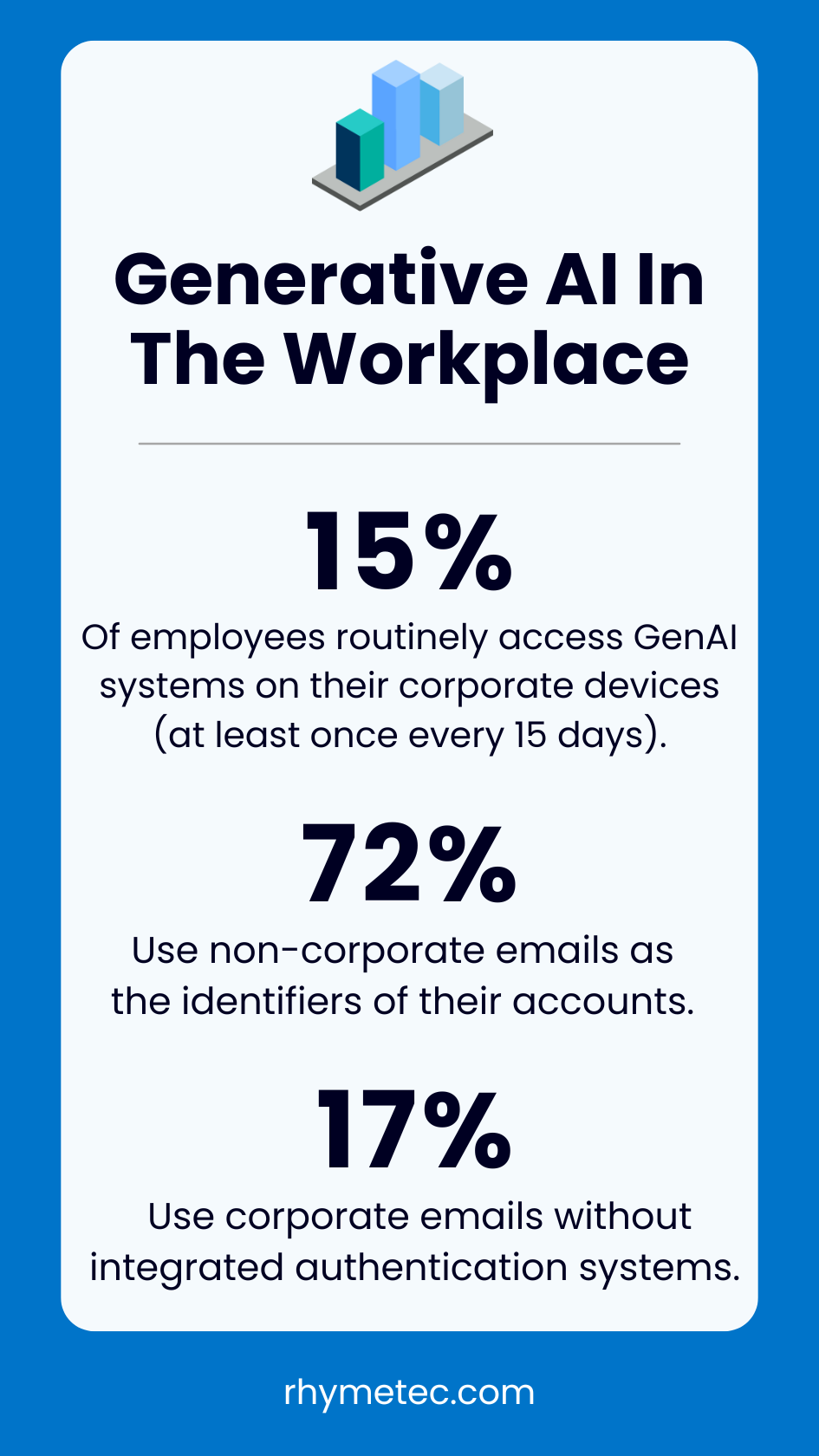
You almost certainly have employees at your company feeding data into AI models that you don't know about. One of the findings that should be the most alarming to information security leaders is that, according to the DBIR:
"15% of employees were routinely accessing GenAI systems on their corporate devices (at least once every 15 days). Even more concerning, a large number of those were either using non-corporate emails as the identifiers of their accounts (72%) or were using their corporate emails without integrated authentication systems in place (17%), most likely suggesting use outside of corporate policy."
Many organizations pick one or two AI vendors and work with those, and accept a certain degree of risk. However, employees signing up directly for generative AI applications can pose severe risks, particularly to organizations that deal with highly sensitive intellectual property, regulated data such as health records, or even national security and classified data.
For example, imagine an employee at a defense contractor decides to use DeepSeek to analyze CUI (controlled unclassified information) that a contractor sends them. They likely unknowingly just sent that data directly to China.
Getting a handle on "shadow SaaS", and particularly which AI applications employees may be sending sensitive data, is likely to be one of the most important issues vexing information security teams in the next five years.
Third-Party Risk Remains Highly Relevant in The 2025 Verizon Data Breach Report
Another key finding in the 2025 DBIR that security professionals should be paying close attention to is the dramatic increase in third-party involvement in breaches. According to Verizon's analysis, third-party involvement in breaches doubled from 15% to 30% in just one year. This isn't merely a statistical blip - it represents a fundamental shift in how attackers are approaching your organization's security perimeter.
As in all things in life, there are tradeoffs. As organizations increasingly adopt convenient SaaS solutions to solve various business challenges, in many cases, they unwittingly dramatically expand their attack surface (sometimes even the business doesn't know what their attack surface is, such as with shadow generative AI use).
The report specifically highlights how several high-profile breaches in services like Change Healthcare, CDK Global, and Blue Yonder exposed sensitive data and created substantial business interruption events across entire industries:
Healthcare providers couldn't process claims, auto dealerships lost access to their systems, and retailers and food services companies found themselves unable to manage inventory. When your critical business functions rely on third-party SaaS providers, their security posture becomes your operational vulnerability.
While compliance frameworks like SOC 2 have recognized third-party risk for years, the real-world impact is growing faster than many organizations' vendor management programs can adapt.
This data should serve as a wake-up call: Today's interconnected business ecosystem requires a much more proactive approach to vendor security assessment, continuous monitoring, and contingency planning. Organizations that fail to evolve beyond "check the box" vendor management will increasingly find themselves dealing with the consequences of their partners' security failures.
Malware Is Fueling Identity-Based Attacks
On page 54 of the report is perhaps one of the most interesting insights of the 2025 DBIR. In a section titled "Infostealers Galore", Verizon discusses one of the most prominent threats to organizations today - infostealer malware.
Infostealers are a type of malware that infects a victim's computer and siphons all of the passwords and session cookies the victim has saved on their browser, sessions for applications such as Discord, crypto wallet keys, autofill data, and basically any other sensitive or valuable lightweight data from the device. This data is then sent back to the threat actor's infrastructure, where individual victims' information is sold as an "infostealer log" containing one victim's data.
As you can imagine, there is a trove of high value information for threat actors to leverage within this data to include session cookies which can be used to hijack active sessions to facilitiate account takeover attacks for major web applications and e-commerce companies, crypto wallet keys which can allow the threat actor to steal currency, and even credit card data from autofills which can facilitate fraud.
However, this malware can also grab corporate emails and passwords for SaaS applications, VPN's, corporate bank accounts, and other critical information. Verizon estimates that 30% of the tens of millions of logs out there come from devices that are corporate-owned, an absolutely astounding figure.
A discerning observer might ask an obvious question: Does the prevalence of corporate credentials, session cookies, and information available in the stealer log ecosystem enable ransomware groups and other similar threat actors?
Well, Verizon has the answer there, too.
"By examining some of the victims posted to the ransomware extortion sites, we found that 54% of the victims had their domains show up in at least one infostealer log or in marketplace postings, and 40% of those logs contained corporate email addresses." - Verizon Data Breach Report 2025, page 57.
This type of analysis is critical, as threat actors are continuously evolving their tactics, techniques, and procedures in response to improvements in organizational cybersecurity. Oftentimes, threat actors will use whatever is easiest, and active sets of corporate credentials and session cookies floating around in the criminal ether is indeed a pretty easy way to get access to some high-value systems.
Ransomware Is On the Rise, Sort Of
Speaking of ransomware, many organizations make the mistake of believing that they are too small for ransomware groups and threat actors to target.
However, this belief couldn't be further from the truth. One of the most interesting and relevant findings from the DBIR was the data around ransomware attacks in 2024. While attacks continue to rise, victim behavior and attacker strategies are evolving in notable ways.
Ransomware incidents jumped dramatically, showing a 37% increase from last year. These attacks now represent 44% of all data breaches analyzed - up from 32% in the previous report. Nobody expected ransomware to go away, but this data shows that even the notable law enforcement takedowns of Lockbit, Black Cat, and other high-profile ransomware groups has at best dented this highly financially lucrative criminal operation.
However, it's worth digging in a bit on the ransomware piece of the report because the increase in ransomware as a proportion of all attacks doesn't tell the whole story. The reports section on ransom payments shows a potential silver lining:
Both the frequency and size of ransom payments are decreasing. The median ransom payment dropped to $115,000 in 2024, down from $150,000 in 2023. More significantly, 64% of victims now refuse to pay ransoms altogether - a substantial increase from 50% just two years ago.
While the report doesn't directly make the connection, organizations improving backup and recovery combined with defensive measures may be fueling another trend - the increased targeting of small and midsize businesses by ransomware operators.
Perhaps the most alarming finding is how severely ransomware affects smaller organizations. While ransomware appears in 39% of breaches at large enterprises, it's present at a staggering 88% of breaches at SMBs.
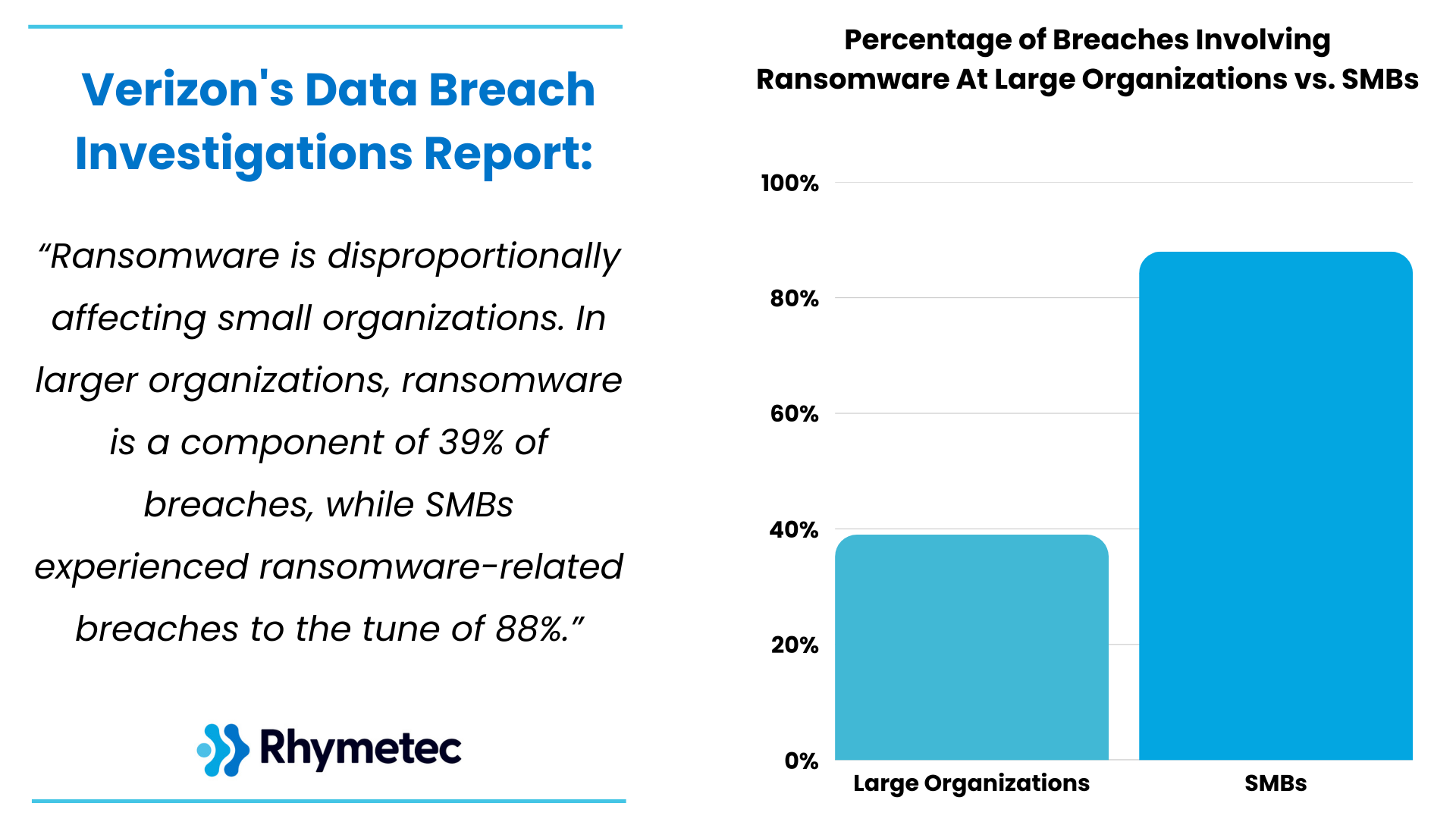
This disparity likely reflects the resource gap in cybersecurity preparedness. Smaller organizations typically have less robust backup solutions, fewer security controls, and limited incident response capabilities, making them both easier targets and more likely to suffer catastrophic impacts.
Concluding Thoughts: The Verizon Data Breach Report 2025
The 2025 Verizon Data Breach Report paints a clear picture of an evolving threat landscape that demands more than just a checkbox approach to security. Compliance frameworks like SOC 2 and ISO 27001 provide a valuable foundation, but going beyond them is essential for organizations to protect themselves from sophisticated ransomware groups and other threat actors.
The data tells a compelling story: Third-party risks have doubled, credential theft via infostealers is directly fueling ransomware attacks, and shadow AI usage presents entirely new vectors for data loss. These threats are often moving faster than regulatory and best practice frameworks can adapt.
At Rhymetec, we recommend that organizations build their compliance foundation with targeted security investments that address these emerging threats:
- Implement continuous monitoring for external threats.
- Develop comprehensive controls for third-party risk management that go beyond questionnaires.
- Establish clear policies and technical controls for AI platform usage.
- Prioritize edge device security given their increased targeting by threat actors.
- Develop security strategies that account for the human element, which remains involved in 60% of breaches.
The most successful organizations will be those that view compliance as the starting point, not the destination, of their security journey. And most importantly, those who stay educated on how the threat landscape is shifting over time.
About Rhymetec
Our mission is to make cutting-edge cybersecurity available to SaaS companies and startups. We've worked with hundreds of companies to provide practical security solutions tailored to their needs, enabling them to be secure and compliant while balancing security with budget. We enable our clients to outsource the complexity of security and focus on what really matters – their business. Contact us today to get started.
So, you're considering SOC 2 or ISO 27001 for the first time - and realizing just how much time and expertise it takes to actually get there. That's where Vanta (and Rhymetec!) comes in:
Vanta automates 90% of compliance monitoring through integrations with 300+ systems, real-time control insights, and automated evidence collection—enhancing your visibility into your security posture. Rhymetec handles the hands-on readiness tasks for you. The combination of Vanta with our tailored services delivers a faster, more manageable path to audit success.
Our team of experts at Rhymetec, by leveraging Vanta for you, accelerates every step of your compliance journey from the initial scoping phase to auditor handoff. We've helped over 1,000 organizations efficiently meet their security and compliance goals with this method. Here's how Vanta works in conjunction with our services, and how the platform can benefit you immediately, especially if you are early on in the process of compliance:
Vanta Automates Compliance Workflows
Vanta automates the visibility into tasks required to build a compliance program. One of the main value adds of Vanta is that it will handle the repetitive work for you and give you back your time to focus on what really matters - growing your business. Here's how it works, particularly for organizations early in their compliance journey:
Using Vanta circumvents the need to even get started on tedious manual spreadsheets and checklists. Instead, Vanta enables organizations to jump right in and leverage its capabilities, including system integrations and automated collection of evidence.
For instance, a startup pursuing SOC 2 may need to prove that it restricts employee access to production systems, monitors for security incidents, and keeps its asset inventory up-to-date and in line with SOC 2 requirements. Vanta connects to systems including AWS, GitHub, Google Workspace, and Okta to automatically accomplish the following:
- Display passing controls.
- Simplify policy management.
- Collect the evidence needed for an audit.
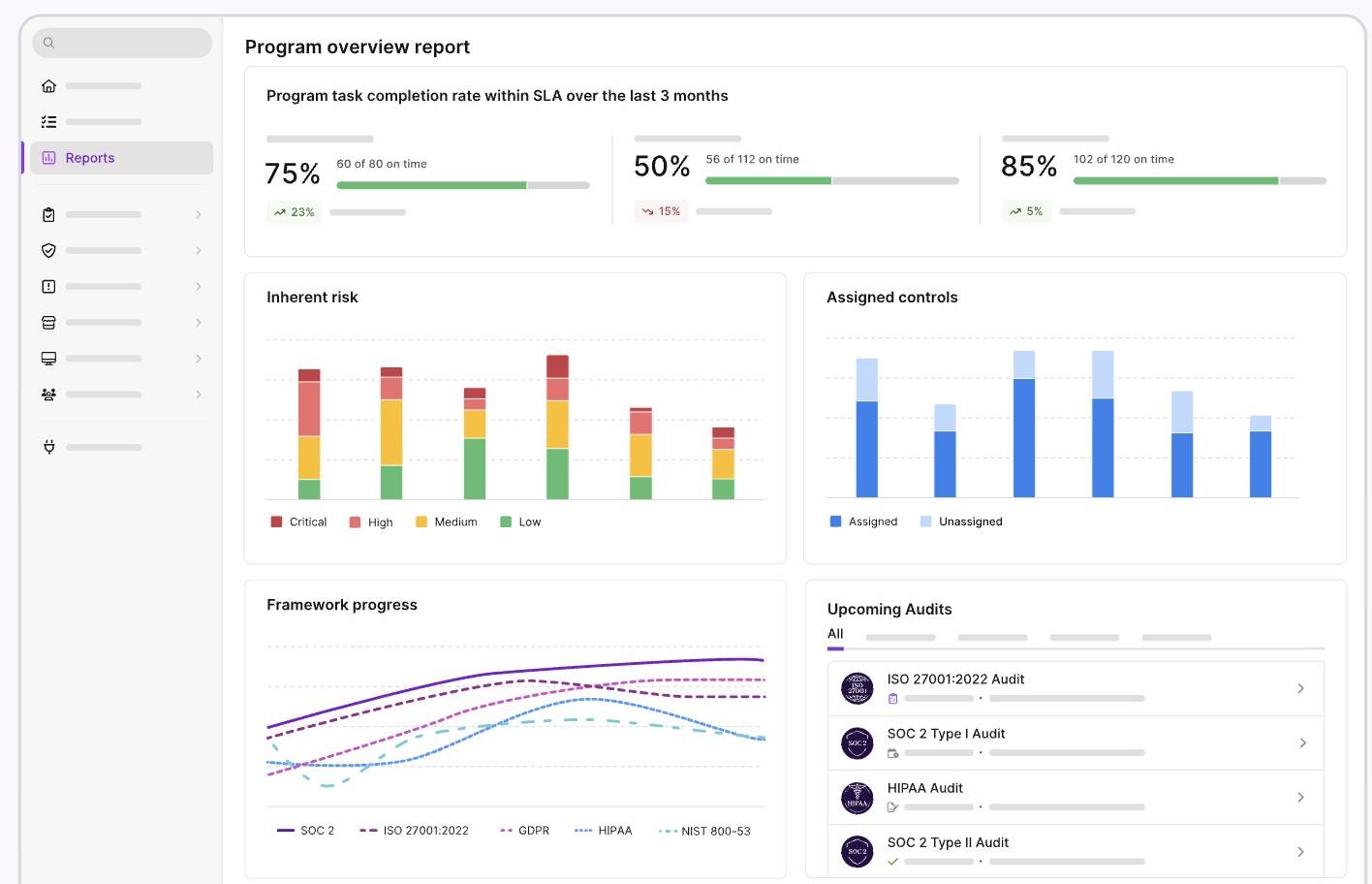
It also includes pre-built policy templates for every framework, so teams can work from a baseline and avoid having to write everything from scratch. Leadership is able to track compliance status in real time and improve visibility tied to audit preparation for employees—resulting in efficiency and reduced time to compliance.
Who Uses Vanta And Why
Vanta is primarily used by fast-growing, cloud-native organizations that are seeking to meet relevant security and data privacy requirements in the most efficient way possible. Often, these organizations are trying to avoid dedicating excessive internal resources to manual compliance work. However, we’ve seen companies from all sizes—startup to enterprise—with varying environments—such as multi-cloud and hybrid—utilize Vanta to streamline their compliance efforts.
Some of the main reasons companies opt to use Vanta are to help them:
- Reduce their audit timelines.
- Improve visibility into their security posture.
- Lower the overall cost of compliance.
Vanta connects to the tools you use via API, the cloud infrastructure you're set up in, and your internal systems to give you a complete view of your security and compliance.
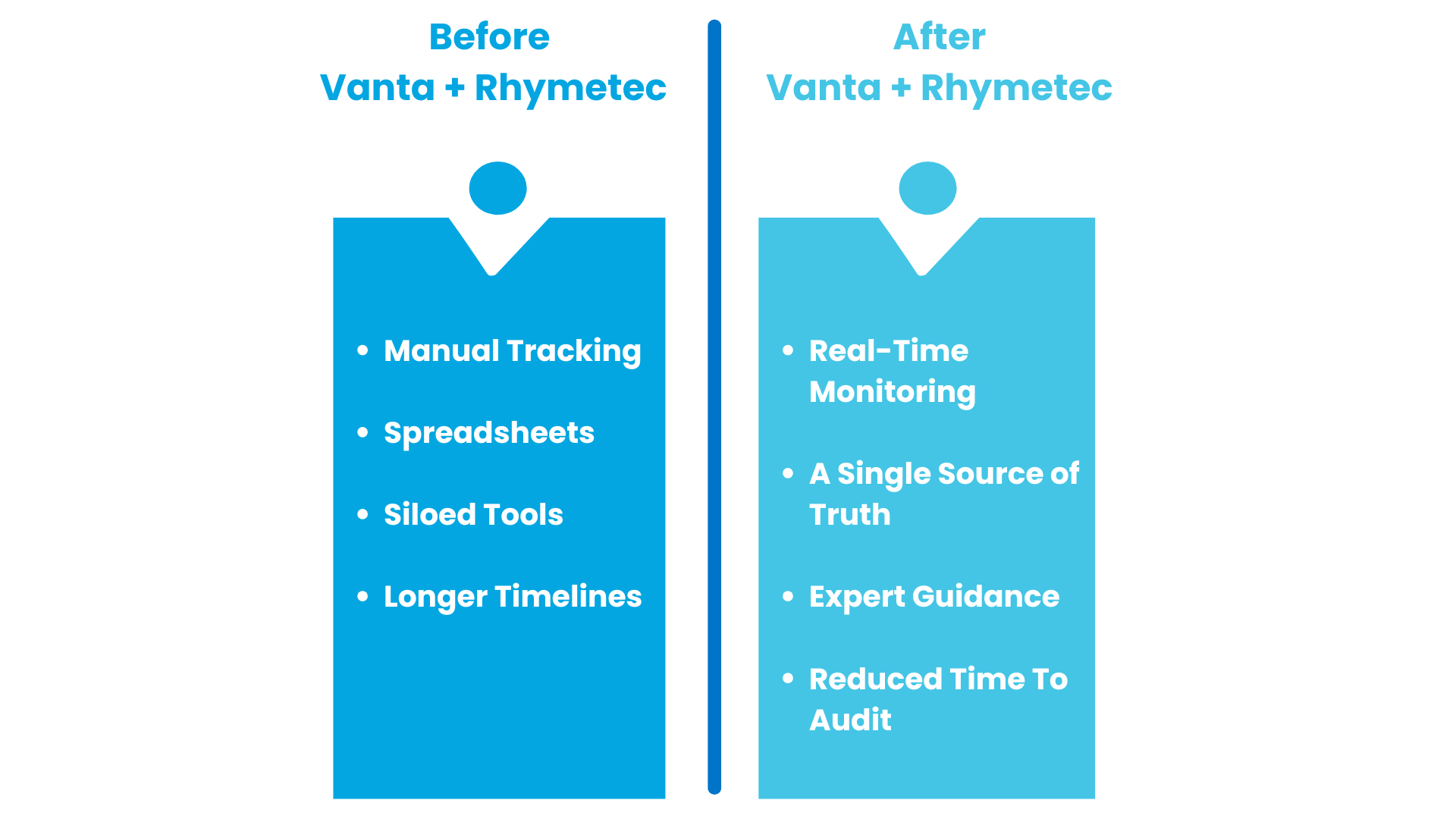
This eliminates the need for fragmented spreadsheets and manual checklists, providing leadership more control over compliance progress and unburdening technical teams that are already stretched thin.
Another core value add is that Vanta enables a single source of truth for audit readiness, helping leaders and your sales team demonstrate you're where you need to be in terms of security and compliance to auditors, customers, your partners, and other stakeholders.
What Does Vanta Do? Vanta Supports Continuous Compliance
It's important to know going into your compliance journey that compliance doesn’t stop after one audit.
Frameworks like SOC 2, ISO 27001, and HIPAA require ongoing evidence of control effectiveness, which means you need continuous monitoring rather than only point-in-time documentation.
Vanta is built precisely to support this model. It runs in the background, constantly monitoring your infrastructure and systems for changes that could impact compliance. It will flag any issues in real time, such as expired access, unapproved software, or missing security training. The platform centralizes the evidence you'll need to show controls are operating continuously.
This approach replaces manual check-ins and periodic reviews with continuous visibility. Combined with Rhymetec's guidance and remediation support, clients stay audit-ready year-round without having to rebuild compliance work from scratch each cycle.
Vanta Streamlines The Work of Cybersecurity & Compliance Experts
Vanta automates the visibility into tasks (While Rhymetec can support the completion of them) that are most likely to slow down compliance teams, allowing the experts to focus on higher-impact and more specific work. Tasks like collecting screenshots, tracking evidence, and managing spreadsheets shift to automated processes within the platform.
For Rhymetec's team, the platform provides a centralized source of truth and allows us to spend more time analyzing results and guiding clients through control implementation. Our team uses Vanta in every step of the compliance automation process on your behalf. By handling repetitive tasks and bringing issues to our attention automatically, Vanta allows us to carry out a more efficient process to compliance readiness for your organization.
How Rhymetec Leverages Vanta To Deliver Compliance - Fast
Rhymetec leverages Vanta as a core part of our compliance delivery model.
Our approach combines all of the benefits of automation with hands-on cybersecurity expertise to shorten the path to audit readiness. Our team configures Vanta for your systems and selected framework. We work hard to eliminate common setup delays and create alignment between compliance goals and actual business operations.
Once deployed, Vanta automatically monitors your cloud infrastructure and systems for compliance-related activities. But automation alone doesn’t get you audit-ready. That’s where Rhymetec comes in. After the initial setup, our team steps in to:
- Interpret and prioritize Vanta’s findings based on your unique business needs
- Remediate flagged issues with hands-on support — not just advice
- Tackle all remaining manual components like policy creation, access reviews, evidence collection, and control implementation
The combination of automated and manual work keeps the momentum going and gets clients through readiness assessments and audits on a much faster timeframe. By managing both Vanta and the 'hands-on' components of compliance readiness work on your behalf, we’re able to accelerate every phase of the compliance process.
Why Pairing Vanta and Rhymetec Delivers Better Outcomes
Most frameworks require an array of expert judgment, manual implementation of certain controls, and a level of preparation that automation can't complete 100% of on its own.
Rhymetec fills that gap by managing the manual work and aligning Vanta specifically to your environment. We interpret control requirements, resolve flagged issues, write custom policies, manage communication with auditors on your behalf, and more.
By using Vanta for compliance automation - and Rhymetec filling in the gaps for you when needed - clients move faster and meet their compliance goals with less internal burden. Together, we consistently generate strong audit readiness and stronger security programs.
Accessing Vanta Through Rhymetec
Rhymetec is proud to offer Vanta (in conjunction with our Vanta compliance services) directly to clients who haven't yet selected a compliance automation platform.
Particularly in the case of clients early in their compliance journey, this vastly simplifies the buying process by providing both the technology and the services needed to meet requirements in one engagement. We give clients access to a world-class platform without requiring them to manage separate vendor relationships or navigate pricing and setup alone.
Our team at Rhymetec handles everything from the initial deployment and setup in Vanta to ongoing administration of the platform on your behalf. This allows you to adopt automation earlier, which will accelerate your compliance timelines and help you avoid missteps that a self-directed rollout could entail. Contact our team to learn more:
Deepak Chopra once said, "All great changes are preceded by chaos." This has never been more accurate than when it’s applied to the current AI and cybersecurity environments—and the regulations that govern them.
New frameworks like the Digital Operational Resilience Act (DORA), the EU AI Act, the Network and Information Systems Directive 2 (NIS2) and the Cybersecurity Maturity Model Certification (CMMC) are reshaping how businesses handle security, risk and compliance. These regulations aren't just about ticking boxes—they carry major financial penalties and demand real operational changes.
For companies in financial services, AI development, critical infrastructure or defense, staying ahead of the changes is vital to avoid penalties, protect data and maintain trust. Let's look at what each entails.
DORA: Protecting Financial Institutions From Cyber Disruptions
Financial institutions face constant cyber threats and operational risks. DORA aims to empower financial organizations to weather system disruptions and continue operating smoothly.
DORA requires penetration testing, vulnerability assessments and disaster recovery planning. It focuses on business continuity to ensure that if a system fails, a plan is in place to keep operations running. Banks, insurance companies and investment firms must validate security controls through rigorous testing.
This regulation is a wake-up call for financial institutions to take cybersecurity resilience seriously. The penalties for non-compliance are severe, making it crucial for businesses to invest in robust security testing and operational risk management.
The EU AI Act: Setting The Global Standard For AI Compliance
AI development currently operates in a regulatory gray area, but the EU AI Act is changing that. One of the first laws to set clear boundaries on AI usage, it focuses on ethical risks, security concerns and prohibited applications.
The most important takeaway is the significant financial penalties for non-compliance: These can be up to 7% of a company's global annual revenue or 35 million euros, whichever is higher. That's more than GDPR, which has already forced businesses worldwide to rethink their approach to data privacy.
This law explicitly bans certain AI applications, particularly those that exploit vulnerabilities. The ban includes AI-powered cyberattacks, social manipulation and unethical facial recognition practices. Article 5 of the act outlines prohibited AI uses, such as systems that exploit people's age, disabilities or socioeconomic circumstances.
This isn't simply a privacy factor; its purpose is to prevent AI from being weaponized.
A common misconception is that this law only affects European companies. That's not the case. Any company developing, deploying or processing AI systems in the EU—or serving EU customers—must comply. For example, if a U.S. company hosts its platform in an EU data center or processes European customer data, this regulation applies.
The EU AI Act is setting the stage for global AI governance. Similar regulations are expected to emerge worldwide, making it smart for businesses to adapt now rather than scrambling to comply later.
NIS2: Strengthening Cybersecurity For Critical Infrastructure
Also in the EU, the NIS2 Directive expands cybersecurity requirements for critical industries like energy, healthcare, transportation and digital services. It builds on the original NIS Directive but goes much further, applying to more organizations, increasing security expectations and enforcing stricter penalties.
The enhanced reporting requirements are one of the biggest challenges. Companies must notify regulators of cyber incidents within 24 hours, provide a complete assessment within 72 hours and demonstrate they are actively managing security risks.
The directive also emphasizes stronger supply chain security, holding companies responsible for ensuring their vendors meet cybersecurity standards. This means businesses can't just secure their own systems—they must also vet suppliers and partners to prevent weak links in the supply chain.
Beyond reporting and supply chain oversight, NIS2 enforces stricter governance requirements. Organizations must appoint security officers, conduct regular risk assessments and develop robust cybersecurity policies. Those that fail to comply face heavy financial penalties and increased regulatory scrutiny.
Compliance isn't optional for companies operating in or serving the EU market. NIS2 is setting a new cybersecurity standard, and businesses that don't act risk fines, operational disruptions and reputational damage.
CMMC: Raising the Bar For U.S. Defense Contractors
The CMMC is a requirement for companies working with the U.S. Department of Defense (DoD). It builds on cybersecurity frameworks like NIST 800-171, ensuring that defense contractors follow strict security protocols to protect sensitive government data.
Recent changes to CMMC include a new self-assessment option for Level 1 compliance, making it easier for smaller contractors to meet requirements without hiring third-party auditors. However, higher certification levels still require independent verification, adding layers of accountability.
With the new compliance requirements going into effect in mid-2025, businesses need to act now. The DoD has made it clear that CMMC certification will be mandatory for contracts, and companies that don't comply risk losing business.
Evolving Security Frameworks: A Smarter Approach To Compliance
For organizations handling sensitive data in healthcare, finance and other regulated industries, new security frameworks present a way to prove compliance with strict privacy and cybersecurity standards. In the past, certification required a lengthy, one-size-fits-all assessment, but newer models offer more flexible options with fewer controls, reducing complexity while maintaining security.
Many businesses don't realize that certification levels vary, and choosing a lower-tier option may not meet regulatory or customer expectations. This is especially important for HIPAA compliance, where recognized certifications can demonstrate that companies meet security standards. As cybersecurity laws evolve, understanding these frameworks ensures that businesses stay compliant, competitive and prepared for future regulations.
Laws like DORA, the EU AI Act and NIS2 are designed to keep technology from becoming a threat. AI development currently lacks clear rules—without oversight, it can be used in dangerous ways. These regulations force businesses to prioritize security and ethics upfront, preventing bigger problems down the road.
To stay ahead, organizations must:
- Identify relevant regulations and update security policies.
- Invest in risk assessments, penetration testing and employee training.
- Stay informed—more regulations are coming.
Compliance isn't just about avoiding penalties but about building a safer, more resilient digital future. Companies that act now will lead, while those that wait will fall behind.
You can read the original article posted in Forbes by Rhymetec CISO, Metin Kortak.
About Rhymetec
Our mission is to make cutting-edge cybersecurity available to SaaS companies and startups. We've worked with hundreds of companies to provide practical security solutions tailored to their needs, enabling them to be secure and compliant while balancing security with budget. We enable our clients to outsource the complexity of security and focus on what really matters – their business. Contact us today to get started.
The advent of the Digital Operational Resilience Act (DORA) has introduced a new set of regulatory expectations that financial entities operating in the European Union need to be aware of. Additionally, organizations such as SaaS startups that provide services to financial entities, or plan to, must begin preparing to meet DORA's requirements.
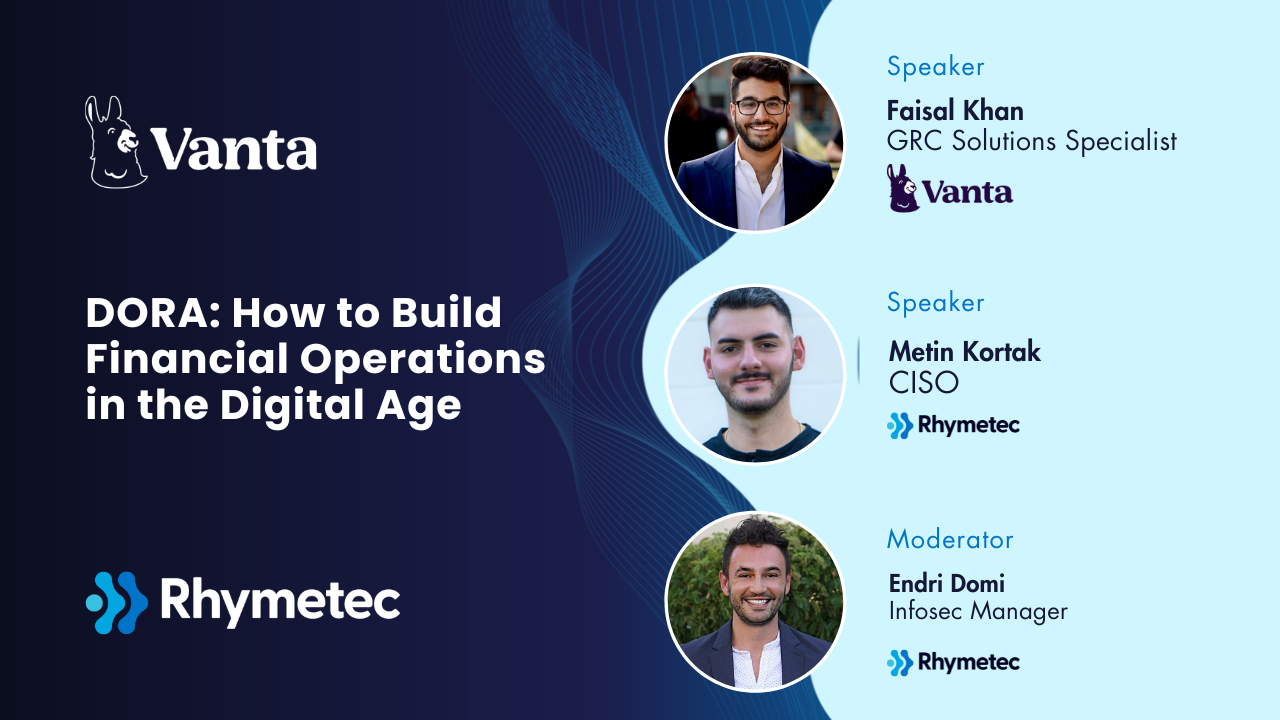
In a recent webinar hosted by Rhymetec and Vanta, we unpacked DORA requirements and discussed practical steps organizations can take now to align with DORA. Endri Domi, Infosec Manager at Rhymetec, moderated an insightful discussion between Faisal Khan, GRC Solutions Specialist at Vanta, and Metin Kortak, CISO at Rhymetec.
This blog post highlights the key points from their discussion, with a focus on what organizations need to understand and prioritize in the months ahead. You can check out the full webinar here.
What Are DORA Requirements, and Who Must Comply?
DORA requirements come from the EU's Digital Operational Resilience Act, which is now in effect. The regulation applies to financial institutions operating in the EU, as well as certain types of service providers that support them.
According to Faisal Khan, GRC Solutions Specialist at Vanta, the purpose of DORA is to improve the resiliency of financial institutions:
"DORA is an EU regulation designed to improve the ability of financial institutions to weather and recover from any information or technology-related disruptions like cyber attacks, data breaches, and system failures. It's really to build that tolerance for themselves so that they're protected in the event some of those things would happen." - Faisal Khan, Vanta
DORA covers both financial entities, such as banks, insurance companies, and investment firms, as well as their ICT third-party service providers. ICT (Information and Communication Technology) third-party service providers include cloud providers and other vendors that manage or support technology for other organizations.
The regulation introduces two types of regulatory documents that support its implementation:
Regulatory Technical Standards (RTS) and Implementing Technical Standards (ITS). RTS specifies what organizations must actually do to meet DORA's requirements, while ITS focuses on how the information should be reported. How each of the 5 pillars of DORA is applied in practice, as shown in the next section, is shaped by the technical standards.
What Are The Five Pillars of DORA Requirements?
DORA requirements are structured around five pillars. Each pillar is designed to reduce ICT-related disruption risk in financial services and strengthen the resilience of the ecosystem. In our webinar, our experts honed in on explaining each pillar in detail, particularly those involving third-party risk and incident reporting:
1. ICT Risk Management
Mitigating ICT-related risks across your organization's digital environment is a core part of DORA. Typically, this entails starting with a live, centralized asset inventory and linking each asset to a business function. This enables you to then align risk prioritization with actual operational impact, and helps keep future reporting manageable.
2. ICT-Related Incident Reporting
As highlighted by our experts, ICT-related incident reporting includes notifying both national competent authorities and any stakeholders who may be affected, such as customers or partners who rely on your platform:
"If you do have ICT-related incidents, those incidents will need to be communicated to the national authorities and other stakeholders who may be impacted by your platform, such as your customers." - Metin Kortak, Rhymetec
If an incident meets the criteria for "major ICT-related incident", you must notify your national competent authority (typically, your financial services or cybersecurity regulator) within 24 hours of detection. Follow-up reports are required as the situation evolves.
Incidents are classified based on metrics such as the number of users affected, duration of the disruption, and impact on data integrity or confidentiality. Your report should explain in detail what your response is and provide guidance for the recipient. The final report submitted to regulators must include a root cause analysis, detailing what happened and why it happened.
Bonus Tip: DORA goes further than GDPR by imposing stricter timelines, requiring a reporting process with multiple updates, and mandating the notification of any major ICT–related incidents (not just those involving personal data). In general, it covers a broader range of disruptions that impact operational continuity.

3. Digital Operational Resilience Testing
Under DORA requirements, operational resilience testing is addressed in Articles 24-27. Organizations must be able to demonstrate that their critical ICT systems can withstand disruption. Testing must be continuous and evidence-based:
"The point of this requirement is to ensure you have testing to verify that the resiliency of your application can be proved. This can be either third-party testing, or it can be internal testing." - Metin Kortak, Rhymetec
This includes a mix of internal exercises (such as tabletop exercises) and, where applicable, advanced testing techniques like threat-led penetration testing (TLPT). The intent is to ensure that your organization is able to 1) recover from disruption and 2) continue delivering critical services under adverse conditions.
For most organizations, the following action items are good options to fulfill the requirements in this pillar:
Tabletop Exercises
Tabletop exercises are scenario-based discussions that mirror real-world scenarios. Undergoing a tabletop exercise allows your organization to test its response capabilities, validate roles and responsibilities, and improve communication without affecting live systems.
Technical Testing
For systems deemed critical, DORA encourages more rigorous validation, which can take the form of failover testing, load testing, and red team exercises. Third-party involvement is encouraged at this stage, particularly for high-risk or business-critical functions.
Testing must occur on a regular basis and must reflect the scale and risk profile of your organization. DORA does not prescribe a one-size-fits-all cadence, but regulators will expect to see a documented rationale for test frequency and scope.
Remediation and Continuous Improvement
Testing is only the first part of the requirement. DORA also expects organizations to conduct lessons learned from testing, remediate weaknesses accordingly, and feed results back into their risk management and ICT governance processes.
The overarching goal of this requirement is to encourage a shift from static, checklist-driven compliance to real-world resilience. Instead of simply having a plan, organizations have to prove it works.
Bonus Tip: Don't forget about your critical third parties! We'll get into that more in the next pillar, but it's also relevant here. In areas where external service providers support your organization's critical functions, you'll need to evaluate their resilience as well. To do this, you can obtain assurance reports, risk assessments, validate their compliance with DORA if applicable, and/or coordinate joint exercises.
4. ICT Third-Party Risk
"If you do not understand your subprocessors, that's probably the first thing you want to do. If you have to comply with GDPR, you probably already understand the subprocessors that you're working with. For DORA, the next step would be to really understand how much data they process and how critical they are to your organization." - Metin Kortak, Rhymetec
One of the foundational steps in meeting DORA requirements is gaining full visibility into your third-party relationships. While organizations that already comply with GDPR are required to maintain records of data subprocessors, DORA introduces an operational resilience component that extends beyond data protection. Under DORA, your organization has to consider not only who you're working with, but how much risk those relationships introduce into your business.
Subprocessors often include cloud providers, SaaS tools, and outsourced IT or security vendors. DORA requires that financial entities mandate ICT third-party service providers that service those entities to map out these relationships and assess their criticality. Article 28 of DORA explicitly mandates risk assessments of ICT third-party service providers, with an emphasis on concentration risk.
"DORA also impacts the other third-party vendors and subprocessors that you are working with, because those vendors ultimately impact also the availability of your platform. For example, if you are hosted by a third-party hosting provider, they also impact the availability of your application. Therefore, you also need to conduct a risk assessment to ensure that the provider can actually support the resiliency of your application." - Metin Kortak, Rhymetec
If you are a financial entity subject to DORA requirements, you must maintain a register of all contractual agreements with ICT third-party providers and identify those considered "critical or important". This represents a broader industry shift from reactive vendor management to proactive operational resilience planning. Organizations that enact these changes will not only be positioned to comply with DORA, but also to build a more resilient overall business.
Other important considerations for the ICT-Third Party Risk Pillar include:
The Volume of Data Processed
How much sensitive or operational data flows through the vendor's systems? The more data processed, the higher the impact of a service disruption or breach.
Criticality to Business Operations
If a subprocessor experiences downtime, how does that affect your ability to deliver services, meet SLAs, and maintain operational continuity?
Dependency Risk
Are there alternative providers or workarounds if a subprocessor fails? If not, that relationship may require additional safeguards in your contract or contingency planning.
Oversight and Exit Strategy
Ongoing monitoring and having the ability to disengage from a vendor if needed (without causing your organization to risk operational issues!) are essential under DORA.
5. Information Sharing
DORA encourages financial entities to participate in trusted information-sharing arrangements around cyber threat intelligence. While not mandatory, participation supports sector-wide resilience.
Bonus Tip: Join regional or sector-specific ISACs (Information Sharing and Analysis Centers) early. This gives your team early visibility into threats targeting similar organizations, often before they've hit public feeds or the news.
What Are Some Considerations When Becoming DORA Compliant, According to The Experts?
As you are working to achieve compliance with DORA requirements, here are several practical considerations to keep in mind, according to our experts at Rhymetec and Vanta:
Trade Reporting Integrity
If your organization is subject to transaction reporting requirements (such as under EMIR or MiFIR), DORA reinforces the need for accuracy and completeness of those reports. Insufficient reporting could raise compliance concerns.
Lack of An Official DORA Certification
This is a common misconception.
Unlike some regulatory frameworks, DORA does not offer a formal certification or audit program. Instead of a formal certification, organizations are expected to demonstrate compliance with DORA requirements through internal audits or third-party assessments.
However, it's important to note that regulators still have the authority to request evidence and conduct inspections, so being "audit-ready" is still critical.
Framework Synergies
DORA is good at outlining what must be done, but often leaves the how to up to each organization and lacks specific implementation guidance. This opens the door to leverage existing security and compliance frameworks, such as ISO/IEC 27001 and 27002, SOC 2, or NIST, to guide implementation.

For example, DORA requires regular risk assessments but doesn't prescribe a methodology. Therefore, ISO 27005 or NIST SP 800-30 can provide details on how to actually carry out risk assessments. Aligning DORA controls with these frameworks, if you already have them, helps avoid duplicating your efforts.
In Conclusion: How Organizations Leverage vCISO Services To Meet DORA Requirements
A virtual CISO (vCISO) can play a critical role in preparing your organization to meet DORA requirements. vCISOs provide technical guidance and control implementation, operational support, and oversight without the cost of a full-time executive hire.
For startups, a vCISO can help build foundational controls, align existing security processes to DORA's requirements, and lead efforts like risk assessments, incident response planning, and third-party due diligence. For more mature organizations, a vCISO can support internal audit functions, map DORA requirements to existing frameworks (such as ISO 27001 or SOC 2), and create alignment between IT, legal, and compliance teams.
Regardless of organization size, a vCISO helps translate complex regulatory language into actionable plans that will hold up under regulatory scrutiny. vCISO services provide access at scale to top-tier cybersecurity and compliance services. vCISOs can also leverage the most cutting-edge tools, such as compliance automation platforms, to get you compliant in the fastest timeframe possible.
About Rhymetec
Our mission is to make cutting-edge cybersecurity available to SaaS companies and startups. We've worked with hundreds of companies to provide practical security solutions tailored to their needs, enabling them to be secure and compliant while balancing security with budget. We enable our clients to outsource the complexity of security and focus on what really matters – their business. Contact us today to get started.
Interested in reading more? Check out more content on our blog.
- DORA Compliance Checklist: What The EU's Digital Operational Resilience Act Means For Your Business
- Meeting EU AI Act Compliance: Core Requirements and Business Benefits
- Penetration Testing FAQ: What You Need To Know | Rhymetec
Working with a CMMC consultant is an attractive option for many organizations seeking to meet the updated CMMC requirements nowadays.
The Department of Defense (DoD) released CMMC 2.0 on October 15th, 2024, a requirement for defense contractors and subcontractors with the goal of improving cybersecurity standards. The updated version refines the original framework, aiming to simplify the path to compliance while maintaining the highest security standards for organizations that handle Controlled Unclassified Information (CUI) and other sensitive contract data.
One way in which the updated version simplifies compliance is by aligning requirements even more closely with existing cybersecurity standards like NIST SP 800—171. Many organizations may already comply with NIST 800-171 or another framework very closely aligned with it. Either way, the shift in compliance expectations has led many organizations to assess whether they have the in-house resources to manage security or if they need external support through a CMMC consultant.
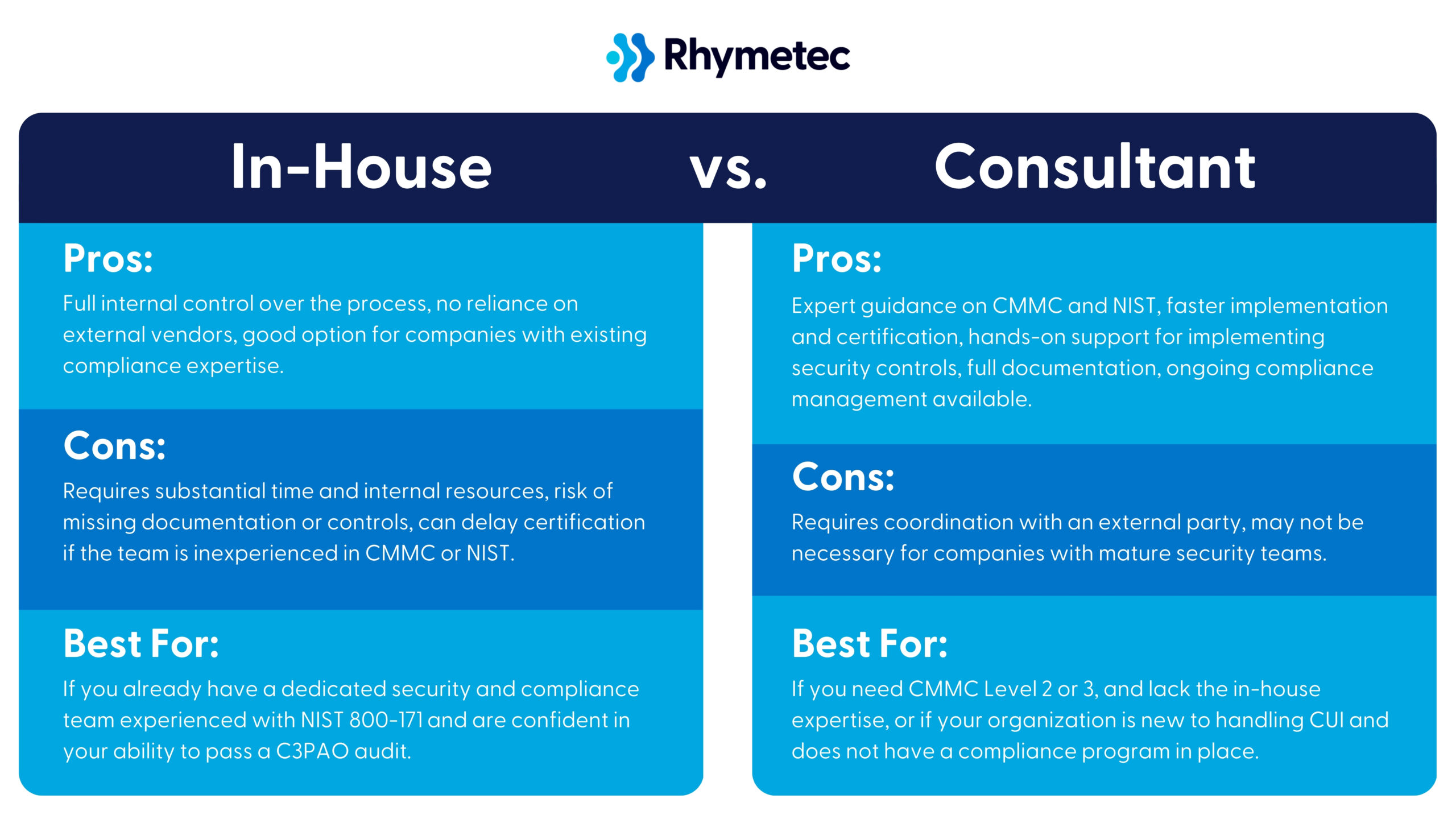
Working with a Managed Security Services Provider that offers CMMC consulting services (like Rhymetec!) can help contractors meet CMMC 2.0 requirements efficiently. MSSPs take the work off your plate and help you meet your goals in the fastest time frame possible. We've helped over 1,000 organizations meet their compliance and security requirements in the fastest time frame possible.
In this article, we go over how CMMC 2.0 works, the options available for achieving compliance, and the potential advantages of working with a CMMC consultant.
What Is A CMMC Consultant, and What Do They Do?
Unless you have a fully built-out in-house cybersecurity and compliance team, CMMC can be a massive project to take on internally—taking a year or longer to meet requirements. This is where a CMMC consultant comes in.
A CMMC consultant is a cybersecurity and compliance expert who helps defense contractors meet the requirements of the Cybersecurity Maturity Model Certification (CMMC) 2.0. Consultants do everything from conducting a gap assessment to see where you are versus where you need to be, developing practical strategies to achieve compliance that will fit seamlessly (and as non-disruptively as possible!) into your operations, and guiding you through the certification process in partnership with an external auditor.
For many businesses, especially small and mid-sized contractors, understanding and implementing CMMC controls can be challenging. A CMMC consultant provides tailored, specialized knowledge to streamline the entire process, reduce your risk of non-compliance, and make big improvements to your overall security if you do not already have certain measures in place.
Do You Need A CMMC Consultant?
The best way to determine if you need a CMMC consultant is to look through the responsibilities and deliverables in the next section and assess whether or not you have the in-house capacity to fulfill all of these items.
If you are a larger organization and already have a security team with personnel that can accomplish the necessary tasks for CMMC (A Chief Information Security Officer, Penetration Tester, Cloud Security Specialist, Vulnerability Management Analyst, etc.), you can probably do most of this on your own or with guidance from a CMMC consultant rather than full support.
However, for smaller organizations or those without a fully developed in-house security program, engaging a CMMC consultant entails multiple benefits.
According to A-LIGN’s 2025 Compliance Benchmark Report, 57% of government-affiliated organizations reported conducting audits specifically to meet contract requirements, up from 40% in 2024. DoD contractors and subcontractors will need to obtain certification under one of three trust levels to demonstrate that they have adequately implemented cybersecurity measures.
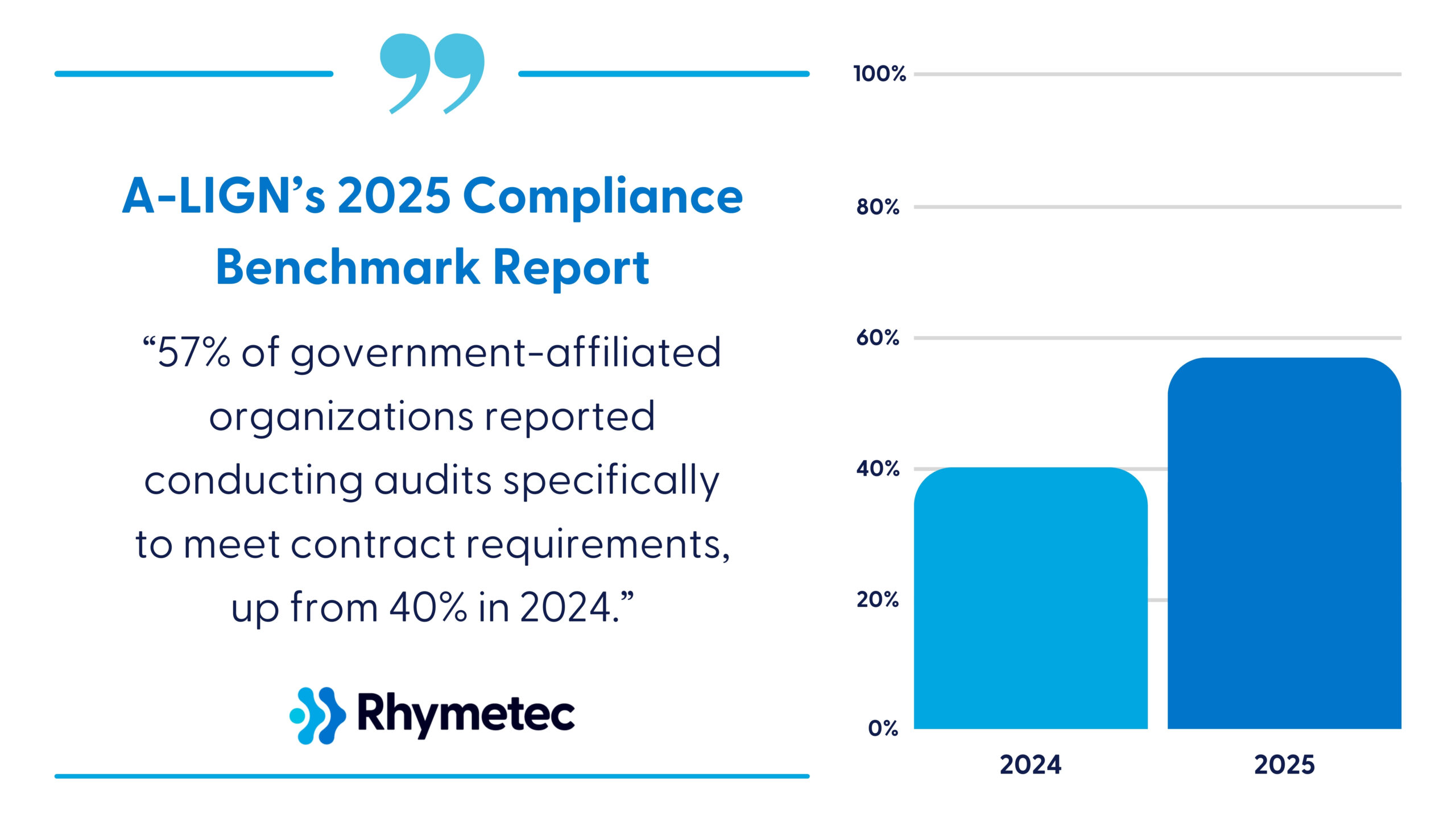
Below are some questions to help you assess whether working with a consultant is the right choice. After you answer these questions and review the responsibilities and deliverables listed below in the next section, you should have a clear picture of whether or not you need a CMMC consultant:
1. Which CMMC Level Do You Need To Achieve?
The CMMC level you need depends on the type of contracts you handle:
CMMC Level 1 (Basic Cyber Hygiene) is required for contractors who only handle Federal Contract Information (FCI). Compliance is self-assessed, but security controls must still be implemented.
CMMC Level 2 (Advanced Cyber Hygiene) is required for contractors who handle Controlled Unclassified Information (CUI). Compliance requires a third-party assessment (C3PAO) every year.
CMMC Level 3 (Expert) is required for contractors who are working on high-security DoD projects. Compliance entails DoD-led audits and adherence to NIST SP 800-171 and portions of NIST SP 800-172.
If you need CMMC Level 2 or Level 3, working with a CMMC consultant can be extremely helpful, given the amount of work involved in the third-party assessment process, implementing missing security controls, and maintaining ongoing compliance.
2. Do You Have An Internal Cybersecurity Team With Compliance Expertise?
If you have a dedicated cybersecurity and compliance team, you may be able to handle CMMC requirements internally. Even if you do have an internal team, however, a CMMC consultant can still be beneficial if:
- Your internal team is unfamiliar with NIST 800-171 and CMMC requirements.
- You need help preparing evidence for a third-party assessment.
- Your security team does not specialize in compliance or lacks the expertise to develop CMMC procedures and policies.
3. Have You Implemented a NIST 800-171 Self-Assessment?
If you need CMMC Level 2 or Level 3, you should already have a NIST 800-171 self-assessment and an SPRS score recorded. If you haven't completed this step, a CMMC consultant can guide you through the process. Additionally, if your SPRS score is low, or if you have many missing security controls, you may need a consultant to develop a remediation strategy before moving forward.
4. Do You Need Help Implementing Technical Security Controls?
There are a range of technical security controls required by CMMC that many organizations may not have adopted yet. If your company lacks the bandwidth to deploy these measures, a CMMC consultant can provide guidance and support (or do it for you, depending on the level of support outlined in the engagement). These types of technical controls include configuring multi-factor authentication, implementing network segmentation, SIEM logging and monitoring, and vulnerability management.
5. Are You Prepared For A Third-Party or DoD Audit?
For Levels 2 and 3, organizations have to pass an official assessment conducted by a Certified Third-Party Assessor Organization (C3PAO) or the DoD. The most common issues contractors face with these assessments are due to insufficient documentation, improperly implemented controls, or lack of audit preparation. A CMMC consultant can remediate these issues and more in advance of your assessment.
6. Do You Need Ongoing Compliance Support?
Lastly, it's important to know that CMMC compliance requires ongoing monitoring and maintenance. You'll need to keep your certification in good standing year-round. If your organization does not have a dedicated team to handle continuous compliance, a CMMC consultant can provide long-term security and compliance management. Ongoing support can include:
- Review of your security controls
- Vulnerability scanning (and remediation as needed)
- Incident response drills
- Log reviews and SIEM tuning.
If the answer is "yes" to multiple questions, partnering with a CMMC consultant may be a good option for your organization.
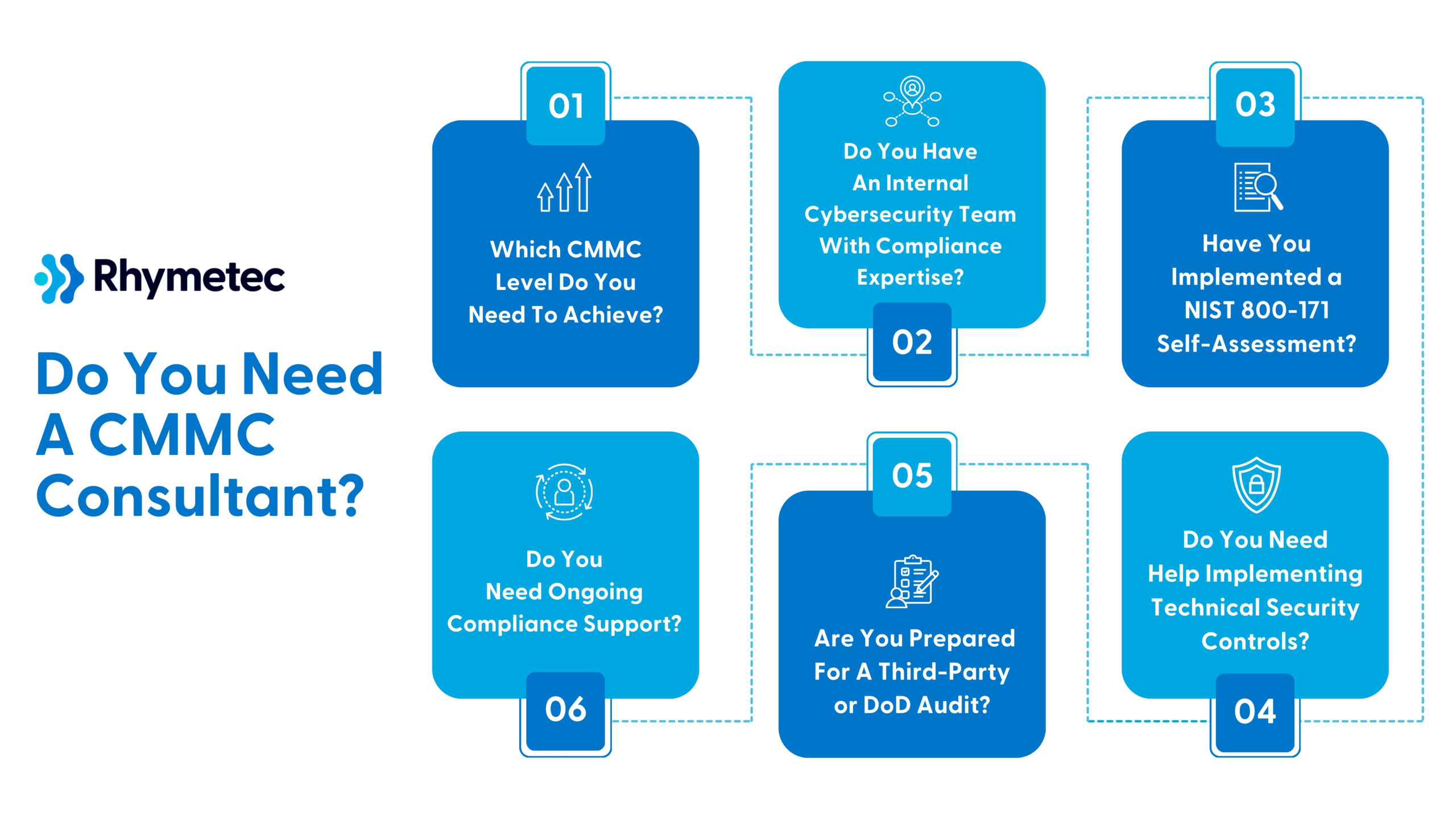
Next, let's go over what a CMMC consultant typically accomplishes for organizations throughout the engagement. This should help give you a good idea of what to expect:
Timelines And Deliverables From A CMMC Consultanting Engagement
A CMMC consultant provides end-to-end support to help defense contractors achieve CMMC compliance. At a high level, this process entails assessing your organization's current security posture, implementing the required controls you don't already have, developing documentation, training personnel, and preparing for the official assessment.
Here is what this process and the deliverables will look like, in general, for an organization starting from a more basic security posture:
1. CMMC Initial Assessment - Documentation and Gap Assessment:
- Conduct a gap assessment to assess your current CMMC maturity level.
- Review existing security documentation to determine alignment with CMMC 2.0. requirements and identify any gaps in your documentation to be addressed before certification.
- Review CUI/FCI data flows to assess how sensitive information is handled.
- Map current security controls to NIST SP 800-171 and CMMC requirements.
- Document your organization's Supplier Performance Risk System (SPRS) score.
- Develop a preliminary Plan of Action & Milestones (POA&M) to address deficiencies.
- Estimate resource requirements for remediation.
Timeline With A CMMC Consultant: 1-2 Months
2. Implementation of Access Control and System Security
- Configure multi-factor authentication (MFA) for all required systems.
- Implement least privilege access principles to restrict user permissions.
- Set up remote access controls and document access control procedures.
- Deploy a Privileged Access Management (PAM) solution for sensitive accounts.
- Implement network segmentation and develop network diagrams.
- Deploy endpoint protection solutions.
- Configure logging and monitoring systems, including SIEM solutions.
- Set up backup solutions and document backup and recovery procedures.
Timeline With A CMMC Consultant: 1-3 Months
3. Documentation and Policy Development
- Develop a System Security Plan (SSP) documenting security controls.
- Create an Incident Response Plan for handling security incidents.
- Establish a Disaster Recovery Plan.
- Create training documentation for security awareness and compliance.
Timeline With A CMMC Consultant: 1-2 Months
4. Training
- Conduct security awareness training for employees.
- Develop role-specific training for personnel handling CUI/FCI.
- Run incident response drills to prepare teams for cyber threats.
- Train employees on documentation procedures.
- Hold policy review sessions.
Timeline With A CMMC Consultant: 1 Month
5. Testing and Control Validation
- Perform internal control testing to verify compliance.
- Conduct vulnerability assessments and penetration testing to evaluate system defenses.
- Review security documentation for accuracy/completion.
- Validate processes and security controls through real-world testing.
Timeline With A CMMC Consultant: 1-2 Months
6. C3PAO Assessment
- Conduct a final documentation review to make sure all requirements have been met.
- Validate security controls against CMMC 2.0 standards.
- Prepare teams for staff interviews conducted during the official assessment.
- Perform technical testing to confirm systems meet all requirements.
Timeline With A CMMC Consultant: 1 Month
Ongoing Maintenance
To maintain compliance and readiness for recertification, a CMMC consultant provides ongoing support through the following:
- Monthly security control reviews to assess compliance status on an ongoing basis.
- Vulnerability scanning to identify and remediate emerging threats.
- Access reviews to ensure permissions remain properly restricted.
- Incident response testing to evaluate security team preparedness.
- Log review to monitor system activity and detect anomalies.
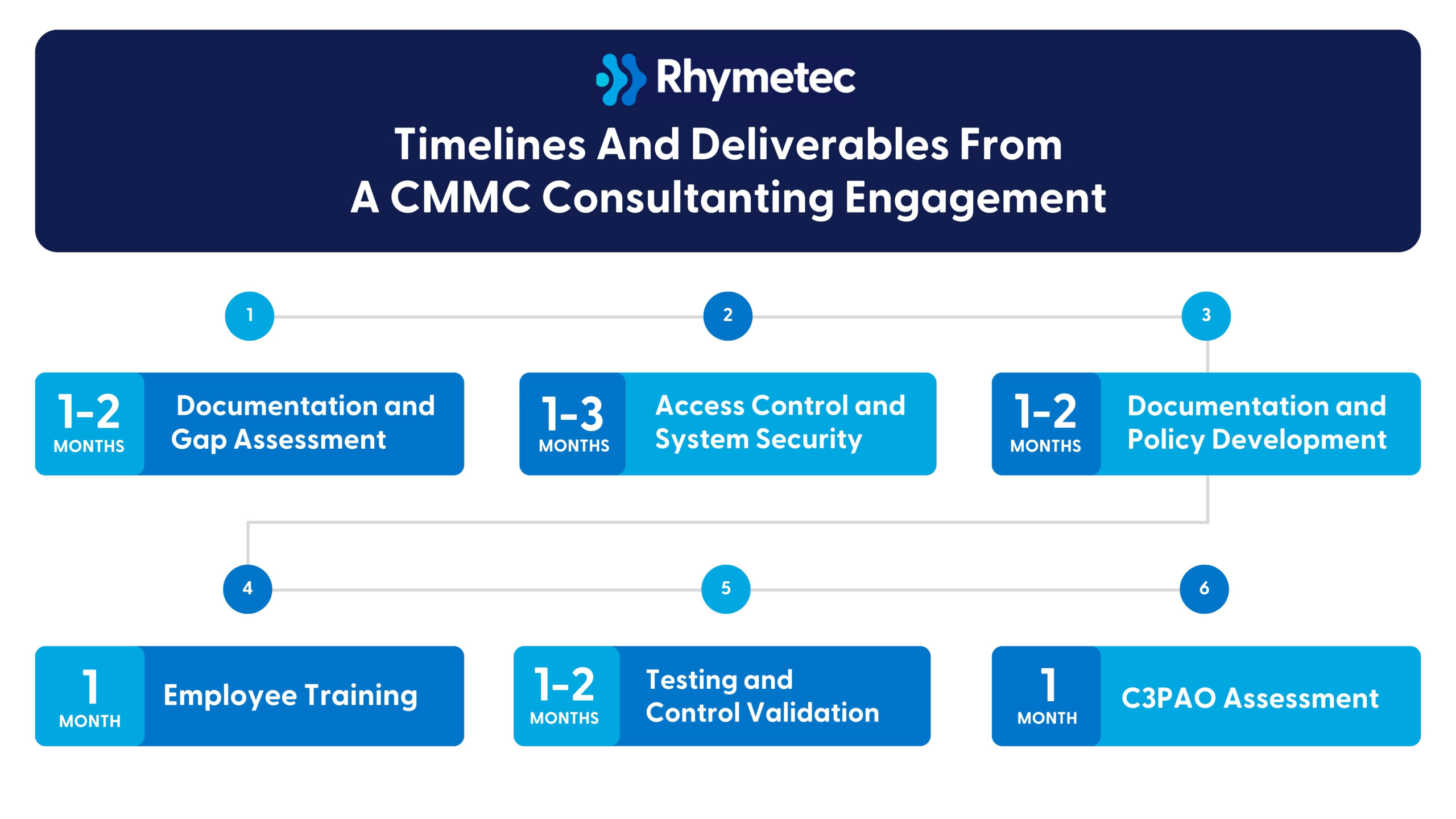
Why Work With A CMMC Consultant?
Achieving compliance is not simple. There is an array of technical and procedural controls and extensive required documentation. A CMMC consultant helps businesses navigate these requirements by providing specialized expertise (at a much lower price point than building out an in-house team would cost) and reducing administrative burdens.
Many defense contractors lack the in-house resources to manage requirements, especially as the DoD increases enforcement of cybersecurity standards. Often, for example, small defense contractors with no formal cybersecurity programs need to achieve CMMC Level 1 to continue bidding on DoD contracts. Having limited IT staff and a lack of security policies and policies can be a significant roadblock.
In this scenario, a CMMC consultant would help by starting with an initial assessment to determine the company's current security posture and documentation and, from there, develop all missing policies, procedures, and documents. Often, this includes a System Security Plan (SSP), access control policies, and an incident response plan.
Many contractors also underestimate the complexity of CMMC and wait too long to start the process. The risk of failing an assessment can lead to contract loss and reputational damage. Working with a CMMC consultant reduces risk, streamlines implementation, strengthens your cybersecurity, and ensures you stay audit-ready year-round.
If your business relies on DoD contracts, CMMC certification isn't optional. Engaging a CMMC consultant early on in the process saves significant time and headaches down the road.
About Rhymetec
Our mission is to make cutting-edge cybersecurity available to SaaS companies and startups. We’ve worked with hundreds of companies to provide practical security solutions tailored to their needs, enabling them to be secure and compliant while balancing security with budget. We enable our clients to outsource the complexity of security and focus on what really matters – their business. Contact us today to get started.
Interested in reading more? Check out more content on our blog.