Now that Phase 1 of the Cybersecurity Maturity Model Certification (CMMC) rollout is fully operational, defense industrial base (DIB) contractors face an immediate regulatory timeline. The implementation of the Department of Defense (DoD) final rule has shifted cybersecurity from an internal checklist to an enforceable contractual requirement.
The next major milestone arrives on November 10, 2026, with the launch of Phase 2. This phase introduces mandatory third-party assessments for the majority of contractors handling Controlled Unclassified Information (CUI).
For organizations operating in the defense supply chain, achieving CMMC Level 2 compliance is no longer a forward-looking goal, it is a critical requirement for maintaining contract eligibility and protecting enterprise revenue.
This comprehensive guide delivers a practical CMMC Level 2 checklist, maps out the framework's core data boundaries, and outlines precisely how to get CMMC Level 2 certification ahead of upcoming DoD solicitation deadlines.
What is CMMC Level 2?
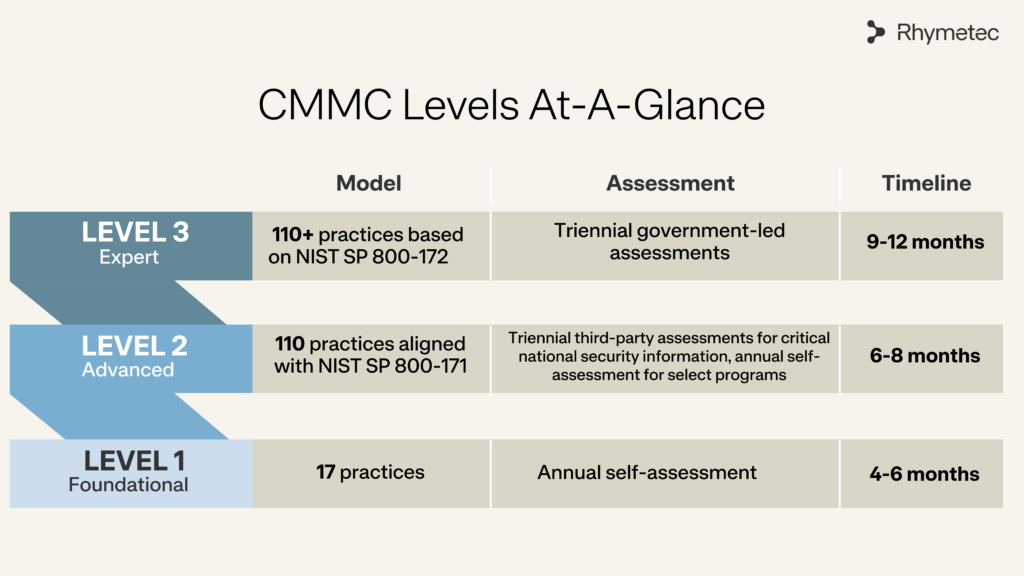
CMMC is the DoD’s unified framework designed to standardize cybersecurity practices across its supply chain. While Level 1 establishes baseline hygiene for basic contract data, CMMC Level 2 focuses heavily on protecting sensitive, unclassified technical data.
"CMMC applies to anyone who's working with the Department of Defense and also processes, transmits, or stores controlled unclassified information. If you're processing that information and you're also working on direct contracts with the Department of Defense, or if you're one of their subcontractors, that means CMMC applies to you." — Metin Kortak, CISO at Rhymetec
The framework includes contractors, manufacturers, SaaS vendors, and cloud service providers that interface with DoD data either directly or indirectly. Compared to the original CMMC 1.0 blueprint, which featured a convoluted five-tier architecture and distinct, framework-only controls, CMMC 2.0 streamlines the process. By eliminating legacy redundancy, Level 2 maps directly to the 110 security practices established in the National Institute of Standards and Technology Special Publication (NIST SP 800-171).
This harmonization significantly reduces friction for organizations that must simultaneously align with other rigorous federal standards, such as FedRAMP. For a complete blueprint of how these standards interact across the entire defense supply chain, explore our full CMMC compliance guide.
Scoping Your Environment & The Gap Assessment
Achieving CMMC Level 2 compliance requires absolute clarity regarding your data boundaries and current technical gaps. Before implementing a single control, your team must execute a precise scoping exercise and a rigorous gap assessment.
1. Identify Your Data Assets (FCI vs. CUI)
Your data footprints dictate your compliance obligations. The framework separates data into two primary categories:
- Federal Contract Information (FCI): Information provided by or generated for the government under a contract that is not intended for public release (e.g., project timelines, contract logistics, and organizational charts). FCI requires a foundational Level 1 posture.
- Controlled Unclassified Information (CUI): Government-created or owned unclassified data that requires safeguarding and dissemination controls under federal laws and policies. Examples include proprietary defense software code, system specifications, blueprint schematics, and sensitive API documentation defining how your applications interoperate with DoD environments. This is more sensitive than FCI and mandates a Level 2 architecture.
2. Conduct a Gap Assessment
Once you confirm that your systems process, store, or transmit CUI, you must test your infrastructure against the explicit CMMC Level 2 requirements.
"At Rhymetec, we always start with a gap assessment. A gap assessment against the NIST 800-171 controls is a must-have…It helps you determine if you have any missing controls or if you have any gaps in your compliance, so you can start putting together a roadmap for completing the remaining controls." — Metin Kortak, CISO at Rhymetec
The gap assessment compares your current state against the required 110 controls, identifying technical or procedural deficiencies. During this phase, a Plan of Action and Milestones (POA&M) serves as your primary remediation tracker.
Under current CMMC guidelines, you can achieve a "Conditional Pass" with a minimum scoring threshold of 88 out of 110 points, provided no critical, high-weighted controls are deficient. However, any remaining gaps documented in your POA&M must be fully closed and verified by an assessor within 180 days.
The Definitive CMMC Level 2 Checklist
To streamline your preparation, Rhymetec compliance experts have categorized the mandatory CMMC Level 2 requirements into three distinct operational phases: Documentation, Technical Implementation, and Third-Party Verification.
1. Documentation and Pre-Audit Assessment
- Map CUI Data Flows: Explicitly document how CUI traverses your network, cloud environments, and vendor integrations to define an airtight security boundary.
- Develop a System Security Plan (SSP): Author a comprehensive SSP detailing exactly how your organization implements every individual NIST control. This document serves as the core evidence package for your external assessment by a C3PAO.
- Establish a Plan of Action and Milestones (POA&M): Formally document any security gaps discovered during your preliminary assessments, detailing remediation timelines, resource allocations, and ownership.
- Calculate and Submit Your SPRS Score: Enter your self-assessment score into the DoD’s Supplier Performance Risk System (SPRS). Contracting officers use this score to evaluate your organization's immediate eligibility for active contract awards.
2. Core Implementation Across the 14 Security Domains
The 110 controls span 14 specialized security families. Your technical architecture must robustly fulfill each domain:
- Access Control (AC): Enforce measures to include least privilege and MFA, and manage privileged accounts.
- Awareness and Training (AT): Deliver role-specific cybersecurity training to ensure all personnel recognize insider threats and social engineering risks.
- Audit and Accountability (AU): Retain records and review logs for anomalies.
- Configuration Management (CM): Establish secure baseline configurations and change control procedures.
- Identification and Authentication (IA): Enforce enterprise-wide multi-factor authentication (MFA), prevent password reuse, and implement cryptographic protections for authentication mechanisms.
- Incident Response (IR): Create an incident response plan if your organization doesn't already have one, and test it.
- Maintenance (MA): Ensure all system maintenance activities are explicitly logged, and strictly authenticate any remote diagnostic sessions.
- Media Protection (MP): Create policies to limit and monitor removable media and sanitize storage before reuse.
- Personnel Security (PS): Screen employees, terminate access promptly, and deliver regular security training.
- Physical Protection (PE): Secure physical perimeters, limit facility access to authorized personnel, maintain visitor logs, and safeguard alternate work locations.
- Risk Assessment (RA): Conduct scheduled risk assessments and perform routine vulnerability scanning.
- Security Assessment (CA): Conduct internal control testing and prepare for external audits.
- System and Communications Protection (SC): Implement boundary defenses and encryption for CUI in transit.
- System and Information Integrity (SI): Deploy advanced endpoint protection, automate patch management schedules, and establish real-time alerting.
3. Third-Party Certification
- Verify Assessment Track: Determine if your specific contract allows for an annual executive-signed self-attestation or if it mandates an independent assessment.
- Engage an Accredited Partner: For the vast majority of Level 2 contractors, independent verification is non-negotiable.
"C3PAOs come in and assess you against the requirements, depending on the level that you're at. Our goal is to validate that the sensitive data is actually being protected, because looking historically at just relying on self-attestations to 800-171 for anybody within the supply chain has not been sufficient." — Matt Bruggeman, A-LIGN

Navigating the CMMC Level 2 Compliance Timeline
Building an audit-ready security program requires dedicated time and resource coordination. For an organization implementing the controls from a baseline posture, a typical compliance roadmap spans 6+ months.
Organizations with pre-existing NIST SP 800-171 alignment may move faster, but the looming Phase 2 enforcement rollout means scheduling bottlenecks are increasing across the defense industrial base.
- Gap Assessment and Planning (Months 1–2): Define the exact boundaries of your CUI environment, map data flows, conduct your initial gap assessment, and submit your initial baseline score to SPRS.
- Control Implementation (Months 3–4): Remediate infrastructure vulnerabilities. This includes deploying technical controls like centralized logging (SIEM), advanced endpoint detection, FIPS-compliant encryption, and updating corporate policy documentation.
- Internal Validation (1 Month): Perform comprehensive internal testing, execute vulnerability scans, finalize your SSP, and gather your audit artifacts.
- C3PAO Audit Execution (1 Month): Undergo the formal independent assessment, including technical verification, staff interviews, and final scoring submission to the DoD database.
Note: C3PAO lead times can stretch for several months due to high demand ahead of the Phase 2 implementation. Securing an assessment window early in your readiness phase is critical to avoiding contract disruption.

Strategic Advantages of an Experienced Partner
The technical and documentation requirements of Level 2 are resource-intensive. Attempting to interpret the 320 underlying evaluation objectives within NIST SP 800-171 without specialized compliance expertise can result in misconfigured controls and delayed contract awards.
Engaging a Virtual CISO (vCISO) resolves this complexity. A vCISO functions as an extension of your team, translating dense regulatory clauses into structured engineering milestones. At Rhymetec, our vCISO experts manage the heavy lift of your compliance journey, from executing your initial gap assessment and deploying required technical safeguards to orchestrating your complete SSP documentation.
Ready to Speak to a CMMC Consultant?
At Rhymetec, we deliver the clarity, documentation, and technical expertise needed for successful compliance. With a decade of trusted delivery and a 100% in-house team, we support you through every stage of your CMMC readiness journey.
As an approved Registered Provider Organization (RPO), we work hand-in-hand with industry-leading, accredited C3PAOs to streamline your validation process. We handle the consulting, remediation, and evidence compilation, ensuring you are fully prepared when your formal third-party audit begins.
Contact us today to speak with one of our compliance experts.