Information security is no longer a defensive technical safeguard, it is a high-stakes financial strategy that directly impacts corporate valuation. Organizations face a global average breach cost of $4.44 million, a figure that skyrockets to an all-time high of $10.22 million for businesses operating in the United States.
Whether you are a scaling SaaS startup or an established cloud-native enterprise, proving your security posture to sophisticated B2B clients is essential to closing deals and growing your business.
When it comes to global gold standards for information security, ISO/IEC 27001 stands at the top. Achieving ISO 27001 certification proves that your organization has built a robust Information Security Management System (ISMS) capable of protecting sensitive data. However, the path to compliance can look daunting.
To help you navigate the process, we’ve put together a practical ISO 27001 checklist designed to get you audit-ready efficiently.
What is ISO 27001?
ISO/IEC 27001 is the international gold standard framework for managing information security. It outlines the specific blueprint required to establish, operate, maintain, and continually optimize an Information Security Management System (ISMS).
Achieving third-party certification systematically proves to enterprise buyers, stakeholders, and global regulators that your organization has implemented highly rigorous, risk-based defenses to safeguard sensitive data and defend your digital assets against modern threat landscapes.
Who Needs to Comply with ISO 27001?
While ISO 27001 is technically a voluntary framework rather than a geographic regulatory mandate, it has become the baseline for international commerce. For growing tech companies, achieving certification is a strategic necessity to establish credibility on a global scale.
You should prioritize an ISO 27001 checklist if your organization:
- Operates in the SaaS or Cloud Space: Enterprise buyers routinely demand third-party validation of your security controls before sharing data.
- Handles Sensitive Global Data: If you handle intellectual property, financial information, or personally identifiable information (PII) across international borders, ISO 27001 serves as a universal trust passport.
- Wants to Shorten Sales Cycles: Having an ISO 27001 certification allows your sales team to bypass lengthy, customized security questionnaires from prospects.
The Phase-by-Phase ISO 27001 Compliance Checklist
Building an ISMS requires a structured approach. Rather than looking at compliance as a massive, single task, it is highly effective to break it down into five core phases aligned with standard security operational workflows.
Phase 1: Scope & Framework Definition
Before writing policies, you must draw a boundary around what you are actually protecting. Trying to secure an entire corporate ecosystem at once can dilute your resources.
- Define the ISMS Roadmap: Establish your core timelines, identify project management tools, and allocate an appropriate budget relative to your company size. Unsure what to budget? Check out our breakdown of ISO 27001 certification costs.
- Determine the Scope: Clearly document which business areas, systems, locations, and technologies are covered by your ISMS, and which ones are explicitly out of scope.
- Assemble Your Security & Governance Team: Assign specific technical roles to your engineering staff, but also secure active executive buy-in. Senior leadership must allocate resources and drive accountability.
Phase 2: Gap & Risk Assessment
ISO 27001 is explicitly risk-based. Rather than enforcing a rigid, one-size-fits-all checklist, the standard demands that you design a highly rigorous security program tailored precisely to your specific threat landscape, meaning every control you implement must directly defend against a verified risk to your business.
- Inventory Your Information Assets: Catalog everything where data is stored, processed, or accessed. This includes digital assets (customer databases, SaaS tools), physical assets (laptops, servers), and intangible assets (intellectual property).
- Perform a Formal Risk Assessment: Establish a consistent risk framework. Identify threat scenarios, evaluate the likelihood of occurrence, and determine the potential impact on data confidentiality, integrity, and availability (the CIA triad).
- Develop a Central Risk Register: Log and rank your identified risks so you have a single source of truth for your security vulnerabilities.
- Document a Risk Treatment Plan: For each risk identified, assign an owner and choose a response strategy: mitigate it, accept it, transfer it, or avoid it.
- Complete the Statement of Applicability (SoA): Review the 93 security controls listed in Annex A of the ISO 27001 standard. Formally document which controls are relevant to your risks, and justify any exclusions.
Tip: Aligning your risk assessment with existing frameworks you might already possess (like SOC 2 or NIST) can dramatically accelerate this phase.
Phase 3: Program & Control Implementation
With your blueprint ready, it's time to build the protective barriers around your assets.
- Draft and Customise Core ISMS Policies: Create clear, actionable documentation covering access control, cryptography, network security, physical security, and incident response.
- Deploy Technical Controls: Implement the technical safeguards justified in your SoA, such as multi-factor authentication (MFA), end-to-end encryption, network segmentation, and continuous logging.
- Establish Employee Security Awareness Training: Security is a cultural effort. Embed security training into your onboarding process and run continuous phishing simulations to ensure your team knows how to spot common threats.
Phase 4: Continuous Monitoring & Review
An ISMS is not a "set-and-forget" project. It requires continuous validation to ensure your security controls are functioning as intended over time.
"After helping organizations navigate their ISO 27001, one thing is very clear: success comes from treating compliance as an ongoing business initiative rather than a one-time audit. A well-designed ISMS becomes the foundation for stronger security and customers are better positioned to win enterprise customers"
— Endri Domi, Senior Manager of Service Delivery
- Conduct Regular Management Reviews: Meet at least annually (or quarterly if your infrastructure changes rapidly) with executive leadership to review ISMS performance, audit results, and emerging risks.
- Execute a Mandatory Internal Audit: Before inviting an external auditor, you must conduct an internal audit. This must be done by an independent in-house team member who wasn't involved in building the ISMS, or by a qualified third party.
- Remediate Gaps and Nonconformities: Document the findings of your internal audit and immediately address any weaknesses before moving to the official certification stage.
Phase 5: External Audit & Certification
The final phase involves bringing in an accredited, independent third-party registrar to validate your hard work.
- Select an Accredited ISO 27001 Auditor: Partner with a reputable external certification body. When you partner with a Rhymetec vCISO, we handle the entire audit coordination process from start to finish. You can utilize your preferred auditor, or leverage our network of trusted audit partners to ensure a smooth, predictable experience.
- Complete the Stage 1 Audit (Documentation Review): The auditor reviews your ISMS documentation, scope, SoA, and risk assessment to evaluate your readiness for the live test.
- Complete the Stage 2 Audit (Operational Testing): The auditor performs fieldwork, interviews employees, tests your controls in real-world scenarios, and observes your operational functionality.
- Resolve Auditor Findings: Address any minor nonconformities identified during Stage 2 to receive formal validation.
- Plan for Surveillance Audits: Your ISO 27001 certificate is valid for three years. You must plan for annual surveillance audits in Years 2 and 3 to ensure your compliance program remains effective.
Business Benefits of Completing the ISO 27001 Checklist
While the implementation process requires a strategic investment of time and capital, the business advantages extend far beyond checking a compliance box:
- Unlock Enterprise and Global Markets: Many international enterprises will simply not sign vendor contracts without an ISO 27001 certification.
- Operational Optimization: Mapping your digital assets frequently uncovers redundant software subscriptions, helping you scale down infrastructure costs while improving overall performance.
- Pre-positioning for Future Regulations: Because ISO 27001 covers the core pillars of comprehensive data governance, being compliant positions your business to achieve 80% of the requirements for future frameworks (like SOC 2, DORA, or GDPR) with minimal extra friction.
Streamlining Your Certification Journey
Building an ISO 27001 program requires more than checking boxes. Success comes from combining the right strategy, technology, and expertise to create a security program that scales with your business.
Modern compliance programs pair GRC automation with experienced guidance. A virtual CISO (vCISO) acts as an extension of your team, translating complex framework requirements into practical, repeatable processes.
At Rhymetec, we help organizations build, manage, and maintain ISO 27001 with confidence, from framework development and continuous monitoring to end-to-end audit coordination. The result is a streamlined path to certification and a stronger security foundation that keeps your business moving forward.
Ready to accelerate your path to ISO 27001 certification? Contact our team of compliance experts today to learn how Rhymetec can build a tailored security roadmap for your business.
At Rhymetec, we do all the hard work so that you can sail through your ISO audits. We implement and monitor the AI governance and security controls required to meet ISO/IEC 42001 standards. With our personalized risk assessments, managed Artificial Intelligence Management Systems (AIMS) development, customized policy creation, and more—, we ensure your journey to ISO/IEC 42001 certification is smooth sailing.
What is ISO/IEC 42001?
ISO/IEC 42001 is an international standard that specifies requirements for implementing, maintaining, and continually improving an Artificial Intelligence Management System (AIMS) within organizations. ISO/IEC 42001 certification helps entities that provide or use AI-based products or services ensure responsible use of their AI systems.
Why is ISO/IEC 42001 certification a good idea?
ISO/IEC 42001 compliance allows organizations to leverage AI responsibly and enables them to provide evidence of responsible AI practices to partners, prospects, and other stakeholders.
Adherence to ISO/IEC 42001 standards supports reputation management efforts. By addressing concerns related to environmental, societal, and economic impacts, ISO/IEC 42001 certification signals a commitment to addressing these issues and demonstrates that you've taken a proactive approach to responsible AI implementation.
The basic benefits of ISO/IEC 42001 certification are:
- Responsible AI: Enables ethical and responsible use of artificial intelligence.
- Reputation management: Enhances trust in AI applications.
- AI governance: Supports compliance with legal and regulatory standards.
- Practical guidance: Manages AI-specific risks effectively.
- Identifying opportunities: Encourages innovation within a structured framework.
How do we do it?
At Rhymetec, we implement an Artificial Intelligence Management System (AIMS) to help you obtain ISO/IEC certification. An Artificial Intelligence Management System is essential to complying with the ISO/IEC 42001 standard.
What to expect with ISO/IEC 42001 readiness and management alongside Rhymetec:
- Clearly define and document all AI management roles and responsibilities across the organization.
- Create detailed procedures and guidelines for maintaining AIMS, ensuring ongoing compliance and adaptability to changes in AI technology and business practices.
- Manage all AI-specific management policies that govern the development, deployment, and continuous improvement of AI systems.
- Implement all ISO 42001 controls as tailored to the specific needs and risks associated with your organization's AI applications and systems.
- Implement a process for monitoring, measurement, analysis, and evaluation as required to achieve ISO/IEC 42001 compliance.
- Leverage existing security and performance monitoring tools to track AI system behaviors and outcomes.
- Develop and implement a continuous monitoring and improvement program as required by ISO/IEC 42001 to improve the effectiveness of the AIMS.
Deliverables from Rhymetec
Our team is dedicated to delivering premium-tier service to ensure ISO/IEC 42001 certification, from developing and managing your AI Management System to outlining risks and managing your external audit through certification.
Rhymetec specializes in enabling meaningful, real-world solutions to the most pressing challenges of the modern SaaS security environment. Assessment and reporting are contextualized to your business sector and custom-tailored to your specific needs.
Our process is engineered to provide all the data and insights you need to make informed decisions and take definitive action. Contact us
In 2025, more companies than ever before are budgeting for ISO 27001 certification costs. In a recent ISO survey, the global number of ISO 27001 certificates reached over 70,000 certificates and were reported in 150 countries and across a range of economic sectors.
Many of these certifications are driven by customer demand and procurement requirements, in particular in fields such as B2B SaaS.
Understandably, cost is often one of the most important questions companies exploring their compliance options have. ISO 27001 is a bit more involved than other frameworks in this space, such as SOC 2, as it requires a broader set of security controls and third-party requirements.
External audit costs, internal resource time, implementing technology changes at your organization, and ongoing maintenance all factor into ISO 27001 certification costs. Without a clear breakdown, it can be easy to underestimate both the initial investment and the ongoing effort.
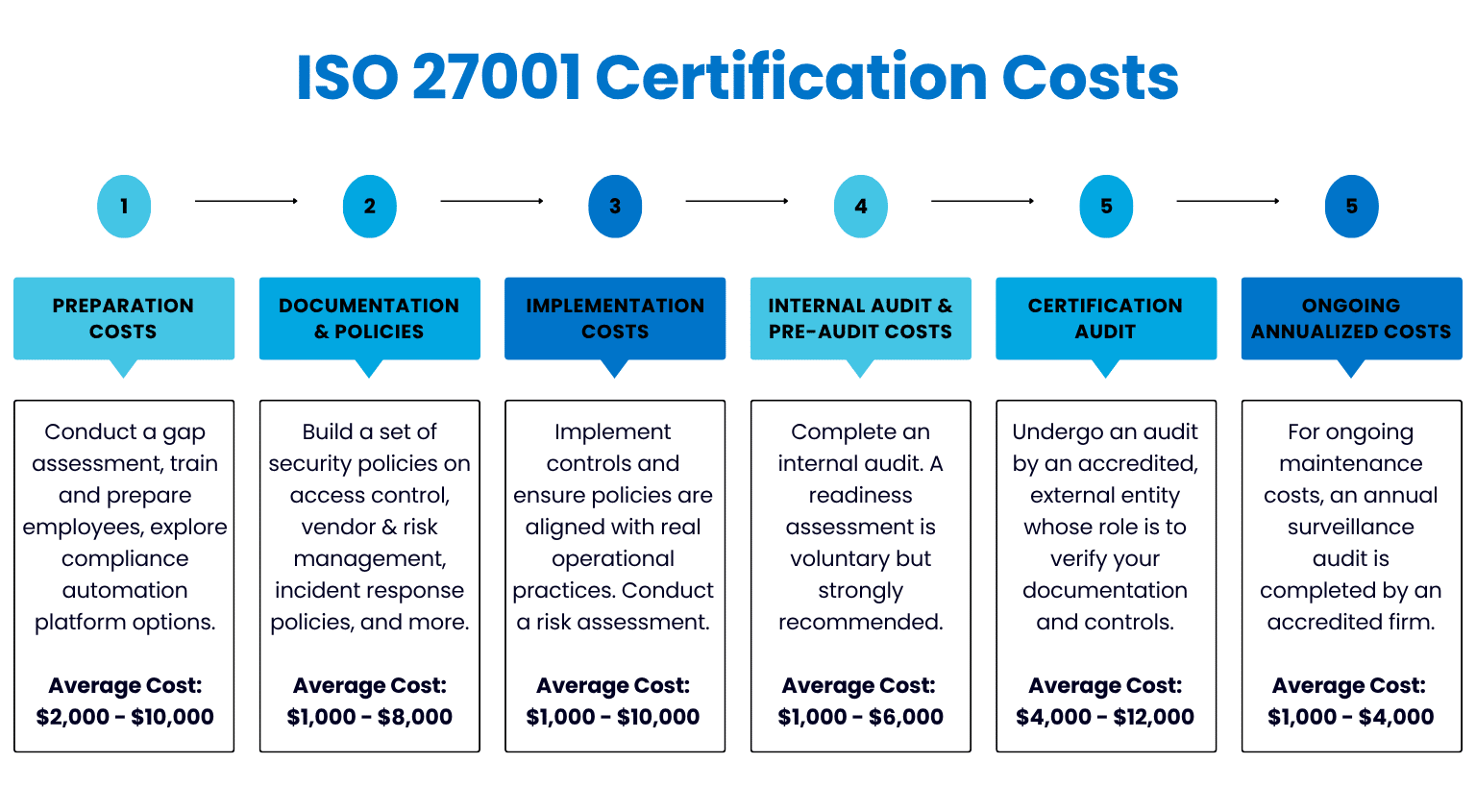
This blog outlines what to expect for ISO 27001 certification costs, based on current market data, our team’s firsthand experience working with SaaS startups, and input from certified auditors we work closely with.
Preparation Costs
Preparation costs for ISO 27001 represent a substantial part of the overall investment. Before engaging a registrar (an accredited certification body), your organization must complete a range of activities that require time, resources, investing in new technologies, and, in many cases, external support.
Typically, the first step of an ISO 27001 engagement is a gap assessment. A gap assessment shows where you are versus where you need to be by identifying missing controls and policy gaps in comparison to the ISO 27001 standard. Companies may complete this assessment internally or work with a third-party consultant for greater objectivity and expertise (if you don’t have in-house personnel with compliance experience).
Following the gap assessment, staff training and security awareness are typically the next steps.
Every employee needs to understand their role in protecting both company and customer data. Your organization will likely need to develop new onboarding materials, invest in employee training sessions, and plan targeted training sessions for engineers and leadership.
The adoption of new software for compliance is often included in the preparation phase. Startups in rapid phases of growth typically select to use tools like Drata or Vanta to automate the pieces of compliance that can be automated, and keep track of their progress in one central place.
These tools support policy management, control tracking, evidence collection, audit preparation, and more. These platforms can vastly simplify the compliance process, but they do entail an investment. Check out our blog post on compliance automation platforms for more information on how these tools work and how they accelerate compliance.
Each one of these preparation activities helps to create a foundation for a successful certification process. Companies that invest early on in assessments, training, and new technologies tend to move through the audit with greater efficiency and fewer surprises. While the cost ranges vary, the effort spent up front directly impacts how much time and work will be needed later on.
Estimated Total Cost of Preparation: $2,000 - $10,000
ISO 27001 Certification Cost: Documentation and Policy Development
ISO 27001 requires formal documentation of the Information Security Management System (ISMS), including your policies and procedures. Documents are reviewed during the audit and must align with how your organization operates in practice.
For this step, most companies begin by building out a core set of policies around access control, vendor management, risk management, acceptable use policies, incident response policies, and asset management. Policies must reflect actual practices and responsibilities that are implemented.
While templates can be used to accelerate this step, customization specific to your organization is important. This is a good example of where using a compliance automation tool (such as Vanta or Drata) in combination with working with an expert security and compliance professional (such as our vCISOs at Rhymetec) can be extremely helpful:
The compliance automation tool provides an excellent baseline, while a dedicated team can customize documentation and policy development to your organization in a way that will pass scrutiny during your audit.
Some companies choose to adopt a full ISMS documentation toolkit or policy automation platform. Although optional, these tools simplify everything from version control to auditor access and stakeholder review, but they do come with additional software costs.
Your documentation will be one of the most scrutinized aspects of your ISO 27001 audit. It’s critical to adequately plan out enough time and resources to draft, review, and align policies with actual practices. Building out your policies with day-to-day operations in mind can help streamline the audit process while supporting long-term security and compliance.
Estimated Cost of Documentation and Policy Development: $1,000 - $8,000
Implementation Costs: Building The Framework
Once documentation is drafted, the next step is to begin actually implementing the controls required by ISO 27001.
The most critical piece of this phase is making sure your policies are aligned with real operational practices. Additionally, at this stage, you will assign responsibilities and validate that controls work as they are meant to. Costs can also add up during the implementation phase from technology upgrades you may need.
Conducting a risk assessment and documenting a plan to mitigate any identified risks is also a key part of this stage. Many companies choose to circumvent the need to acquire new technologies and dedicate internal resources by engaging a vCISO (Virtual CISO). At Rhymetec, our vCISOs take the implementation work off your plate and accomplish these items for you.
Estimated Implementation Costs: $1,000 - $10,000
Internal Audit and Pre-Audit Expenses
Before undergoing your certification audit, you’ll need to complete an internal audit.
In many cases, organizations will outsource this step to a firm specializing in pre-audit assessments (or, if you are already working with a vCISO, they will do this work for you!). Organizations with internal teams can manage this on their own, but many choose to work with outside consultants to speed things up and ensure objectivity. It’s important to note that it’s encouraged to find internal auditors who are PECB-accredited.
The pre-audit, or readiness assessment, is a voluntary but highly recommended assessment typically carried out by a consultant (such as a vCISO) or the certification entity. This serves to mimic your official audit, identifying areas of weakness and reducing the risk of non-conformity during your real audit. Costs during this stage also reflect the need to revise any discovered gaps, finalize your evidence collection, and coordinate between teams.
Estimated Internal Audit & Pre-Audit Costs: $1,000 - $6,000
Certification Audit Costs
After you’ve completed your ISO 27001 readiness work, the ISO 27001 certification audit is conducted by an accredited, external entity. The process is divided into two phases:
Phase 1 - Verifies your documentation.
Phase 2 - Verifies that controls are working as intended.
Costs depend primarily on organizational size, which region you are in, how complex your infrastructure is, and the level of risk associated with your operations. The total cost of the audit covers both of these phases. For startups or for SMBs with less than 100 employees, the audit typically takes anywhere from a few days to two weeks.
If areas of non-conformity are discovered during the audit, it may be necessary to undergo a follow-up audit after making changes. This can cost extra as well. Some auditing firms also tack on administrative costs, in addition to the baseline cost of the audit.
Estimated Cost For Accredited ISO 27001 Audit: $4,000 - $12,000
Ongoing Costs: Maintaining Your Certification
Once certification has been obtained, your organization must maintain the ISMS and undergo annual surveillance audits. This requirement generates a recurring set of compliance activities to be completed every year:
The annual surveillance audit is completed by an accredited firm. While less demanding compared to the original audit, it’s still an obligatory step. Your internal team or vCISO will manage updating documentation, risk remediation where needed, technical control updates, and more.
Additionally, every three years your organization will need to undergo a recertification audit, with costs similar to the initial audit. This is built into the overall ISO 27001 certification costs for ongoing maintenance.
Estimated Ongoing Costs (Annualized): $1,000 - $4,000
Additional Factors That May Influence Your ISO 27001 Certification Cost
While most organizations follow a similar certification process, a number of variables can influence total cost. The following factors will affect the duration of your audit, internal preparation effort, and the level of external support needed:
Company Size and Structure
Larger teams, companies with multiple office locations, or hybrid work environments tend to increase both the number of controls and the audit scope. Costs due to these factors add up in terms of time spent on audit activities, documentation, and coordinating with internal teams.
Level of Technical Complexity
Companies with custom infrastructure, multi-cloud environments, or proprietary platforms often require additional effort in terms of documentation and control verification. Auditors also need to spend more time reviewing technical evidence in these cases.
Systems and Vendors That Are In-Scope
The number of systems and third-party services included in the ISMS directly affects the depth and length of your audit. Most companies include at least a dozen vendors in their initial ISO 27001 scope.
Internal Experience Level
Companies without prior compliance experience will require a greater level of external guidance. Meanwhile, teams that are already familiar with SOC 2 or similar frameworks tend to move faster and are able to reduce external costs.
The controls required for ISO 27001 overlap with several other popular frameworks in this space. If you already have SOC 2, for example, your organization can leverage some of those requirements to meet some of the ISO 27001 requirements.
Auditing Body Selection
Certification bodies charge different rates and employ slightly different methodologies. Regional pricing differences, travel costs, and preferred audit partners can influence the final quote.
Total ISO 27001 Certification Cost
For most startups and SMBs, the full cost of ISO 27001 certification falls between $10,000 - $50,000. This covers everything from preparation, implementation, internal and external readiness assessments, the official audit, and the first year of ongoing expenses.
Companies building from scratch and managing the process on their own will fall toward the higher range, while companies that opt to engage external support (such as a vCISO) will see lower overall bundled costs, even if they are starting from scratch.
This cost is front-loaded in year one, with most of the budget being allocated before and during the initial audit. After certification, annual maintenance costs are typically much lower.
In Conclusion: Planning For ISO 27001 Certification Cost
ISO 27001 certification is a multi-phase effort that touches nearly every part of a company’s operations. The audit itself is just one part of the full cost. Preparation work, implementation of the ISMS, internal (and external) testing, and ongoing maintenance all contribute to the total budget.
Companies that plan early on and understand their internal capacity are better positioned to keep costs under control. For early-stage teams, the main drivers of cost are scope, control maturity, and whether you’re handling the work internally or bringing in outside help.
Most startups and small to mid-sized companies spend between $10,000 - $50,000, depending on how much needs to be built from scratch. Large corporations may spend over $100,000, depending on their industry and the complexity of their operations. At Rhymetec, our vCISO pricing depends on which tier of support you select:
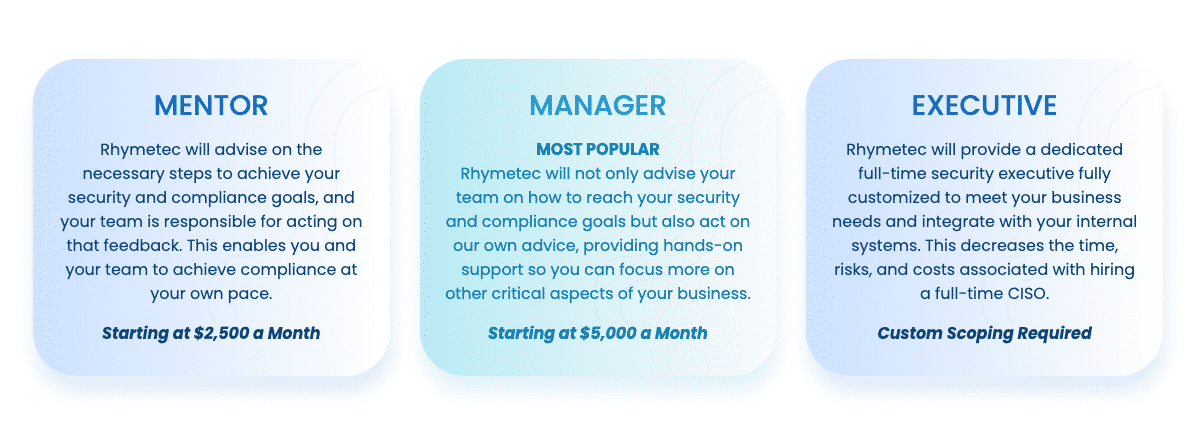
Properly budgeting for ISO 27001 certification costs enables organizations to get certified while building sustainable security practices that scale as the business grows. Whether you are in the early stages of building your compliance program or if you have already started the work and feel stuck, our experts can assist. Contact us today to get started.
This ISO 42001 checklist will walk you through the four phases of achieving certification.
These steps are based on our security team's process for helping organizations complete their ISO/IEC 42001 certification readiness. Our security team at Rhymetec has helped hundreds of companies achieve their security goals and meet compliance requirements. To find out how we can fast-track you to ISO 42001 compliance, contact our team today:
Hopefully, this checklist will give you a clear idea of the work ahead needed for ISO 42001 compliance and will help you create a project plan.
We'll start with a high-level overview of your ISO 42001 checklist and then dive into each phase in detail:
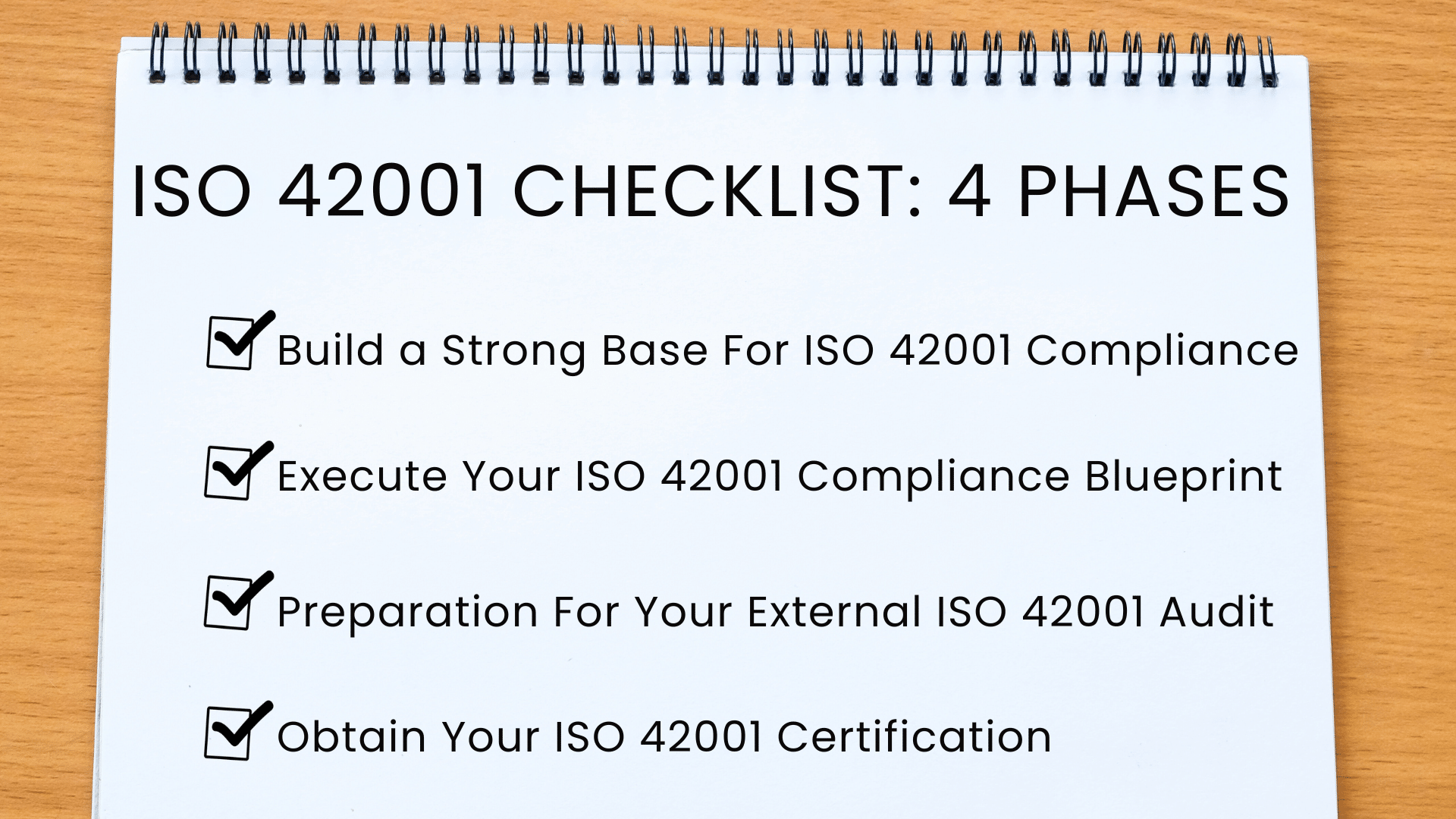
ISO 42001 Checklist Overview
1. Build a Strong Base for ISO 42001 Compliance.
- Understand Your ISO 42001 Requirements
- Conduct An Initial Gap Analysis
- Conduct A Risk Assessment
- Obtain Executive Support
2. Execute Your ISO 42001 Compliance Blueprint.
- Designate a Compliance Project Leader
- Draft An Implementation Roadmap For AIMS
- Set Up The AIMS Structure
- Create Organization-Wide Awareness
- Apply Necessary AIMS Controls
- Conduct Executive AIMS Evaluations
3. Preparation for Your External Audit.
- Conduct Internal Audits
- Select an ISO 42001 Certification Body
- Prepare Documentation
- Pre-audit Meeting
4. Obtain Your Certification.
- Undergo Your Audit
- Address Any Identified Issues
- Ongoing Improvements & Post-Audit Plan
Let's go over detailed steps under each phase:
Phase 1: Build A Strong Base For ISO 42001 Compliance
In this phase, you'll lay the groundwork for your organization to build an Artificial Intelligence Management System (AIMS) and achieve ISO 42001 compliance.
Establishing an AIMS is not just about compliance; it's about crafting a concrete strategy to improve decision-making and risk management around AI technologies. After this phase, you'll have a clear direction for responsible AI use and be on the right path to work towards ISO 42001 compliance:
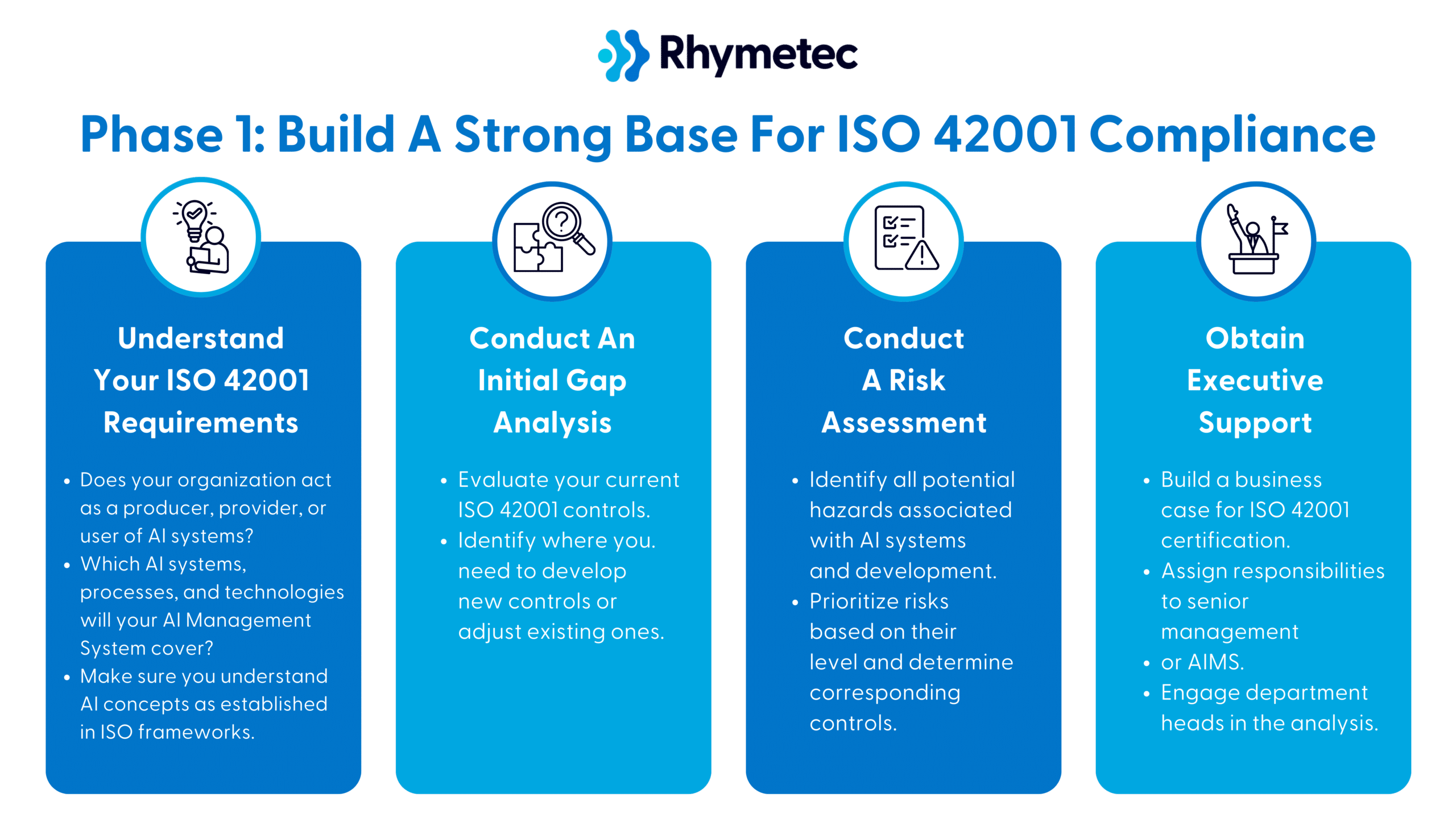
1. Understand Your ISO 42001 Requirements
Does your organization act as a producer, provider, or user of AI systems?
You'll have different requirements depending on which of these your organization falls under.
Providers are companies such as OpenAI that build AI models like ChatGPT. Service providers customize and use these models. Users can include any business that uses AI services either directly from producers or via services from providers.
Which AI systems, processes, and technologies will your AI Management System cover?
Which technologies and assets do you have that incorporate AI? You will need to identify what will be included to map out the boundaries of your Artificial Intelligence Management System (AIMS).
Make sure you understand AI concepts as established in ISO frameworks.
Are you already familiar with how ISO frameworks define terms like "AI systems" and "machine learning models"?
If so, great! If not, ISO provides a glossary of terms you can use to see exactly what the frameworks mean when they use these terms. It's important to familiarize yourself with the terminology to understand each step of the compliance process, speak the same language as your auditors, and avoid miscommunications.
2. Conduct An Initial Gap Analysis
Evaluate your current ISO 42001 controls.
Compare your existing practices against ISO 42001 controls. Do you have any current practices to mitigate AI risks? What about ethical concerns related to AI, and data integrity concerns? You may already have a basis for some of the controls, especially if you already have another ISO framework.
Identify where you need to develop new controls or adjust existing ones.
Now that you have an idea of how your current practices map onto ISO 42001 controls, draft up a complete list of what you need to do to develop new controls or adjust existing ones. You will need this going forward.
3. Conduct A Risk Assessment
Identify all potential hazards associated with AI systems and development.
Unlike frameworks like ISO 27001, ISO 42001 does not focus heavily on security.
Security is an element of the framework, but a relatively small one. Instead, the potential hazards associated with AI, such as ethical issues, environmental considerations, and concerns around fairness and bias, are key.
Focusing on the areas mentioned above, come up with a list of potential AI risks related to your products, services, and all other activities.
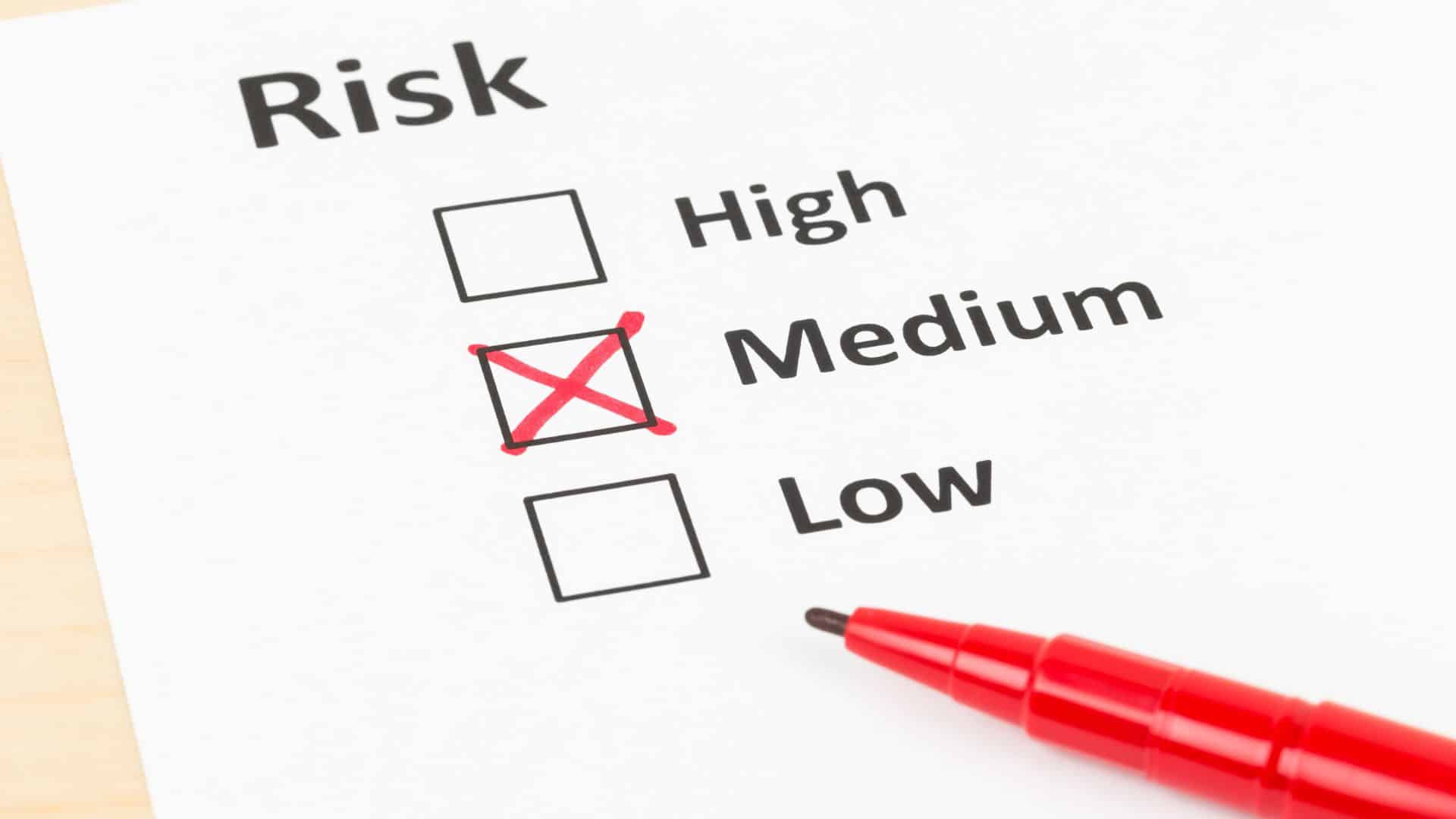
Prioritize risks based on their level and determine corresponding controls.
Assess the likelihood and potential consequences of each risk. You will need this documentation later on. Start drafting an action plan to remediate risks, focusing on the highest risks first. Assess your list of existing practices and their effectiveness in mitigating risks.
Threats range from cybersecurity attacks to operational risks like system failures or errors in the AI's decision-making process. For each AI-related risk that your organization could potentially encounter, the impact level needs to be assessed:
Impact is categorized as low, medium, or high based on factors like financial loss, legal repercussions, and damage to customer trust. As an example, if your AI handles sensitive or critical data, the risk of a data breach would be considered high risk (as a breach could result in substantial legal and reputational damage).
A medium risk could be data bias in functions that are not critical to core operations but could impact user satisfaction or minor decision-making processes. A threat with a low-risk level could be any potential minor AI performance fluctuations. If you use an AI-driven customer support chatbot, for example, the risk of users experiencing minor delays in response time or slight inaccuracies in non-critical responses could be considered low risk.
Think ahead when conducting your risk assessment: What would happen if your organization experienced each risk? How complex would remediation be? How would employees, stakeholders, and your business operations be impacted?
4. Obtain Executive Support
Build a business case for ISO 42001 certification.
Create a compelling business case that shows the strategic benefits of ISO 42001 certification. Include how it will enable AI governance, help your organization comply with regulations, ease concerns that customers and prospects may have, and build stakeholder trust.
A formalized AI management system offers a lot of long-term value. What this looks like will depend on your specific organization. Try to emphasize not only the ways in which ISO 42001 mitigates risk but also how it offers opportunity and innovation potential.
Assign responsibilities to senior management for AIMS.
Assign senior management responsibilities to align the AIMS with your goals and provide them with the necessary resources.
Engage department heads in the analysis.
Bringing in department heads from IT, legal, operations, and human resources into the gap analysis process, for example, is a great way to create engagement across the organization. Plus, their involvement ensures all potential impacts of AI systems are being considered.
ISO 42001 Checklist Phase 2: Execute Your ISO 42001 Compliance Blueprint
Here, you'll activate the plans laid out above. This phase involves hands-on tasks such as appointing a project manager, setting up the structures for your AIMS, and implementing controls. This phase of your ISO 42001 checklist ends with your internal audit to assess your ISO 42001 certification readiness before moving on to external evaluations:
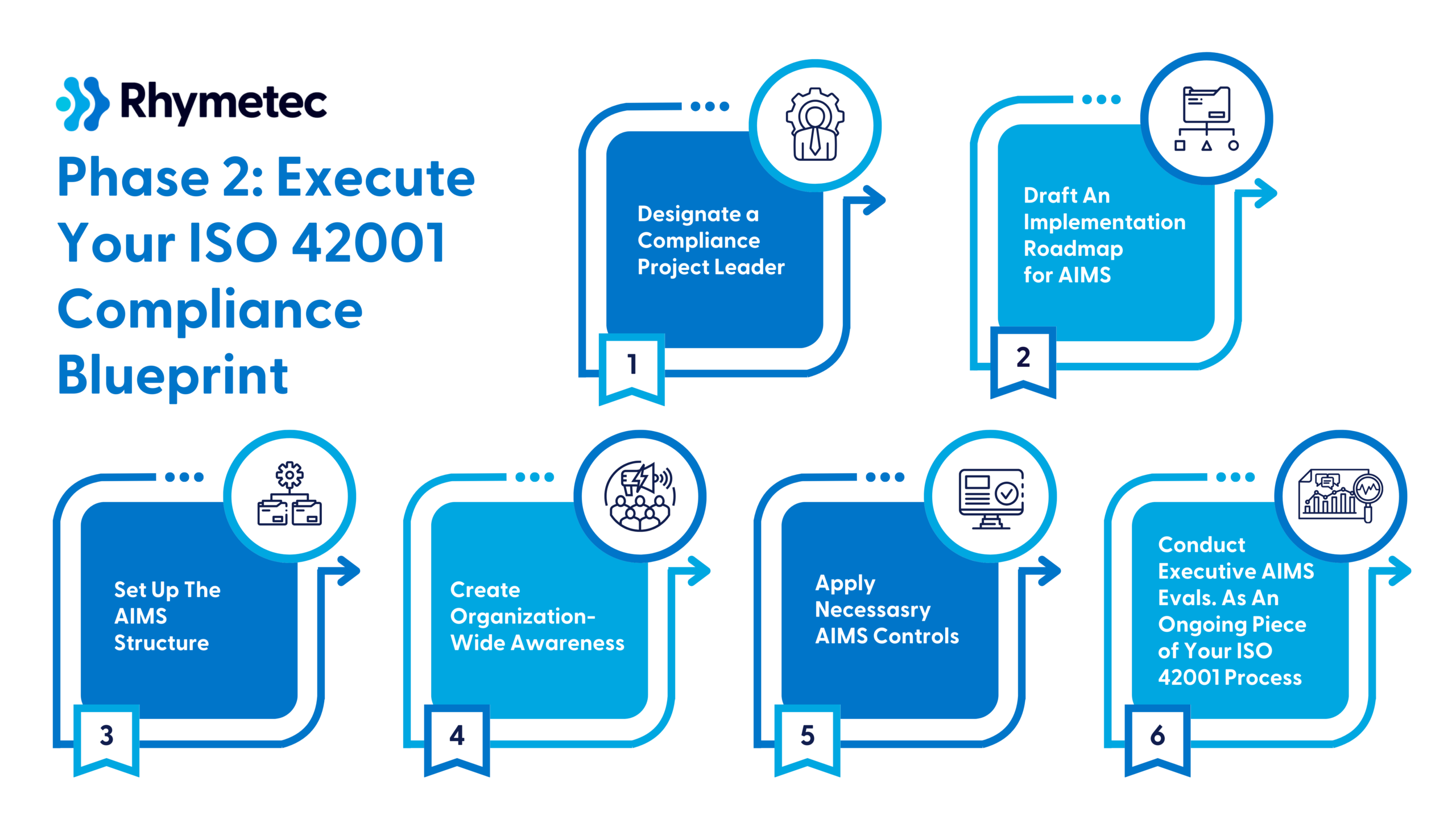
1. Designate a Compliance Project Leader
Select a qualified compliance leader.
Appoint a project manager with a solid understanding of AI and compliance issues. This individual will coordinate all activities related to achieving ISO 42001 certification and act as the point of communication between departments and external auditors.
2. Draft An Implementation Roadmap For AIMS
Develop a detailed project plan for your ISO 42001 process.
Solidify your project plan using the gap analysis conducted earlier as a baseline. Your plan should include deadlines, resource allocations, and every stage from the initial assessment to the final audit.
Budget appropriately.
Allocate sufficient financial and human resources to support the project. This includes funding for training, external consultants, auditing costs for certification, and technology upgrades needed to comply with ISO 42001.
*TIP: When implementing ISO 42001, you should not rely on checklists alone from external sources. Purchasing the standard should be in your budget for successful implementation.
3. Set Up The AIMS Structure
Define Your AI Management System Structure.
Set up a structure for your AIMS that integrates with existing organizational processes. The structure should support all stages of AI lifecycle management, from development to deployment and maintenance.
Document All Processes.
Make sure you are documenting everything as you work through these steps. You'll need everything from workflows, decision-making processes, and control measures documented when it comes time for your audit.
*TIP: Using a compliance automation tool at this point can be tremendously helpful. Compliance automation platforms allow you to easily organize your documentation. When it comes time for your audit, it makes your auditor's job easier and more efficient to be able to see everything clearly laid out in one central place.
4. Create Organization-Wide Awareness
Develop training programs.
Organize training sessions to improve your employees' AI and compliance knowledge base. Focus on ethical AI use, data security, and the legal implications of AI technologies.
Circulate information across the organization.
Distribute informational materials and regular updates about AIMS and its importance to encourage organization-wide understanding and engagement. Internal communications channels such as newsletters, intranets, and staff meetings are all good avenues for dissemination.
5. Apply Necessary AIMS Controls
Implement controls.
ISO 42001 controls address risk management, data protection, system reliability, and transparency.
The way controls are implemented will vary depending on your organization's industry, needs, risks, and the types of AI applications you use. (A complete control list can be found in ISO/IEC 42001:2023, Annex A).
*TIP: Consulting with a compliance expert at this step may be necessary. Many startups choose to work with a Managed Security Services Provider (MSSP) at this stage. Rhymetec's vCISO program provides hands-on managed security services, taking the complexity of compliance off your plate, and doing the readiness and audit phases for you.
Plan to regularly update control measures.
Continuous improvement is required by ISO 42001. You should plan to continuously monitor and update controls to adapt to new technologies, changes in organizational processes, and shifts in regulatory requirements.
6. Conduct Executive AIMS Evaluations As An Ongoing Piece of Your ISO 42001 Process
Organize regular review meetings.
Hold management review meetings periodically to assess the AIMS' performance. Reviews should involve top management and key stakeholders to help AI systems & applications align with broader organizational goals.
Update your executive team regularly.
The last step in this phase of your ISO 42001 checklist is to regularly update your executive team. Keep them informed about the outcomes of management reviews, including challenges, achievements, and the effectiveness of the AIMS.
ISO 42001 Checklist Phase 3: Preparation for External ISO 42001 Audit
This stage is where you make sure everything is in perfect order for your audit.
Choosing the right auditor is critical - you want to choose a reputable certification body that will conduct a legitimate and fair audit, providing credible validation of your AIMS.
Each step in this phase is also an opportunity to solidify stakeholder confidence and demonstrate your proactive approach to responsible AI management and compliance.
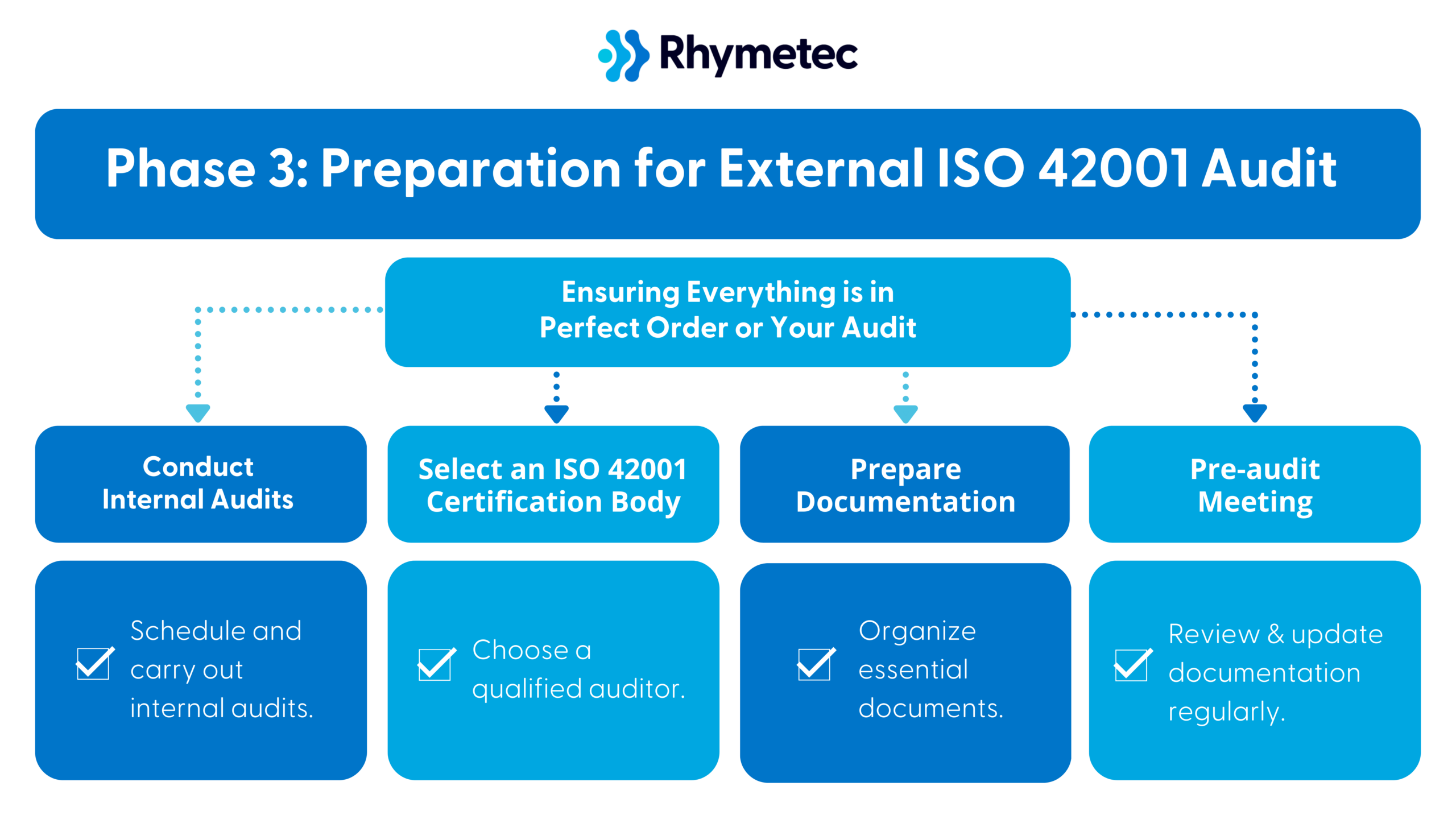
1. Conduct Internal Audits
Schedule and carry out internal audits.
ISO internal audits identify any gaps in compliance and provide recommendations for improvements before your external audit. It serves as a trial run, providing insights into potential audit challenges and giving you a chance to address any issues.
2. Select an ISO 42001 Certification Body
Choose a qualified auditor.
Select an auditing firm that has been certified to offer ISO certifications and has demonstrated experience in assessing AI management systems. Your certification body must be accredited to guarantee a legitimate audit and certification.
3. Prepare Documentation
Organize essential documents.
Gather documentation that demonstrates your compliance with ISO 42001. Documents are to include policies, procedures, control implementation records, and evidence of your plans for continuous improvement efforts.
Make things as easy as possible for your auditors! Documents should be in a format that is readily available and organized for easy reference during the audit.
Review and update documentation regularly.
Regularly review your AIMS documentation to make sure it accurately reflects current AI management practices and that all modifications are recorded. Keep this documentation accessible to all relevant personnel and the auditing team.
4. Pre-audit Meeting
Set up an initial audit meeting.
Arrange a meeting with the selected certification body to discuss the audit process. Use this as an opportunity to understand the audit scope, methodology, and specific focus areas. You should also align expectations and clarify the audit schedule.
Compile key audit questions.
Beforehand, prepare a list of questions and points needing clarification. Cover logistical details, specific compliance queries, and any concerns about the AIMS implementation.
Discuss audit scope.
You'll want to clarify the detailed scope of the audit and confirm that both parties have a mutual understanding of the audit boundaries. The scope must cover all relevant areas of your AIMS.
Phase 4: Obtaining your ISO 42001 Certification
This final phase is where all of your preparation pays off.
Engaging fully with auditors transforms this process from a compliance exercise to a powerful tool for improving your operations and reputation. Undergoing your audit isn't just a badge for your business to put on your website; it's a statement that you take AI risks seriously and are ahead of the curve in managing AI responsibly.
Lastly, continually improving after the audit shows you're not just "checking a box" to get through an audit. Ongoing improvements post-audit strengthen trust among clients and partners and support compliance maintenance.
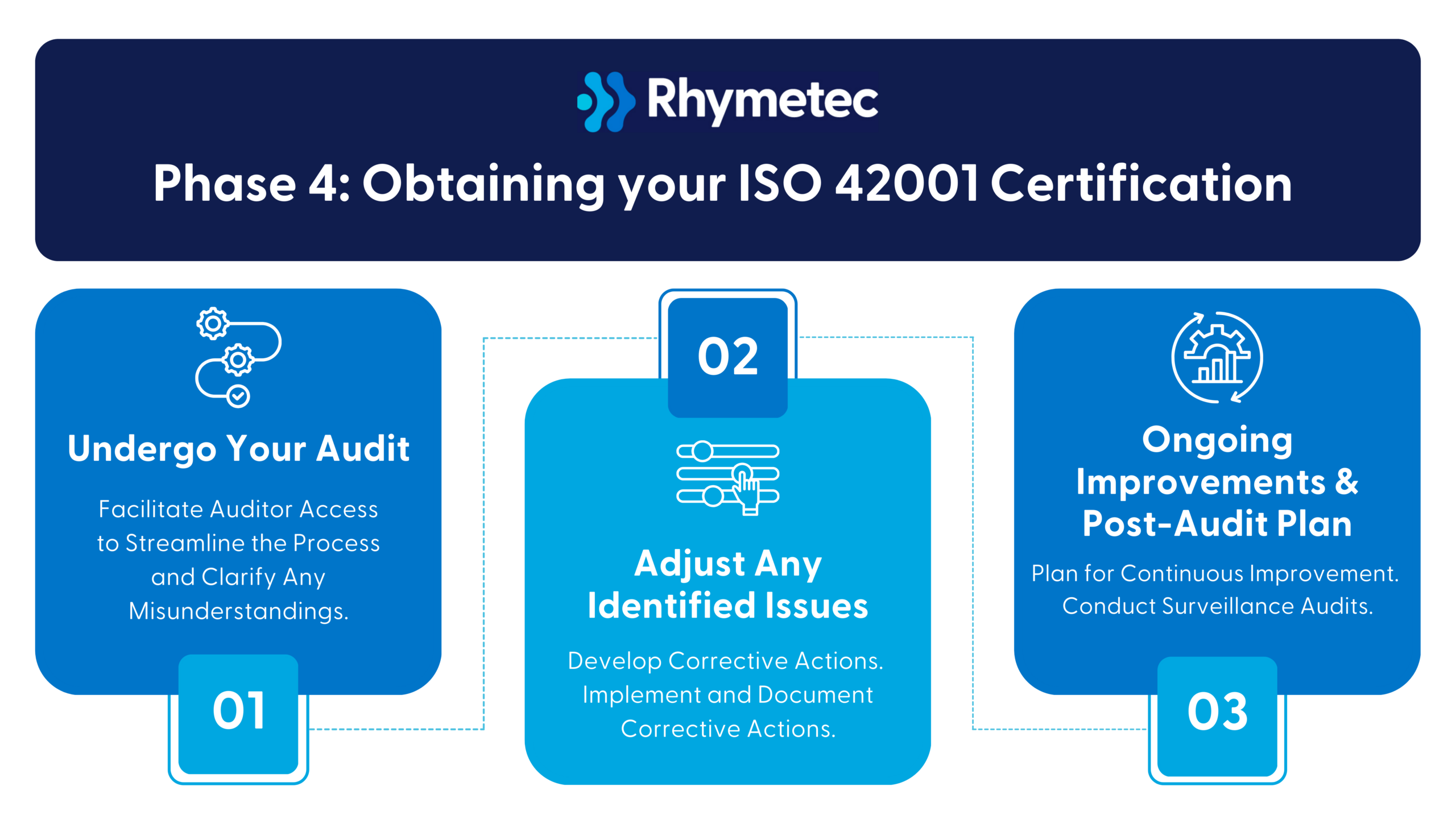
1. Undergo Your Audit
Facilitate Auditor Access.
Auditors need to have full access to all relevant sites, personnel, and documentation. Designate a team member to serve as a point of contact and participate in discussions with auditors to streamline the process and clarify any misunderstandings.
2. Address Any Identified Issues
Develop Corrective Actions.
Promptly create action plans for any non-compliance issues identified during the audit. Assign clear responsibilities and timelines for these actions.
Implement and Document Corrective Actions.
Execute the necessary corrective measures and document the processes. You will need this documentation during follow-up audits.
3. Ongoing Improvements & Post-Audit Plan
Plan for Continuous Improvement.
Develop a plan for continuous improvement based on audit findings.
Your post-audit plan should include updating training programs and communication with employees to address any changes. Schedule regular intervals to review the AIMS and identify opportunities to improve.
Conduct Surveillance Audits In Preparation to Re-certify Every 3 Years.
Lastly, keep in mind you will need future surveillance audits as part of your ongoing ISO 42001 process:
ISO 42001 requires recertification every 3 years to remain compliant. Surveillance audits are needed in between to ensure your organization is ready for the next official audit.
Immediate Benefits After Completing Your ISO 42001 Checklist
After you've completed all items in your ISO 42001 checklist and have your certification in hand, you will see a number of immediate benefits:
You will now be able to communicate, through verified third-party documentation, to your prospects and customers that your AI use follows the highest industry standards. You can use your certification to assuage any concerns your clients and prospects may have about AI. Being able to show them your documentation increases trust and can shorten your sales cycle. This is especially important given that there is growing concern over generative AI security risks.
Additionally, you will have peace of mind knowing that your risk is substantially reduced. The roadmap you now have for the strategic use of AI will serve as a business enabler as you continue to expand your AI offerings and break into new marketplaces.
For more information, check out our ISO 42001 Compliance FAQ for the most common questions our team at Rhymetec sees about ISO 42001 (Who Needs ISO 42001?, How Different Is ISO 42001 Vs. ISO 27001?, How Much Does ISO 42001 Certification Cost?, How Long Does ISO 42001 Certification Take?, and more), or contact our team today:
About Rhymetec
Our mission is to make cutting-edge cybersecurity available to SaaS companies and startups. We've worked with hundreds of companies to provide practical security solutions tailored to their needs, enabling them to be secure and compliant while balancing security with budget. We enable our clients to outsource the complexity of security and focus on what really matters – their business.
If your organization is interested in exploring compliance with AI standards, we now offer ISO/IEC 42001 certification readiness and maintenance services and are happy to answer any questions you may have on the ISO 42001 process.
Interested in reading more? Check out more content on our blog.
If there's one thing most people agree on in 2025, it's that we need strong regulations around artificial intelligence (AI). Nearly 80% of Americans want stricter regulations on the use of public data to train AI models, and surveys show a growing concern over AI jeopardizing our privacy.
Meanwhile, companies are barreling ahead: Over 56% of businesses use AI to improve business operations, and 83% of executives see AI as a strategic priority. The excitement around this technology and its innovative use cases is understandable, but integrating AI without slowing down to consider privacy, safety, and ethical concerns is risky.
Implementing an AI framework that directly addresses these issues is a major step companies can take to assuage concerns. Certification with ISO 42001 promotes responsible AI use and provides verified, documented evidence to stakeholders that you take AI risks seriously.

What Is ISO 42001?
ISO 42001 is a certifiable international standard providing guidelines for building and managing AI tools. It offers a repeatable framework from which organizations can build solid operational governance and management systems while promoting responsible AI usage.
The standard covers areas including security, privacy, and ethical practices. It specifies the requirements for creating a reliable AI program that, when developed with overall business goals and daily functions top of mind, can improve the safety of AI systems while also serving as a business enabler.
With AI becoming widely accessible since the introduction of tools like ChatGPT in 2022, the demand for security and privacy measures around AI has been amplified. Enter the role of AI frameworks - of which ISO 42001 is one of the most prominent.
ISO 42001 supports the development of AI that respects data security and user privacy, addressing the increasing public demand for transparency and accountability:
Why Is ISO 42001 Compliance Important?
A growing number of organizations seek to obtain ISO 42001 compliance for two primary reasons:
1. Certification as a Marketing & Reputation Management Tool: Compliance with ISO 42001 allows companies to communicate to their customers, prospects, and stakeholders that they adhere to the highest standards in AI use and development.
Organizations can use their certification to reassure clients and prospects. ISO 42001 certification acts as a mark of credibility, signaling that the organization has taken steps to implement best practices as laid out by an industry gold standard framework.
This builds trust with stakeholders concerned about the potential impacts of AI and can shorten the sales cycle. If a prospect asks about your organization's AI practices, being able to show a certification is a powerful tool.
2. To Guide Strategic Implementation of AI: Companies seek to leverage the roadmap offered by ISO in a meaningful way that leads to AI-related strategies that ultimately serve as business enablers.
ISO 42001 certification not only supports compliance with other regulatory and legal requirements but also positions you to fully reap the business benefits of responsible AI use. By following ISO 42001, companies reduce security risks, optimize decision-making processes, foster customer trust, and ultimately drive business growth and sustainability.
Who Needs ISO 42001 Compliance?
ISO 42001 is particularly useful for companies:
- Developing new AI features
- Creating AI-powered products
- Acting as AI producers, service providers, or end-users
Companies must be prepared to make changes to their products as AI technology evolves. Adherence to ISO 42001 largely offsets the amount of time you'll need to spend implementing changes down the road while reducing risk long-term.
The AI ecosystem can be categorized into three roles:
- AI Producers: Companies like Microsoft, OpenAI, and Anthropic that build and sell foundational AI models.
- Service Providers: Organizations that consume these models from producers, customize them, and then sell them downstream.
- Customers and Users: The end-users and businesses that utilize AI services and products.
ISO 42001 can apply to any business interacting with others in this ecosystem. Organizations in each of these three roles can benefit from establishing an AI management system as per ISO 42001 guidelines, and focusing on areas such as data provenance, the handling of training data and algorithms, and the outcomes produced by AI systems.
Encouraging organizations to think deeply about the potential impacts of AI for everyone in their ecosystem is one of the main purposes of frameworks like ISO 42001.
How To Get ISO 42001 Certification: How Easy Is It?
One major misconception about ISO 42001 is that it focuses solely on the security and privacy of AI systems. In reality, the standard encompasses a border range of considerations, including ethical practices, fairness, bias resolution, and understanding the overall impact of AI systems.
Security alone is actually a small component in the context of the entire framework.
At a high level, achieving ISO/IEC 42001 certification includes several steps:
1. Gap Analysis
Conducting a gap analysis identifies the differences between your organization's current state and where you need to be to meet the requirements of ISO 42001.
2. Implementation
Based on the gap analysis, the next step is to implement changes to align with ISO 42001 controls. This could include everything from revising policies to updating procedures and training employees.
3. Internal Audit
Before seeking external certification, conducting an internal audit helps ensure you meet all requirements and are ready for the external audit.
4. External Audit
An accredited certification body performs your external audit, determining whether or not you obtain certification at that time.
Depending on factors like company size and infrastructure, this process can be complex and time-consuming. However, it ultimately strengthens your organization's AI governance and management practices, reducing risk and saving time and money down the road.

How Different Is ISO 42001 Vs. ISO 27001?
Organizations with ISO 27001 certification may assume that transitioning to ISO 42001 compliance is straightforward. However, ISO 42001 is fundamentally different from ISO 27001, despite their complementary nature from a high-level structure perspective.
While ISO 27001 centers around information security management systems (ISMS), ISO 42001 is highly specialized in the scoping of AI systems. The good news is that ISO 42001 is designed to integrate smoothly with existing ISO frameworks, including ISO 27001. The new framework is designed to be easily integrated for organizations that already have an ISO framework.
All of the ISO frameworks are designed in a way that allows them to act as building blocks for each other. The areas in which they diverge, meanwhile, leave opportunities for organizations to adapt controls to their specific needs and environments.
As an example, both ISO 27001 and 42001 require a risk assessment. However, even if you've completed your risk assessment for ISO 27001, you would still need to identify risks specific to AI systems for 42001.
The impact assessment of ISO 42001 goes beyond security and privacy, encompassing broader aspects such as the ethical implications and the societal impact of AI. This expanded focus means that the way controls are operationalized will both diverge from and build on ISO 27001.
How Much Does ISO 42001 Certification Cost?
Let's break down the costs:
Direct Costs
Hiring an accredited certification body to conduct the audit is a primary cost. Depending on the size and complexity of your organization, this can range from $5,000 - $20,000. This fee typically covers the initial certification audit and any follow-up assessments.
Implementing ISO 42001 requires time and effort from your team. You may need to allocate significant internal resources to manage the project, which can translate into measures like hiring temporary staff to handle regular duties.
Many startups choose to hire consultants.
Consulting fees can range from $10,000 - $50,000, depending on the level of support you need. Consultants assist with gap analysis, control implementation, and preparation for your audit.
Indirect Costs
There are potential costs around employee training and awareness, with the goal of making sure everyone understands their role in working towards ISO 42001 compliance. Technology upgrades represent another indirect cost. You may need to invest in new software or upgrade existing systems to meet ISO 42001 requirements. Costs here can vary greatly depending on your technology stack.
Lastly, there are costs associated with ongoing maintenance. Maintaining ISO 42001 certification requires regular audits and continuous improvement. Budget for annual internal audits and surveillance audits, which can cost between $3,000 - $10,000 per audit per year, and allocate resources for ongoing training and process updates.
Cost-Benefit Analysis
While the costs may seem significant, consider the benefits: ISO 42001 certification can improve your company's reputation, build customer trust, and open doors to new markets. It mitigates risks associated with AI, potentially saving money in the long run by avoiding costly security issues and reputational damage.
How To Implement ISO 42001: Critical Components of Building an AIMS & Demonstrating Compliance
Implementing ISO 42001 involves establishing an AI Management System (AIMS) that aligns with the standard's requirements and fits the context of your organization. The framework is structured around 10 clauses, similar to other ISO management systems, and includes annex controls that can be operationalized differently depending on the organization.
Below are 6 key components of meeting ISO 42001 compliance:
1. Management Commitment
Leadership must define AI policies, set objectives that align with the strategic direction of the organization, and make resources available for the implementation and maintenance of the system.
2. Risk Assessment and Impact Analysis
Unlike traditional frameworks that focus on security and privacy, ISO 42001 requires a broader impact assessment. A core part of the framework involves identifying and evaluating AI-related risks across areas, including environmental impact and ethical considerations.
3. ISO 42001 Annex Controls
The annex of ISO 42001 provides specific controls that need to be implemented, which can be adapted to the context of the organization. For example, this may include guidelines around data provenance, with the goal of making sure training data and AI algorithms are not biased.
4. Operational Planning, Documentation, and Training
Documenting everything pertaining to processes for the effective operation of the AIMS is another key step. Processes need to be clearly defined and laid out for all employees, so they can be consistently followed.
All staff involved in the AIMS need to have the necessary skills and knowledge. Appropriate training and resources need to be provided to support this.
5. Monitoring and Measurement
Mechanisms to monitor the performance of the AIMS over time are another key component of ISO 42001 compliance. Such measures can take the form of regular audits and assessments to see if the system remains effective and aligned with requirements. Any issues identified should be addressed promptly.
6. Continuous Improvement
A process must be established to regularly review and update the AIMS to reflect changes in technology, regulatory requirements, and organizational goals. This iterative approach allows you to stay ahead of emerging risks and challenges.

How Long Does ISO 42001 Certification Take?
With managed security services providers like Rhymetec, it takes anywhere from 4 - 6 months for the preparation and readiness portion of ISO 42001 compliance.
This timeline varies depending on organization size and the complexity of their AI systems. If an organization has already implemented ISO 27001, the process will be on the faster end, with many controls needing to be tweaked rather than built from scratch.
Several scoping factors determine how long your timeframe will be for the audit, such as the number of employees, complexity factors, and organizational role (producer, provider, developer, or user of AI). As a rough estimate, you can expect the certification audit by an accredited body to take 4 - 8 weeks.
About Rhymetec
Our mission is to make cutting-edge cybersecurity available to SaaS companies and startups. We've worked with hundreds of companies to provide practical security solutions tailored to their needs, enabling them to be secure and compliant while balancing security with budget. We enable our clients to outsource the complexity of security and focus on what really matters – their business.
If your organization is interested in exploring compliance with AI standards, we now offer ISO/IEC 42001 certification readiness and maintenance services and are happy to answer any questions you may have.
ISO 42001 sets the stage for responsibly managing AI systems within organizations. Taken together, ISO 42001 controls and policies represent the first international AI management system standard. With the proliferation of AI across many industries showing no signs of slowing down, guidance is sorely needed to address potential security, societal, environmental, and other risks posed by the use of AI.
Security concerns around AI are top of mind for many organizations at the moment. Recently, companies like Samsung have gone as far as banning the internal use of generative AI tools after a data leak with ChatGPT. Meanwhile, consumers are becoming increasingly concerned about how companies utilizing AI systems handle their data.
ISO 42001 aims to provide clarity around how organizations can responsibly use AI. Adherence to ISO 42001 controls sends a strong signal that an organization takes the security component of AI seriously. It is the most comprehensive attempt to date to provide clear requirements for implementing and continually managing the use of artificial intelligence. In this article, we go over what it is, who it applies to, and what businesses need to do to implement it.
Who Does ISO 42001 Apply To?
ISO 42001 is a voluntary standard. There are no legal obligations to adhere to it. However, it becomes a must-have for many organizations once their prospects and clients start asking for evidence and reassurance that their data is being safely handled by systems using AI.
Given the wave of media hype around AI, and the rapid improvement of the technology itself, many organizations have started to ask serious questions about the potential risks.
The standard applies to any organization developing or providing products or services that utilize AI systems. Based on official guidelines, ISO/IEC 42001 is for:
"Organizations of any size involved in developing, providing, or using AI-based products or services. It is applicable across all industries and relevant for public sector agencies as well as companies or non-profits."
The implementation of ISO 42001 controls, as well as the responsibilities within the management of AI systems, can vary depending on the individual organization.
What Do Businesses Need To Do To Implement ISO 42001 Controls?
The standard is quite robust but can be summarized into three main action items that organizations must complete in order to implement it. There is a clear focus on risk assessment, the role of governance, and compliance as a continuous process rather than a "check the box" item for businesses. The focus on these trends is reflected across the standard's three main components:
1. Create An AI Management System
A key component of ISO/IEC 42001 is the concept of an Artificial Intelligence Management System (AIMS). An AI management system is a documented system an organization uses to establish and enforce policies that manage assets using AI.
The AI management system also establishes objectives related to the use of AI and creates processes to achieve them. The goal is to have a set strategy for responsibly managing AI that is applied across the organization and aligns with overall business goals.
At a high level, the AI Management System should:
- Align with organizational objectives.
- Define and manage both risks and opportunities associated with AI.
- Oversee the implementation of controls to address AI security risks.
- Manage third-party vendors and partners involved in the development and/or ongoing use of AI systems.
In conjunction with the creation and documentation of an AI Management System, organizations must also conduct an impact analysis (determining the broader potential security and societal impact of AI systems, as well as the impact on business goals), establish clear policies on the use of AI, and implement controls to ensure data is responsibly handled in AI systems.
Lastly, the standard emphasizes the importance of continuous monitoring and improvement of the AI management system.
2. Conduct An Impact Analysis
There is a clear focus on the importance of assessing the societal impacts of AI systems. One of the core controls requires organizations to assess and document the potential impacts of their AI systems in the following areas:
- Environment sustainability (including the impacts on natural resources and greenhouse gas emissions);
- Economic (including access to financial services, employment opportunities, taxes, trade and commerce);
- Government (including legislative processes, misinformation for political gain, national security and criminal justice systems);
- Health and safety (including access to healthcare, medical diagnosis and treatment, and potential physical and psychological harms);
- Norms, traditions, culture and values (including misinformation that leads to biases or harms to individuals or groups of individuals, or both, and societies).
ISO 42001 controls require an AI risk assessment, along with an AI system impact assessment, to be conducted and continuously evaluated. This means that organizations must not only continuously monitor the impact of AI as risks change but must also evaluate the efficacy of their systems intended to mitigate that risk.
3. Implement and Continuously Improve ISO 42001 Controls
There are many areas where controls can be adjusted according to the organization's industry and needs.
Here is a summary of the standard's additional controls and overall implementation guidance:
Establish Roles & Responsibilities, and Document AI Policies: Organizations must establish and document clear policies around AI that are aligned with overall objectives and demonstrate a commitment to continuous improvement. Leadership must communicate the importance of AI management across the organization and share resources with employees. The roles and responsibilities related to the AI management system should be made clear, as well as how the AI management system requirements fit into business processes and goals. AI design choices, including machine learning methods, must also be documented.
Address Risks and Opportunities: Identifying potential risks and establishing a plan to address them is a critical step. This involves conducting an AI risk assessment and then selecting appropriate risk treatment options, implementing controls, and producing a statement of the applicability of controls. Objectives related to the use of AI, as well as a plan to achieve them, must be established and continuously reassessed.
Provide Organization-Wide Resources and Support: Create and distribute resources necessary for the AI management system and its ongoing improvement. Ensure that employees involved in AI-related activities receive appropriate training and education and that employees are aware of their roles within the AI policies.
Evaluate Performance: This involves ongoing monitoring, analysis, and evaluation of the performance of the AI management system. This can take the form of internal audits, intended to ensure conformity to AI management system requirements across the organization. Reviews of the AI management system must be conducted at planned intervals throughout the year.
Continual Improvement and Corrective Action: This last piece highlights the increasing importance being placed on continuous compliance rather than a "check the box" mentality. This is a shift we are seeing across the board for other requirements and standards, such as in the latest version of NIST CSF with the addition of the NIST Governance function.
In the context of ISO 42001, this means that organizations must continually improve their AI management system and take corrective action to make changes as needed.
In Conclusion: What ISO 42001 and The AI Management System Mean For Businesses
Organizations that adhere to ISO 42001 gain several key benefits. First and foremost, they gain the benefit of responsible use of AI and the peace of mind knowing they can provide evidence of that to any partners, prospects, or other business stakeholders.
As is often the case with other voluntary standards (such as SOC 2), organizations often find that their deals cycle becomes shorter, as prospects' questions around security are proactively answered and they no longer need to fill out lengthy security questionnaires.
Secondly, organizations gain the benefit of reputation management. Given the focus on mitigating environmental, societal, and economic damage, adherence to ISO 42001 controls serves as a signal that organizations care about their role in these issues and have taken steps to invest in the responsible use of AI. This can have the effect of improving their reputation as reliable, responsible, and trustworthy.
Lastly, there is an enormous benefit in terms of AI governance. ISO 42001 controls map onto laws and regulations around the use of artificial intelligence, allowing organizations to align the use of AI with laws relevant to their industry and location. As one of the first frameworks to directly address AI, ISO 42001 will serve as a baseline for future standards and laws.
Organizations can take a proactive approach by complying with ISO 42001. This saves time and money down the line when other frameworks and laws catch up.
About Rhymetec
Our mission is to make cutting-edge cybersecurity available to SaaS companies and startups. We’ve worked with hundreds of companies to provide practical security solutions tailored to their needs, enabling them to be secure and compliant while balancing security with budget. We enable our clients to outsource the complexity of security and focus on what really matters – their business.
If your organization is interested in exploring compliance with AI standards, we now offer ISO/IEC 42001 certification readiness and maintenance services and are happy to answer any questions you may have.
About The Author: Metin Kortak, CISO
Metin Kortak is the Chief Information Security Officer at Rhymetec. Metin began his career working in IT security and gained extensive knowledge of compliance and data privacy frameworks such as SOC 2, ISO 27001, PCI, FedRAMP, NIST 800-53, GDPR, CCPA, HITRUST and HIPAA. He joined Rhymetec to build data privacy and compliance as a service offering.
Under Metin’s leadership, these offerings have grown to more than 200 customers, positioning the company as a leading SaaS security service provider in the industry.
Interested in reading more? Check out additional content on our blog: