Preparing for your PCI audit isn't a matter of simply "checking the boxes" to meet compliance requirements. Ongoing compliance with PCI DSS builds trust with customers and stakeholders, protects your customers' data, and helps with long-term reputation management.
With recent updates in PCI DSS 4.0, there's been an increased focus on compliance maintenance. This article will help you understand the core principles of PCI DSS, how to apply them to your organization, and how to stay compliant over time.
What Is A PCI Audit and How Does It Work At A High Level?
A PCI audit is an assessment of an organization's compliance with the Payment Card Industry Data Security Standard (PCI DSS), a set of security requirements that protect cardholder data. The auditor reviews your organization's security measures, policies, and technical infrastructure to verify that you meet requirements.
In our recent webinar on Compliance to Confidence: Simplifying PCI Security Standards, Rhymetec CISO Metin Kortak discussed frequently asked questions and concerns around PCI DSS Version 4.0 with Kevin Whalen, Head of PCI at Prescient Security.
"The Version 4 standard has a number of new requirements, but I don't think any of the changes are overly difficult. There are a few that are, but a lot of what the update did was simplify and consolidate some of the requirement language. But there are some new enhancements to it to be aware of," noted Kevin Whalen during our webinar.
One such enhancement is the new focus on ensuring organizations maintain compliance over time. As we have seen with other recent updates to cybersecurity and compliance frameworks like NIST CSF Version 2.0, there is a stronger focus in the updated PCI DSS 4.0 on continuous compliance. This means businesses need to show they maintain compliance on an ongoing basis rather than just at the time of the audit.
The PCI compliance readiness process starts with a gap analysis to identify areas that need remediation. Once gaps are addressed, the formal audit is conducted by a Qualified Security Assessor (QSA). This individual reviews documentation, interviews staff, and tests controls to validate compliance. Following your audit, they will provide a report on the findings and note any corrective actions you need to take.
Core Principles and Requirements Under PCI DSS
There are five core principles under PCI DSS. Each of the following requirements is important from a compliance perspective and will also vastly improve your security if you did not have them in place previously.
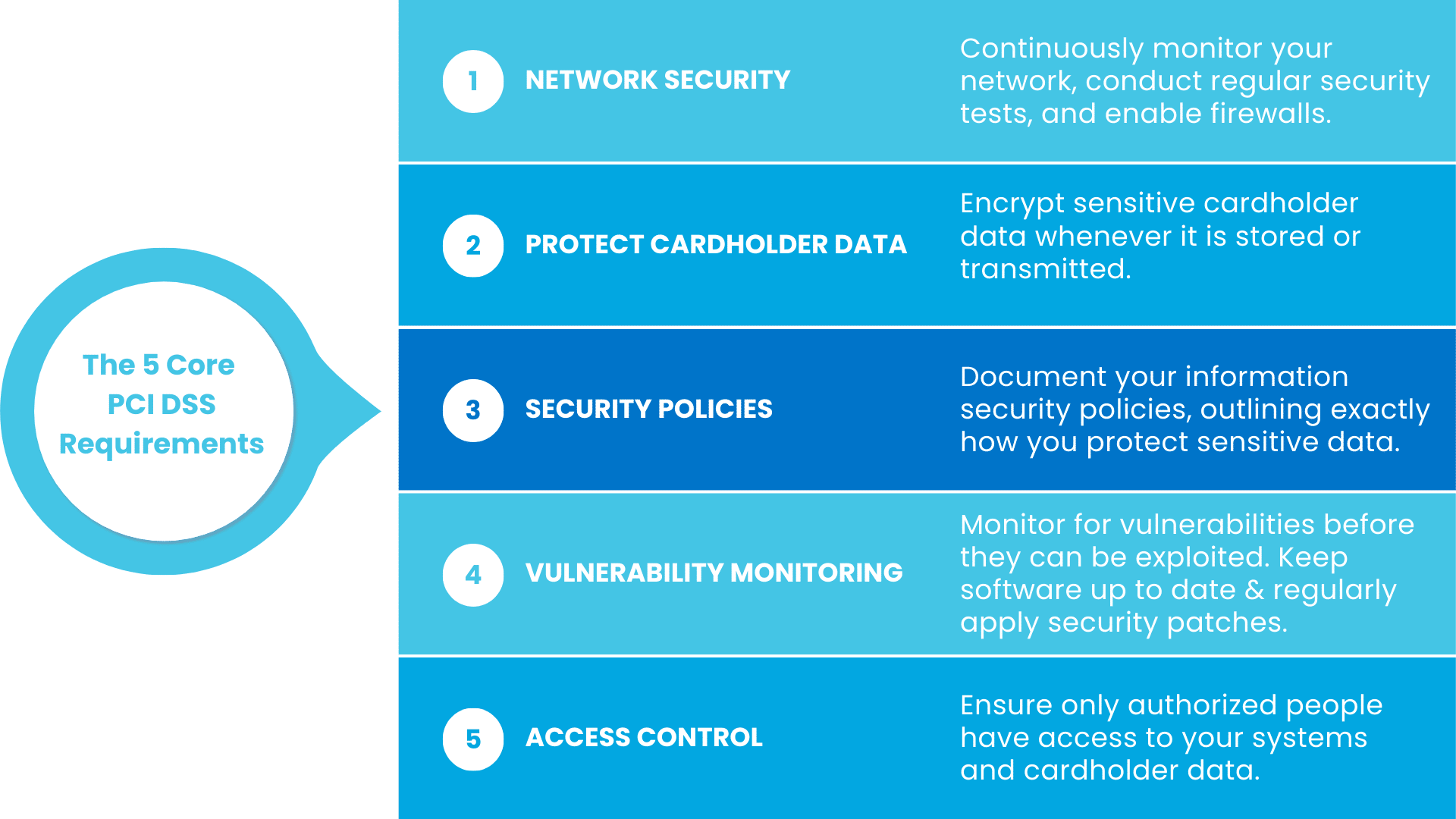
Let's go over each principle in more detail, and explain how they help prevent breaches and keep your customers' data safe:
1. Securing and Monitoring Your Network
PCI DSS requires that you set your network up with security top-of-mind.
This includes measures like firewalls to block unauthorized traffic and making sure your systems are configured securely. You also should set up ways to constantly monitor your network for suspicious activity and conduct regular security tests.
Let's say you run a SaaS platform offering payment processing for small retailers:
If your network isn't secured properly, it's easier for hackers to intercept cardholder data during transactions. By setting up proper firewall measures, you can block unwanted traffic and limit access to only those who really need it.
Regular network monitoring, meanwhile, will alert you to unusual activity, such as an unexpected increase in traffic to your payment systems. Lastly, ASV scans for PCI, vulnerability scans, and penetration tests can help identify weak points and enable you to fix them before they can be exploited.
2. Protecting Cardholder Data
Under PCI DSS, you must encrypt sensitive cardholder data whenever it's stored or transmitted. Encryption makes the data unreadable to anyone without the decryption key, so even if it's intercepted, it's useless to bad actors.
As an example, if a platform offers subscription services and stores credit card information for recurring payments, under PCI DSS they must have encryption enabled to prevent hackers from being able to steal readable credit card data. This is a particularly important measure if your business deals with large volumes of recurring transactions where cardholder data may be stored for longer periods of time.
3. Updating Security Policies For Your PCI Audit
Under PCI DSS, organizations must have a set of documented information security policies. Your policies should outline precisely how you protect sensitive data, and how different members of your teams play a role in this.
For example, your policies may require that all developers at your company use secure coding practices, or that support staff avoid accessing customer payment data directly.
*Note: Having strong security policies in place is critical regardless of organization size, but small businesses or those without designated security members on staff often struggle to set up clear and usable policies. Check out our blog on crafting security policies for small businesses for guidance on how to not only write, but how to effectively communicate your security policies so they are followed by employees.

4. Vulnerability Monitoring
Vulnerability monitoring entails common sense security measures like keeping antivirus software up to date and regularly applying security patches to your systems. The idea is to address security vulnerabilities before they can be exploited.
If a known vulnerability exists in one of the software components your project management tool relies on to work, for example, threat actors could use that to access your customers' data. Continuously monitoring for potential vulnerabilities and having a plan to address them is critical not only for your PCI audit but also from a baseline security perspective.
5. Access Control
Access control measures need to be implemented to ensure only the right people can get into your systems and access sensitive cardholder data. Baseline security measures that all organizations should ideally be doing, like multi-factor authentication (MFA), also help with access control.
You never want everyone internally to have full access to cardholder data. By limiting access to only the employees who absolutely need it - and by also adding MFA to verify their identity - you reduce the risk of unauthorized access enormously.
Why Is PCI DSS Compliance Important For Your Business?
Businesses that handle cardholder data are required to obtain PCI DSS compliance. Non-compliance can result in fines, legal penalties, and damage to your organization's reputation. Breaches can lead to financial losses, erode customer trust, and cause disruptions to your business operations.
Compliance also reduces the risk of fraud and theft of payment data, which can result in financial harm to both your business and your customers. With the introduction of PCI DSS 4.0, businesses are expected to demonstrate continuous compliance and show that they are taking a proactive approach to managing security risks.
Types of PCI DSS Audits and Their Scope
The type of PCI audit your business requires depends on your merchant level and the volume of transactions you process annually. Each audit type covers all of the requirements in the PCI DSS standard, but may vary in depth based on the size of your business and the sensitivity of the cardholder data you process:
Self-Assessment Questionnaire (SAQ)
This is a self-evaluation tool used by smaller businesses that don't handle large volumes of cardholder data. The SAQ is basically a checklist where you answer a series of questions about your security practices, and is broken down into different versions depending on how you process payments. There are specific versions for businesses that process payments online, through a physical point-of-sale system, or over the phone.
As an example, if you run a SaaS business that provides a billing platform for freelancers, and you rely on a third-party payment processor like Stripe to handle the actual transactions, you wouldn't be storing or processing cardholder data directly. Therefore, you'd likely fall under the SAQ version that applies to businesses that outsource their payment processing, and it would serve to validate that your company never stores or has access to that data.
Report on Compliance (RoC)
For larger organizations or those processing a large volume of transactions, a PCI audit conducted by a Qualified Security Assessor (QSA) is required.
This audit is more extensive and includes on-site assessments of your security controls, and is generally required for larger businesses or those processing a significant number of transactions. If your company processes more than 6 million transactions per year, you'll likely need an RoC.
5 Steps To Prepare For Your PCI Audit
At a high level, the following 5 steps illustrate the process leading up to your PCI DSS audit.
At any one of these steps, it can be helpful to consult an outside expert, such as a Managed Security Services Provider (MSSP), with ample prior experience helping organizations achieve PCI DSS compliance.
1. Understand your scope.
Mapping out the scope of your audit is the first step. You'll need to determine which of your systems, networks, and processes handle cardholder data. Merchants have to request additional information from customers under certain circumstances:
"When we start our scoping process, what we usually try to understand in the beginning is how the payments are being processed…Where it gets complex is when the physical card is not present when you're making a purchase. Because the physical card is not present, PCI has certain requirements in place so that when you make a purchase online, for example, you have to provide some additional information like your billing address," said Rhymetec CISO Metin Kortak on this topic during our webinar.

You also need to define your Cardholder Data Environment (CDE).
"What that means is we need to understand exactly where the card information is being processed. Is it only processed by the customer's hosting provider? Or does the card information also reside in other third-party applications or physical servers? It's important to understand the entire scope so that when we go through an audit, we can give them the proper scope and make sure that the PCI security controls are implemented on all of those hosting providers and other vendors," said Metin.
2. Conduct a gap analysis leading up to your official PCI audit.
Perform an internal assessment to pinpoint areas where your organization does not meet PCI DSS audit requirements. This is important to do before your formal audit, as it will give you a chance to address any deficiencies beforehand. MSSPs that are experienced in compliance and offer one-off gap assessment services can be a great resource during this step.
3. Remediate any identified gaps.
Next, address any gaps found during your internal assessment. Common security measures that may need to be addressed at this stage include updating your firewalls, strengthening encryption protocols, or further formalizing your access controls.
4. Update your documentation.
Prior to your audit, make sure all of your policies and security measures are well-documented in a format that will make it easy for your auditor to keep track of. Using a compliance automation tool can be extremely helpful with this, as they provide a single, easily accessible place to upload all of your documentation for your auditors to see.
5. Perform ongoing monitoring for your next PCI audit.
This element is one of the heaviest lifts of the current version of PCI DSS.
Compliance maintenance under PCI DSS 4.0 is expected, and ongoing monitoring will help you stay compliant throughout the year. You should be regularly monitoring security systems and processes to detect any potential misconfigurations or vulnerabilities. This includes automated monitoring of various controls, such as payment page script security:
"The most significant change of 4.0 is the payment page script security, where they've added some new requirements in the software development controls as well as automated security controls around monitoring for changes to the construction of your pages that contain input fields for cardholder data." - Kevin Whalen, Prescient Security
Common Challenges and What To Do
Some common challenges businesses face when preparing for PCI DSS audits include:
Defining the Scope of Your PCI Audit
Many businesses struggle with understanding the full scope of systems that must be in compliance with requirements under PCI DSS. To address this, perform an inventory of systems handling cardholder data. As an example, you will have more strict requirements that apply to your scope if you take payments over the phone instead of in person.
"Depending on how the payments are being processed, how the credit card information is being collected by the buyers - that impacts the level of work that we're going to do for our customer," Metin Kortak, Rhymetec
Maintaining Compliance Over Time After Your PCI Audit
Maintaining an effective compliance maintenance program that scales with your business can be a challenge. Using automated monitoring and logging tools to track compliance in real-time can be helpful, as can working with an outside expert like a Managed Security Services Provider with specific expertise in enabling organizations to stay compliant over time.
Documentation
Many organizations lack adequate documentation of their security policies and controls.
You need this documentation not only for compliance purposes but also as a common-sense security measure: All of your employees should be aware of your security policies and procedures, such as your policy on measures like multi-factor authentication (MFA).
Bonus Tip: For your PCI DSS audit, a compliance automation platform can be incredilby helpful with documentation. Compliance automation tools provide a single location with all of your documentation clearly laid out, so that you and your auditors can easily access and keep track of it.
Third-Party Risk
Third-party risk management plays an important role in PCI compliance. If you're using a third party to process or store credit card information, you generally need to obtain that company's own attestation or certification document to include in your own PCI audit.
"Collecting your third parties' PCI certifications is important, especially if the vendor is processing or transmitting credit card information. Aside from that, you still need to conduct vendor assessments on all of your vendors. And that needs to go beyond just collecting the PCI certifications. That might mean checking that those vendors have proper information security policies in place, if they have conducted their own business continuity tabletop exercises, if they conduct access reviews…Just really conducting a thorough due diligence." - Metin Kortak, Rhymetec
In sum, you need to make sure your third-party vendors that process or store your cardholder data in any way are also PCI DSS compliant.

Post PCI Audit Action Items: How To Stay Compliant
After your audit, there are several steps to help maintain compliance:
Address audit findings.
The first step post-audit is to thoroughly review the auditor's report and remediate any identified deficiencies as needed.
Be sure you've implemented continuous monitoring measures.
Set up monitoring systems to track your compliance with key PCI DSS controls discussed previously, including encryption, access management, and vulnerability scanning. As noted above, a compliance automation tool can be incredibly helpful with this.
Update your policies as needed.
It can help to schedule regular intervals to review your security policies going forward. This will enable you to change your policies as needed to reflect any changes in your organization's operations, your risk profile, or the PCI DSS standard.
Have regular internal audits.
Schedule periodic reviews to assess your compliance posture between your annual PCI DSS audits.
Vendor management.
Lastly, remaining in compliance with PCI DSS requires ongoing monitoring of your third-party vendors to confirm their continued compliance, especially if they are involved in how you handle cardholder data.
In Conclusion
Although it may seem daunting to prepare for your PCI audit, by following the steps outlined in this article, you can feel confident that you are well prepared for your audit and that your customers' data is protected.
PCI DSS compliance is not just a one-time effort - compliance requires ongoing attention, especially with the updates introduced in PCI DSS 4.0. After your PCI audit, be sure to continue monitoring your network, confirming third-party due diligence, and updating your policies as needed. Staying proactive will help your business stay secure, remain in compliance, and build long-term trust with your customers and stakeholders.
About Rhymetec
Our mission is to make cutting-edge cybersecurity available to SaaS companies and startups. We’ve worked with hundreds of companies to provide practical security solutions tailored to their needs, enabling them to be secure and compliant while balancing security with budget. We enable our clients to outsource the complexity of security and focus on what really matters – their business. Contact us today to get started.
Interested in reading more? Check out more content on our blog:
- Generative AI Security Risks For Businesses: Practical Advice For The Concerned
- vCISO Pricing Breakdown: Find The Best Fit For Your Needs
- Cybersecurity for SMBs: 10 Key Measures and Statistics
This article goes over vCISO pricing models and services, how to choose the right option for your business, and how to make sure you receive the guidance and services you need without unnecessary expenditure.
For startups and SMBs, cybersecurity and regulatory compliance are challenges that demand expert attention. However, many organizations either lack the resources or don't need to hire a full-time Chief Information Security Officer (CISO) to meet their needs. A Virtual CISO (vCISO) offers a practical alternative, delivering high-level security leadership on a flexible, cost-effective basis.
Today, vCISO services are used not only by startups but also by enterprises that need executive-level security leadership without the full-time salary overhead. By partnering with an MSSP like Rhymetec, organizations of all sizes gain access to compliance expertise across SOC 2, ISO 27001, HIPAA, GDPR, and CMMC, plus global regulations like NIS2 and GDPR for European expansion.
vCISO Pricing Structures
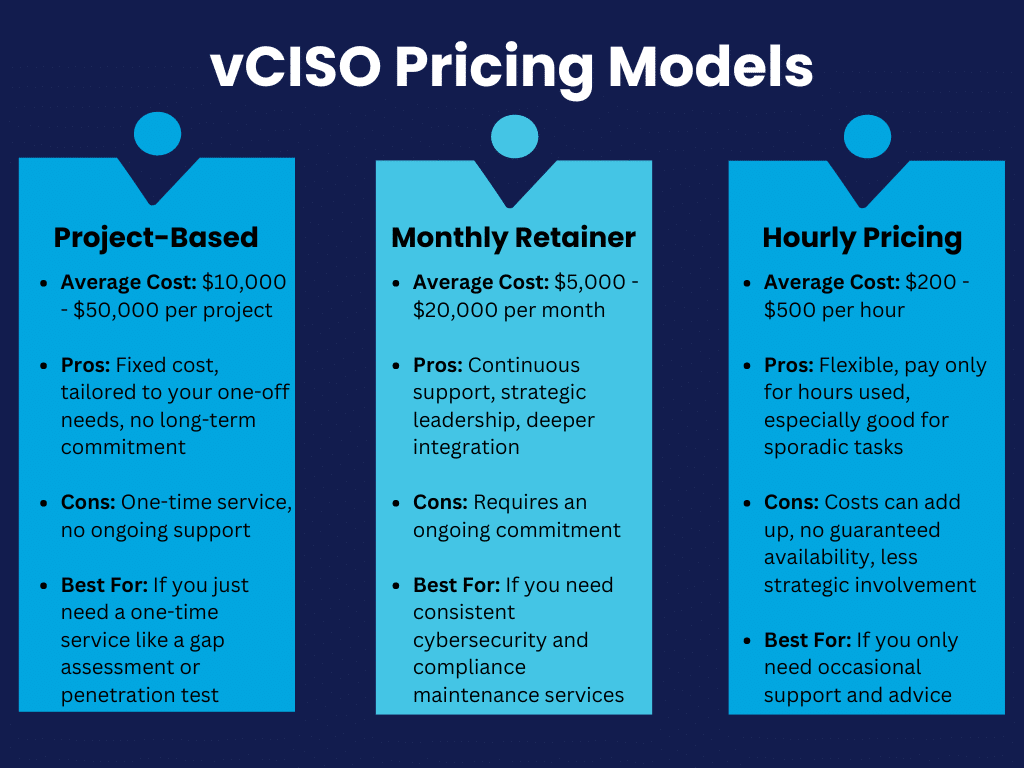
Let's go over the three main vCISO pricing structures and their average costs right off the bat:
Project-Based Pricing
Businesses often select this option if they need one-time tasks like security audits, risk assessments, or gap assessments. As you can probably imagine, the cost varies widely depending on the specific project.
As an estimate, project-based vCISO pricing ranges from $10,000 (for services like gap & risk assessments) - to $50,000 (prices can go up this high for things like penetration testing and compliance certifications).
This option is best for companies tackling immediate needs, such as preparing for a SOC 2 or HIPAA readiness assessment, or validating new cloud infrastructure security controls.
Hourly vCISO Pricing
Hourly vCISO pricing typically falls between $200 - $500 per hour. This option may be suitable for companies that need occasional expert input or are looking to address specific tasks without a long-term contract.
However, a major con of hourly pricing is that your hours may be capped on a weekly or monthly basis. This means that if you need extra support if something comes up, you may not be able to receive it on demand.
For example, Rhymetec’s Executive Tier provides what is essentially a full-time vCISO, fully integrated into your systems, offering audit preparation, vendor management, and direct collaboration with trusted auditors and partners such as A-LIGN.
Monthly Retainers
Monthly retainer fees typically range from $5,000 - $20,000 per month, depending on the level of service and the vCISO's involvement.
This pricing model allows you to have continuous access to a vCISO, offering the most comprehensive support. This benefits businesses that need ongoing direction and hands-on management of their infosec programs.
What Does The vCISO Role Entail?
A Virtual Chief Information Security Officer (vCISO) is a seasoned cybersecurity professional who provides the strategic leadership and services of a traditional CISO, but operates remotely and often on a part-time basis.
vCISOs work with businesses to develop and manage their security programs, maintain overall good security hygiene, and protect the company's data and systems. This role is particularly appealing to startups and SMBs that need expert guidance and support but without the full-time commitment or cost of an in-house CISO.
vCISOs assist with a wide range of services, including risk management, compliance with regulatory standards, incident response, and security policy development. Some Managed Security Services Providers (MSSPs), such as Rhymetec, offer comprehensive vCISO services that provide an elegant solution for businesses aiming to improve their security posture without the overhead of a full-time CISO.
In practice, a vCISO helps organizations evaluate risk, implement security frameworks, maintain audit readiness, and navigate changing regulatory environments. They often work hand-in-hand with compliance automation platforms for evidence collection and reporting, setting them up and leveraging them on your behalf.
What Are The Advantages of a vCISO vs. In-House Security?
For SMBs and startups, the choice between a vCISO and an in-house security team often comes down to three main considerations:
- Cost
- Expertise
- Flexibility
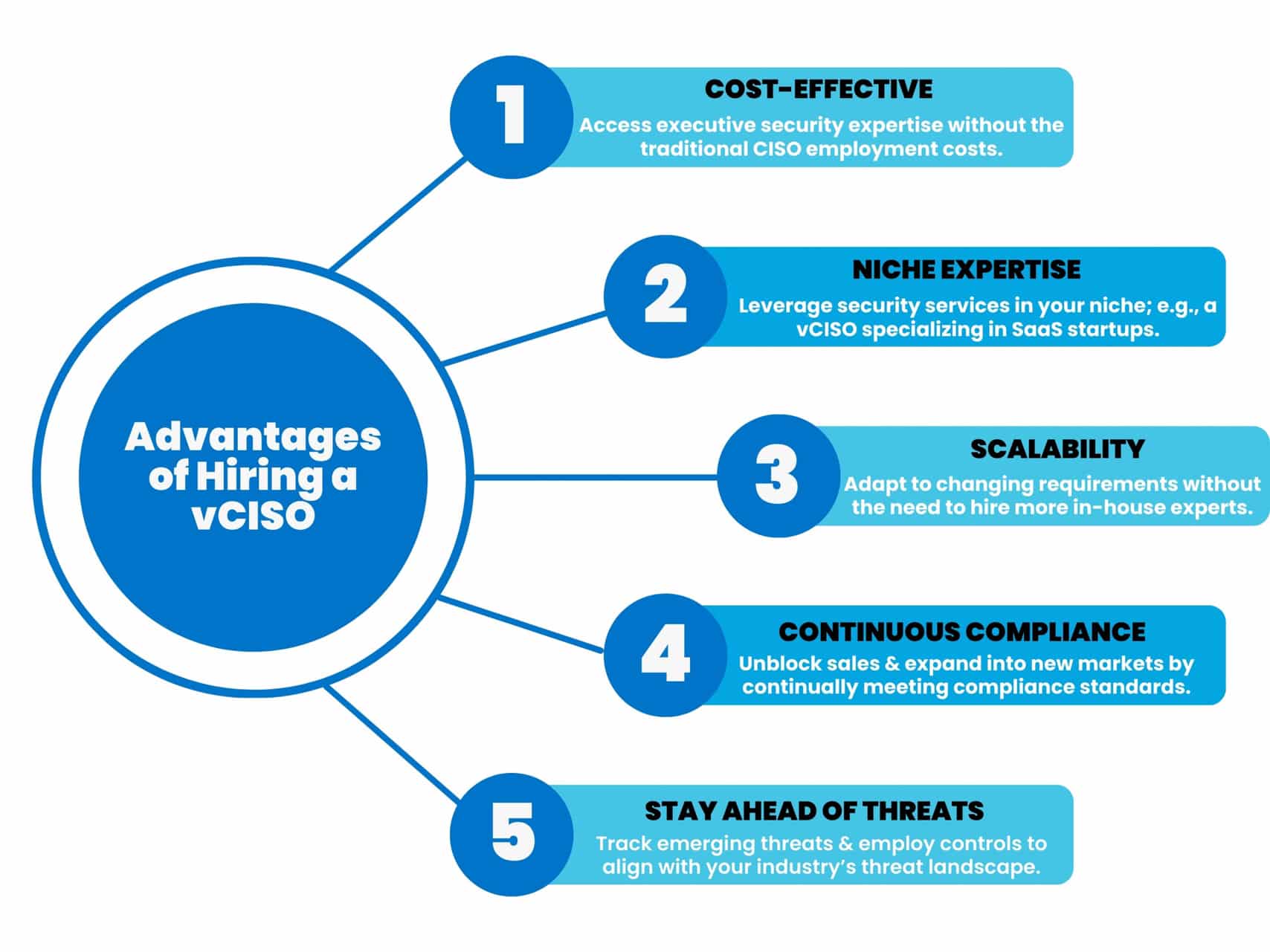
Hiring a full-time CISO can be prohibitively expensive, with salaries often exceeding six figures. Not to mention, there are the additional costs of benefits, training, and other resources required to support the role.
A vCISO, on the other hand, offers the expertise of a seasoned CISO at a fraction of the cost, often working part-time or on a retainer basis. vCISOs bring a breadth of experience from working with multiple clients across various industries, which can be particularly beneficial for smaller companies that may not have the resources to stay on top of the latest threats and regulatory changes.
For instance, Rhymetec's Executive Tier vCISO Service provides not just a dedicated vCISO, but also full integration with the client's systems, providing a level of support that rivals that of an in-house team. This allow startups and scaling enterprises to achieve enterprise-grade security without building costly in-house departments.
Factors Impacting vCISO Pricing
vCISO pricing can vary substantially depending on the scope of services, the requirements specific to your location and industry, and the complexity of your existing infrastructure. The broader the scope of services - such as adding compliance frameworks or expanding to full-time support - the higher the cost.
For example, Rhymetec's pricing structure adjusts based on the level of service required. Our Mentor Tier starts at $2,500 per month, which covers essential advisory services and assistance in maximizing your use of a compliance automation platform.
However, if a client needs additional services, such as manual security services to meet requirements under a framework like SOC 2 or align with new NIST governance requirements, the monthly fee increases by a minimum of $500. Companies in highly regulated industries may face higher costs due to the need for specialized expertise and more comprehensive services.
For instance, a vCISO can act as a CMMC consultant and help defense contractors navigate the requirements by determining which certification level applies to them and how to reach compliance efficiently. Many organizations begin by reviewing a CMMC Level 1 Checklist, but a vCISO builds on that by mapping the right controls and managing implementation. They help also clarify higher-level common doubts such as when CMMC versus FedRAMP is the right framework to pursue, since both can impact federal contracts.
Pricing Models for vCISO Services
As discussed previously at a high level, there are several common pricing models for vCISO services:
The most straightforward and popular option is a flat monthly fee. Businesses often find that this option allows them to budget more effectively and provides predictability. This model is often tiered, with different levels of service available depending on the company's needs.
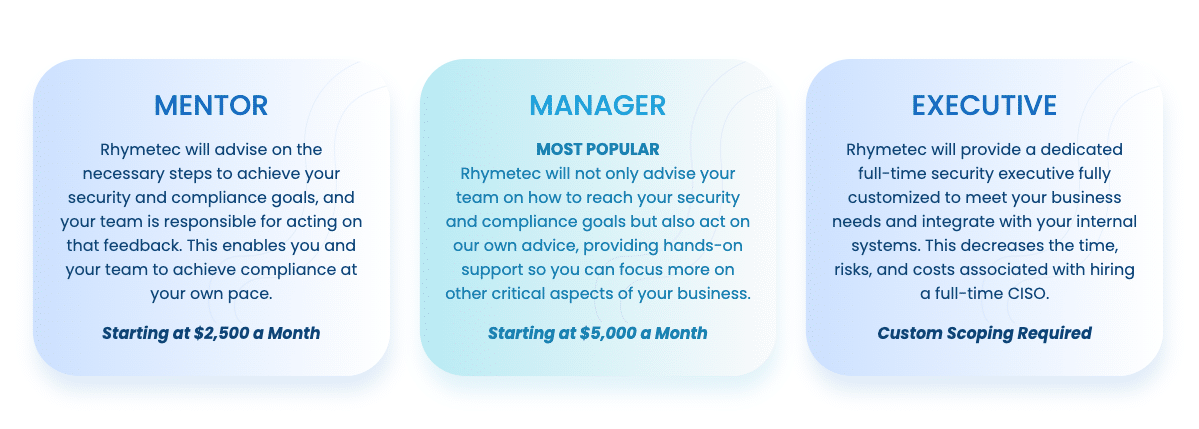
Rhymetec, for instance, offers three tiers of service on a monthly basis: Mentor, Manager, and Executive. The Mentor Tier is ideal for startups and SMBs needing strategic guidance, while the Manager Tier adds more hands-on management of security and compliance.
The Executive Tier, with custom scoping, offers the equivalent of a full-time vCISO, including advanced services like penetration testing and vendor risk management:
Another model is an hourly-based arrangement, where the vCISO is available for a set number of hours per month. This model offers flexibility but can lead to variable costs depending on how much time is used.
Some providers also offer project-based vCISO pricing for specific initiatives, such as phishing training for employees, a security audit, gap assessments, penetration testing, or compliance certification.
vCISO Pricing Compared To In-House Options
Taking a look at the differences in vCISO pricing and in-house options reveals substantial cost savings:
The average salary for a full-time CISO can exceed $200,000 per year, not including bonuses, benefits, and investing in necessary resources. Companies often need to invest in ongoing training and potentially expand their IT team to support the CISO's initiatives.
In contrast, a vCISO from Rhymetec's Mentor Tier, as an example, costs a total average of $30,000 per year, with options to scale services as needed. Even the top-tier Executive service, which provides comprehensive, full-time support, is more cost-effective than hiring an in-house CISO, particularly when considering the added value of expert-level services that might otherwise require multiple hires!
Consider the average cost of the following positions:
Job Title (Salary range for an in-house full-time hire in 2024):
- CISO ($215,000 – $275,000 per year)
- Cloud Security Specialist ($110,000 – $150,000 per year)
- Application Security Specialist ($130,000 – $180,000 per year)
- Penetration Tester ($110,000 – $150,000 per year)
- Security Operations Analyst ($110,000 – $160,000 per year)
- Threat Intelligence Analyst ($80,000 – $140,000 per year)
- Governance, Risk and Compliance Specialist ($65,000 – $100,000 per year)
- Vulnerability Management Analyst ($100,000 – $165,000 per year)
SMBs and startups need the same level of expertise but not necessarily the same amount of work as large enterprises that spend millions of dollars on a security team with many highly specialized individuals.
Small businesses need the same level of experience but not necessarily the same amount of work. Many organizations choose to work with a Managed Security Services Provider with vCISO support precisely for this reason, as they fill this gap perfectly. At Rhymetec, our vCISO pricing model centralizes all of these skillsets under a single engagement, giving SMBs access to the same expertise as large enterprises without the payroll overhead.
vCISO Pricing & Scope of Work
When considering working with a vCISO, understanding the scope of work and exactly what will be delivered is crucial.
A typical vCISO proposal will outline the specific services offered, the frequency of engagements (such as weekly meetings or monthly reports), and the expected outcomes. Rhymetec's Mentor Tier includes weekly virtual meetings, gap assessments, and policy development, while the Manager and Executive Tiers expand the scope to include incident management, vendor management, and even penetration testing upon request.
The proposal will also detail if and how the vCISO will integrate with your existing team. In Rhymetec's Executive Tier, this includes not just virtual support but also on-site meetings and close collaboration with the client's internal IT team. This helps align your tailored vCISO services with your business objectives and cybersecurity needs.
Case Studies: SMBs and Startups Leveraging vCISOs
In our experience with clients, particularly with B2B startups, the vCISO program enables companies to meet their security and compliance goals in a much shorter timeframe than other options would have allowed for:
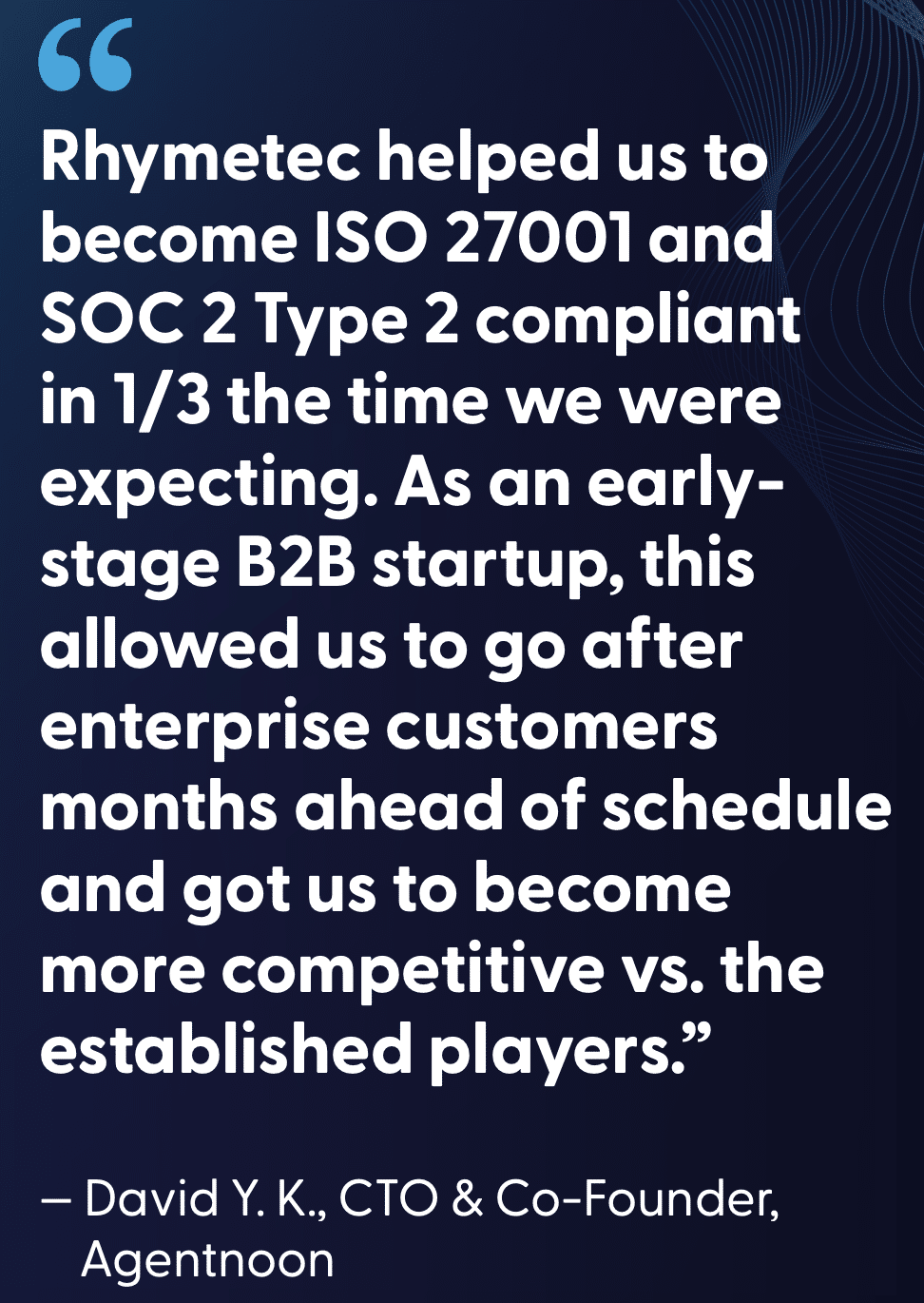
In our cybersecurity case studies, we've found that the vCISO pricing model and services provide several key advantages for companies. First and foremost, when working with a vCISO, specifically through an MSSP, it allows access to a vast set of skills:
"You can rely on a single individual, or you can have the benefit of a whole team of deep expertise and process knowledge. It's a small investment when you're considering in-house resources versus an entire team available on call at a fractional need – the ROI is really compelling."
– Harry Karamitopoulos, President, Modicum
Customers leveraging a vCISO program also find that it enables them to stay on track with their security and compliance goals, while being able to move their business forward and eliminating the need to build out expensive in-house teams:
"It kind of is like my 'security blanket.' I am a team of one for security and I need support. Having the Rhymetec team to lean on, help me consider options, weigh the pros and cons for different assets around security, and have someone else to bounce ideas off of has been helpful. Also, helping me stay on track and act as a copilot to help manage and navigate those decisions are all things that are essential to me. Without it, I would have to go out and hire more people, and the vCISO essentially cuts out the workforce I would need to hire full-time."
– Rolland Miller, Vice President of Security and Compliance, Orum
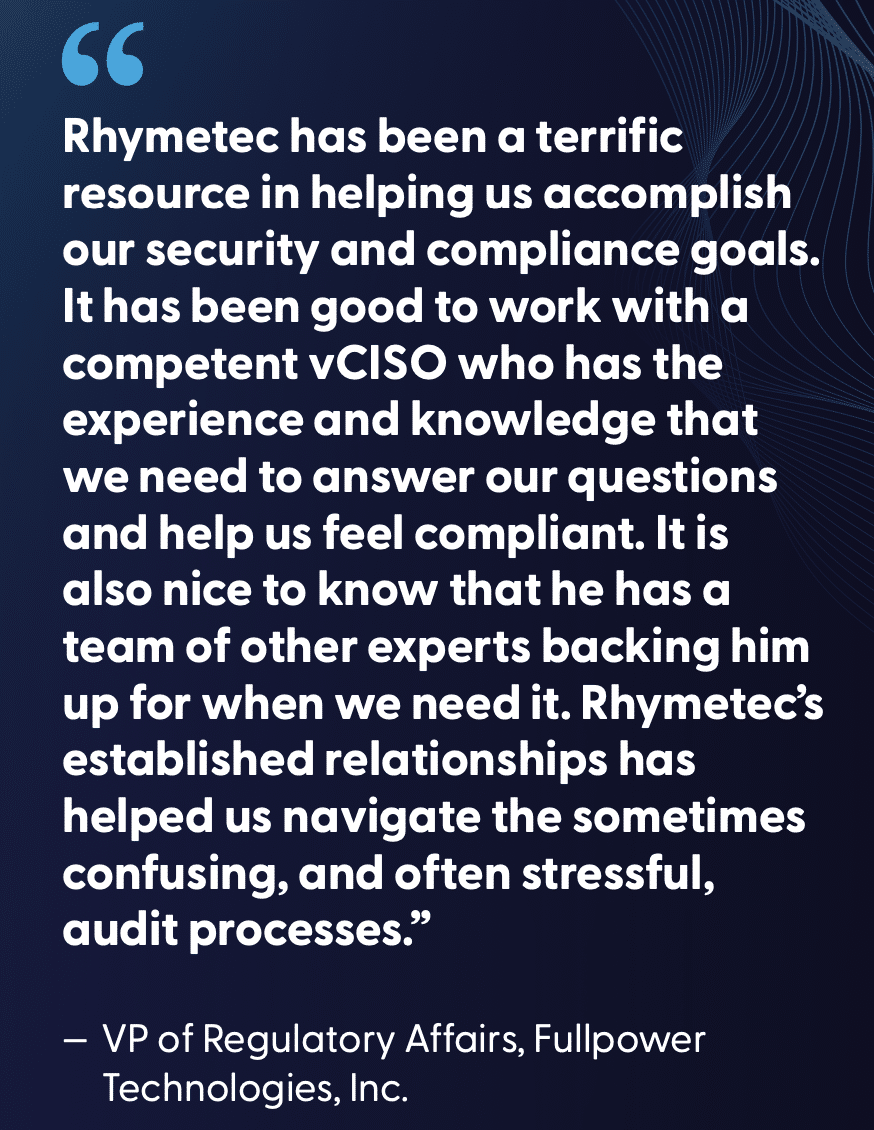
Lastly, we often hear from clients that working with their vCISO provides the level of experience and knowledge they need to meet their goals, and their vCISO's established relationships with auditors and compliance automation companies are a critical resource during the audit process:
Maximize The Value of Your vCISO Investment
To get the most value from a vCISO, businesses should do the following:
- Make sure your objectives from working with a vCISO are clearly defined
- Communicate regularly with your vCISO
- Establish metrics for success and periodic reviews of your security posture as it evolves
Rhymetec's vCISO services are designed with flexibility in mind, allowing businesses to begin with basic services and scale up as their needs grow. For example, a startup might begin with the Mentor Tier to establish a security foundation and achieve security advisement, then transition to the Manager or Executive Tier as their operations and the marketplaces they sell to expand. This not only helps manage costs but also ensures that the vCISO's services evolve in tandem with the business.
An effective engagement with a vCISO enables you to vastly improve your company's overall security posture over time, and serves as a business enabler as you break into new marketplaces and grow your business.
At Rhymetec, we act as both strategic advisors and hands-on operators, making advanced security and compliance attainable for companies of any size through our vCISO pricing options.
Concluding Thoughts: A Model for vCISO Pricing & Services With Busy Technology Executives Top of Mind
Whether you're looking to start out with basic advisory services or invest in full-time support, the right vCISO can provide the expertise required to protect your business and take security off your plate so you can focus on what really matters - your business.
Rhymetec's vCISO pricing tiers and vCISO services were created with busy technology executives and their workflows in mind. Our goal is to help you shorten your timelines, reduce your team's level of effort, and successfully guide your company through all of your cybersecurity and compliance needs so you can continue to move your business forward. Contact us today to learn more:
FAQs - vCISO Pricing & Services
What is a vCISO and how is it different from a full-time CISO?
A vCISO provides the same strategic leadership as a Chief Information Security Officer but works on a part-time or flexible basis. This makes it far more cost-effective while still delivering deep expertise.
How much does a vCISO cost?
Costs vary depending on scope and pricing model. Project-based engagements can range from $10K–$50K, hourly rates run $200–$500, and monthly retainers average $5K–$20K. Rhymetec offers tiered services beginning at $2,500/month.
Why would a company choose a vCISO over hiring in-house?
Hiring in-house requires salaries exceeding $200K annually plus benefits. A vCISO gives access to equivalent expertise at a fraction of the cost, with the flexibility to scale services as needed.
Can a vCISO help with compliance certifications?
Yes. vCISOs often lead compliance readiness efforts for SOC 2, ISO 27001, HIPAA, GDPR, CMMC, and other frameworks. They manage everything from gap assessments to evidence collection to audit prep.
Do vCISOs work with partners or tools?
Many vCISOs, including Rhymetec’s team, collaborate with audit partners like A-LIGN and leverage compliance automation platforms such as Drata and Anecdotes to streamline readiness.
What industries benefit most from vCISO services?
Startups, SaaS companies, healthcare, fintech, and government contractors all benefit. Any organization that needs to prove compliance to customers, investors, or regulators can use a vCISO to reduce cost and complexity.
About Rhymetec
Our mission is to make cutting-edge cybersecurity available to SaaS companies and startups. We've worked with thousands of organizations to provide practical security solutions tailored to their needs, enabling them to be secure and compliant while balancing security with budget. We enable our clients to outsource the complexity of security and focus on what really matters – their business.
Interested in reading more? Check out more content on our blog:
- Managed Compliance: An Updated Approach For The Cyber Regulatory World
- Why Managed Security Services? In-House vs External Security
- AI Frameworks: What They Are & Why We Need Them
When evaluating vendors to build and audit your information security (infosec) program, there are many important questions to ask: Who exactly will be handling your data? What are the team's credentials and prior experience? Will the vendor be outsourcing services internationally, and if so, how will their control and oversight of the process be impacted?
Is the vendor claiming to be able to both build your infosec program AND conduct your official audit?
Some MSSPs and "compliance as a service" providers are now advertising that they can help organizations meet required controls and conduct their certification audit. In this article, we'll go over the potential issues with this from a legal, reputational, and ethical perspective.
Let's be clear about a few of the potential pitfalls of this approach right off the bat:
Potential Pitfalls Of Engaging "All In One" Vendors
Having the same entity create and assess your infosec controls introduces a blatant conflict of interest. This presents clear ethical issues, as it's essentially like having a restaurant conduct its own health inspection.
They may not provide a fully objective assessment and could be inclined to overlook issues to hand you a more favorable report. Your audit may not hold up under scrutiny from stakeholders in the future, especially if you were to experience a security incident.
Another red flag is if an "all in one" vendor is claiming to be able to implement your security controls and conduct your audit at a suspiciously cheap price tag. Meeting requirements such as SOC 2, HIPAA, GDPR, and dozens of others can be fairly economically efficient and not break the bank. However, compliance isn't incredibly cheap either. As in many cases in life, when something seems too good to be true, it probably is.
Meeting information security compliance requirements isn't always an easy process. It often takes making many complex decisions involving business outcomes, processes, technologies, and acceptable risk. In other cases, it means fundamentally reworking a core business process to meet a requirement.
When done correctly, meeting requirements provides regulators and potential customers the assurance that your organization takes security seriously.
When done poorly, it can result in expensive boondoggles that cost your organization legal fees and valuable customer relationships. Engaging separate entities to develop and audit your infosec program is a safeguard against bias and helps you uphold the integrity of your compliance efforts.
So, what are the actual requirements and guidelines from which the robustness of your compliance can be judged?
Let's take a look at what a few entities and guidelines have to say on audit independence:
Guidelines and Best Practices To Ensure Audit Independence
Sarbanes-Oxley (SOX) is a U.S. federal law aiming to protect investors by improving the reliability of corporate disclosures. Although it primarily applies to publicly traded companies, it can indirectly impact privately held SaaS companies, for example, that may plan to go public in the future or those that provide services to public companies.
For instance, a SaaS company that handles financial data or provides financial reporting services to public companies may need to make sure its controls align with SOX requirements.
Section 404 of Sarbanes-Oxley requires that companies have an independent audit of internal controls over financial reporting.
The Public Company Accounting and Oversight Board (PCAOB) states the following:
A registered public accounting firm and its associated persons must be independent of the firm's audit client throughout the audit and professional engagement period.
Note 1: Under Rule 3520, a registered public accounting firm or associated person's independence obligation with respect to an audit client encompasses not only an obligation to satisfy the independence criteria applicable to the engagement set out in the rules and standards of the PCAOB, but also an obligation to satisfy all other independence criteria applicable to the engagement, including the independence criteria set out in the rules and regulations of the Commission under the federal securities laws.
Note 2: Rule 3520 applies only to those associated persons of a registered public accounting firm required to be independent of the firm's audit client by standards, rules or regulations of the Board or Commission or other applicable independence criteria.
Now that description is a bit heavy on jargon, so we can consult another source. SOC 2 is overseen by the American Institute of Certified Public Accountants (AICPA). AICPA has (fortunately for the non-accountants and lawyers among us) published a "Plain English Guide to Independence," which provides the following guidance:
Independence of mind is the state of mind that permits a member to perform an attest service without being affected by influences that compromise professional judgment, thereby allowing an individual to act with integrity and exercise objectivity and professional skepticism.
Independence in appearance is the avoidance of circumstances that would cause a reasonable and informed third party, who has knowledge of all relevant information, including safeguards applied, to reasonably conclude that the integrity, objectivity or professional skepticism of a firm or member of the attest engagement team is compromised.
Image Source: AICPA
In even plainer English, AICPA is saying that auditors should avoid any conflicts of interest that could impair their objectivity. This includes scenarios where they might audit their own work or the work of close colleagues, which would naturally apply to building and then auditing the same infosec program.
The AICPA's guidance, particularly under the SOC standards, prohibits organizations from auditing their own services, stating that:
"The auditor's responsibility is to provide an independent assessment of the service organization's controls that may affect user entities' financial reporting."
AICPA's emphasis on independence effectively makes it clear that an organization both implementing security controls for compliance and conducting the audit would risk impairing the auditor's independence and objectivity, thus not aligning with best practices. It's clear from their guidance that auditors should avoid any conflicts of interest that could impair their objectivity.
Lastly, many standards and frameworks, such as ISO/IEC 27001 and NIST, emphasize the importance of independence in the auditing process. They recommend that audits be conducted by individuals who are not involved in the day-to-day operations or implementation of the security program.
Assessing Audit Independence and Quality
Now, let's imagine a SOC 2 audit. Say you've hired an accounting firm with a security branch to help implement controls pursuant to SOC 2. Now imagine that the very same firm is going to audit your organization for compliance. Could a reasonable and informed observer conclude that the firm auditing the controls may be biased as a result of the fact that they were the ones who also implemented the controls?
To recall an earlier analogy, it's as if a restaurant were to perform its own health inspection. What are the odds that they are going to find major violations? Probably pretty low. When the same person who designed and implemented the infosec program also audits it, there is a significant risk of bias. They may inadvertently overlook issues or be less critical of their own work.
Even if this "all in one firm" issues a SOC 2 report without findings, your organization could still be at substantial risk. Imagine you have a major cyber event in the future, and customers find out that your SOC 2 report wasn't entirely accurate and that the firm you hired took shortcuts through the process. Information security isn't just a legal risk; it's a business and reputational risk.
A reputable information security compliance provider (whether an accounting firm or a managed security services provider) should do the following:
- Be able to provide reference customers, either publicly or privately, who have worked with the firm in the past to implement controls.
- Work with a reputable outside auditing firm that conducts independent audits of control implementation.
- Ensure that all employees adhere to industry standards, guidelines, and best practices such as those set by the AICPA.

Some firms, such as Rhymetec, have identified specific high-quality third-party firms that we often recommend to our clients to complete the audit process. But if clients prefer a different audit partner, that is okay too.
Information security compliance requirements shouldn't be considered a burden to businesses. Implementing requirements such as SOC 2, GDPR, HIPAA, and others should help organizations be assured that they are meeting relevant legal and ethical requirements while taking adequate and appropriate measures to safeguard customer data.
When conducted by ethical providers, standards like SOC 2 can substantially enhance a business's confidence and security protocols without disruption and without massive cost. Independent audits provide greater credibility to your stakeholders, including management, customers, and regulatory bodies. You can be confident that the audit findings are impartial and accurate.
About Rhymetec
Our mission is to make cutting-edge cybersecurity available to SaaS companies and startups. We've worked with hundreds of companies to provide practical security solutions tailored to their needs, enabling them to be secure and compliant while balancing security with budget. We enable our clients to outsource the complexity of security and focus on what really matters – their business.
Interested in reading more? Check out more content on our blog:
- Maximize Your Use of Compliance Automation Platforms
- Cybersecurity For Startups: A Rhymetec Guide
- Security vs. Compliance? A False Dichotomy
If there's one thing most people agree on in 2025, it's that we need strong regulations around artificial intelligence (AI). Nearly 80% of Americans want stricter regulations on the use of public data to train AI models, and surveys show a growing concern over AI jeopardizing our privacy.
Meanwhile, companies are barreling ahead: Over 56% of businesses use AI to improve business operations, and 83% of executives see AI as a strategic priority. The excitement around this technology and its innovative use cases is understandable, but integrating AI without slowing down to consider privacy, safety, and ethical concerns is risky.
Implementing an AI framework that directly addresses these issues is a major step companies can take to assuage concerns. Certification with ISO 42001 promotes responsible AI use and provides verified, documented evidence to stakeholders that you take AI risks seriously.

What Is ISO 42001?
ISO 42001 is a certifiable international standard providing guidelines for building and managing AI tools. It offers a repeatable framework from which organizations can build solid operational governance and management systems while promoting responsible AI usage.
The standard covers areas including security, privacy, and ethical practices. It specifies the requirements for creating a reliable AI program that, when developed with overall business goals and daily functions top of mind, can improve the safety of AI systems while also serving as a business enabler.
With AI becoming widely accessible since the introduction of tools like ChatGPT in 2022, the demand for security and privacy measures around AI has been amplified. Enter the role of AI frameworks - of which ISO 42001 is one of the most prominent.
ISO 42001 supports the development of AI that respects data security and user privacy, addressing the increasing public demand for transparency and accountability:
Why Is ISO 42001 Compliance Important?
A growing number of organizations seek to obtain ISO 42001 compliance for two primary reasons:
1. Certification as a Marketing & Reputation Management Tool: Compliance with ISO 42001 allows companies to communicate to their customers, prospects, and stakeholders that they adhere to the highest standards in AI use and development.
Organizations can use their certification to reassure clients and prospects. ISO 42001 certification acts as a mark of credibility, signaling that the organization has taken steps to implement best practices as laid out by an industry gold standard framework.
This builds trust with stakeholders concerned about the potential impacts of AI and can shorten the sales cycle. If a prospect asks about your organization's AI practices, being able to show a certification is a powerful tool.
2. To Guide Strategic Implementation of AI: Companies seek to leverage the roadmap offered by ISO in a meaningful way that leads to AI-related strategies that ultimately serve as business enablers.
ISO 42001 certification not only supports compliance with other regulatory and legal requirements but also positions you to fully reap the business benefits of responsible AI use. By following ISO 42001, companies reduce security risks, optimize decision-making processes, foster customer trust, and ultimately drive business growth and sustainability.
Who Needs ISO 42001 Compliance?
ISO 42001 is particularly useful for companies:
- Developing new AI features
- Creating AI-powered products
- Acting as AI producers, service providers, or end-users
Companies must be prepared to make changes to their products as AI technology evolves. Adherence to ISO 42001 largely offsets the amount of time you'll need to spend implementing changes down the road while reducing risk long-term.
The AI ecosystem can be categorized into three roles:
- AI Producers: Companies like Microsoft, OpenAI, and Anthropic that build and sell foundational AI models.
- Service Providers: Organizations that consume these models from producers, customize them, and then sell them downstream.
- Customers and Users: The end-users and businesses that utilize AI services and products.
ISO 42001 can apply to any business interacting with others in this ecosystem. Organizations in each of these three roles can benefit from establishing an AI management system as per ISO 42001 guidelines, and focusing on areas such as data provenance, the handling of training data and algorithms, and the outcomes produced by AI systems.
Encouraging organizations to think deeply about the potential impacts of AI for everyone in their ecosystem is one of the main purposes of frameworks like ISO 42001.
How To Get ISO 42001 Certification: How Easy Is It?
One major misconception about ISO 42001 is that it focuses solely on the security and privacy of AI systems. In reality, the standard encompasses a border range of considerations, including ethical practices, fairness, bias resolution, and understanding the overall impact of AI systems.
Security alone is actually a small component in the context of the entire framework.
At a high level, achieving ISO/IEC 42001 certification includes several steps:
1. Gap Analysis
Conducting a gap analysis identifies the differences between your organization's current state and where you need to be to meet the requirements of ISO 42001.
2. Implementation
Based on the gap analysis, the next step is to implement changes to align with ISO 42001 controls. This could include everything from revising policies to updating procedures and training employees.
3. Internal Audit
Before seeking external certification, conducting an internal audit helps ensure you meet all requirements and are ready for the external audit.
4. External Audit
An accredited certification body performs your external audit, determining whether or not you obtain certification at that time.
Depending on factors like company size and infrastructure, this process can be complex and time-consuming. However, it ultimately strengthens your organization's AI governance and management practices, reducing risk and saving time and money down the road.

How Different Is ISO 42001 Vs. ISO 27001?
Organizations with ISO 27001 certification may assume that transitioning to ISO 42001 compliance is straightforward. However, ISO 42001 is fundamentally different from ISO 27001, despite their complementary nature from a high-level structure perspective.
While ISO 27001 centers around information security management systems (ISMS), ISO 42001 is highly specialized in the scoping of AI systems. The good news is that ISO 42001 is designed to integrate smoothly with existing ISO frameworks, including ISO 27001. The new framework is designed to be easily integrated for organizations that already have an ISO framework.
All of the ISO frameworks are designed in a way that allows them to act as building blocks for each other. The areas in which they diverge, meanwhile, leave opportunities for organizations to adapt controls to their specific needs and environments.
As an example, both ISO 27001 and 42001 require a risk assessment. However, even if you've completed your risk assessment for ISO 27001, you would still need to identify risks specific to AI systems for 42001.
The impact assessment of ISO 42001 goes beyond security and privacy, encompassing broader aspects such as the ethical implications and the societal impact of AI. This expanded focus means that the way controls are operationalized will both diverge from and build on ISO 27001.
How Much Does ISO 42001 Certification Cost?
Let's break down the costs:
Direct Costs
Hiring an accredited certification body to conduct the audit is a primary cost. Depending on the size and complexity of your organization, this can range from $5,000 - $20,000. This fee typically covers the initial certification audit and any follow-up assessments.
Implementing ISO 42001 requires time and effort from your team. You may need to allocate significant internal resources to manage the project, which can translate into measures like hiring temporary staff to handle regular duties.
Many startups choose to hire consultants.
Consulting fees can range from $10,000 - $50,000, depending on the level of support you need. Consultants assist with gap analysis, control implementation, and preparation for your audit.
Indirect Costs
There are potential costs around employee training and awareness, with the goal of making sure everyone understands their role in working towards ISO 42001 compliance. Technology upgrades represent another indirect cost. You may need to invest in new software or upgrade existing systems to meet ISO 42001 requirements. Costs here can vary greatly depending on your technology stack.
Lastly, there are costs associated with ongoing maintenance. Maintaining ISO 42001 certification requires regular audits and continuous improvement. Budget for annual internal audits and surveillance audits, which can cost between $3,000 - $10,000 per audit per year, and allocate resources for ongoing training and process updates.
Cost-Benefit Analysis
While the costs may seem significant, consider the benefits: ISO 42001 certification can improve your company's reputation, build customer trust, and open doors to new markets. It mitigates risks associated with AI, potentially saving money in the long run by avoiding costly security issues and reputational damage.
How To Implement ISO 42001: Critical Components of Building an AIMS & Demonstrating Compliance
Implementing ISO 42001 involves establishing an AI Management System (AIMS) that aligns with the standard's requirements and fits the context of your organization. The framework is structured around 10 clauses, similar to other ISO management systems, and includes annex controls that can be operationalized differently depending on the organization.
Below are 6 key components of meeting ISO 42001 compliance:
1. Management Commitment
Leadership must define AI policies, set objectives that align with the strategic direction of the organization, and make resources available for the implementation and maintenance of the system.
2. Risk Assessment and Impact Analysis
Unlike traditional frameworks that focus on security and privacy, ISO 42001 requires a broader impact assessment. A core part of the framework involves identifying and evaluating AI-related risks across areas, including environmental impact and ethical considerations.
3. ISO 42001 Annex Controls
The annex of ISO 42001 provides specific controls that need to be implemented, which can be adapted to the context of the organization. For example, this may include guidelines around data provenance, with the goal of making sure training data and AI algorithms are not biased.
4. Operational Planning, Documentation, and Training
Documenting everything pertaining to processes for the effective operation of the AIMS is another key step. Processes need to be clearly defined and laid out for all employees, so they can be consistently followed.
All staff involved in the AIMS need to have the necessary skills and knowledge. Appropriate training and resources need to be provided to support this.
5. Monitoring and Measurement
Mechanisms to monitor the performance of the AIMS over time are another key component of ISO 42001 compliance. Such measures can take the form of regular audits and assessments to see if the system remains effective and aligned with requirements. Any issues identified should be addressed promptly.
6. Continuous Improvement
A process must be established to regularly review and update the AIMS to reflect changes in technology, regulatory requirements, and organizational goals. This iterative approach allows you to stay ahead of emerging risks and challenges.

How Long Does ISO 42001 Certification Take?
With managed security services providers like Rhymetec, it takes anywhere from 4 - 6 months for the preparation and readiness portion of ISO 42001 compliance.
This timeline varies depending on organization size and the complexity of their AI systems. If an organization has already implemented ISO 27001, the process will be on the faster end, with many controls needing to be tweaked rather than built from scratch.
Several scoping factors determine how long your timeframe will be for the audit, such as the number of employees, complexity factors, and organizational role (producer, provider, developer, or user of AI). As a rough estimate, you can expect the certification audit by an accredited body to take 4 - 8 weeks.
About Rhymetec
Our mission is to make cutting-edge cybersecurity available to SaaS companies and startups. We've worked with hundreds of companies to provide practical security solutions tailored to their needs, enabling them to be secure and compliant while balancing security with budget. We enable our clients to outsource the complexity of security and focus on what really matters – their business.
If your organization is interested in exploring compliance with AI standards, we now offer ISO/IEC 42001 certification readiness and maintenance services and are happy to answer any questions you may have.
The advent of generative AI has been a wake-up call for risk management and information technology professionals. GenAI applications have been notably compared to the invention of the internet, computing, and fire, depending on who you ask.
At the same time, concerns over the risks of AI continue to grow, with many governments and organizations concerned over implicit bias trained into the models and the lack of transparency into how the models output answers.
This article examines the new era of AI regulation augured by one of the first AI frameworks, ISO 42001. We will begin by outlining how GenAI works and identifying a few fundamental issues with current systems. Following that, we'll do a synopsis of the ISO 42001 framework, as well as two other AI frameworks, before concluding with what organizations can expect going forward.
How Do Language Models Work At A High Level?
To understand why we need to manage risk around generative AI, it's first important to understand how they work at a basic level. Let's take large language models (LLMs) as an example, as they are currently all the rage among companies adopting AI.
LLMs are AI applications built on the machine learning paradigm of deep learning. To be simplistic, language models are trained to predict the next token, which you can think of as the next word:
Imagine you are asked to complete the sentence, "I'm feeling very under the _."
Your brain probably filled in the word "weather" to complete the sentence, almost automatically. AI language models are trained on unimaginably large corpora of information, with the full contents of the internet being a starting but not ending point.
The training data serves as a guide, providing language models with a statistical way to identify the fundamental data structures within language. LLMs then essentially optimize through a process called stochastic gradient descent to identify the next most likely word in every sentence and every paragraph, and can do this at scale across incredibly complex prompts.

AI & Transparency
Many claim that "we don't understand how AI works." This is both true and not true. At a conceptual level, we absolutely understand how AI works. Language models are trained across unimaginably large data sets to complete the next token using what amounts to complex matrix multiplications.
At a granular level, AI language models are a black box. To illustrate the point, let's imagine you have implemented a large model to help screen for healthcare fraud. Now imagine that after hundreds of thousands of case reviews, you notice that the language model flags people named "Amy" for fraud at 3000% the rate of every other first name.
Understanding that the model is optimizing for the next token prediction doesn't do you much good. Trying to understand why the language model is singling out Amy is like taking a satellite photo of New York City and asking why you can't use that to predict where there are going to be traffic accidents on any given day. The level of complexity is unimaginably great.
Generative AI, Bias, and AI Frameworks and Regulations
GenAI applications reflect many of the biases, errors, and cognitive traps that the average human falls into. And given the lack of transparency, this also means that we can't even understand why a language model is exhibiting bias. At the same time, the public's trust in AI is waning, with surveys showing there is an increasing concern about losing privacy.
Questions with unsatisfactory answers abound:
How do we address AI systems perpetuating existing biases present in their training data, leading to discriminatory outcomes? AI systems require vast amounts of data to work. How is our personal information being collected, stored, and used?
How are AI companies addressing the risk of their technologies being used to create misinformation? AI models require huge computational resources and massive energy consumption - what are doing to mitigate their impact on carbon emissions?
In an attempt to assuage such concerns, enter the era of AI frameworks, standards, and regulation. This can generally be marked with the creation of three new standards: ISO/IEC 42001, the EU AI Act, and the NIST AI Risk Management Framework.
1. ISO/IEC 42001
ISO 42001 is the first AI Management Systems framework to be published. The goal is to allow companies to proactively certify they are using AI safely and establish company-wide guidelines for managing AI applications. The framework directly addresses many of the concerns around AI and transparency, bias, and ethics:
The Documentation of AI Systems & Algorithmic Transparency
Organizations should maintain detailed documentation of their AI algorithms, data sources, and decision-making processes.
Recommendation engines, for example, collect data on user behavior, such as past purchases, search queries, browsing history, and more that is then used by an AI algorithm to generate recommendations for users.
Under ISO 42001, companies that deploy AI-driven recommendation engines (such as Netflix's personalized show/movie recommendations) must document the types of data from consumers it uses, the algorithm's logic, and how recommendations are generated.
Furthermore, AI systems must be designed to provide explanations for their decisions that are understandable to non-experts. For instance, an AI used for loan approval must provide applicants with a clear explanation of the factors that influenced their application decision, such as income and credit score.
Data Privacy and Security
Under ISO 42001, measures to protect data should be integrated into the use of AI. There are many factors to consider before implementing AI into systems and applications.
Furthermore, security measures mapped onto ISO 42001 data privacy and security controls help meet compliance with industry-specific data protection regulations such as HIPAA. Under both HIPAA and ISO 42001, for example, measures an AI-driven health app might take would be to encrypt user data both at rest and in transit and implement strict access controls to protect sensitive health information.
Ethical Principles Controls Under ISO 42001
ISO 42001 controls emphasize accountability and human oversight of AI. Part of this entails a clear assignment of roles and responsibilities for AI system outcomes. As an example, a company could designate a Data Protection Officer repsonsbile for overseeing the ethical use of AI and handling any issues.
AI Frameworks & Continuous Improvement Controls
One of the core tenets of ISO 42001 is continuous improvement.
Organizations should be continuously monitoring AI performance to identify areas for improvement. For instance, a healthcare AI system used for diagnosis should continuously monitor for accuracy and be updated based on the latest medical research.
2. The EU AI Act
The EU AI Act is the world's first comprehensive AI law. It was passed by the EU parliament in March 2024 and will shortly be adopted as EU law. Understanding the implications of this act is critical for businesses, as it directly addresses common concerns about the use of AI:
Risk-Based Classification
The EU AI Act introduces a risk-based classification system to regulate AI systems according to the level of risk they pose to individual users and society more broadly. The aim is to strike a balance between innovation and the need for safety and ethical considerations.
In practice, this means categorizing AI systems into four risk levels: unacceptable risk, high risk, limited risk, and minimal risk. Each category entails specific requirements to address the potential impact of the AI system. More stringent regulations are applied to AI technologies that could significantly affect human rights, safety, and well-being, while allowing a greater degree of flexibility for lower-risk applications.
An AI system controlling autonomous vehicles would be naturally considered high risk and would need to comply with stringent safety standards. Meanwhile, an AI-driven spam filter or an AI being used to help personalize content would be considered minimal risk and face less strict requirements.
Transparency, Accountability, & Data Governance
Organizations must disclose when AI is used and provide transparent information about its functionality. For example, an e-commerce website using a chatbot has to disclose to users that it's an automated system.
The EU AI Act also contains requirements around high-quality data management practices to prevent biases. A real-life example of this is that AI recruitment tools must be trained on diverse and representative datasets, with training data to include a wide range of demographic information to prevent bias against any particular group.
3. NIST AI Risk Management Framework
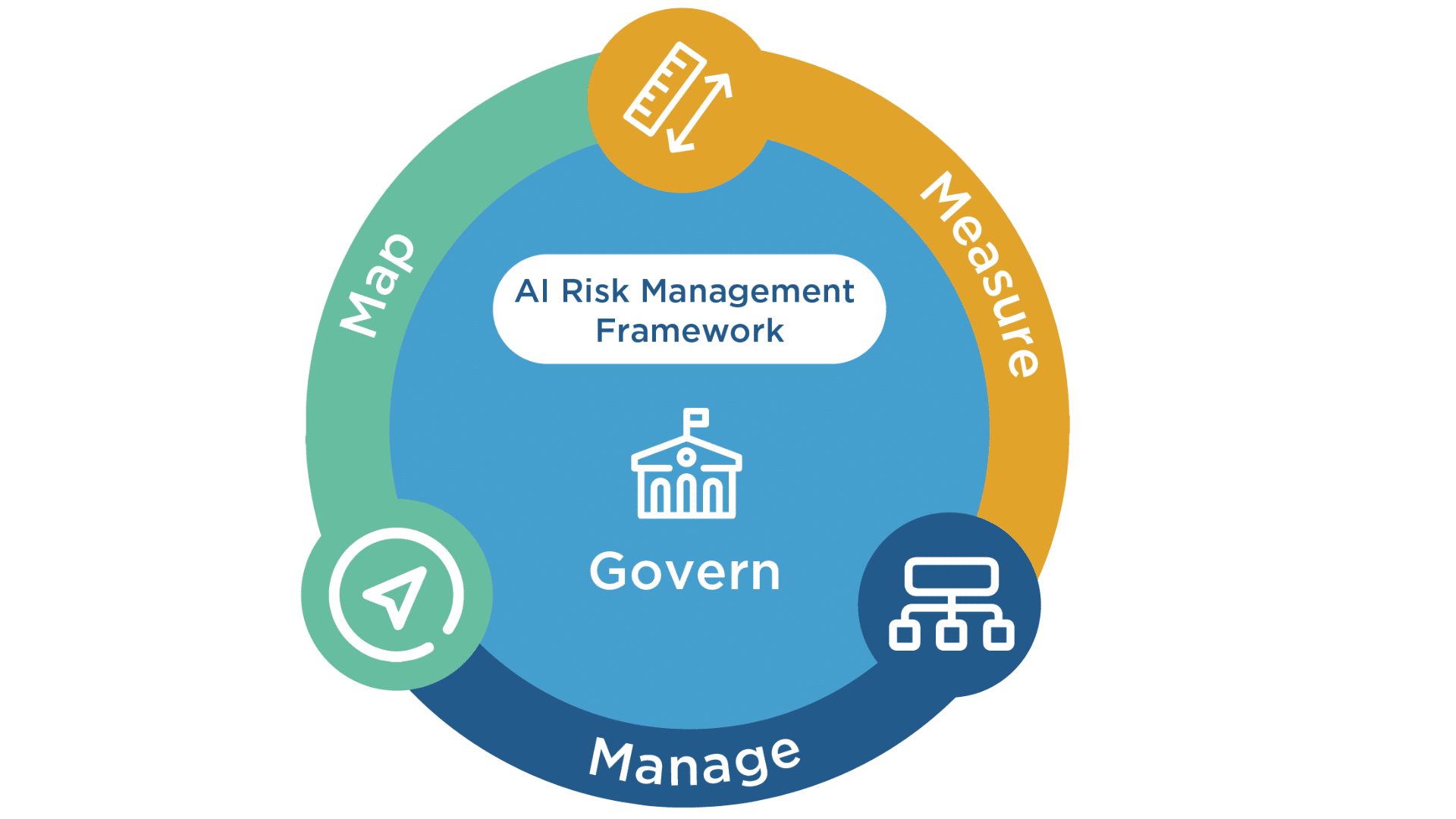
Image Source: NIST AI Risk Management Framework
The NIST AI Risk Management Framework is a voluntary, flexible framework for managing AI-related risks. It focuses on several key areas:
Governance: A Common Core Tenet of AI Frameworks
The role of governance is central under the NIST AI Risk Management Framework. This is unsurprising, as there has been a similar focus in other recent frameworks, such as Version 2.0 of the NIST Cybersecurity Framework with the addition of the NIST governance section.
Company leadership must establish procedures to oversee AI development and use. As an example, a marketing agency could document all of its AI usage policies so that employees understand if/how AI tools should be used for daily tasks such as copywriting, generating images, and social media posts.
Similar to ISO 42001 and the EU AI Act, the NIST AI Risk Management Framework also emphasizes the importance of assigning clear responsibilities for AI risk management. Businesses should designate a team member, such as the head of IT, to oversee AI usage and projects.
Risk Identification
Pinpointing the potential risks and impacts associated with AI systems is another key component of the NIST AI framework. This can take the form of conducting a simple risk assessment. For instance, an online retailer may evaluate the risks of using an AI chatbot for customer service to provide clarity on the following questions:
Are there scenarios in which the AI may fail to understand complex customer queries? How often is this projected to occur, and what would be the impact on customer satisfaction? How often might the chatbot provide incorrect information?
These are important questions to answer.
Tracking Performance Metrics & Bias Assessments
Lastly, the NIST AI framework requires organizations to assess their AI systems regularly and enact corresponding improvements. Companies should develop key performance indicators (KPIs) that are used to measure AI accuracy, performance, and bias.
Specific KPIs obviously vary depending on the industry. Let's take a healthcare provider as an example:
A medical clinic using an AI application for diagnostic support may examine the accuracy rate as a KPI by comparing AI diagnostic results with diagnoses made by human doctors. Another KPI they might assess could be false positive/negative rate - the number of instances where the AI system incorrectly identifies an illness where there is none (false positive) or misses a diagnosis (false negative).
Assessing the reliability and fairness of AI systems is a cornerstone of the three AI frameworks we've gone over in this article. By measuring outcomes, organizations can enable their AI applications to continuously improve and deliver desired results while alleviating concerns from prospects, customers, and partners.

Concluding Thoughts On AI Frameworks
The three AI frameworks discussed in this article share several common goals and approaches:
Each framework emphasizes a risk-based approach that prioritizes risk remediation based on the potential impact of AI systems. Additionally, they each stress the importance of making AI systems transparent and explainable. There is a shared emphasis on the need for ethical AI development to protect individuals and society, and each framework underscores the importance of governance in its own way.
Lastly, ISO 42001, the EU AI Act, and the NIST AI Risk Management Framework all focus on the role of continuous improvement: Adherence to AI frameworks is an ongoing process that involves embedding security functions into daily business operations. AI technologies are swiftly evolving, and organizations must be prepared to pivot their approach and adapt their policies based on change.
By implementing these frameworks, organizations can be better equipped to manage the risks associated with AI, answer their customers' and prospects' concerns about AI, and ensure their use of AI is safe and responsible.
About Rhymetec
Our experts have been disrupting the cybersecurity, compliance, and data privacy space since 2015. We make security simple and accessible so you can put more time and energy into critical areas of your business. What makes us unique is that we act as an extension of your team. We consult on developing stronger information security and compliance programs within your environment and provide the services to meet these standards. Most organizations offer one or the other.
From compliance readiness (SOC 2, ISO/IEC 27001, HIPAA, GDPR, and more) to Penetration Testing and ISO Internal Audits, we offer a wide range of consulting, security, vendor management, phishing testing services, and managed compliance services that can be tailored to your business environment.
Our team of seasoned security experts leverages cutting-edge technologies, including compliance automation software, to fast-track you to compliance. If you're ready to learn about how Rhymetec can help you, contact us today to meet with our team.
Interested in reading more? Check out other articles on our blog:
- AI In Cyber Defense: Pioneering The Future of Security
- Security vs. Compliance? A False Dichotomy
- How AI Is Disrupting Our Industry, and What We Can Do About It
Cybersecurity compliance is a fast-growing field, with many new regulations being propagated on an annual basis globally. Many organizations struggle with understanding which compliance requirements they need to meet and how to operationalize complex controls that pertain to technology, people, and processes.
Even more, some believe that compliance comes at the cost of security - money they could be using to reduce their attack surface, identify threats, or install next-generation security software gets taken to meet imposed requirements with less security value.
A real-life example of this is meeting a control under NIST 800-171 to regularly review access control for all employees. If you have 1,000 employees, this is a time-consuming process! It can be easy to see how the same organization may feel they could benefit far more from spending $60,000 on an advanced XDR system.
At Rhymetec, we believe that security and compliance are complementary, and both can be designed to enable business outcomes.
Security vs. Compliance: Definitions And Goals
Compliance is a pass-or-fail measurement of controls against a standard, while security is the management of risk through the implementation of controls and is measured through control maturity and effective risk mitigation.
Complying with an external standard doesn't necessarily make you secure, but without compliance checks, it's hard to assess if your security meets industry standards. It's also difficult to reassure prospects and customers that their assets are safe with your organization if you are not compliant.
Additionally, compliance can form the basis for security and serve as the building block for a successful cybersecurity program. Compliance is very process-driven and focuses on the same set of policies, technologies, and procedures. Meeting requirements such as SOC 2, ISO 27001, the HIPAA Security Rule, and many others helps ensure you have the basics covered for a competent information security program.
Let's imagine a hypothetical world without compliance requirements. Cybersecurity programs would likely be far more divergent from each other, with many companies doing nothing, a few doing something, and a very few that have sophisticated programs.
Compliance establishes a common baseline, providing customers and employees with assurances that the organization takes steps to adequately protect their data.
Compliance Drives Improved Security For Many Organizations
Compliance vastly improves your security posture if you weren't doing certain foundational measures previously.
Measures like multifactor authentication (MFA) are required under nearly all compliance requirements and may seem like a basic security practice. However, organizations that were not already requiring MFA will substantially improve their security posture simply by enacting that one measure.
Our research on SMB cybersecurity shows that MFA is one of the most common sense and cost-effective security practices, yielding the greatest effectiveness for the lowest investment. Many SMBs are driven to invest in measures like MFA, specifically due to compliance requirements.
Other such "baseline" measures include:
- Employees be effectively offboarded within 24 hours of departing their position
- Having a documented incident response policy and plan
- Using a firewall to protect the network
- Employing the principle of least privilege to protect sensitive data
Compliance helps ensure measures like these are in place and provides organizations motivation to routinely audit their security practices and make sure they are being adhered to.
Security and Compliance Are Both Business Enablers
One of the most important criteria consumers and corporations use to choose who they do business with is the information security program of their potential vendor. This is especially true for tech firms that often hold highly sensitive data.
Saying that you have an information security program is kind of like claiming that you are incredibly smart. Sure, it might be true - but you need to demonstrate it.
Both mandatory compliance requirements like HIPAA and voluntary frameworks like SOC 2 offer opportunities to proactively demonstrate your organization's commitment to keeping customer and employee data safe. Meeting compliance requirements gives you real-life documentation (that can be shared with your customers and prospects!) on your organization's information security practices.
We regularly hear from our SOC 2 compliance customers that one of the major motivating factors in choosing Rhymetec was that large enterprise opportunities were completely stopping at legal and procurement without information security documentation to share:
"The first priority was to remove that barrier in the deal flow. Now, whenever people see the certifications, they stop worrying about security. It stops that conversation, and we can move on to more valuable conversations."
– Chuck Goss, VP of Engineering, Kizen
Compliance offers you a chance to demonstrate that you invest to meet and exceed security requirements.
Bonus Tip: Creating a public trust and safety center on your website can be an excellent way to demonstrate to prospective customers that you have a serious information security program and that you can be trusted with their data. This can increase conversion rates and provide assurance up front that your organization takes security seriously.
Security vs. Compliance: What About Frameworks?
Information security is both an art and a science.
Security leaders should start with the basics. What does an organization legally need to do? From there, they should look at business outcomes. How does the security program need to enable the business? Finally, look at risk reduction. What actions do we need to take to reduce risk to an acceptable level at an optimal cost?
One tool that can be extremely effective in this process is to use a cybersecurity framework as a roadmap.
For example, the National Institute of Standards and Technology recently published the NIST Cybersecurity Framework Version 2.0, with the addition of the NIST governance function. This document serves as a gold standard with hundreds of controls across multiple axes that help organizations organize their security program around best practices.
Additionally, NIST CSF controls form the basis for many legal compliance requirements. Meeting controls under NIST meets many controls under regulations such as the HIPAA Security Rule, NYDFS Cybersecurity Regulations, and others.
At Rhymetec, we help our customers "crosswalk" controls to implement a minimal number of new policies, processes, procedures, and technologies in order to meet their compliance requirements while maximally reducing risk.
In our webinar "Security vs. Compliance," Rhymetec CISO Metin Kortak discussed how we enable businesses to leverage compliance to meet their overall goals:
"If a client knows they want to build an infosec program but they don't really understand which frameworks they want to base that off of, usually we recommend selecting a compliance framework that's general and overlaps with other frameworks. For example, NIST 800-53 and SOC 2 are both great options. They have many security controls that overlap with other frameworks. This allows you to not only build a good infosec program but also sets you up to easily meet compliance with other frameworks in the future."
Security Expertise Helps Avoid Overly Onerous Control Implementation
A good security program isn't about implementing every control in a framework. Instead, it involves a complex process where the organization:
Understands Its Threat Model: Not all companies have the same set of threats. Our practitioners work directly with the client to identify the risks that are most likely to impact them. This forms the basis for building a winning security program that provides real business value and reduces the risk of major negative events such as ransomware and data breaches.
Identifies Key Legal Requirements: Between state, federal, and international laws, there are dozens of potential legal requirements impacting organizations, with even more for certain industries such as healthcare. At Rhymetec, we perform a comprehensive review with each client to understand the legal requirements they need to meet.
Considers Business Requirements: Finally, we work with the client to understand the business requirements of the organization. Are large sales opportunities being held up due to a lack of compliance? Does the organization have mission-critical systems that may need backup and recovery options available in minutes?
Answering questions across these three pillars and using a gold standard framework like NIST CSF enables us to build a security program that serves as a business enabler.
This approach gives executives confidence they are meeting compliance requirements, gives employees confidence they are protected, and gives customers confidence that your organization is a vendor that can be trusted with their most sensitive data.
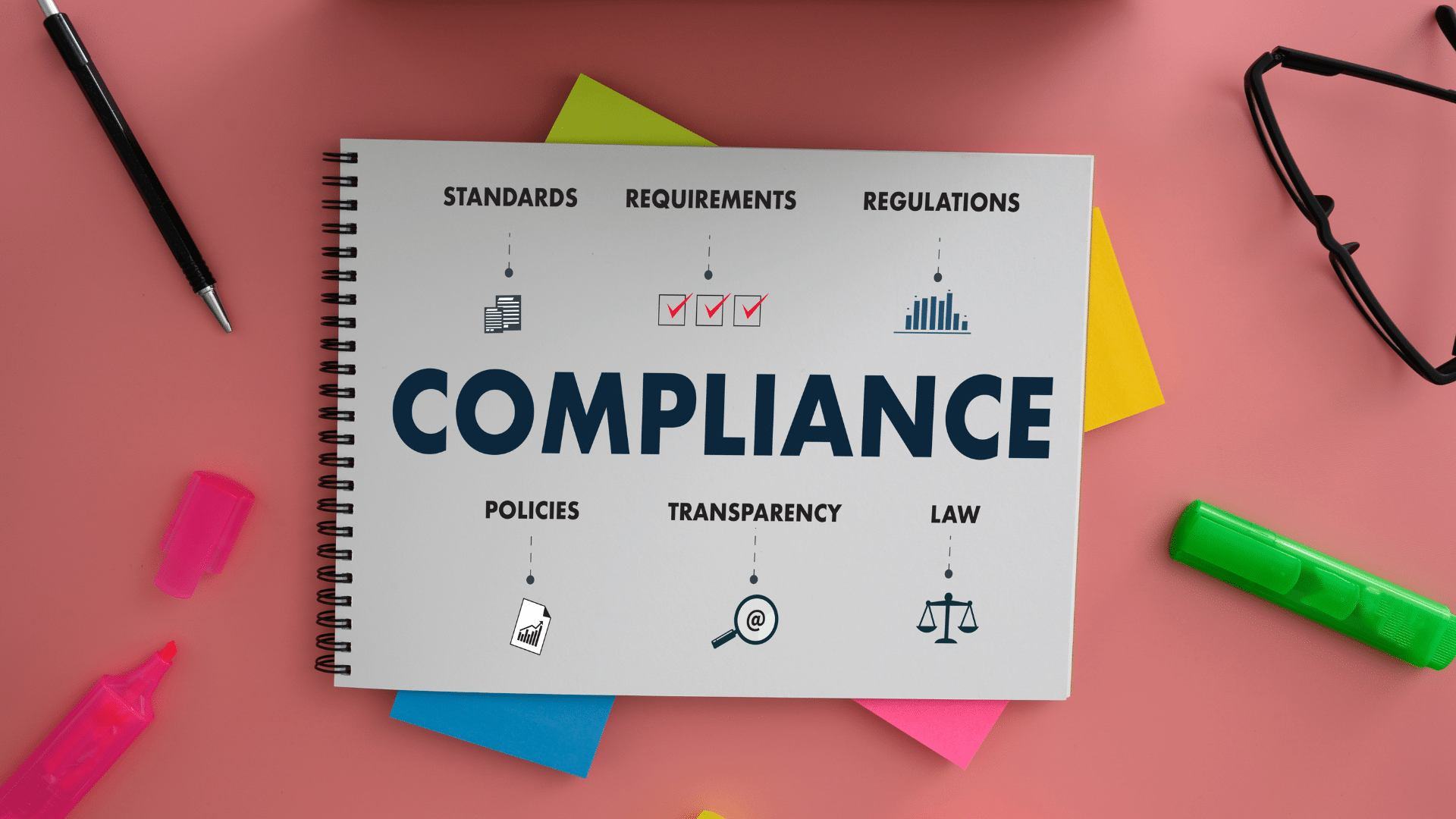
Security Elevates Compliance Beyond A "Check-The-Box" Approach
"Compliance is not the end goal when it comes to building an information security program," noted Rhymetec CISO Metin Kortak in our recent webinar on Security vs. Compliance.
Many organizations want to comply with compliance frameworks because it's a necessity for their customers or industry. However, there are many security measures that need to be carried out to build a truly robust infosec program that goes beyond a "check-the-box" approach to compliance.
Security is not a binary.
The question isn't, "Is this secure or is it not?". It's about the specific threats you want to protect against, the level of investment you can make, and the assets you're most concerned with protecting. Risk modeling is a great first step to answer these questions. Your security program should stem from your risk modeling and business goals.
"You need to be more proactive rather than reactive when building your information security goals. We don't want to be purely reactive and implement security controls just for a short-term necessity - we want to build long-term information security programs," said Metin.
In Conclusion: The Symbiotic Relationship Between Security and Compliance
Compliance is a great vehicle for setting goals, while security is one of the many pillars propping up and maintaining an organization's compliance. Security underpins the factors that help you stay compliant.
As an example, a compliance standard may have vague language requiring patching for all critical vulnerabilities within X number of days. Meeting that requirement is important from a compliance perspective. Where security comes in is to figure out how you should operationalize this process. How will you know about these vulnerabilities in the first place? Who will be responsible for designing a plan to patch them?
These are extremely important questions to answer that go beyond controls in many compliance frameworks. At the same time, building long-term strong security processes makes it easier to remain compliant over time.
At Rhymetec, we firmly believe that meeting key requirements is only the first step in establishing a strong security program.
About Rhymetec
Our experts have been disrupting the cybersecurity, compliance, and data privacy space since 2015. We make security simple and accessible so you can put more time and energy into other critical areas of your business. What makes us unique is that we act as an extension of your team. We consult on developing stronger information security and compliance programs within your environment and provide the services to meet these standards. Most organizations offer one or the other.
From compliance readiness (SOC 2, ISO/IEC 27001, HIPAA, GDPR, and more) to Penetration Testing and ISO Internal Audits/ISO Compliance, we offer a wide range of consulting, security, vendor management, phishing testing services, and managed compliance services that can be tailored to your business environment.
We leverage cutting-edge technologies, including compliance automation software, to fast-track you to compliance. If you're ready to learn about how Rhymetec can help you, contact us today to meet with our team.
About the Author: Justin Rende, CEO
Justin Rende has been providing comprehensive and customizable technology solutions around the globe since 2001. In 2015 he founded Rhymetec with the mission to reduce the complexities of cloud security and make cutting-edge cybersecurity services available to SaaS-based startups. Under Justin's leadership, Rhymetec has redesigned infosec and data privacy compliance programs for the modern SaaS-based company and established itself as a leader in cloud security services.
Interested in reading more? Check out additional content on our blog.
A SOC 2 readiness assessment is an important first step if your organization is thinking about obtaining SOC 2 compliance. Think of the readiness assessment as a health check for your security practices - it's meant to help you get everything you need completed before the formal audit.
In this FAQ, we'll tackle some of the most common questions we hear about SOC 2 readiness assessments - why you might need one, what it costs, how long it takes, who should be involved, and more. This will give you a clear picture of what to expect and help you understand what your organization needs before undergoing an external audit.
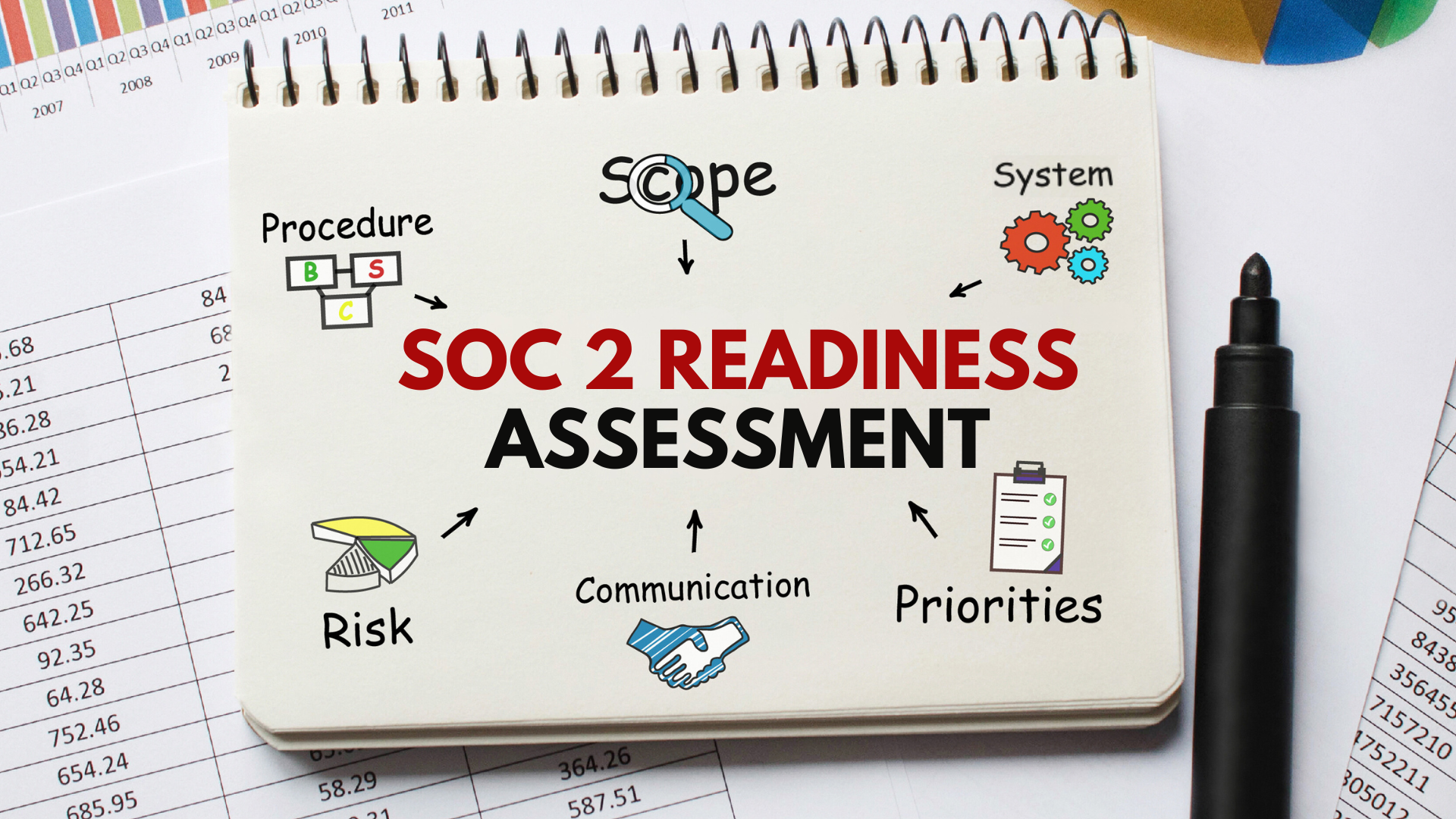
What Is A SOC 2 Readiness Assessment?
A SOC 2 readiness assessment is a pre-audit process that helps organizations prepare for their official SOC 2 audit. It identifies gaps in your current security controls and SOC 2 policies and procedures compared to where you need to be.
The first step is to select an external consultant. Your consultant will conduct a thorough review of your existing security controls (security measures, documentation, operational procedures, and more) to identify areas where you may not be meeting SOC 2 standards.
The assessment entails several key benefits, allowing you to:
- Have a third-party opinion of your SOC 2 audit preparedness
- Pinpoint gaps and weaknesses in your existing controls
- Obtain ideas on how to strengthen your processes and procedures
Testing your current controls and finding areas where remediation is needed is important to do in preparation for your audit.
How Much Does A SOC 2 Readiness Assessment Cost?
The cost of a SOC 2 readiness assessment can vary. The following factors impact cost: Organization size, the complexity of your IT infrastructure, the consultant you work with, the Trust Services Criteria you selected, the use of project management or GRC tools, and other factors that vary from consultant to consultant.
Readiness assessment estimates start at around $7,000 - $15,000. For a small startup with a straightforward infrastructure, costs typically start at the lower end. For larger organizations or for those with complex systems, costs can increase significantly, potentially reaching tens of thousands of dollars.
Some firms offer fixed-price packages that bundle the SOC 2 readiness assessment into the overall cost of obtaining SOC 2 compliance. Others charge based on the time and resources required to complete the assessment. Obtaining detailed quotes from multiple providers can help you understand the potential costs for your organization.
How Long Does A SOC 2 Readiness Assessment Take?
The timeframe to complete a SOC 2 readiness assessment varies. For large organizations or for those with more complex IT environments, it can take anywhere from 1-4 weeks. For smaller organizations with less complex environments, it can take as little time as several days to a week.
During this period, key activities include evaluating your existing security controls, identifying any deficiencies, and creating a plan to address those gaps. Another factor that impacts the time frame is how quickly your organization can make changes and remediate gaps.
Who Should Be Involved From Your Team?
A SOC 2 readiness assessment requires involvement from several key members of your team. These typically include:
1. IT and Security Personnel, as they have the best understanding of your technical infrastructure and current security measures.
2. Compliance Officers (If Applicable): Whomever at your organization is responsible for ensuring adherence to regulatory and industry standards should be involved.
3. Operations Managers: Personnel who oversee the processes and controls related to daily business activities can help make sure daily operations adapt to and are impacted as little as possible by any new security measures.
4. HR Personnel can provide information on employee onboarding, training, and access controls.
5. Executive Leadership: Executives are responsible for allocating resources and ensuring changes to the organization's security posture are communicated down the line. (Note: An emphasis on the role of executive leadership and governance in cybersecurity is increasingly being seen across other cybersecurity standards, including under the recently added NIST governance function).
Involving all of these specialized roles allows you to speed things up and facilitates an effective assessment. Using compliance automation software can also help fast-track the process by providing a centralized location where all involved parties can access and track pertinent information.
Does Your Organization Need a SOC 2 Readiness Assessment?
Whether your organization needs a SOC 2 readiness assessment depends on your circumstances and goals. It's particularly useful if you're new to SOC 2 or if you have not previously undergone a SOC 2 audit. It serves to make the entire SOC 2 process easier, as assessments are highly tailored to your organization's unique needs.
Not every company should follow everything under the SOC 2 standard. Choosing the right Trust Services Criteria is an important step in your journey. A readiness assessment allows you to identify the security controls and practices that you actually need to implement.
Can You Fail A SOC 2 Readiness Assessment?
No, you cannot technically "fail" a SOC 2 readiness assessment. The assessment is a preparatory step that identifies gaps and recommends improvements before your formal audit. It serves as a diagnostic tool to help you understand which areas need to be addressed to meet SOC 2 requirements.
What Happens If Gaps Are Found During The Assessment?
If gaps are found it means your organization has some work to do before pursuing the official audit. That's the purpose of the readiness assessment: to highlight and correct issues in advance.
The controls you may need to remediate depend on which Trust Services Criteria you selected. For example, if you selected the Security Trust Services Criteria and are not currently conducting measures like regular phishing training for employees, you may need to implement stronger controls to protect against unauthorized access and disclosure of data.

Who Performs A SOC 2 Readiness Assessment?
The assessment is typically performed by experienced third-party firms that specialize in compliance and security audits. This includes:
1. Certified Public Accountants (CPAs) with IT specializations have the expertise needed to understand both the technical and compliance aspects of SOC 2.
2. IT Consulting Firms that focus on cybersecurity and compliance, and are experienced in assessing and improving IT controls.
3. Managed Security Service Providers (MSSPs) offer a range of security services and can conduct readiness assessments as part of their broader security offerings.
These options all provide an external expert perspective, enabling you to identify gaps and act on expert recommendations to effectively meet SOC 2 requirements.
What Are The Most Frequently Found Gaps In SOC 2 Readiness Assessments?
At Rhymetec, we have worked with hundreds of companies on their SOC 2 readiness. Some of the most common gaps we see companies have include the following:
1. Access Controls: We often see gaps related to inadequate controls over user access to systems and data. This includes weak password policies, lack of multi-factor authentication, and improper user permissions.
2. Security Monitoring: Many organizations lack up-to-par monitoring based on SOC 2 guidelines if this is an area they haven't previously paid much attention to. Under SOC 2 requirements, systems and networks should be monitored for suspicious activities or unauthorized access.
3. Data Protection: There is often room for improvement in areas like data encryption. Our security experts have helped many organizations improve their data backup and recovery procedures in preparation for their audit.
4. Vendor Management: A lot of organizations don't realize how much oversight of their third-party vendors and service providers is required under SOC 2. We help organizations identify any gaps in due diligence, contract management, and vendor review & risk assessments.
5. Incident Response: Organizations often need to create a documented incident response policy and accompanying procedures. At Rhymetec, we craft detailed incident response plans tailored to our clients’ individual industries and needs.

Addressing these common gaps is not only critical for achieving SOC 2 compliance, but also for better protecting your organization's (and end users') data and systems.
Interested in reading more on SOC 2? Check out additional content on our blog:
- SOC 2 Compliance Checklist
- SOC 2 Type 1 vs Type 2: Which Do You Need?
- Rhymetec's Complete SOC 2 Compliance Guide
About Rhymetec
Rhymetec was founded in 2015 as a Penetration Testing company. We offer a range of penetration testing services to include:
- Mobile Application Penetration Testing
- Web Application Penetration Testing
- External Network Penetration Testing
- API Penetration Testing
After seeing a gap for broader security support in the market, Rhymetec grew to offer managed compliance services for frameworks like SOC 2, ISO 27001, GDPR, CCPA, HIPAA, HITRUST, NIST and more. Since then, we have served hundreds of SaaS businesses globally in all their cybersecurity, compliance, and data privacy needs. We're industry leaders in cloud security, and our custom services align with the specific needs of your business. If you want to learn more about how our team can help your business with your security needs, contact our team for more information.
Companies often find that SOC 2 compliance acts as a business enabler, unblocking sales and allowing them to break into new marketplaces.
However, obstacles like resource constraints and a lack of in-house expertise make crossing the finish line with compliance a challenge, especially for small and mid-sized businesses.
Achieving compliance with standards like SOC 2 can seem like a daunting task. In our latest webinar, Rhymetec CISO Metin Kortak spoke to Craig Saldanha from Insight Assurance about how to simplify SOC 2 compliance and navigate the 5 SOC 2 Trust Services Criteria:
Check out the recording to watch their discussion. A bit about the speakers:
Metin Kortak started his career in IT security and then joined Rhymetec to build data privacy and managed compliance as a service offerings. Rhymetec started as a penetration testing firm in 2015, and under Metin's leadership, we've expanded to do all things security and compliance, with a focus on working with startups.
Craig Saldanha from Insight Assurance has nearly 10 years of audit experience. He's an expert in GRC and third-party/vendor risk management. In his current role at Insight Assurance, he leads and manages SOC 2, PCI, & vCISO service lines.
What Are The 5 Trust Services Criteria for SOC 2?
The SOC 2 Trust Services Criteria are used to evaluate an organization's controls related to data management. The 5 criteria are:
- Security (the protection of data against unauthorized access).
- Availability (the system's operational uptime and accessibility).
- Processing Integrity (ensuring that system processing is complete, valid, and accurate).
- Confidentiality (protection of sensitive information from unauthorized disclosure).
- Privacy (focuses on the collection, use, and retention of personal information).
"Security is the most common one that we see at Rhymetec," Metin noted.
The entire SOC 2 set of controls is over 150 controls. About 70% of that is likely going to be controls related to the security Trust Services Criteria. When customers are pursuing a SOC 2 assessment, security Trust Services Criteria are usually selected by default and included in every report.
The remaining 4 have fewer available controls to select. Some of them are more challenging to implement, which is one reason some companies just select the security criteria.
When it comes to which criteria to select, there are two main things to consider:
- What your requirements from your client base are
- What you value in your information security program
At Rhymetec, "We usually look at what our customers need, what is most important to them, and what their customer requirements are. A lot of organizations pursue SOC 2 because their clients are requiring them to have it, or they would like to pursue a larger client that has stricter requirements to start working with them," said Metin.
It also depends on what you value as a company. If you really value the availability of customer data and are concerned about privacy, you'd also want to select those criteria. Lastly, it also depends on factors like the type of data you handle and requirements specific to your industry.
At Rhymetec, we sometimes see customers pursuing all 5 Trust Services Criteria:
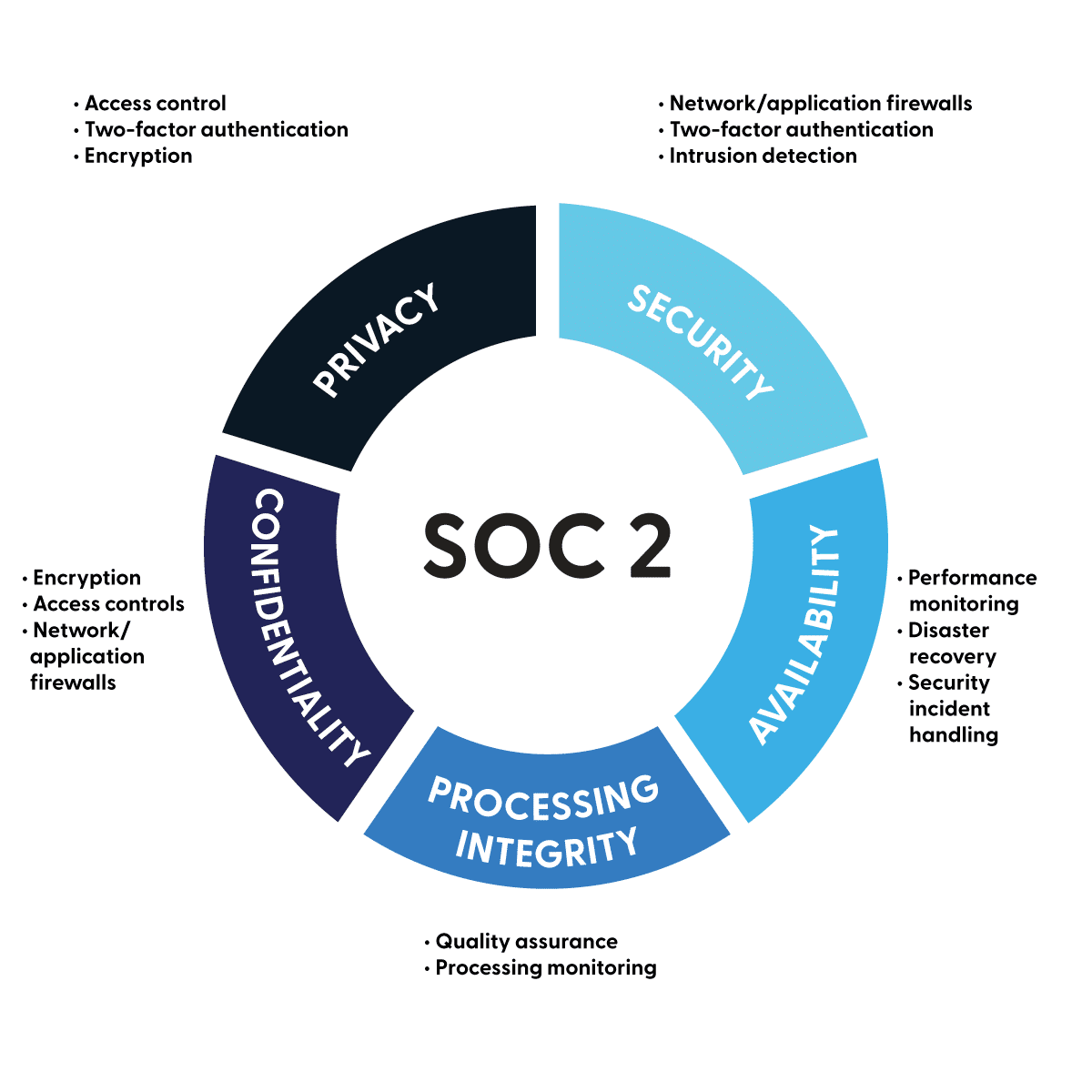
What Is SOC 2 and Why Are The SOC 2 Trust Services Criteria Important?
SOC 2 is a security and compliance standard created by the AICPA.
The primary purpose of SOC 2 is to ensure that third-party companies, SaaS providers, and other organizations protect their client information in a secure manner. SOC 2 compliance demonstrates your commitment to security and builds trust with your clients and stakeholders.
There are two types of SOC 2 audits: Type 1 and Type 2.
"Type 1 is a point-in-time audit and takes a much shorter time to complete with our customers at Rhymetec," Metin explained in our webinar. "We can usually get them compliant within about three months, and in some cases even less if they have already implemented some security controls."
For SOC 2 Type 2 (the more commonly sought type), companies are audited over a period of time.
Observation windows start at a minimum of three to six months, with some auditors requiring a 12-month period. Metin noted that, "...it makes the audit definitely more challenging, as companies are audited over the course of the observation window. If you missed an SLA (service-level agreement), or if an employee was onboarded incorrectly, that may cause some issues with your audit reports."
Getting expert input from the beginning of your SOC 2 journey can avoid these pitfalls, and enable you to choose the right criteria for your business.
From an MSSP (Managed Security Services Provider) perspective, Metin typically finds that there is a lack of understanding about the SOC 2 Trust Services Criteria in particular:
"When customers start working with us, we usually need to explain to them what the 5 Trust Services Criteria are and which ones they should select for their business. It's a very critical decision-making process."
So, let's jump right into what the Trust Services Criteria are, how to select the right ones for your business, and more:
Industry-Specific Examples for Each SOC 2 Trust Services Criteria
Let's take a closer look at each individual Trust Services Criteria:
1. Security
Regardless of your industry or what type of company you are, the security Trust Services Criteria is a mandatory component of the SOC 2 Report. It's required for all SOC 2 engagements and forms the baseline on which other criteria are then built.
For the next 4 criteria, we will provide examples of the types of companies that may opt to select each one:
2. Availability
Criteria around the availability of data apply to companies like online realtors and e-commerce platforms that rely on continuous uptime to support their customer transactions.
Telecom companies that provide communication services and need to maintain uninterrupted network availability would also want to explore availability criteria under SOC 2. Lastly, utilities and other critical infrastructure providers that need to ensure constant availability for operational purposes may opt for this set of criteria.
3. Processing Integrity
This applies to investment firms, accounting firms, and financial service providers that manage financial transactions and require accurate processing of data. Manufacturers that rely on automated processes for production and distribution would also want to consider the integrity selection criteria.
4. Confidentiality
"Law firms and legal service providers that handle sensitive client information would want to consider confidentiality," said Craig. So would consulting firms that deal with proprietary business strategies and government organizations that handle classified or sensitive information.
5. Privacy
Last but not least, privacy is often selected by schools, universities, and online education platforms to protect the personal data of students and staff. Likewise, online retailers that collect customer information for marketing purposes and healthcare organizations often opt for privacy criteria.
It's important to note that companies must roll out SOC 2 compliance across all locations and business units. Some adjusting may be needed if you operate across multiple regions to reflect nuances like local regulations and cultural differences. But in general, controls under the selected Trust Services Criteria should be consistently implemented.
Who And What Should Be In Scope?
The scope refers to the specific boundaries and focus areas that an audit will cover concerning the SOC 2 Trust Services Criteria.
By paying close attention to scope from the beginning, you can help reduce the scope and get through your audit easier. Here is what auditors will look for of who will be in scope, according to Craig:
"Any users that are critical to the delivery or the service that we are auditing should be in scope. In addition to anyone with access to sensitive data, customer data, or production data."
This could include your core team members across IT security, compliance, HR, finance, and operations, as well as consultants or contractors.
As for systems in scope (the what), it depends on 1) which systems impact your customers, and 2) which systems contain customer information.
"When we go through a SOC 2 Type 2 audit with a client, the auditors are looking into the production systems, production networks, and other production devices that actually impact customers. Staging environments or test environments that do not impact customer systems are not monitored or even audited," Metin explained.
If you have a SaaS product or other technical systems in place, you should think about what is actually in production and what impacts your customers. This also applies to any third-party vendors you work with.
If a vendor does not impact your customers in any way and does not process sensitive information, it will likely be assigned as low-risk and won't be subject to the same scrutiny as high-risk vendors (like your hosting provider or your email provider).
What Tools and Advice Should Companies Consider To Help Streamline Compliance?
"First off, consider using compliance automation tools," suggested Craig. "We see clients save time to focus on their business by leveraging compliance automation tools in the market."
Spreadsheets don't cut it anymore. Compliance automation tools speed things up for everyone and are favored by auditors.
Having a solid project management tool is also very important.
There is a lot of work involved in SOC 2 compliance and there are typically 10 - 15 stakeholders who need to follow these controls and track them to completion. With a project management tool, you can add certain tasks (such as your penetration tests, access reviews, and risk assessments), assign them to the right personnel, and track them to completion.
Craig also suggested seeking guidance from compliance experts. Choosing the right vCISO and the right auditing partner for your business is critical, as is investing in internal training to ensure everyone understands their roles in your compliance journey.
Next, implementing continuous monitoring for compliance maintenance is extremely important. Any instances of non-compliance should be quickly rectified. Be sure to keep thorough documentation for your audit for any areas that fall out of compliance and how you addressed them.
There are some additional baseline security tools you will need to have, depending on which controls you select. These include vulnerability monitoring tools, intrusion detection systems, and a system to enable multifactor authentication.
5 Ways To Streamline Compliance
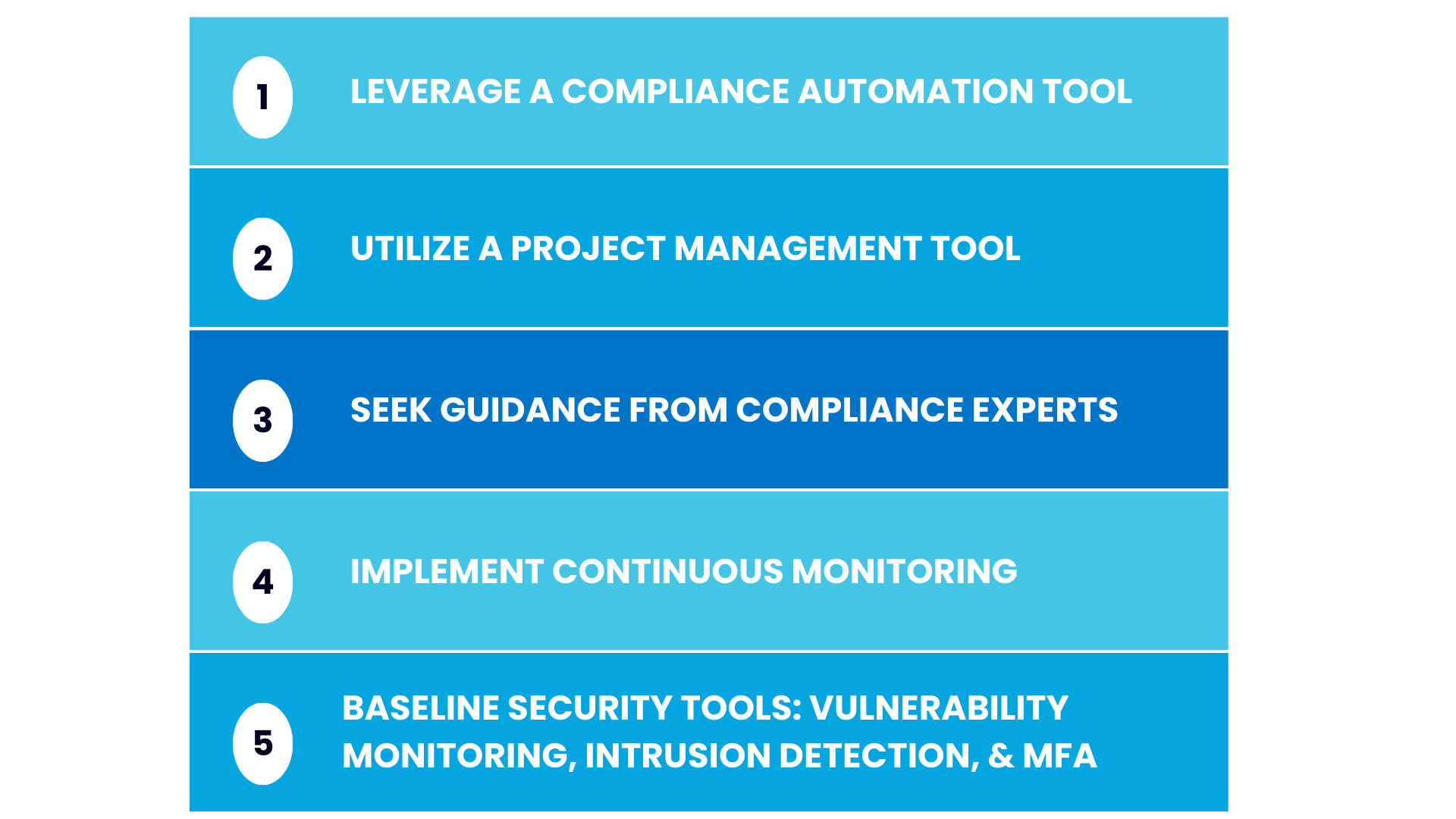
Concluding Thoughts: How Rhymetec Aligns SOC 2 Trust Services Criteria With Businesses' Operations & Goals
At Rhymetec, we enable businesses to align SOC 2 controls with their operations and goals to protect data, build customer trust, and meet regulatory requirements in their industry.
SOC 2 compliance shows that you take security seriously and mitigates risks. As demonstrated in our case studies with businesses like Kizen and Modicum, companies also find that having their SOC 2 report unblocks sales and opens up new market opportunities.
At Rhymetec, we see compliance and security as business enablers. We've helped over 600 companies establish scalable security solutions and get compliant in record time. Our custom solutions are specifically tailored to each organization we work with so their cybersecurity grows with their business and goals.
Explore our transparent pricingand schedule a time to chat with our team to learn more.
Interested in reading more? Check out additional content on our blog.
ISO 42001 sets the stage for responsibly managing AI systems within organizations. Taken together, ISO 42001 controls and policies represent the first international AI management system standard. With the proliferation of AI across many industries showing no signs of slowing down, guidance is sorely needed to address potential security, societal, environmental, and other risks posed by the use of AI.
Security concerns around AI are top of mind for many organizations at the moment. Recently, companies like Samsung have gone as far as banning the internal use of generative AI tools after a data leak with ChatGPT. Meanwhile, consumers are becoming increasingly concerned about how companies utilizing AI systems handle their data.
ISO 42001 aims to provide clarity around how organizations can responsibly use AI. Adherence to ISO 42001 controls sends a strong signal that an organization takes the security component of AI seriously. It is the most comprehensive attempt to date to provide clear requirements for implementing and continually managing the use of artificial intelligence. In this article, we go over what it is, who it applies to, and what businesses need to do to implement it.
Who Does ISO 42001 Apply To?
ISO 42001 is a voluntary standard. There are no legal obligations to adhere to it. However, it becomes a must-have for many organizations once their prospects and clients start asking for evidence and reassurance that their data is being safely handled by systems using AI.
Given the wave of media hype around AI, and the rapid improvement of the technology itself, many organizations have started to ask serious questions about the potential risks.
The standard applies to any organization developing or providing products or services that utilize AI systems. Based on official guidelines, ISO/IEC 42001 is for:
"Organizations of any size involved in developing, providing, or using AI-based products or services. It is applicable across all industries and relevant for public sector agencies as well as companies or non-profits."
The implementation of ISO 42001 controls, as well as the responsibilities within the management of AI systems, can vary depending on the individual organization.
What Do Businesses Need To Do To Implement ISO 42001 Controls?
The standard is quite robust but can be summarized into three main action items that organizations must complete in order to implement it. There is a clear focus on risk assessment, the role of governance, and compliance as a continuous process rather than a "check the box" item for businesses. The focus on these trends is reflected across the standard's three main components:
1. Create An AI Management System
A key component of ISO/IEC 42001 is the concept of an Artificial Intelligence Management System (AIMS). An AI management system is a documented system an organization uses to establish and enforce policies that manage assets using AI.
The AI management system also establishes objectives related to the use of AI and creates processes to achieve them. The goal is to have a set strategy for responsibly managing AI that is applied across the organization and aligns with overall business goals.
At a high level, the AI Management System should:
- Align with organizational objectives.
- Define and manage both risks and opportunities associated with AI.
- Oversee the implementation of controls to address AI security risks.
- Manage third-party vendors and partners involved in the development and/or ongoing use of AI systems.
In conjunction with the creation and documentation of an AI Management System, organizations must also conduct an impact analysis (determining the broader potential security and societal impact of AI systems, as well as the impact on business goals), establish clear policies on the use of AI, and implement controls to ensure data is responsibly handled in AI systems.
Lastly, the standard emphasizes the importance of continuous monitoring and improvement of the AI management system.
2. Conduct An Impact Analysis
There is a clear focus on the importance of assessing the societal impacts of AI systems. One of the core controls requires organizations to assess and document the potential impacts of their AI systems in the following areas:
- Environment sustainability (including the impacts on natural resources and greenhouse gas emissions);
- Economic (including access to financial services, employment opportunities, taxes, trade and commerce);
- Government (including legislative processes, misinformation for political gain, national security and criminal justice systems);
- Health and safety (including access to healthcare, medical diagnosis and treatment, and potential physical and psychological harms);
- Norms, traditions, culture and values (including misinformation that leads to biases or harms to individuals or groups of individuals, or both, and societies).
ISO 42001 controls require an AI risk assessment, along with an AI system impact assessment, to be conducted and continuously evaluated. This means that organizations must not only continuously monitor the impact of AI as risks change but must also evaluate the efficacy of their systems intended to mitigate that risk.
3. Implement and Continuously Improve ISO 42001 Controls
There are many areas where controls can be adjusted according to the organization's industry and needs.
Here is a summary of the standard's additional controls and overall implementation guidance:
Establish Roles & Responsibilities, and Document AI Policies: Organizations must establish and document clear policies around AI that are aligned with overall objectives and demonstrate a commitment to continuous improvement. Leadership must communicate the importance of AI management across the organization and share resources with employees. The roles and responsibilities related to the AI management system should be made clear, as well as how the AI management system requirements fit into business processes and goals. AI design choices, including machine learning methods, must also be documented.
Address Risks and Opportunities: Identifying potential risks and establishing a plan to address them is a critical step. This involves conducting an AI risk assessment and then selecting appropriate risk treatment options, implementing controls, and producing a statement of the applicability of controls. Objectives related to the use of AI, as well as a plan to achieve them, must be established and continuously reassessed.
Provide Organization-Wide Resources and Support: Create and distribute resources necessary for the AI management system and its ongoing improvement. Ensure that employees involved in AI-related activities receive appropriate training and education and that employees are aware of their roles within the AI policies.
Evaluate Performance: This involves ongoing monitoring, analysis, and evaluation of the performance of the AI management system. This can take the form of internal audits, intended to ensure conformity to AI management system requirements across the organization. Reviews of the AI management system must be conducted at planned intervals throughout the year.
Continual Improvement and Corrective Action: This last piece highlights the increasing importance being placed on continuous compliance rather than a "check the box" mentality. This is a shift we are seeing across the board for other requirements and standards, such as in the latest version of NIST CSF with the addition of the NIST Governance function.
In the context of ISO 42001, this means that organizations must continually improve their AI management system and take corrective action to make changes as needed.
In Conclusion: What ISO 42001 and The AI Management System Mean For Businesses
Organizations that adhere to ISO 42001 gain several key benefits. First and foremost, they gain the benefit of responsible use of AI and the peace of mind knowing they can provide evidence of that to any partners, prospects, or other business stakeholders.
As is often the case with other voluntary standards (such as SOC 2), organizations often find that their deals cycle becomes shorter, as prospects' questions around security are proactively answered and they no longer need to fill out lengthy security questionnaires.
Secondly, organizations gain the benefit of reputation management. Given the focus on mitigating environmental, societal, and economic damage, adherence to ISO 42001 controls serves as a signal that organizations care about their role in these issues and have taken steps to invest in the responsible use of AI. This can have the effect of improving their reputation as reliable, responsible, and trustworthy.
Lastly, there is an enormous benefit in terms of AI governance. ISO 42001 controls map onto laws and regulations around the use of artificial intelligence, allowing organizations to align the use of AI with laws relevant to their industry and location. As one of the first frameworks to directly address AI, ISO 42001 will serve as a baseline for future standards and laws.
Organizations can take a proactive approach by complying with ISO 42001. This saves time and money down the line when other frameworks and laws catch up.
About Rhymetec
Our mission is to make cutting-edge cybersecurity available to SaaS companies and startups. We’ve worked with hundreds of companies to provide practical security solutions tailored to their needs, enabling them to be secure and compliant while balancing security with budget. We enable our clients to outsource the complexity of security and focus on what really matters – their business.
If your organization is interested in exploring compliance with AI standards, we now offer ISO/IEC 42001 certification readiness and maintenance services and are happy to answer any questions you may have.
About The Author: Metin Kortak, CISO
Metin Kortak is the Chief Information Security Officer at Rhymetec. Metin began his career working in IT security and gained extensive knowledge of compliance and data privacy frameworks such as SOC 2, ISO 27001, PCI, FedRAMP, NIST 800-53, GDPR, CCPA, HITRUST and HIPAA. He joined Rhymetec to build data privacy and compliance as a service offering.
Under Metin’s leadership, these offerings have grown to more than 200 customers, positioning the company as a leading SaaS security service provider in the industry.
Interested in reading more? Check out additional content on our blog:
- Maximize Your Use of Compliance Automation Platforms
- 7 Factors To Consider Before Implementing AI in Your SaaS Company
- Phishing Training For Employees: 5 Steps To Success
How are resource-savvy businesses fast-tracking and maintaining cybersecurity compliance in 2024?
Many companies are now using an innovative and complete solution that combines automation with hands-on, expert security services. Compliance automation platforms provide an invaluable tool that works in sync with manual tasks to achieve compliance in the fastest timeframe possible, helping you effectively prepare for your audit.
Our team of security experts at Rhymetec is extremely experienced with this process. We have helped hundreds of companies build strong infosec programs and meet compliance requirements while reaping the full benefits of an automation tool. For more information on how we can help with all of your security and compliance automation needs, contact our team today:
The Benefits of Compliance Automation
Compliance automation is an innovative tool companies use to establish and scale their information security (infosec) programs. The platform serves as a single source of truth for everything related to compliance, allowing companies to have sharp visibility into these areas and pinpoint exactly what they need to do.
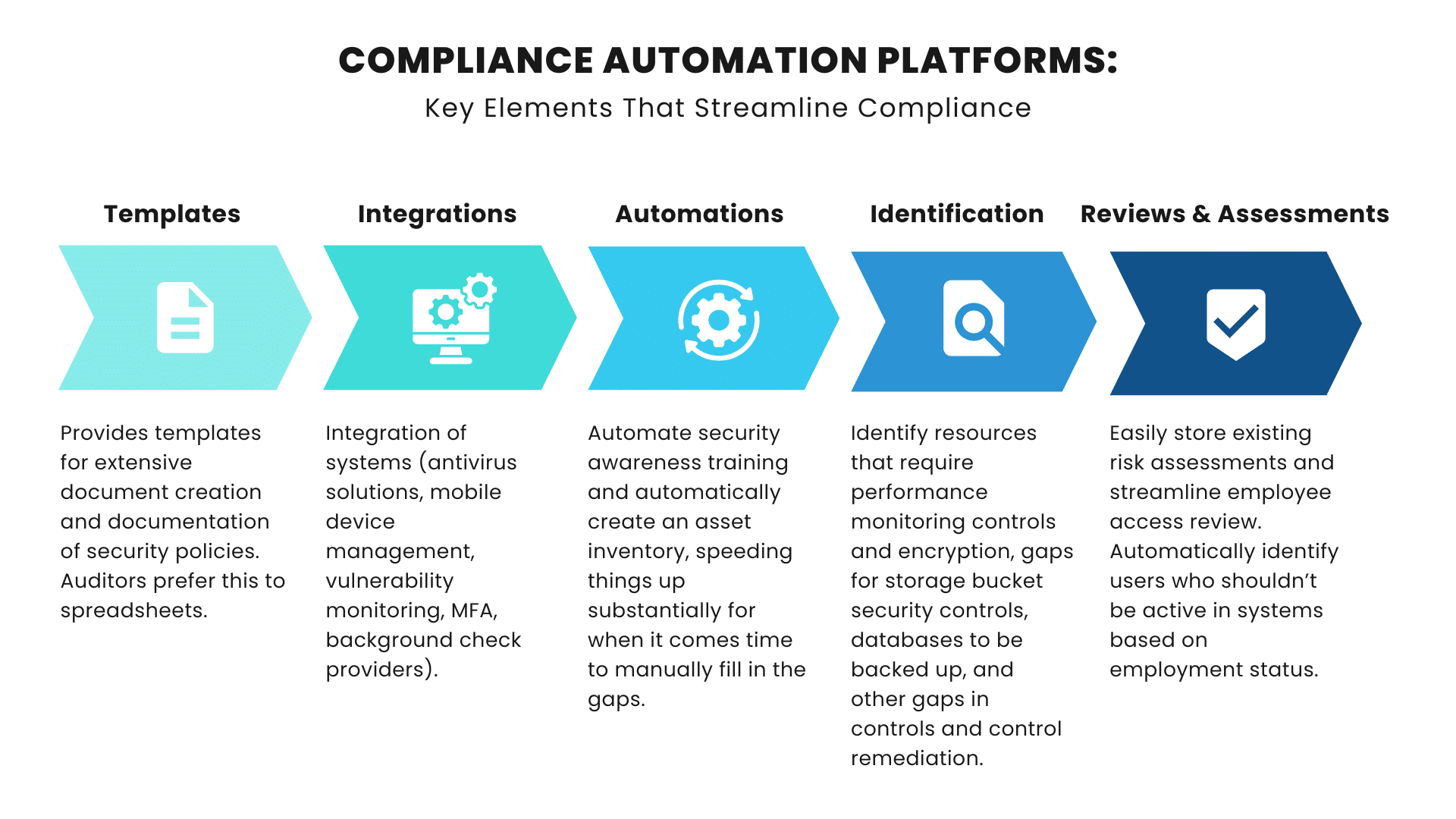
Many companies elect to use an automation tool because they are astutely thinking ahead about their audits and what they can do to make the process easier. After all, what makes life easier for your auditor will ultimately make your life easier as well.
No auditor likes receiving headache-inducing 50-page Excel spreadsheets that they have to figure out how to navigate for every new engagement. Instead, auditors appreciate having a single place where companies can easily collect all relevant documentation laid out in a clear format. Compliance automation platforms provide exactly this.
They streamline the process in many areas, accomplishing the following tasks:
Policy Templates:
Compliance automation platforms provide robust templates for extensive document creation and documentation of security policies.
Integrations Provided By Compliance Automation:
A key advantage of using an automation platform is the level of integrations it provides. Platforms provide integrations in the following areas (and more) in order to streamline compliance:
- Background check providers to notify clients if background checks are missing for any employees.
- Vulnerability monitoring solutions to create test failures based on vulnerabilities and source code tools for identification of testing failures.
- Relevant client systems to identify systems without MFA.
- Mobile Device Management and antivirus solutions to identify gaps in compliance.
Human Resource (HR) Security Solutions:
Automation platforms can automate security awareness training for organizations. This is an important advantage, as many frameworks require security awareness training. Employee access reviews can also be conducted by identifying users who shouldn't be active in systems based on their employment status. This is made possible by collecting user access information through integrations with other systems.
Frameworks like SOC 2 require periodic performance reviews for employees. These platforms provide a centralized place for evidence collection of performance reviews.
Asset Inventory:
The automatic creation of an asset inventory using available integrations is a key benefit, speeding things up substantially for when it comes time to manually fill in the gaps.
Identification Through Compliance Automation:
Compliance automation platforms automatically identify control items in the following areas:
- Resources that require performance monitoring controls.
- Resources that require encryption in transit.
- Resources with gaps for storage bucket security controls.
- Databases that are not backed up.
- Gaps in controls and control remediation.
Risk Management:
Compliance automation platforms store existing risk assessments conducted by the customer or security professional. Additionally, they provides 3rd party supplier management by storing existing risk assessments for all vendors, and their security reports.
Security Questionnaire Fulfillment:
Lastly, they offer automated security questionnaire fulfillment, removing a large amount of the burden of filling out long questionnaires.
The automation and integrations provided by compliance automation platforms speed up an array of complex processes that would otherwise take substantially longer. However, a security and compliance professional is still needed to ensure your team is doing the manual tasks of meeting your desired compliance goals; drafting policies, setting up company-specific security awareness training, conducting risk assessments, and much more.
Pinpointing The Controls You Need and That Align With Auditor Expectations
Don't have a security or compliance professional in-house? Or unsure where to start?
This is where an outsourced team of security professionals can come in to carry out a wide range of manual components necessary to get businesses across the finish line for compliance. Rhymetec's team provides the customization needed to make security and compliance efforts specific to your unique infrastructure every step of the way.
For example, one of the best parts of SOC 2 is the level of flexibility it provides for the controls, allowing companies the ability to tailor it to fit their needs. A compliance automation platform used in tandem with the customized services from an expert security team enables companies to speed things up while also ensuring they implement only the controls that make sense for their business and will align with what the auditor will expect to see.
The specialization provided by a security team allows businesses to avoid overly onerous control implementation that may not be necessary in their compliance journey.
The Manual Components of Compliance: Humans Still In The Loop
Compliance requirements and voluntary standards mandate an array of hands-on security support that only a team of qualified professionals with years of experience across different subdisciplines in cybersecurity can perform. To achieve and maintain compliance, organizations need a team of experts in GRC, penetration testing & vulnerability management, cloud security, network security, incident response, and more.
Compliance automation platforms provide a great way to manage the process and continually identify areas that need attention, speeding up the time it takes to get started and complete manual tasks. Meanwhile, the customization provided by working with Rhymetec's team ensures alignment between the controls and auditors' checklists. It enables clients to show evidence of completion of controls that cannot be automated, including penetration testing, internal audits, and tabletop exercises.
The Initial Phase: Getting Set Up
In the initial phase of the engagement, Rhymetec's security team gets the client set up in the compliance automation platform by manually accomplishing the following tasks:
- Initial Set Up In The Platform: Rhymetec manually adds the client's information to the compliance automation platform. Additionally, employees, users, and all other relevant information depending on the individual client's needs are added to the platform.
- Integration of Relevant Systems: Next, the team integrates relevant systems with the automation platform and configures settings to get items including security awareness training and onboarding setup.
- Project Planning: Rhymetec's team meets with the client to determine the infrastructure details and create a system description. The security team works closely with the client at this phase to gain a deep understanding of their individual needs and to identify the exact controls they need to adhere to under the chosen framework(s).
Compliance isn't one-size-fits-all.
Organizations can have vastly different needs depending on factors like their industry, geography, company size, the third parties they work with, the types of data they handle, and more. Without an experienced security and compliance team to examine these factors, there's a risk of not doing enough or even doing too much.
Filling In The Gaps
Using the information provided by the platform as a baseline, Rhymetec's team goes from there to fill in the gaps based on each client's individual needs. This stage involves:
- Gap Assessment: Rhymetec manually reviews all controls and identifies gaps in compliance for the client.
- Evidence Gathering: The security team works with the client and other stakeholders to collect and store evidence required by auditors, using the compliance automation platform as a convenient place to upload all documentation.
- Policy Management: Using templates provided by the compliance automation platform as a baseline, Rhymetec fully customizes and edits information security policies based on individual client needs.
- Performance monitoring controls: Based on the resources identified by the compliance automation platform, Rhymetec implements controls on infrastructure systems such as databases, servers, and buckets. This helps the client gain visibility into their infrastructure.
- Asset inventory: Using the asset inventory created by the automation platform, Rhymetec manually reviews the inventory and ensures all production systems are included in it.
These action items work hand-in-hand with the compliance automation platform in the following ways:
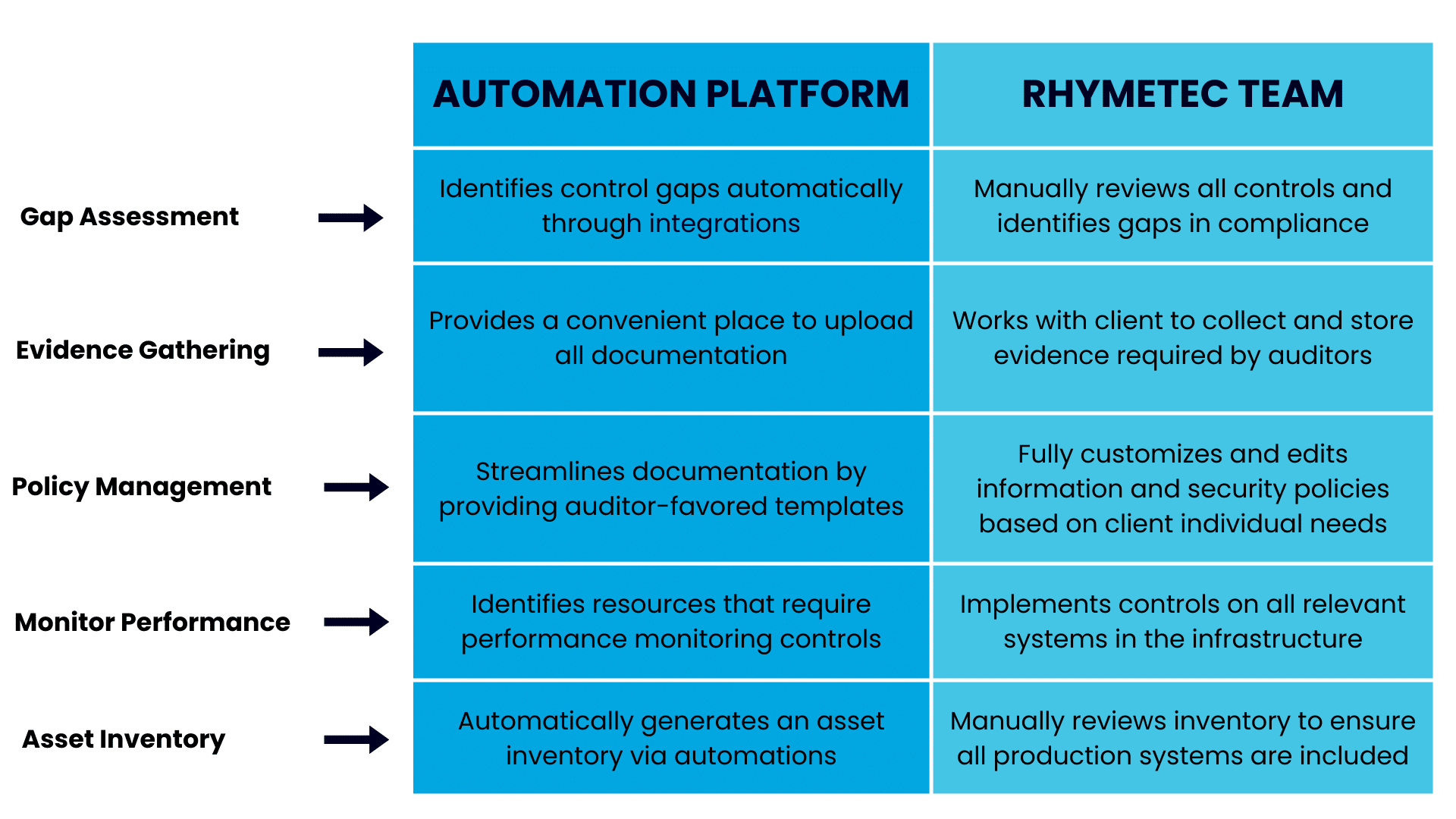
Completion of Manual Security Tasks
Thanks to the features of the compliance automation platform, many items are able to be easily identified as needed for the client on an ongoing basis. This substantially cuts down time, enabling the security team to fill in the manual pieces as soon as they are identified.
However, not every task has elements that can be automated. The fully manual tasks needed to meet controls under many cybersecurity regulations and frameworks include the following:
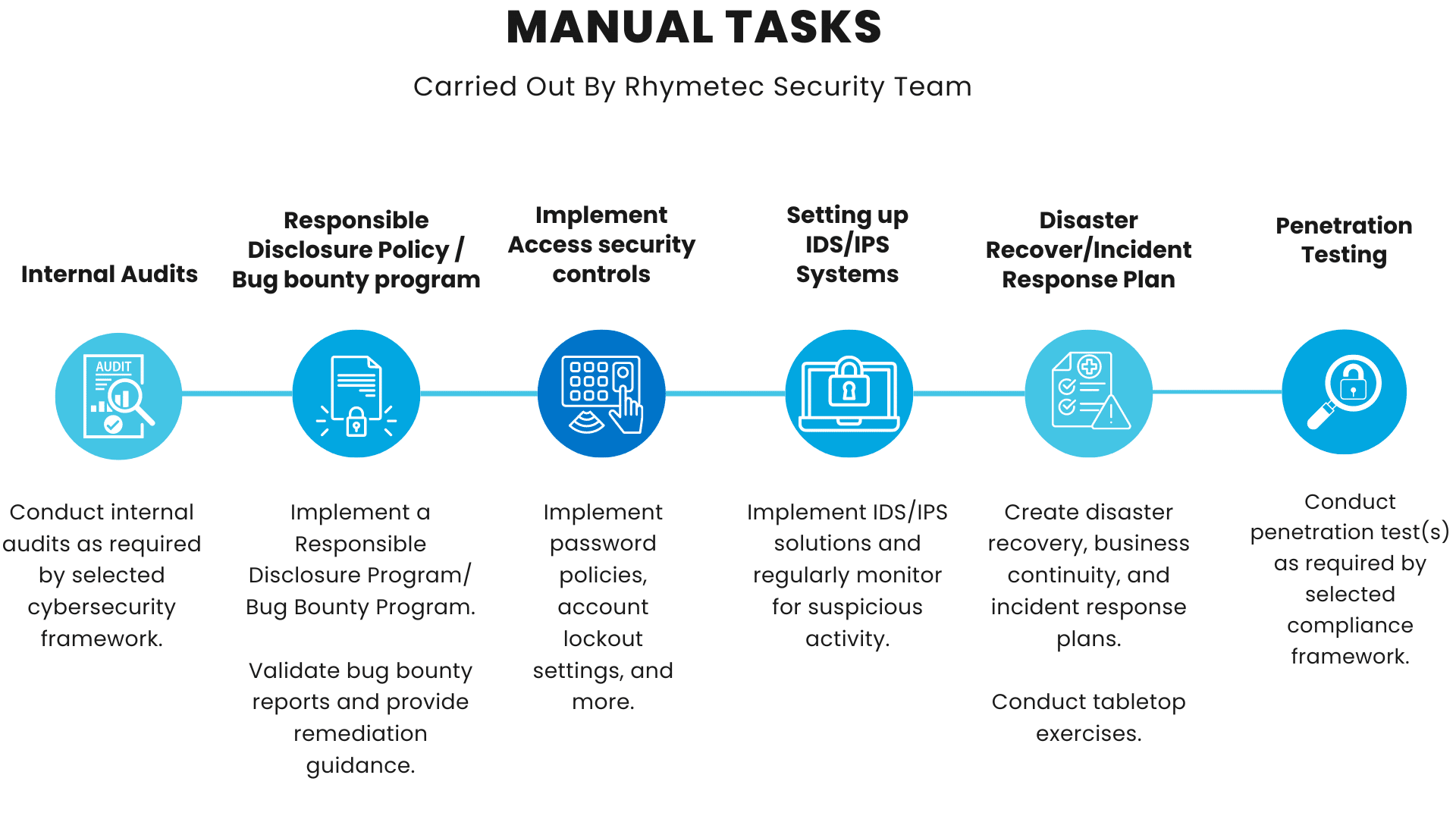
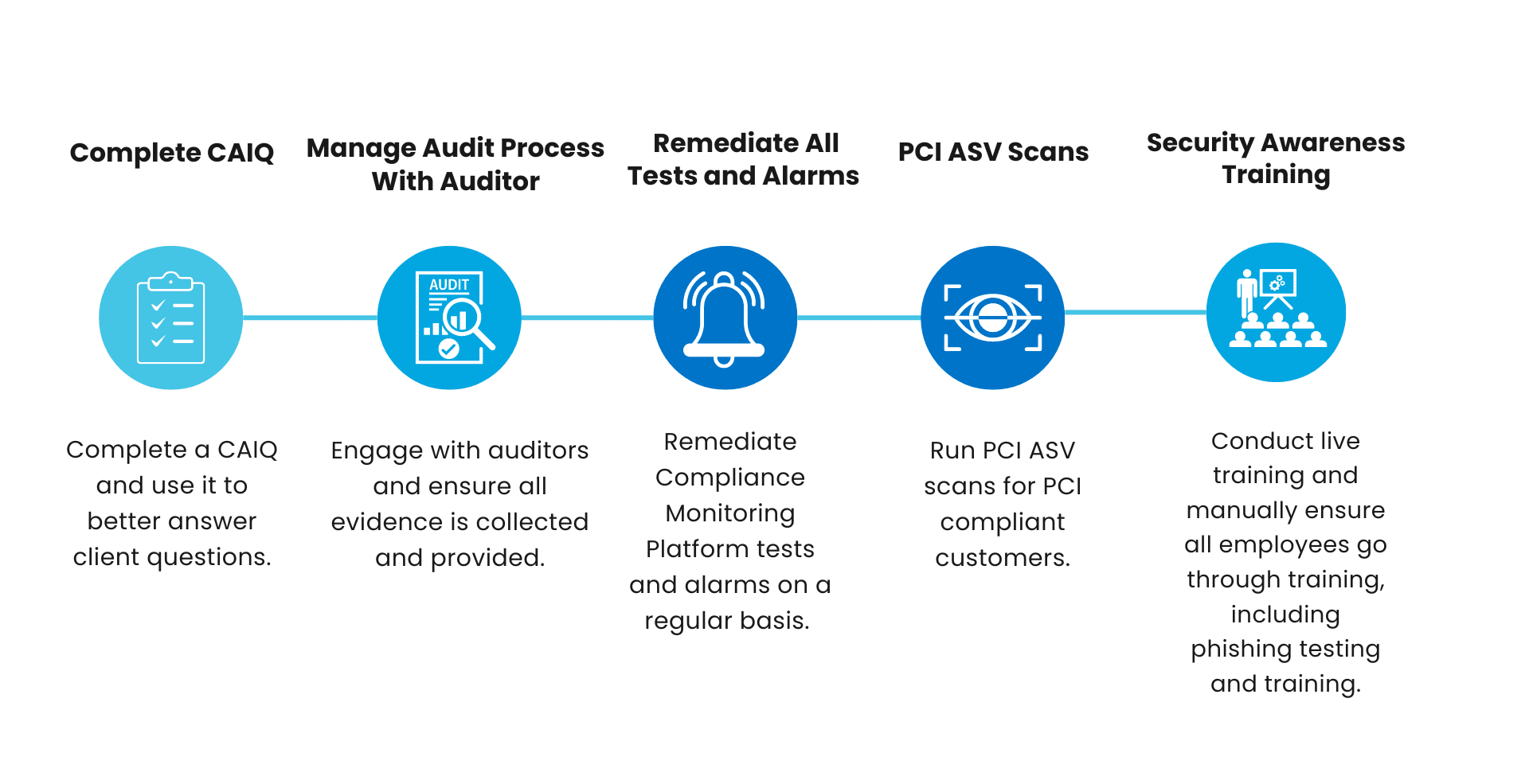
The above action items needed for compliance, such as penetration testing and tabletop exercises, cannot be automated. Items such as incident response plans also must be manually completed in order to be tailored to each individual company, their risk profile, and their industry.
The compliance automation platform comes back into play in the next phase, streamlining the completion of all additional security controls.
Fulfillment Of Additional Critical Security Controls: Manual Solutions Working With Compliance Automation
Rhymetec creates and implements the additional cybersecurity controls required by the compliance framework selected by the client. The compliance automation platform, meanwhile, plays a key role in this step for each control through system integrations and identification of areas for improvement.
Here's how the two solutions work in sync to streamline the implementation of critical security controls needed across many different frameworks, laws, and regulations:
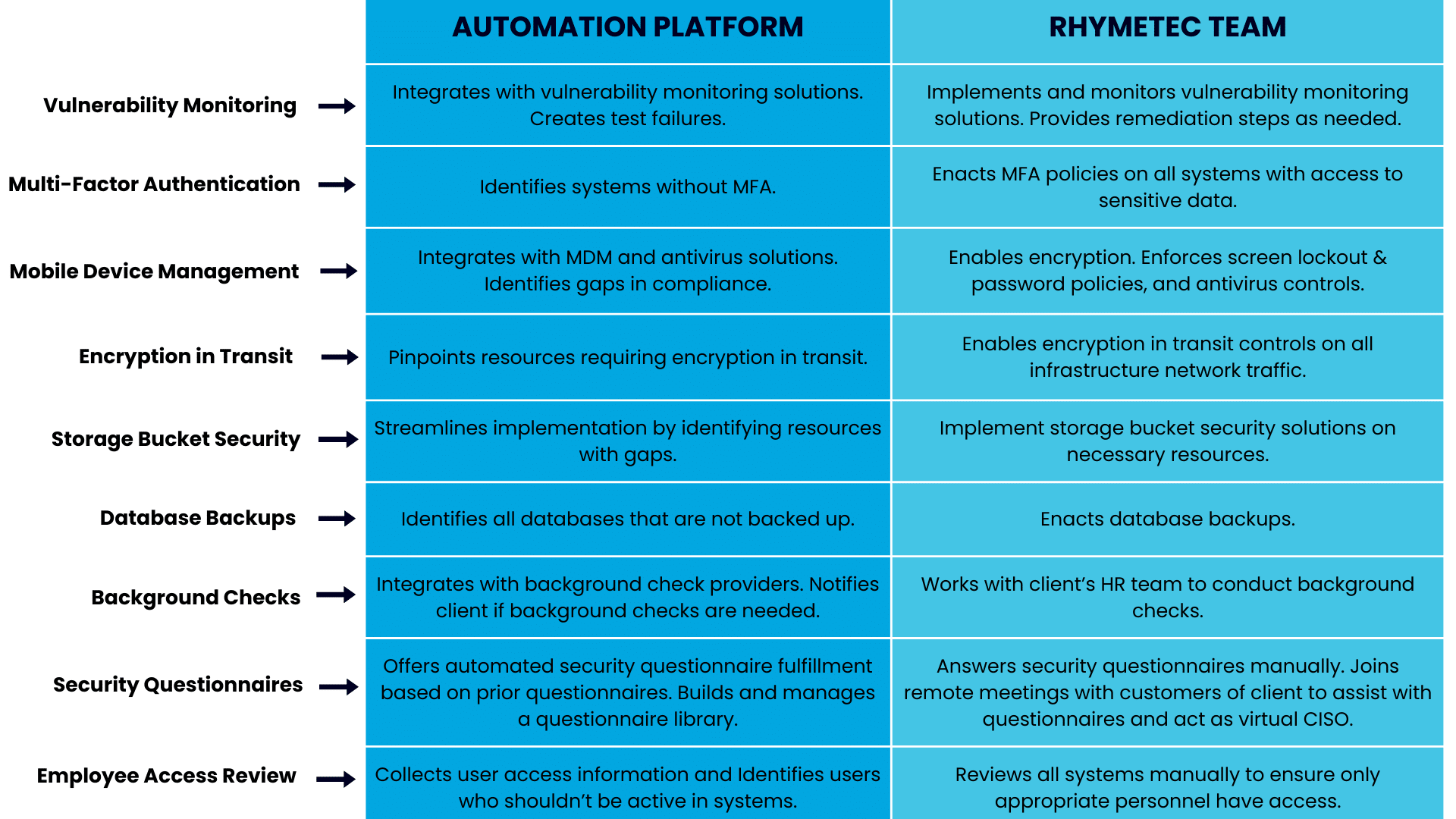
The platform serves as a foundation for the tasks performed by Rhymetec's security team, enabling them to jump right in and start the hands-on work.
As an example, almost every cybersecurity standard nowadays requires organizations to implement multi-factor authentication, as it is one of the best measures companies can take to protect themselves. The compliance automation platform is able to identify systems in a client's infrastructure without MFA. The security team takes it from there to enable MFA policies on all critical systems.
Final Audit Preparation, Conducting The Audit, & After The Audit
In preparation for the audit, Rhymetec ensures all necessary documentation is organized and accessible. For frameworks like ISO 27001, Rhymetec will conduct an internal audit to identify and address any non-conformities in preparation for the external audit. During the official audit, Rhymetec works closely with auditors to ensure all evidence is collected and provided.
For standards like SOC 2 that clients will be audited on annually, and to maintain a continuous strong posture of security, Rhymetec completes the following items on an ongoing basis: Annual vendor risk assessments, regularly updating risk assessments to reflect new risks, regularly reviewing firewall rules for customers to ensure they stay compliant with policies, and running continuous assessments like PCI compliance scans for PCI-compliant customers.
Don't forget, for some stakeholders compliance isn't always enough. Security questionnaires are a secondary tool that prospects use to evaluate your security against their own standards. Utilizing compliance automation can help you streamline this process. Using Rhymetec's team of experts can help you get into the weeds around more robust or complex questionnaires and even represent your business on security-related discussions.
In Conclusion: How Compliance Automation and Manual Security Services Provide A Full Portfolio Solution For The Modern Business
Compliance is not a sprint right before an audit.
It requires an ongoing solution that streamlines the process by automating the pieces that can be automated and leveraging a team of experts to fill in the gaps and carry out the manual tasks. Through a combination of automation and manual security services, organizations can maintain a posture of continuous compliance, ensuring that requirements are always being met and evidence of these standards can be accessed easily.
When used together, a compliance automation platform and the level of customization provided by an experienced security team fast-tracks compliance while avoiding a one-size-fits-all approach. Every company has its own controls that need to be implemented, as well as a unique risk profile. For effective compliance maintenance, modern businesses need an automation platform plus a team of security experts to carry out and maintain these requirements.

With Rhymetec, the manual components are accomplished by a security team with more than a century of cumulative experience across a diverse array of cybersecurity disciplines. Rhymetec leverages this experience to tailor compliance to fit organizations' individual needs and to maximize the efficiency of control implementation. Meanwhile, the compliance automation platform speeds things up every step of the way, provides a single source of truth for the client, and serves as an auditor-favored platform with all documentation presented in a clear format.
About Rhymetec
Our mission is to make cutting-edge cybersecurity available to SaaS companies and startups. We’ve worked with hundreds of companies to provide practical security solutions tailored to their needs, enabling them to be secure and compliant while also balancing security with budget.
We enable our clients to outsource the complexity of security and focus on what really matters – their business. If you are interested in our services, or if you simply have questions about security, you can contact our team for more information.
Interested in reading more? Check out our other blogs: