The array of compliance requirements being propagated by both government and private sector entities is dizzying. The European Union's NIS2 regulations, the recent SEC data breach notification rule, and the ever-impending requirements under the U.S. DoD's CMMC are all examples of an expanding regulatory framework meant to bolster corporate information security practices and protect consumer data.
Building a comprehensive information security program that maps technical and process controls to existing and pending regulations has never been more critical, but companies still struggle.
Compliance is complex. Small companies often lack the full-time subject matter experts required to translate technical jargon into risk reduction and compliance controls. Large organizations, meanwhile, struggle with massive IT infrastructures and huge amounts of data.
This article dives deep into the world of information security compliance. First, we'll examine why governments and private industry groups are expanding requirements. We'll then spotlight a few upcoming requirements. Finally, we will review a way that organizations, both large and small, can stay current with compliance - an approach Rhymetec dubs "managed compliance" or "compliance management."
Managed Compliance: Why Is The Regulatory Landscape Shifting?
Before we dive into how the landscape is shifting, let's start with a more basic question - why is it shifting?
The simple answer is that the cyber threat landscape is becoming increasingly dire at the same time as geopolitical tension is increasing around the world.
Ransomware continues to plague both large enterprises and small organizations, and ransomware groups are resorting to increasingly high-stakes gambits in order to elicit payments.
These aggressive tactics were on full display in February of 2024 with the attack on Change Healthcare, which allegedly compromised terabytes of personal health data belonging to millions of consumers. The ransomware group Black Cat not only encrypted files but also threatened to publicize the information if payment was not made, resulting in an eye-popping twenty-two million dollar ransom.
Secondly, geopolitical tensions between the United States and Russia continue to remain at a post-Cold War low point. The risk of Russian, Iranian, and Chinese cyber-espionage against the U.S. technology and critical infrastructure sectors continues to remain acute, with both CISA and the U.S. FBI publishing repeated warnings that they have evidence of ongoing campaigns.
Finally, the cybercrime ecosystem itself is expanding rapidly, and the cybercrime market is booming: The global cost of cybercrime is projected to increase 15% year over year, reaching an annual $10.5 trillion USD by 2025. Market economics incentivizes threat actors to target both consumers and businesses as it pays, particularly in countries and economies with relatively weak rule of law and low median earnings.
Governments around the world, but particularly in Western Europe and the United States, are responding to these challenges with an increasing array of regulations, warnings, and executive decrees designed to incentivize companies to improve their security posture and reduce risk.
Pending Regulations & Examples of Managed Compliance in a Rapidly Changing World
There are many regulations one could cover in this article.
To illustrate our point we will focus on two salient requirements that are particularly telling of where things are moving: The EU's NIS2 Directive and the SEC data breach notification requirement. We will also talk about recent updates to frameworks like ISO that address new risks to organizations posed by Artificial Intelligence.
The NIS2 Directive and The EU
NIS2 is an EU-wide compliance requirement that will require many EU businesses to meet increasingly stringent information security requirements. Version 2 builds on an original framework that was specifically targeted to improve the security of a narrow band of critical infrastructure companies within the European Union. NIS2 expands on both the scope and scale of NIS, mandating requirements for what will likely be the majority of EU businesses.
EU regulations work by creating a comprehensive framework at the EU level, which is then written into each EU member's legal code by a certain date. As it stands, many organizations will be required to implement NIS2 by the fall of 2024, specifically ones that provide necessary services to the EU member states, regardless of location.
Some key changes in NIS2 include:
Executive teams and boards of directors become directly liable for compliance violations under the update. Organizations that fall under the regulation are required to implement many specific technical safeguards and are required to report serious incidents to their national Cyber Security Incident Response Teams (CSIRT). Covered organizations are also required to carefully evaluate their supply chains for risks that could result in substantial disruption.
NIS2 is novel in several respects, particularly by making boards of directors and corporate executives directly liable for non-compliance. We've seen a similar move to raise cyber risk to the board level in the United States, with the recent propagation of the voluntary framework NIST CSF V2.0 with the addition of the NIST governance function.
SEC Data Breach Notification Rule
The United States currently lacks a strong national cybersecurity regulation such as NIS2. However, various states and federal entities continue to add additional requirements. In 2023 the U.S. Securities and Exchange Commission published a data breach notification rule, requiring covered financial entities to publicly report a substantially adverse event within 24 hours. While this may seem relatively minor, this extends reporting requirements to thousands of publicly traded financial institutions.
The new SEC rule is illustrative of the U.S. patchwork approach to security compliance. Unlike the EU, which is adopting sweeping pan-national legislation, the U.S. instead operates under an array of state, federal, and administrative information security requirements. This can create enormous complexity for both startups and large enterprises as there are questions of jurisdiction, legal language, and mapping complex controls to a variety of requirements.
ISO 42001 and The AI Management System
The AI boom isn't showing any signs of slowing down. Organizations all over the world are increasingly incorporating the use of AI into their operations and systems. While AI may represent exciting opportunities, a cautious approach that keeps in mind security risks is necessary, particularly as AI is increasingly incorporated into many SaaS companies.
Before implementing AI, security experts recommend that organizations consider the following factors: The projected impact on products, transparency and customer trust, contractual obligations and customer agreements, how AI processes data, and, above all - data privacy and security concerns.
Enter ISO 42001.
ISO 42001 is the first international standard for the use of Artificial Intelligence. It provides comprehensive guidance for organizations on how to establish and manage systems using AI. Similar to the updated NIST CSF framework and NIS 2 in the EU, there appears to be a stronger focus on governance in ISO 42001.
Certification with the standard includes incorporating a defensible systems management strategy specifically for AI. Under controls that address leadership, top management must show how the AIMS (AI Management System) is being used across the organization and how it aligns with the overall direction and goals of the organization.
It's important to note here that this part of the standard emphasizes continuous improvement. To stay compliant, organizations must provide ongoing evidence that their AIMS is not only continually working as intended but that they are continually improving it to align with new uses of their systems.
Overall, ISO 42001 illustrates yet another shift in the direction of two areas:
1 ) The increasing importance of governance.
2) The sharper focus on continuous compliance rather than a "check the box" mentality of compliance.
Three Benefits of Managed Compliance
At Rhymetec, our vCISO services take the approach of continuous managed compliance.
That is, we don't treat requirements as a fixed-in-time prescriptive list that's checked off once it's done. Instead, we work with our customers to continuously demonstrate affirmative compliance across multiple frameworks and requirements.
We fully manage your legal and voluntary compliance for you in a way that is guaranteed to continuously fine-tune your security posture, be defendable to auditors, and scale with your growing business. We take a multi-step process that includes:
1. Understanding Which Compliance Requirements Apply
It can be remarkably complex for small organizations (and sometimes large ones!) to even begin to understand which compliance requirements they are legally obligated to meet. For example, a large financial institution operating out of New York State may be obligated to meet cybersecurity requirements under:
- NYDFS Cybersecurity Regulation
- The EU's General Data Protection Regulation (GDPR)
- The U.S. Gramm-Leach-Bliley Act (GLBA)
- The Payment Card Industry Data Security Standard (PCI DSS)
- SOC 2 (As required by customers)
- ISO 27001 (As required by customers)
Rhymetec works continuously with our clients to examine their current business and which existing requirements may apply to them while also keeping an eye on developing requirements in order to help our customers proactively meet legal obligations.
2. Implementing Controls Effectively: Doing Just The Right Amount
One of the benefits of working with a Managed Security Services Provider to implement a managed compliance program is that we leverage more than a century of cumulative experience across a diverse range of cybersecurity disciplines. We bring this experience to bear for clients in order to maximize the efficiency of control implementation. We only implement the controls that make sense for our clients.
Fortunately for our clients (and their bank accounts!), in many cases, one security control can meet requirements under multiple frameworks and regulations. For example, the control "employee training" can be tailored to meet requirements under both SOC 2 and HIPAA.
When architected properly, an information security program should be able to meet a large number of requirements with a small number of controls. Effective compliance programs serve as business enablers, allowing the business to work in confidence that they have substantially reduced breach risk and are meeting relevant regulatory requirements.

Bonus Tip For Startups:
As your organization matures, you will likely be asked to meet an increasing number of both legal and voluntary requirements such as SOC 2, NIS2, GDPR, CCPA, FedRAMP, and others. Rhymetec works to understand our client's business so that we can advise you to be as efficient as possible when implementing compliance frameworks the first time, resulting in cost savings down the road.
For example, if you know you will be selling to the federal government in 2025, we can architect your program to begin meeting and documenting FedRAMP requirements early.
3. Continuous Review
Security is not a fixed point in time activity.
A well-managed compliance program should involve continuous review of the organization's security controls to ensure they are being effectively met and that processes are properly implemented. Many organizations that attempt to meet compliance themselves follow a similar pattern:
- An organizational leader is tasked with meeting a common compliance requirement or framework, often SOC 2 or ISO 27001 (more often than not because a prospect has asked for it).
- They spend several weeks building documentation, paperwork, and processes to demonstrate compliance.
- They implement many required technical controls.
- But, by the time the auditor comes, many of the processes have been discarded in favor of efficiency and many of the technical controls have lapsed, resulting in a poor showing on the compliance audit.
At Rhymetec, we take the opposite approach:
Controls are only as effective as their implementation and processes are only as good as the adherence to them is. We work with our clients to ensure that security policies aren't just documents that sit on a shelf collecting dust but are core business documents that form the basis for how the organization does business.
Knowing you've outsourced the complexity of all of this and have a team continuously taking care of your legal and voluntary requirements provides peace of mind. That's one of the key benefits of managed compliance that companies report.
Rhymetec's Method for Accelerating and Managing Compliance
Our team has worked with hundreds of clients across different industries. We are equipped with the expertise to conduct a thorough gap analysis at the beginning of the engagement to identify areas of improvement. Our team works with you to craft a roadmap tailored to your individual security needs and the compliance requirements relevant to your industry.
We leverage the latest technology, such as compliance automation tools, to streamline documentation of your security policies, collect evidence for audits, and more. We offer expert phishing testing services, internal audits, and penetration testing services (including mobile application penetration testing and web application penetration testing) that are guaranteed to meet security controls.
Finally, our team of experts continuously reviews and updates existing controls, evaluates your information security program throughout phases of growth, and stays up to date with the latest changes in the industry or with compliance standards to help you prevent gaps in compliance—providing an effective compliance maintenance program.
About the Author: Justin Rende, CEO
Justin Rende has been providing comprehensive and customizable technology solutions around the globe since 2001. In 2015 he founded Rhymetec with the mission to reduce the complexities of cloud security and make cutting-edge cybersecurity services available to SaaS-based startups. Under Justin’s leadership, Rhymetec has redesigned infosec and data privacy compliance management programs for the modern SaaS-based company and established itself as a leader in cloud security services.
There were many major releases in 2024. The hit new TV series FX Shogun, Dune Part 2, Taylor Swift's Eras Tour on Disney+, and most importantly, the new NIST Cybersecurity Framework Version 2.0 with the addition of the NIST Governance Function.
Thrilled yet? Well, you should be. The National Institute of Standards and Technology regularly releases technical guidance documents and frameworks for both the public and private sectors to use as best practices guides.
The original NIST Cybersecurity Framework (NIST CSF) serves as the basis for tens of thousands of cybersecurity programs around the world and directly inspires many other compliance frameworks and requirements.
By meeting NIST, organizations automatically cover many controls in other requirements that overlap with NIST. It's widely considered the gold standard of robust cybersecurity across many industries.
This article will explore NIST CSF V2.0, what's changed, and what's likely to change going forward.
If you have more specific questions on what these changes may mean for your organization, please feel free to contact our team for support:
What Is The NIST Cybersecurity Framework?
NIST CSF was originally intended as a cybersecurity framework for critical infrastructure companies.
Some key facts about NIST CSF V1.0:
- The original NIST CSF was released in 2014
- NIST CSF was developed in collaboration with industry and government stakeholders
- Provided a high-level framework for cybersecurity risk management
- Consisted of five core functions: Identify, Protect, Detect, Respond, and Recover
- Each core function is broken down into subcategories and controls
- NIST CSF is voluntary, but it is widely used by organizations of all sizes
- NIST CSF was updated on a regular basis to reflect changes in the cybersecurity landscape
In addition, many regulations (particularly those in the United States) directly drew on controls originally formulated in the NIST Cybersecurity Framework.
NIST CSF is split into five modules reflecting elements of the cybersecurity lifecycle, including:
Identify:
- Get visibility into the network environment, including asset categorization.
- Create continuous monitoring for new assets being brought back online or added to the network.
Protect:
- Implement robust security protocols across the organization to include IDS/IPS, firewalls, EDR systems, and anti-virus
- Create and maintain a regular patching program to reduce exploitable vulnerabilities.
- Utilize strong authentication (such as multi-factor authentication) to reduce the risk of unauthorized access.
Detect:
- Use security monitoring tools to get visibility into suspicious activity such as unauthorized access attempts.
- Set up a notifications and alerts system to inform your security team in a timely manner of potential incidents and threats.
Respond:
- Have a well-documented incident response plan that describes the procedures for responding to security incidents.
- Be able to contain security incidents to minimize their impact and mitigate further damage.
Recover:
- Ensure a comprehensive backup and recovery program is in place to protect critical assets and restore data in the event of a security incident or natural disaster.
- Test back up and recovery programs regularly and update as needed.
NIST CSF V2.0: What's In It?
NIST CSF version two carries on many of the fundamental themes found in the original NIST CSF. However, a new element has been added: NIST Governance.
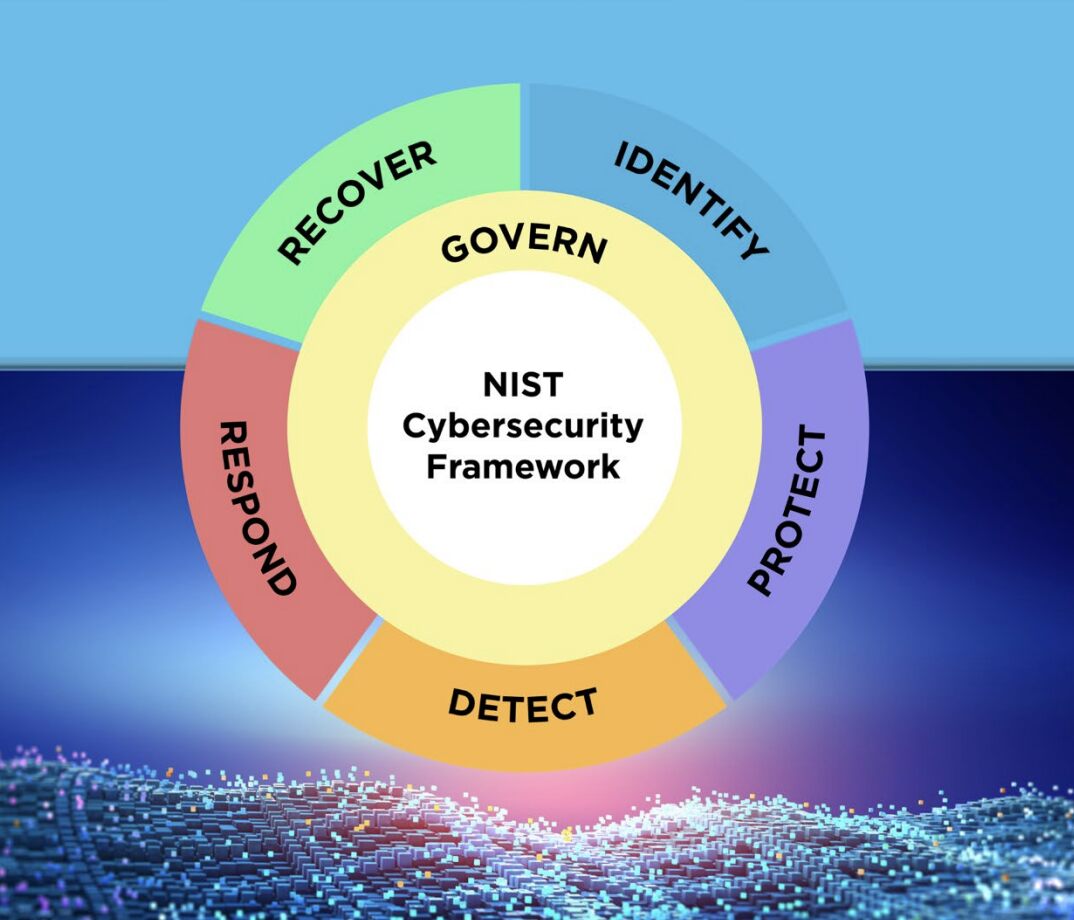
Source: NIST Drafts Major Update To Its Widely Used Cybersecurity Framework.
Note the clear emphasis of the guidance under this new function:
Governance
- Executives take on an active role in organizational risk management and collaborate on how potential cybersecurity gaps across the organization may impact broader objectives.
- Regularly hold dialogue among executives about risk management strategies, roles, and policies.
- Establish security goals tailored to the industry and organization at the executive level.
- Document and communicate security policies and expectations down the line to managers and individuals.
- Encourage collaboration at the executive level and across the organization about risk management strategies, including cybersecurity supply chain risk.
- Ensure cybersecurity risk management is explicitly rolled into overall Enterprise Risk Management (ERM).
In short, the updated CSF is intended to help executives communicate better about cybersecurity, with the goal of ensuring robust security through every level of the organization:
"The CSF helps organizations translate their terminology for cybersecurity and cybersecurity risk management into general risk management language that executives will understand."
The features of the new version also help enforce that the CSF applies to small organizations as well as large ones, and can be easily tailored to fit their needs.
A New Addition: NIST Governance and What It Means For Businesses Going Forward
It's important to remember, that compared to many functions of a business, cybersecurity in its current state is still extremely young.
Cybersecurity began as a sub-discipline of Information Technology.
In the 2010s, business leaders, particularly in industries with a heavy reliance on information technology, increasingly came to see cybersecurity as a standalone field - one that needed adequate resources and provisioning to succeed.
The NIST Governance section is an effort to add concreteness to cybersecurity as a board-level conversation in its own right and not just an offshoot of information technology. NIST states:
"The CSF's governance component emphasizes that cybersecurity is a major source of enterprise risk that senior leaders should consider alongside others such as finance and reputation."
It's worth pausing for a moment and reflecting on what a significant statement this is.
NIST is advising companies to consider cybersecurity as significant of a risk as running out of money or having their reputation destroyed (note that bad cyber practices can cause both of these things).
The new NIST governance function includes six key aspects:
- Organizational Context (GV.OC)
- Risk Management Strategy (GV.RM)
- Roles, Responsibilities, and Authorities (GV.RR)
- Policy (GV.PO)
- Oversight (GV.OV)
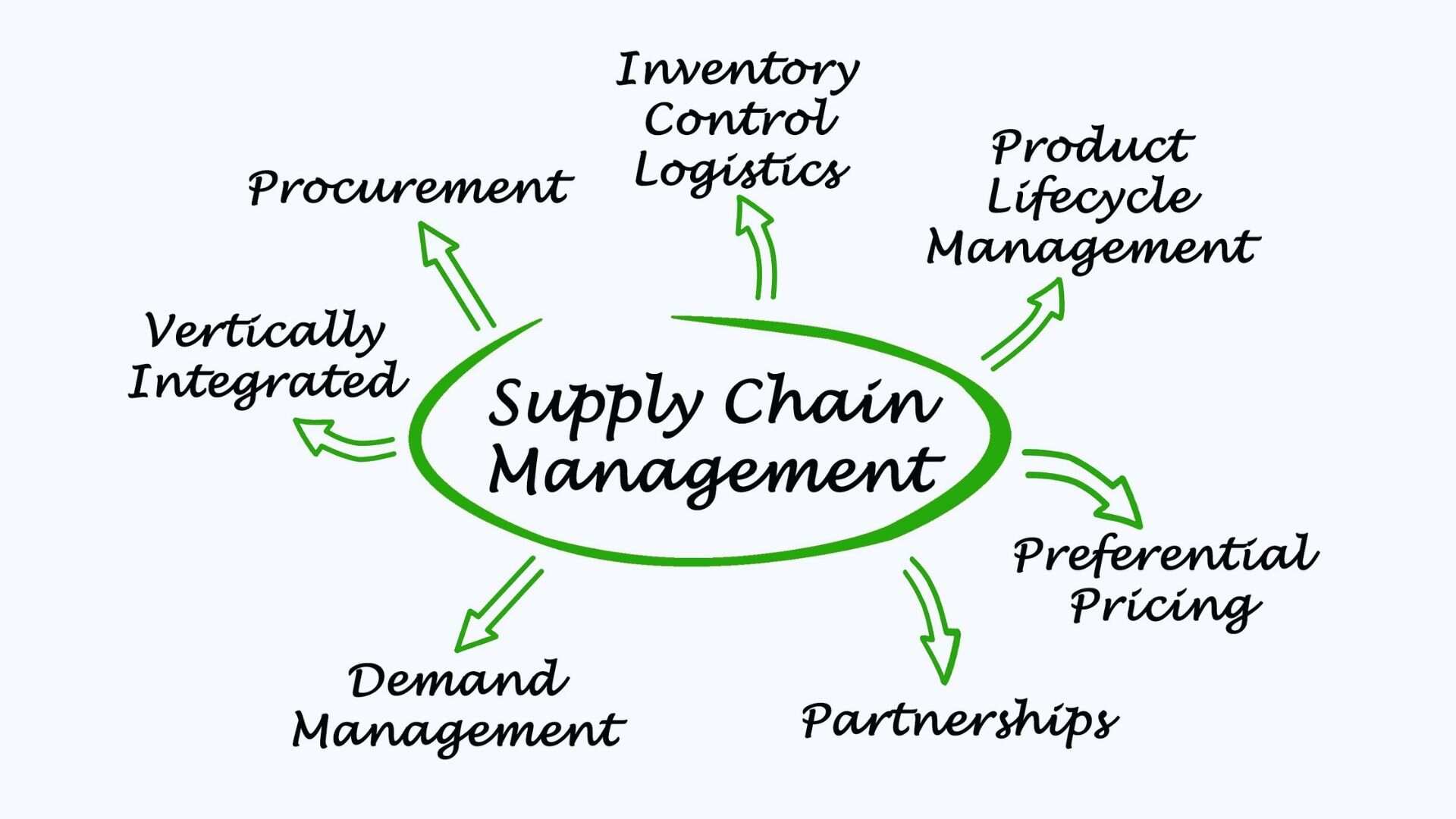
- Cybersecurity Supply Chain Risk Management (GV.SC)
The introduction of Cybersecurity Supply Chain Risk Management (C-SCRM) under governance is another critical addition.
Software supply chain attacks have become increasingly common in recent years, such as the 2020 SolarWinds breach and the 2023 MOVEit vulnerability, famously exploited by the CL0P ransomware group.
Rhymetec's Take: The business impact of investing in cybersecurity is exceptionally high. The threat landscape has continued to increase in risk, and organizations are increasingly expecting third-party suppliers to not only meet compliance but also demonstrate security that goes past it. NIST CSF's Governance change is an excellent addition that reflects the growing importance of security for modern businesses.
The Expanded Scope: NIST Governance
NIST CSF V1.0 was focused specifically on critical infrastructure. While this did not stop organizations all over the world from using it as a basis, it did create a sense that it might be overkill for some businesses.
NIST CSF V2.0 has remedied this flaw and makes it clear that the CSF can be tailored to fit any business regardless of size or maturity.
Rhymetec's Take: In this case NIST is catching up to where many organizations already are. NIST has long and widely been used as the basis for cybersecurity programs, but it is a positive development for them to acknowledge and expand the use case.
Additional Resources for Implementation and The NIST Governance Section
One of the most profound and significant changes has been the additional material NIST is publishing to help organizations build their security programs based on the cybersecurity framework.
NIST is publishing several appendix documents, including:
Implementation Guidance for CSF V2.0
The implementation guidance is an extremely valuable addition to the CSF.
Many organizations, particularly those that don't yet have dedicated cybersecurity staff, may struggle to understand what the cybersecurity framework is actually asking of them. The addition of remediation guidance provides an enormous amount of additional clarity.
For example, let's take a control found in the new governance section:
GV.SC-06: Planning and due diligence are performed to reduce risks before entering into formal supplier or other third-party relationships.
For seasoned governance risk and compliance professionals, this may seem straightforward.
But for an organization without GRC staff that is just beginning to think about third-party due diligence, how can this be implemented?
Fortunately, the Implementation Guidance provides real-life, concrete examples for businesses to better understand how to do a practical implementation of a security control. For GV.SC-06, NIST provides 4 implementation examples:
- Ex1: Perform thorough due diligence on prospective suppliers that is consistent with procurement planning and commensurate with the level of risk, criticality, and complexity of each supplier relationship.
- Ex2: Assess the suitability of the technology and cybersecurity capabilities and the risk management practices of prospective suppliers.
- Ex3: Conduct supplier risk assessments against business and applicable cybersecurity requirements, including lower-tier suppliers and the supply chain for critical suppliers.
- Ex4: Assess the authenticity, integrity, and security of critical products prior to acquisition and use.
For many organizations, implementation examples will undoubtedly be key to help clarify the request being made of them by the guidance. Note how each example has slightly different wording: compliance isn't a one-size-fits-all project.
Many compliance requirements leave room for organizations to implement the security control in a way that will optimally benefit their organization.
Working with a vCISO can help by leveraging decades of experience in tailoring security controls to your company's unique risk profile, maximizing your return on investment while also ensuring that your organization meets the technical and intended definition of the control.
For instance, example 4 only has the organization assessing critical suppliers, whereas example 1 has the organization tiering their suppliers and level of due diligence. If an organization is just beginning their C-SCRM program, they may not have the sophistication or resources (or need!) to fully vet every single supplier based on a tiered approach.
While the company matures, only assessing mission-critical suppliers can be an excellent addition to a security program, and it is far better than doing nothing.
Rhymetec's Take: Implementation guidance should substantially help bridge the gap, particularly with small or immature organizations to effectively implement NIST CSF 2.0's guidance. Note that simply claiming you are meeting a control will not pass an auditor's scrutiny. You need to have a documented process for meeting the control, appropriate technology, and evidence that your policy is acted upon.
NIST CSF 2.0 Reference Tool
Another addition with NIST CSF 2.0 is a new reference tool that can be used to identify requirements and export data quickly.
Rather than reading a massive PDF, the new reference tool makes it simple to rapidly identify controls or subsets of controls within NIST and export that section or subset either in machine or human-readable format.
Users are able to filter based on the control family and whether the control is focused on first or third parties and then export the data into JSON or Excel. The reference tool also includes the aforementioned implementation guidance, significantly simplifying the process of understanding and complying with controls.
This makes it considerably more user friendly and allows easy exporting of data.
The reference tool could be helpful for many organizations, but particularly for large or complex organizations that may have many different individuals and functions responsible for implementing the second version of NIST CSF to include updates in alignment with the NIST Governance element.
NIST CSF 2.0 Quick Start Guides
The last major addition to NIST CSF 2.0 we will cover is quick start guides, designed to help organizations get started on implementing controls from NIST Governance and other functions based on their unique circumstances and risk posture.
Quick start guides are segmented into:
- Organizational Profiles: According to NIST, an organizational profile "...describes an organization's current and/or target cybersecurity posture in terms of cybersecurity outcomes from the Cybersecurity Framework (CSF) Core."
- Community Profiles: These are designed to help specific industries and sectors implement the CSF based on their unique risk profile. According to NIST, "A Community Profile can be thought of as guidance for a specific community that is organized around the common taxonomy of the CSF."
- Small Business Resources: The small business section of the quick start guide is focused on providing actionable, easy-to-implement steps that small businesses can use to begin implementing CSF V2.0 controls.
- Cyber Supply Chain Risk Management (C-SCRM): C-SCRM is a growing concern for organizations of all sizes that continues to be highlighted by major supply chain breaches. The C-SCRM quick start guide provides specific guidance on how you can use the CSF to establish your C-SCRM program.
- Enterprise Risk Management: The Enterprise Risk Management quick start guide helps organizations better understand the implementation of NIST CSF 2.0, particularly NIST Governance, in a complex and multifaceted enterprise context.
- Tiers: NIST CSF 2.0 tiers "...can be applied to CSF Organizational Profiles to characterize the rigor of an organization's cybersecurity risk governance and management outcomes. This can help provide context on how an organization views cybersecurity risks and the processes in place to manage those risks."
Concluding Thoughts On NIST Governance and NIST CSF 2.0
NIST CSF 2.0 represents a huge step from the original NIST.
There has clearly been a focus on making it easier to conceptualize, understand, and implement CSF controls in a way that will reduce organizational risk for businesses.
The NIST governance section is a critical addition that helps solidify the case that cybersecurity and cyber risk management are no longer a function of the IT department, but a function that requires whole-business buy-in from the board of directors down to individual department heads.
Contact our team at Rhymetec for more information:
About Rhymetec
Our mission is to make cutting-edge cybersecurity available to SaaS companies and startups. We’ve worked with hundreds of companies to provide practical security solutions tailored to their needs, enabling them to be secure and compliant while also balancing security with budget. We offer a full suite of security services including mobile application penetration testing services, phishing testing services, PCI compliance scanning, and more.
Our team has extensive experience helping organizations implement a variety of security frameworks and compliance requirements, including NIST CSF, SOC 2, HIPAA, GDPR, and many more.
We enable our clients to outsource the complexity of security and focus on what really matters – their business. If you are interested in our services, or if you simply have questions about security, you can contact our team for more information.
About The Author: Metin Kortak, CISO
Metin Kortak is the Chief Information Security Officer at Rhymetec. Metin began his career working in IT security and gained extensive knowledge of compliance and data privacy frameworks such as SOC 2, ISO 27001, PCI, FedRAMP, NIST 800-53, GDPR, CCPA, HITRUST and HIPAA. He joined Rhymetec to build data privacy and compliance as a service offering. Under Metin’s leadership, these offerings have grown to more than 200 customers, positioning the company as a leading SaaS security service provider in the industry.
So, you've just been handed a security questionnaire by a potential customer, and you're not sure where to start.
What is access control? What should you answer when asked if you utilize strong authentication across all applications with sensitive data?
This Rhymetec guide will not only help you answer these questions but will also provide suggestions that you can use to strengthen your security posture and work with potential customers more confidently, with less risk of non-compliance or a data breach.
What Is A Security Questionnaire?
Security questionnaires are used by your potential customers to assess their third-party vendors and suppliers. Numerous major third-party incidents have occurred in recent years, and threat actors are increasingly attempting "supply chain attacks" - cyberattacks that target a critical element of a particular supply chain and then attempt to move laterally into other parts of the supply chain.
For example, the identity and access management platform Okta recently suffered from numerous compromises that threat actors attempted to use to gain access to Okta's customers' data. All of this was a long way of saying companies with mature cybersecurity programs care about supply chain attacks - a lot.
Enter the security questionnaire.
Security questionnaires are required by some compliance requirements such as HIPAA, GLBA, and PCI DSS. In addition, understanding who you're doing business with, what their security controls are, and what types of data you will be sharing with them is important from a simple risk mitigation perspective.
Security Questionnaire Example Questions
So, what exactly do security questionnaires typically ask?
It can vary a lot, but here are some common types of questions:
- Does your organization employ strong authentication measures such as multi-factor authentication for all corporate applications that hold customer data?
- Does your organization offboard employees within 8 hours of the termination of employment?
- Does your organization conduct routine penetration testing to identify vulnerabilities in your environment?
- Does your organization have documented incident response plans and processes?
- Does your organization routinely train users regarding information security and risk?
Depending on the potential customer you are working with, questions may be very in-depth or very cursory. In many cases, your customers may tier their security questionnaires; a company that stores data about tennis shoe manufacturing needs far less scrutiny than a company storing Protected Health Information (PHI).
Security Questionnaires and Compliance
Security questionnaires aren't only driven by risk requirements. They are also driven by specific legal compliance requirements that your customers fall under. We will provide two examples of major compliance regulations that directly touch on vendor security.
In both of these, notice that nowhere is it mandated that you must send a security questionnaire. Instead, both require that organizations assess their vendors. The security questionnaire is the form that this assessment takes.
The HIPAA Security Rule
The Health Insurance Portability and Accountability Act Security Rule (HIPAA): HIPAA applies to healthcare organizations and other organizations that handle Protected Health Information (PHI).
Under HIPAA, any organization handling PHI that is considered a "covered entity" is required to comply with the HIPAA Security Rule, a specific set of information security standards. In addition, "business associates" of covered entities are also required to meet all requirements in the security rule:
- 164.308 Administrative safeguards. (A) Risk analysis (Required). Conduct an accurate and thorough assessment of the potential risks and vulnerabilities to the confidentiality, integrity, and availability of electronic protected health information held by the covered entity or business associate.
The U.S. Department of Health and Human Services also publishes guidance on how to conduct the risk analysis required by section 164.308.
The Bottom Line: If your organization gets a security questionnaire from a healthcare organization and you will be handing PHI, take it extremely seriously. You may be considered a HIPAA business associate and be required to comply with the HIPAA Security Rule. An experienced vCISO can help guide you on how to answer questions and implement missing security controls.
The Gramm-Leach Bliley Act and The Security Questionnaire
The GLBA applies to financial services organizations. Part of the regulation requires organizations to meet certain information security requirements. eCFR Part 16, § 314.4 spells out specifically what financial institutions need to do in order to maintain compliance regarding third-party suppliers:
- Taking reasonable steps to select and retain service providers that are capable of maintaining appropriate safeguards for the customer information at issue;
- Requiring your service providers by contract to implement and maintain such safeguards; and
- Periodically assessing your service providers based on the risk they present and the continued adequacy of their safeguards.
The Bottom Line: If you are getting a security questionnaire from a financial services organization, they are likely trying to meet their legal requirements under GLBA. The organization likely isn't measuring you against a specific standard where all requirements must be met to do work with your organization. If you don't meet every control in the risk questionnaire, consider having a conversation with the customer about which ones they find totally necessary to work with a vendor, and identify a plan to meet those on a set time scale.
How Do You Answer a Security Questionnaire?
Answers to security questionnaires from customers should be honest, straightforward, and complete.
For example, to answer the following question:
- Does your organization routinely train users regarding information security and risk?
You might reply:
- Users are trained on a monthly basis on information security best practices using the security awareness training platform KnowBe4. In addition, regular simulated phishing campaigns are conducted against employees. If an employee fails a phishing test additional training is mandated.
Notice this answer gives a specific example of not only that the activity is being carried out but how the activity is being carried out (KnowBe4).
It also goes into detail about how often the phishing test takes place, and even provides additional evidence of a serious security posture by describing an interrelated simulated exercise.
However, don't go overboard with information. If your customer is asking a question about training, you don't need to tell them about your amazing vulnerability management practice. Instead, answering questions with additional detail on related policies, procedures, or technology can help make the customer's job easier.
The most important thing to do is never lie.
If there are certain questions that your potential customer has asked that you don't want to disclose, have a frank and honest discussion about what information you can provide, what you can't, and why. Lying on vendor risk questionnaires can put your organization in potential legal jeopardy, both civilly and criminally.
Should I Get Outside Help in Answering a Security Questionnaire?
Many organizations turn to managed security services organizations for help in answering security questionnaires.
Why choose a managed security services company to help you?
There are a few different reasons.
First, cybersecurity can be extremely complex! Answering vendor risk questionnaires isn't always a straightforward exercise. Does your routine security assessment performed by a third party satisfy the definition of a penetration test? Does annual user training meet the question, "Do you regularly engage in security awareness training?"
These types of details matter but aren't always immediately apparent to those answering a security questionnaire.
Secondly, the "why" of a security questionnaire matters. Mistakenly answering a question on a security questionnaire from a customer who is simply doing their due diligence can be damaging. But mistakenly answering a question for an organization assessing your HIPAA compliance under the business associates rule can be fraught with legal peril.
An experienced vCISO can help navigate these waters and ensure that answers are correct and backed with evidence.
Finally, answering security questionnaires doesn't have to be hard! There's no reason that you should be spending weeks fretting over whether your security awareness training program is up to snuff.
Engaging a managed security services company can help you rapidly respond to security questionnaires, unclogging your sales pipeline and turning security compliance into a selling strength.
SOC 2 and The Security Questionnaire
Fortunately, there may be a way that you don't need to answer every security questionnaire that comes your way.
Enter the SOC 2 Report.
SOC 2 is a voluntary framework that organizations can meet and be audited against on an annual basis. By meeting requirements under SOC 2 Type 2 and undergoing an annual audit, you can have a specific report outlining your security controls to provide to prospective customers, dramatically simplifying the process.
SOC 2 isn't just a way to get out of doing security questionnaires, though.
Organizations are increasingly choosing their vendors based on good security practices and continuous compliance. Using a vendor like Rhymetec to help you meet SOC 2 can expedite your sales process, build trust with potential customers, and enable you to engage prospects who want to see evidence of your security before doing business.
The Bottom Line
Many organizations use security questionnaires as a way to screen potential vendors for unacceptable security risks. This is becoming increasingly common, as companies wish to strengthen their third-party risk management in light of recent breaches due to vendors and suppliers.
Hopefully, this guide helped clarify how to answer questions on security questionnaires and how to turn risk assessments into a business enabler rather than a cost center.
About Rhymetec
Our mission is to make cutting-edge cybersecurity available to SaaS companies and startups. We've worked with hundreds of companies to provide practical security solutions tailored to their needs, enabling them to be secure and compliant while also balancing security with budget.
We enable our clients to outsource the complexity of security and focus on what really matters - their business. If you are interested in our services, or if you simply have questions about security, you can contact our team for more information.
About The Author: Metin Kortak, CISO
Metin Kortak is the Chief Information Security Officer at Rhymetec. Metin began his career working in IT security and gained extensive knowledge of compliance and data privacy frameworks such as SOC 2, ISO 27001, PCI, FedRAMP, NIST 800-53, GDPR, CCPA, HITRUST and HIPAA. He joined Rhymetec to build data privacy and compliance as a service offering. Under Metin's leadership, these offerings have grown to more than 200 customers, positioning the company as a leading SaaS security service provider in the industry.
Interested in reading more? Check out our blog.
Ask any security professional what the biggest risk to organizations is, and nine times out of ten you'll get the same answer - people.
What security professionals know from experience is further confirmed by security research. Verizon's 2025 Data Breach Investigations Report puts the percentage of breaches that involved human error as high as 60%. Despite the best intentions, even the most diligent employees are susceptible to falling for social engineering tactics like phishing emails.
The onus is on company leadership to not only establish clear security policies for their business but to effectively communicate these policies to employees.
You could have the best, most meticulously documented security policies in the world, but they won't be able to help if they aren't communicated to the people who handle your assets daily. In 2025, small businesses also face added scrutiny from enterprise customers and regulators, making strong policies not just a security measure but a business requirement.
Rhymetec's Senior Cybersecurity Analyst, Kyle Jones, discussed how to effectively communicate security policies with employees in the latest episode of SaaS District:
Rhymetec, a Managed Security Services Provider focused on cybersecurity, compliance, and data privacy, enables SaaS organizations to have in-house security expertise at a fraction of the cost. Security professionals like Kyle have firsthand experience behind the scenes of the information security programs at hundreds of companies.
Based on Kyle's experience, here are 5 tips he encourages businesses to use to communicate security policies with employees effectively:
1. The First Rule of Security Policies for Small Businesses: Know Your Audience
"The first thing I would suggest is know your audience. Know who you're communicating to,” suggested Kyle when asked how to communicate security policies in a startup environment of rapid growth. "If you're a CEO, a CTO, someone that's going to roll out policies - the first thing you want to focus on is knowing your audience. If you're a marketing agency, you don't want to draft heavily technical policies for your employees, because the communication is going to fail."
When tailoring and communicating policies to your organization, you want the policies to become ingrained as practice, not just documents that sit on a shelf (or in a file on your Google Drive that nobody looks at twice!).
The first step to effectively accomplishing this is to know your audience and make sure you remember to tailor your language to everyone in your audience.
If you work in tech, it may seem evident to you what the policy means when it says:
"All corporate devices must utilize full-disk encryption using the AES-XTS data encryption algorithm in compliance with the NIST Advanced Encryption Standard".
But this likely means nothing to your company's lawyer or accountant. Instead, simplify the language and foster clear communication. If the policy is going to apply to a non-technical audience it's far better to create a policy like:
"All corporate laptops and desktops must enable full-disk encryption in their device's settings."
Creating effective policies and procedures requires remembering that many users may not be security or even IT knowledgeable. This is becoming even more important as many small businesses are adopting AI tools and cloud platforms in 2025. Policies must account for a non-technical audience using technologies that carry significant risk if misunderstood.
2. Make Sure Your Small Business Security Policies Are Drafted by a Subject Matter Expert
Kyle emphasized the importance of working with a subject matter expert who understands the regulatory requirements in your industry as well as the voluntary security standards your customers may want you to have.
Having a subject matter expert develop your policies, especially in the early stages, allows you to align your policies with industry standards and with what you want to achieve as your company grows. Businesses that bake security in from the get-go establish a solid foundation, saving money and headaches in the long term.
Many organizations see security policies as "another GRC checklist item". This couldn't be further from the truth. Security policies are a core part of your business, and working towards adherence is critical.
However, even before building buy-in, you need to make sure your security policies are rock solid.
Here are a few questions you should ask in reference to the organization or individual drafting your policies:
- Are they basing their security policies on a risk assessment specific to your organization?
Organizations have dramatically different risk profiles based on industry or sector. For example, a software as a service company has numerous risks related to cloud hosting, data segmentation, and cloud identity and access management. These risks are not shared by a typical accounting firm. Policies should be tailored to your specific organization and can't be written in a vacuum.
- Does the person or organization have a strong working knowledge of how policies are implemented in practice?
Policies are only as useful as their implementation (and you will be audited based on both!). There should be a strong plan for operationalizing any policies that have been drafted on behalf of your business. This is where working with an outside expert like a Managed Security Services Provider, particularly for startups who may not have the resources to build out large in-house security teams, can come into play as a resource.

Ensuring The Companies of the Future Are Secure
To Kyle, one of the most important challenges of his work is making sure companies have solid security practices in place and that they are secure from the ground up:
"At Rhymetec, we're working with startups. A lot of them are early-stage startups…A lot of the companies that I work with and manage the security program for are the future. They have very powerful technologies and very innovative products".
The companies he works with are forward-thinking and looking to grow quickly. Establishing solid security policies for small businesses is critical before they expand into new marketplaces or internationally, before they go public, or before they are acquired.
Subject matter experts like the team at Rhymetec take the job of security entirely off their plate so they can focus on core tasks and grow their business.
3. Emphasize Security Policies Throughout the Year
There's nothing worse than policies that haven't been adopted.
Identify opportunities throughout the year where you can emphasize security policies for your small business in a proactive and exciting way.
"Something else I think that all organizations can do more of is emphasizing the importance of the policies. The policies are not an annual thing we review and send out to employees, and it's done. We want to find different ways to emphasize the policies," Kyle pointed out.
Have a company all hands?
This can be a great opportunity to discuss security policies, their implementation, and overall best practices. Include policy provisions in your security awareness and training courses, and aim to connect policies with outcomes.
When employees ask questions about anything security or IT-related, that can be a great opportunity to reference the policies and see what they say. When Kyle talks to the companies he manages security programs for, he uses their questions as an opportunity to bring up the policies and emphasize their importance.
It can be difficult for employees to conceptualize why security policies are necessary as they can often seem divorced from outcomes.
Walking the company (at a high level) through how a ransomware attack happens, or how threat actors launch business email compromise campaigns can be informative and help solidify the importance of adhering to policy language. The point is not to fearmonger, but to provide information that helps employees mentally link the policies to the reasons behind them.
People are more likely to adhere to something if they understand it.
In other words, don't just tell people what to do - show them why it matters.

4. Have a Training Program Built Around the Policy Language
Staff awareness training is an excellent opportunity to reinforce and build on your policies.
You want to ensure that your training program directly reflects language from your policies. For example, if you have a policy around full disk encryption (to use an earlier example), reinforcing this and providing a how-to guide in your training provides an excellent opportunity for reinforcement.
As another example, if you have a policy of reporting any suspicious emails as phishing for the security team to look at, reinforce this with training! Small businesses now often rely on a myriad of cloud collaboration tools, APIs, and AI assistants. Your training must be updated to reflect this reality and directly reference related policies, such as how to securely handle shared data or what information can be input into AI systems.
It's hard for employees to remember technical minutia and playbooks, so constantly reinforcing and iterating on your organization's security posture and policies is critical.
5. Update and Review Policies Regularly
Risk to your organization changes.
Both the regulatory and threat landscapes are in constant flux. Policies should not only be updated regularly but should be continuously reviewed and adjusted based on new information.
For example, the advent of large language models such as OpenAI's GPT-4 and Google's Gemini should force organizations to reimagine their policies:
- Are employees allowed to use these applications at work?
- What types of data can be shared with them?
- Do our policies reflect current regulatory language about algorithm decision-making?
These are important questions to answer. At Rhymetec we recommend conducting regular policy reviews. Working with a vCISO can dramatically simplify this process as they will be in tune with regulatory and threat landscape changes that could impact your business.
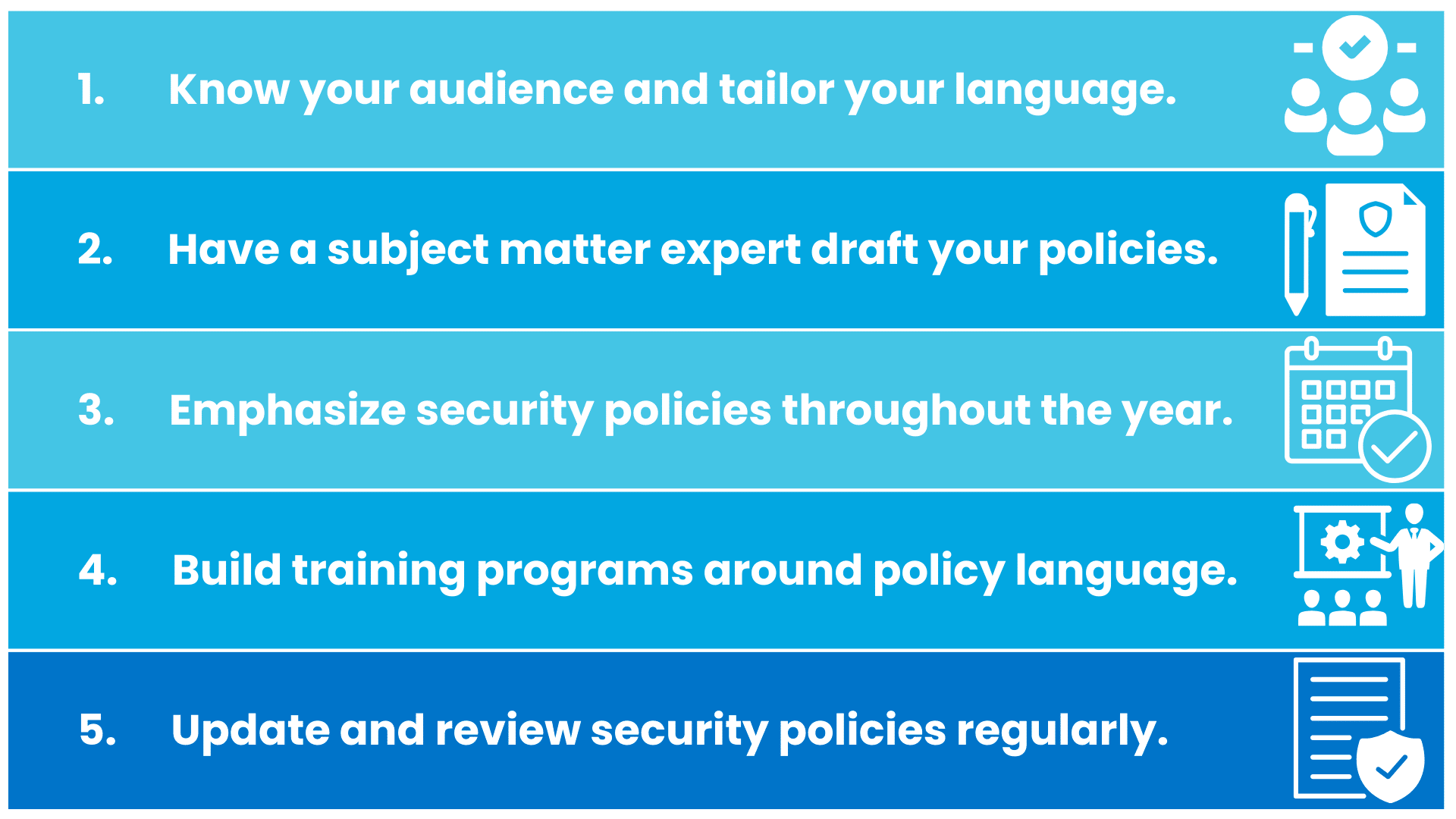
In summary, here are the 5 expert-approved tips discussed in this article to effectively communicate security policies to employees:
Security Policies for Small Businesses: The Bottom Line
Small businesses need security policies that work for them. They need policies that are tailored, based on real risks the business faces, and that meet a range of complex compliance requirements.
When done right, reinforced, and iterated on, policies form the backbone of a security program and enable organizations to do business with confidence and precision.
Hopefully, this article helped solidify how to draft and implement policies effectively. At Rhymetec, we believe that security and compliance are continuous processes that need to evolve and improve over time. We work directly with clients to build policies and security programs that meet regulatory requirements, scale with their growing organization, and enable business outcomes.
If you have more specific questions on crafting security policies for your business, please feel free to contact our team:
FAQs: Security Policies For Small Businesses
Why are security policies so important for small businesses?
Because most breaches stem from human error, strong policies protect against mistakes and provide much-needed guidance to employees. They also demonstrate accountability to customers, auditors, and regulators.
How often should small businesses update their security policies?
At least annually — but ideally every 6 months or whenever major changes occur in technology, staff, or regulations. In 2025, rapid changes in AI and data privacy laws mean reviews are needed more frequently.
Who should write or review a company’s security policies?
A subject matter expert with compliance and technical knowledge. Many SMBs rely on vCISO services or MSSPs like Rhymetec to ensure policies are tailored to industry risks and compliance frameworks.
How can small businesses make policies easier for employees to follow?
Keep language clear and non-technical, integrate policies into training, and connect them to real-world examples like phishing or ransomware incidents. Policies that are simple to understand are more likely to be followed.
Do security policies help with compliance certifications?
Yes. Well-documented policies form the backbone of compliance efforts for frameworks like SOC 2, ISO 27001, HIPAA, GDPR, and CMMC. They are often the first thing auditors request when evaluating a company’s security posture. As part of Rhymetec's Vanta Compliance Services, we can leverage cutting-edge compliance automation technologies like Vanta to accelerate this process for you. We enable our clients to maximize their use of compliance automation platforms like Vanta and Drata.
About Rhymetec
Rhymetec was founded in 2015 as a Penetration Testing company. Since then, we have served hundreds of SaaS businesses globally in all their cybersecurity, compliance, and data privacy needs. We're industry leaders in cloud security, and our custom services align with the specific needs of your business.

About Kyle Jones: Information Security Manager at Rhymetec
Kyle Jones is a Senior Cybersecurity Analyst at Rhymetec. Kyle is an experienced cybersecurity and compliance professional who excels at aligning SaaS cloud architecture with industry standards and regulations. If you have any questions about security, you can get in touch with Kyle on LinkedIn or contact our team at Rhymetec.
Partnering with a Managed Security Services Provider (MSSP) is an elegant solution for many companies for two main reasons:
- MSSPs provide specialized experience at scale, enabling organizations to access expert security services without having to build in-house security teams.
- Companies of all sizes are increasingly recognizing that good security is good business.
Cybersecurity and information technology risks continue to shift more rapidly than ever. Organizations of all sizes are coming under increasing regulatory scrutiny both in the United States and the European Union, with new requirements such as the U.S. SEC Data Breach rule and the EU's NIS2 Directive, as well as upcoming regulations like the Digital Operational Resilience Act (DORA) requirements in Europe and CMMC 2.0 in the U.S. defense sector.
In 2025, enterprise buyers are also raising the bar with stricter vendor due diligence and security questionnaire requirements. At the same time, a vast cybercrime underground continues to flourish, amplifying the ever-present threats of ransomware attacks, data breaches, and insider threats.
But even beyond these well-known risks, having a solid information security foundation is just good business. It inspires confidence with partners, vendors, customers, and employees. Even more than that, it enables organizations to scale effectively without the omnipresent threat of ransomware attacks, data breaches, and compliance violations.
Good security is good business.
What is a Managed Security Services Provider?
Managed Security Services Providers (MSSPs) provide outsourced cybersecurity and consulting services to businesses of all sizes, providing an elegant and simple solution for organizations to reduce the risk of both regulatory noncompliance and experiencing a threat actor attack. Common services provided include incident response, endpoint protection, threat intelligence, patch management, risk management, security questionnaire fulfillment, compliance management, and much more.
MSSPs centralize decades of security experience across different functions and organizations into a single entity, enabling small businesses to leverage security know-how and experience usually reserved for the world's largest and most sophisticated corporations.
Why Organizations Are Turning to MSSPs in 2025
Business drivers in 2025 include:
Expansion into regulated markets (e.g., finance, healthcare, SaaS)
Scaling globally, especially into Europe under NIS2 and DORA
Meeting stricter third-party vendor risk assessments from enterprise buyers
Preparing for CMMC 2.0 certification in the U.S. defense sector
This is why MSSPs like Rhymetec, now serving over 1,000 clients worldwide, are seeing increased demand from SaaS companies, startups, and enterprises alike.
Indeed, MSSPs help organizations work through a variety of complex technical and regulatory challenges, including:
Compliance Frameworks and Regulatory Requirements
Compliance requirements continue to proliferate adding additional regulatory impetus for organizations to improve their cybersecurity.
That's one of the reasons why Managed Security Services Providers with extensive experience helping organizations meet a range of frameworks (such as SOC 2, ISO 27001, PCI DSS, FedRAMP, GDPR, and others) are increasingly seen as the best route to go to meet requirements. In 2025, new frameworks like ISO 42001 (AI Management Systems) are also becoming relevant for companies building or deploying AI, and the EU AI Act is introducing additional oversight.
Many organizations see regulatory requirements as purely a cost. However, collaborating with the right MSSP company can help transform these requirements into a net benefit that can be applied across the organization.
There's a reason that 75% of companies who achieve some level of continuous compliance view their compliance program as a business driver. Meeting regulatory and voluntary standards boosts your ability to serve more clients, unblock sales, and expand into additional markets.
And in 2025, CMMC 2.0 compliance is becoming a key requirement for U.S. defense contractors, making MSSP expertise essential for entry into that market.
Enterprise sales opportunities will want to see compliance with regulations relevant to their industry such as SOC 2, GDPR, HIPAA, and PCI before even considering an engagement. Working with an MSSP simplifies the process of achieving and maintaining compliance standards, ensuring you are able to break into new marketplaces as your company grows.
Penetration Testing
It's no secret that the threat landscape continues to drive higher levels of risk.
Increases in geopolitical tension, growth in cybercrime, and the rapidly evolving risk of ransomware attacks all directly increase risk to organizations. Penetration testing can directly reduce much of this risk.
Currently, another issue is that AI-powered attack tools and supply chain exploits are also creating new levels of exposure for SaaS companies. Through partnerships with leading platforms like XBOW, at Rhymetec, we now combine automation with human-led oversight to scale testing more effectively.
Similar to the importance of continuous compliance discussed above, when exploring how to select the right pen testing vendor, companies should consider the importance of continuous communication and a collaborative approach with the pen tester.
A good pen testing firm will work with you to scope the pen test to your organization's specific requirements and risks. For example, organizations that offer their data via API may benefit from API penetration testing while organizations with web applications may need pen testing specifically scoped to address common vulnerabilities in web applications.
A rigorous penetration test can identify flaws in your application or corporate security that an attacker could exploit. In addition, they can strengthen your compliance posture and reassure potential auditors that your organization takes security seriously.
An MSSP that offers pen testing as a service will collaborate with you to understand your business requirements and scope the pen test to vulnerabilities that threat actors are most likely to exploit based on your unique risk posture. For example, Rhymetec offers a variety of pen testing engagements, including web application, API, network, and mobile application pen testing.
Virtual CISO Services
Security isn't a one-time initiative. It's an evolving process that requires buy-in from individuals across the organization.
Virtual CISO (vCISO) services serve as the linchpin of a security program. A vCISO acts as your organization's security expert - enabling you to leverage executive security expertise without the need to employ a full-time CISO.
A vCISO can advise you on:
- When to make additional security investments
- Which security policies and procedures would most benefit your organization
- Emerging threats that may pose a risk to your business
- Maintaining robust security throughout complex engagements like cloud migrations
- Upcoming changes to compliance regulations that may need to be addressed
- Preparing you for compliance or data privacy audits
A good vCISO has an in-depth understanding of compliance requirements, coupled with the technical resources needed to implement security controls in the context of the threat landscape. Managed Security Services offering a vCISO service provide companies of all sizes access to this valuable combination of skills.
In addition, a vCISO enables you to maintain a posture of continuous compliance.
Working With A Managed Security Services Provider Encourages Continuous Compliance
At Rhymetec, we believe compliance shouldn't be a sprint right before an audit.
Organizations that make compliance core to their business can maintain a posture of constant compliance, reducing the stress and overhead associated with compliance while also ensuring that audit requirements are met.
A common misconception is that smaller businesses are exempt in some way from needing to meet requirements. However, requirements are generally stipulated across the board for most companies regardless of size.
Going beyond compliance frameworks, which represent a reasonable baseline but fall far from the finish line compared to an actual security program, vCISOs are able to implement additional security controls based on the unique risks an organization faces. Before building out or improving upon an existing security program, a vCISO will consider customer requirements and pinpoint specific laws and threats that apply to an organization and its vendors.
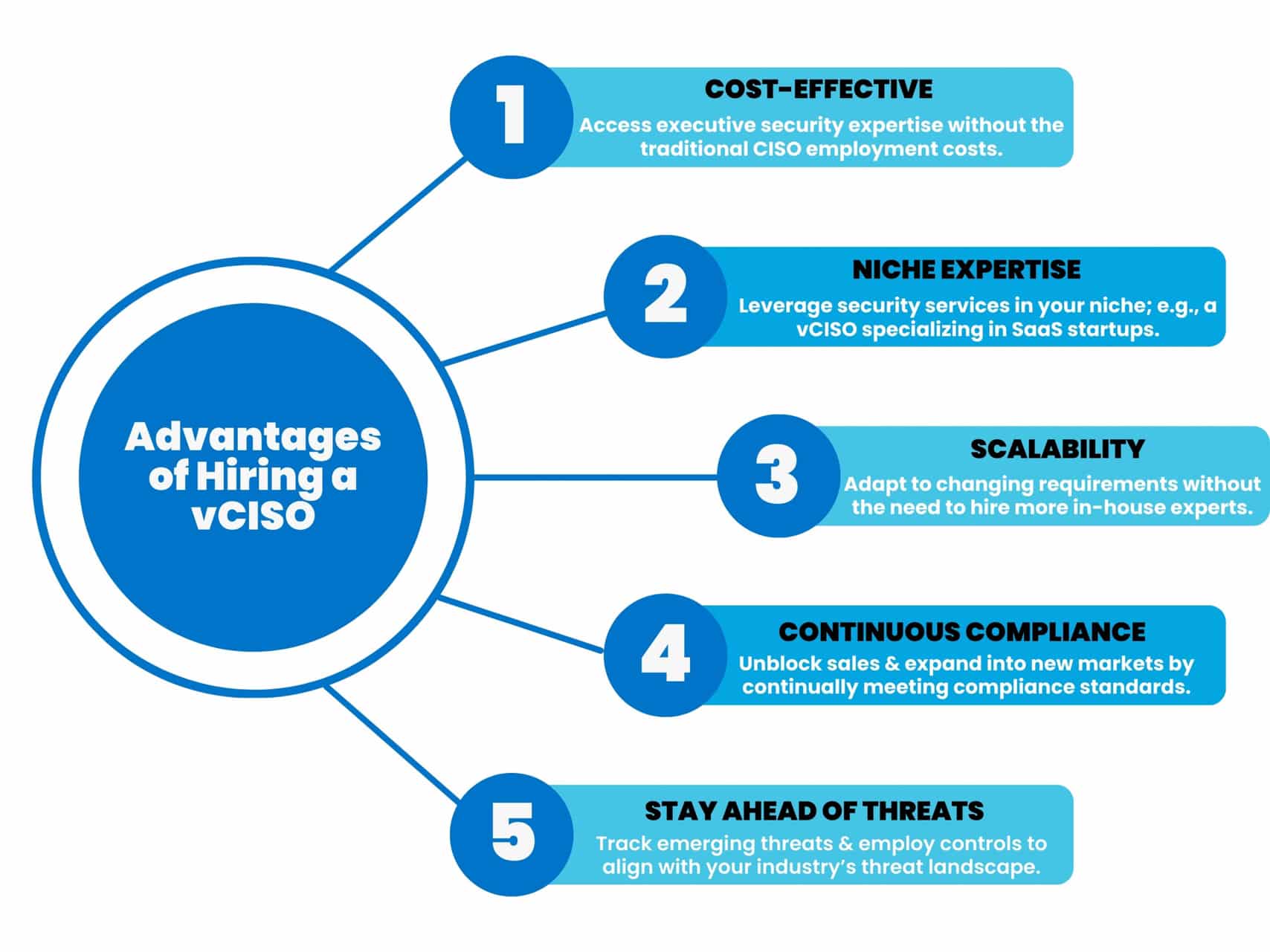
Opting for a vCISO service enables small and mid-size businesses to be certain they meet compliance standards while also leveraging their security dollars to reduce the risk of data breaches and ransomware attacks.
Let's expand on the main reasons why managed security services are an agile solution for smaller organizations:
Why Work With A Managed Security Services Provider? Specialized Experience At Scale.
The reason organizations choose to work with MSSPs is simple - specialized experience at scale. An average MSSP will often have experts on their team across many disciplines to include:
- Job Title (Salary range for an in-house full-time hire in 2025)
- CISO ($215,000 - $275,000 per year)
- Director of Security ($250,000 - $400,000 per year)
- Cloud Security Specialist ($110,000 - $150,000 per year)
- Application Security Specialist ($130,000 - $180,000 per year)
- Penetration Tester ($110,000 - $150,000 per year)
- Security Operations Analyst ($110,000 - $160,000 per year)
- Threat Intelligence Analyst ($80,000 - $140,000 per year)
- Governance, Risk and Compliance Specialist ($65,000 - $100,000 per year)
- Vulnerability Management Analyst ($100,000 - $165,000 per year)
Large enterprises spend millions of dollars on a security team with many highly specialized individuals across a range of disciplines. Small businesses need the same level of experience but not necessarily the same amount of work. Managed Security Services fill this gap perfectly.
Why Managed Security Services? It's Good Business.
Organizations are increasingly scrutinizing their vendors for security practices.
Suffering a major breach leaves a company scrambling to notify consumers, reassure investors, and manage employee fears. Proactively tackling cybersecurity, compliance, and data privacy by getting your SOC 2 Report (or other compliance audits), engaging in routine penetration testing, and utilizing vCISO services can serve as an amplifier across the rest of your business activities.
Having an MSSP as a continuous resource also simply provides peace of mind. When compliance frameworks are inevitably updated, when an auditor requests an evaluation of third-party risk, when you need things like phishing testing services to fulfill controls, or when you receive a security questionnaire from a customer - you'll know where to go for immediate and expert assistance.
Proactively providing SOC 2 Type 2 Reports to potential customers immediately makes your business stand out while also preventing the need for time-consuming security questionnaires. A vCISO service can help your organization identify and prepare for upcoming compliance regulations, saving costs and time in the long run.
Finally, working with an MSSP lets you leverage talent from across a variety of disciplines without the need to build large in-house teams.
Exploring Managed Security Services?
Rhymetec was founded in 2015 as a Penetration Testing company. Since then, we have served thousands of businesses globally in all their cybersecurity, compliance, and data privacy needs. We're industry leaders in cloud security, and our custom services align with the specific needs of your business. We help organizations achieve certifications like SOC 2, ISO 27001, HIPAA, and CMMC while preparing them for the evolving regulatory landscape in both the U.S. and Europe.
To learn more about our offerings and how a Managed Security Services Provider can be an accelerator for your business, contact our team for more information.
FAQs
Why choose managed security services instead of in-house security in 2025?
The demands of compliance and cybersecurity have outpaced what most in-house teams can manage. Managed security services provide access to expert resources, 24/7 monitoring, and full compliance management at a lower cost than building your own team. In 2025, when vendor due diligence and regulatory expectations are stricter than ever, MSSPs give businesses a faster and more reliable way to stay secure and audit-ready.
What is the cost difference between managed security services and hiring in-house?
Hiring a complete in-house security team can cost millions annually, with salaries for CISOs, penetration testers, and compliance specialists ranging from $80K to $275K each. Managed security services let you access the same breadth of expertise on a fractional basis. This approach delivers enterprise-grade protection and compliance readiness without the overhead of staffing a full team.
How do managed security services help with compliance like SOC 2 or CMMC 2.0?
MSSPs guide companies through the full compliance journey. We design policies, implement controls, maintain readiness, and support you through audits. Our team helps organizations meet frameworks such as SOC 2, ISO 27001, HIPAA, GDPR, FedRAMP, and CMMC 2.0. By outsourcing compliance management, businesses expand into new markets and shorten audit timelines, often achieving compliance in one-third of the expected time.
Can managed security services prepare businesses for AI regulations and new laws?
Yes. In 2025, MSSPs are helping organizations align with emerging frameworks like ISO 42001 (AI Management Systems - see our ISO 42001 Checklist for more info), EU AI Act compliance, and stricter privacy and disclosure requirements. By keeping you ahead of regulatory shifts, MSSPs make sure your business avoids gaps, reduces legal exposure, and can adopt AI securely while meeting compliance expectations.
How do managed security services reduce risk for growing businesses?
MSSPs combine continuous monitoring, penetration testing, vCISO leadership, and risk management to reduce the likelihood of breaches or compliance failures. This proactive approach protects your data and strengthens customer trust. For growing businesses, demonstrating strong security and continuous compliance can also shorten sales cycles by removing barriers during vendor assessments.
About the Author: Justin Rende, CEO
Justin Rende has been providing comprehensive and customizable technology solutions around the globe since 2001. In 2015 he founded Rhymetec with the mission to reduce the complexities of cloud security and make cutting-edge cybersecurity services available to SaaS-based startups. Under Justin's leadership, Rhymetec has redesigned infosec and data privacy compliance programs for the modern SaaS-based company and established itself as a leader in cloud security services.
Companies across every industry depend more and more on technology to run their businesses, store sensitive data, and carry out essential operations. With the rise in cybersecurity threats and tough technology regulations, organizations must have a robust security plan to meet IT compliance standards. However, since no two companies are the same, and every business has unique needs, a one-size-fits-all compliance plan is not enough to establish a compliant and effective information security program.
The Current Threat Landscape
Organizations using digital technology and cloud software face a complex threat landscape that grows increasingly sophisticated. Ransomware attacks, phishing attacks that attempt to trick people into sharing sensitive data, advanced persistent threats (APTs), and well-funded, determined attackers all target companies to steal intellectual property or disrupt operations.
Then there's the explosion in connected IoT devices, standing at 15.14 billion as of 2023, and the high risk of DDoS attacks. With individual cyber breaches costing upwards of US$4.35 million, failure of a one-size-fits-all solution can be dangerous and expensive.
Generic Compliance Plan Pitfalls
IT departments these days use many different architectures with various hardware, software, and network configurations. Because of these differences, it's difficult to create a single cybersecurity formula that works for all companies. Some of the pitfalls of trying to cut corners and save costs by implementing a generic plan include:
- Lack of customization: A one-size-fits-all approach doesn't consider the specific problems and needs of each company. What works for one organization may not be enough to address the weaknesses and particular requirements of the next. It's important to customize security measures to fit the unique characteristics of each company to effectively protect against cyber threats.
- Increased risk of breaches: When companies use a standardized compliance plan, it sets a basic level of security. However, this plan might not take into account the specific risks and security gaps that exist in each organization. Without customized security measures, a greater chance exists of experiencing data breaches or cyberattacks.
- Higher chance of vulnerabilities: Cybercriminals take advantage of vulnerabilities that are often not addressed in a generic security plan. In the past, we have seen the severe consequences of inadequate security measures. Well-known breaches caused by a lack of tailored security have resulted in large-scale data leaks, compromised customer information, and significant financial losses for companies.
To keep your data safe, protect against cyberattacks, build trust with customers, and combat the potential risks and consequences of non-compliance, you need a plan tailored for your organization.
The Cost of Corner-Cutting
Few young companies are equipped to handle and overcome the financial and business losses following an attack. The direct costs can be considerable, including legal proceedings, recovering lost data, and repairing damage to the company's reputation. Fines, penalties, and legal settlements can reach millions of dollars. Restoring compromised systems, conducting investigations, and enhancing security measures add to the expenses.
A cybersecurity incident can also seriously disrupt your company operations, resulting in downtime and lost productivity. Systems can become inaccessible, affecting critical tasks and leading to delays or disruptions in operations. Additionally, a breach damages the trust and loyalty of customers, which can cause the company to lose revenue and harm its reputation in the long run.
Advantages of a Human-Centric Approach
In many cybersecurity incidents, human error plays a significant role. According to Verizon's 2022 Data Breaches Investigations Report, 82% of data breaches involved a human element. From being victims of phishing scams to using weak passwords, employees accidentally create vulnerabilities that cyber attackers take advantage of. By adopting a human-centric approach, organizations (especially startups) can establish a strong defense and create a culture where everyone in the company values security. To achieve this, your company must:
1. Invest in education
A human-centric approach propels your organization to provide thorough training that creates a culture of cybersecurity awareness. Education empowers your employees to recognize and handle suspicious emails, avoid clicking on harmful links, and use safe practices when dealing with sensitive information.
2. Keep employees informed
When employees are kept informed about the latest threats and know how to protect company assets, they feel responsible for protecting the company's digital assets. By tailoring your training to address the specific risks employees face and keeping them up to date, your workers become the first line of defense against potential attacks.
3. Empower proactive defense
Companies that recognize a human focus is crucial for quality cybersecurity goals equips employees with the knowledge and skills to prevent cyber incidents proactively. This helps them to successfully reduce the number of threats unique to their industry or work environment.
Tailor Compliance Plans to Meet Organizational Needs
Customizing security and compliance to match your company's unique environment brings several benefits. It allows you to address the specific vulnerabilities and risks that apply to your operations. It lets you focus your resources on the most critical areas and ensures your security efforts are efficient and effective.
Customization also ensures that your security measures align with your company's goals, values, and compliance requirements, putting you in a stronger position to resist cyber threats. By considering factors like the types of data you handle, your IT infrastructure, and the skills of your workforce, you can develop a security approach that is targeted and relevant to your specific situation.
A human-centric compliance and cybersecurity program integrating technology and employee involvement gives you a holistic and robust defense against cyber threats.
You can read the original article posted in Forbes by Rhymetec CEO, Justin Rende.
Need custom cybersecurity and compliance solutions?
Hire a vCISO with years of experience in cloud security at a fraction of the cost of hiring a full-time CISO in-house. Rhymetec’s custom vCISO services adapt to your organization’s cybersecurity and compliance needs and scale as you grow over time. Providing executive-level security leadership, a dedicated Rhymetec vCISO can assess your organization’s cyber risk, develop an internal InfoSec Program, and assist in the compliance and security needs that align with your business.
Interested in reading more? Check out our blog:
If your company is exploring SOC 2 compliance, one of the first questions you may be wondering is—how long does it take to get SOC 2 compliance? The SOC 2 readiness and audit process can take anywhere from 3-12 months to complete. But with the support of a vCISO, service organizations can typically achieve SOC 2 compliance in half the time it would take them to navigate the process alone.
SOC 2 Readiness and Audit Timelines: How Long Does it Take to Get SOC 2 Compliance?
The SOC 2 compliance process generally takes between 3 to 12 months. This estimate includes the time it takes to prepare for an audit, undergo an audit, and receive a SOC 2 audit report. The timeline varies based on your team’s knowledge and expertise, available resources, the nature of your services, the size of your company, the auditor you choose to work with, and more.
SOC 2 Compliance Timeline: What to Expect & How Long A SOC 2 Audit Takes
Here’s what a SOC 2 compliance timeline looks like for clients that work with a Rhymetec vCISO versus those that choose to navigate the process alone. Remember: every organization is different, and yours will look a little different.
Phase 1: Prepare and Plan
During this phase, you’ll choose which type of SOC report you need (SOC 2 Type 1 vs Type 2), identify your compliance requirements, determine the trust services criteria to include in your SOC 2 report, assemble a team, allocate resources, and find an independent auditor.
Duration:
- With Rhymetec: 2 weeks.
- Without Rhymetec: 1-2 months.
Phase 2: Identify and Scope
This phase involves assessing your organization’s current readiness, benchmarking against all relevant SOC 2 Trust Services Criteria, SOC 2 training and employee education.
Duration:
- With Rhymetec: 2 to 3 weeks
- Without Rhymetec: 1 to 2 months
Phase 3: Assess and Implement
Now it’s time to conduct a risk assessment, implement controls, identify and address any outstanding issues, draft policies and procedures, implement monitoring, collect evidence, and ensure that your organization is ready to undergo a SOC 2 audit.
Duration:
- With Rhymetec: 1 to 3 months
- Without Rhymetec: 2 to 6 months
Phase 4: Prepare for Audit
Finally, you’ll need to complete a SOC 2 readiness assessment and address any final concerns before commencing a SOC 2 audit and receiving a SOC 2 report.
Duration:
- With Rhymetec: 4 to 6 weeks
- Without Rhymetec: 6 to 12 weeks
Phase 5: Official audit (2-6 weeks)
Your selected auditor will begin the official process of reviewing your company’s collected evidence and point-in-time snapshot.
How long does a SOC 2 audit take? From the kick-off of the audit to the SOC 2 report delivery, this process can take anywhere between 2-6 weeks. Factors that can impact your SOC 2 Audit timeline include:
- The scope of your audit
- Number of controls involved
- Evidence requests from your auditor
Once the evaluation is complete, your auditor will create and deliver your SOC 2 report. After the report is finalized, you can share it with vendors, partners, customers, and prospects.
How Rhymetec simplifies SOC 2 audits
The traditional SOC 2 process can take hundreds of hours to complete. Working with a Rhymetec vCISO removes the complexity and burden from SOC 2 compliance. Our team of cybersecurity experts has helped hundreds of SaaS and service-based organizations navigate the SOC 2 compliance process; we know what to look for, and we can guide you at every step of the way. How long it takes to get SOC 2 compliance varies, but our team has helped hundreds of companies cut down the amount of time needed substantially.
Not only do we consult you on how to achieve your SOC 2 goals, but provide the managed compliance services you need to get there. We like to say that we act on our own advice, so you can focus on other critical aspects of your business.
What a Rhymetec vCISO Can Do
Rhymetec’s team of cybersecurity experts acts as a member of your team and acts in the best interest of your company’s needs. With years of experience working among some of the most complex compliance regulations, we can provide you with strategic direction and hands-on support to simplify your SOC 2 readiness.
Tasks a vCISO can support in your compliance journey:
- Expert Audit and Compliance Guidance
- Security and Compliance Management
- Compliance Monitoring Software Deployment and Management
- InfoSec Policy and Procedure Development
- Human Resources Security Services
- Employee Access Management Services
- Vendor Management Services
- Incident Management and Response Services
- Security Questionnaire Fulfillment
- Security and Data Privacy Training Services
- Vulnerability Management and System Logging Services
- Risk Management Services
- Audit Management Services
- And More
Not only will a vCISO help you get ready for your audit and work with your auditor, but a Rhymetec vCISO can also support your post-audit maintenance goals to ensure ongoing compliance with SOC 2, and address stakeholder inquiries about security and compliance.
We give you the right level of vCISO support.
Whether your team needs high-level guidance from an experienced vCISO or hands-on support from our team of cybersecurity experts, Rhymetec can provide the level of support your organization needs to quickly achieve SOC 2 compliance.
To Learn More About Rhymetec's Services
Contact Our Team
Measuring the competitive advantage of compliance
Metin Kortak, CISO from Rhymetec, to discuss how to make compliance a competitive advantage. Ben shares news of a Biden Executive Order on commercial spyware after it may have been abused to spy on "autocracies — and some democracies." Dave took a look at export controls and whether they really make a difference when it comes to invasive software.
While this show covers legal topics, and Ben is a lawyer, the views expressed do not constitute legal advice. For official legal advice on any of the topics we cover, please contact your attorney.
Links:
View more of our Blogs here
[embed]https://www.youtube.com/watch?v=oTtsVtATFGE[/embed]
A vital component of any risk and compliance program is implementing maintenance strategies. If you’ve already completed your compliance journey, a compliance maintenance program is the next step in ensuring your organization avoids gaps in both your compliance and infosec program.
Regularly reviewing and maintaining policies and procedures enables firms to keep up to date with the latest regulations, changes in technology, and best practices across the industry. addressing these standards empowers your employees to be more diligent about security within daily business operations, and lead with a security-first mindset when it comes to the construction of your cloud software.
What does compliance maintenance look like?
According to a recent study about compliance trends (Drata), it was found that IT and security professionals spend an average of 4,300 hours annually achieving or maintaining compliance. The survey of 300 US professionals found that 87% had faced consequences as a result of not having a continuous compliance maintenance program within their organization.
- Develop comprehensive security policies: Create security policies that outline the procedures and guidelines required to maintain compliance. These policies should be clear, concise, and accessible to all employees.
- Regularly update software and security systems: Regularly update your software and security systems to protect against vulnerabilities. This includes keeping your operating systems, applications, and antivirus software up to date.
- Conduct regular risk assessments: Conduct regular risk assessments to identify any potential vulnerabilities or threats to your organization. This will help you stay ahead of potential security issues and mitigate them before they become a problem.
- Train employees on security awareness: Educate and train employees on security awareness to ensure they understand their role in maintaining security and compliance. This includes training on how to identify and report security incidents, how to create secure passwords, a phishing test as needed for employees, and guidance on how to avoid phishing attacks.
- Monitor and log all activity: Monitor and log all activity on your network to identify potential security threats and incidents. This includes monitoring access to sensitive data, user activity, and network traffic.
- Perform regular security audits: Perform regular security audits to ensure compliance with industry standards and regulations. This will help you identify any areas where you may be falling short and address them before they become a problem.
- Have an incident response plan in place: Have an incident response policy & plan in place for security incidents, including a clear escalation path. This will help you respond quickly and effectively to any potential security incidents.
By following these tips, you can maintain security compliance and protect your organization from potential security threats and breaches.
What are the benefits of maintaining compliance?
55% of organizations say their compliance strategy is based around a “Can we?” rather than “Should we?” attitude, indicating a focus on building a more proactive and positive compliance strategy. However, stagnant budgets and a shifting workforce have left many compliance teams feeling stretched, with 87% of organizations reporting they have no additional capacity due to being understaffed or only adequately staffed (Deloitte State of Compliance 2020 Report). That being said, compliance offers an abundance of benefits to organizations including:
- Avoiding hefty fines and penalties for non-compliance
- Protecting your business reputation by building a security-aware organization
- Enhancing your data management capabilities which can increase operational efficiency
- Attracting partnerships with other organizations that prioritize compliance and security
- Strengthening company culture by working towards a mutually exclusive benefit of an internal and external identity to stakeholders
- Supporting access controls and accountability to prevent breaches or data loss
- Speeding up the sales cycle when needing to provide proof of compliance
How can an organization simplify and scale the compliance maintenance process?
Whether you already have a CISO/security expert in your organization or are a young startup with limited resources to achieve compliance. The bottom line is that compliance is critical and there are a number of intricacies to achieving and maintaining these standards. The good news, you have options to fit the needs of your organization! For instance, 34% of organizations outsource some or all of their compliance functionality. (Thomson Reuter's Cost of Compliance Report 2021)
Cutting-edge compliance automation tools can help security teams build a foundation for their information security programs, and have a reliable source of truth with their efforts. These tools not only help you continuously monitor your information security programs, but they provide a resource for evidence collection and reporting when it comes to the stress of working with an auditor to evaluate your policies and procedures to determine whether they are in alignment with framework standards.
For organizations that need additional support in their compliance journey or have little to no experience with the process—you can work with cybersecurity consultants or managed service providers like a vCISO (Virtual CISO). Here at Rhymetec, we pride ourselves on being disruptors in the consulting space by acting on our own advice. Not only will we provide you with direction on how to achieve and maintain your security and compliance goals, but we provide the services to help you get there too.
View more of our blogs here.
To Learn More About Rhymetec's Compliance
Readiness or Maintenance Programs:
A vital component of any risk and compliance program is implementing maintenance strategies. If you’ve already completed your compliance journey, a compliance maintenance program is the next step in ensuring your organization avoids gaps in both your compliance and infosec program.
Regularly reviewing and maintaining policies and procedures enables firms to keep up to date with the latest regulations, changes in technology, and best practices across the industry. addressing these standards empowers your employees to be more diligent about security within daily business operations, and lead with a security-first mindset when it comes to the construction of your cloud software.
What does compliance maintenance look like?
According to a recent study about compliance trends (Drata), it was found that IT and security professionals spend an average of 4,300 hours annually achieving or maintaining compliance. The survey of 300 US professionals found that 87% had faced consequences as a result of not having a continuous compliance maintenance program within their organization.
- Develop comprehensive security policies: Create security policies that outline the procedures and guidelines required to maintain compliance. These policies should be clear, concise, and accessible to all employees.
- Regularly update software and security systems: Regularly update your software and security systems to protect against vulnerabilities. This includes keeping your operating systems, applications, and antivirus software up to date.
- Conduct regular risk assessments: Conduct regular risk assessments to identify any potential vulnerabilities or threats to your organization. This will help you stay ahead of potential security issues and mitigate them before they become a problem.
- Train employees on security awareness: Educate and train employees on security awareness to ensure they understand their role in maintaining security and compliance. This includes training on how to identify and report security incidents, how to create secure passwords, a phishing test as needed for employees, and guidance on how to avoid phishing attacks.
- Monitor and log all activity: Monitor and log all activity on your network to identify potential security threats and incidents. This includes monitoring access to sensitive data, user activity, and network traffic.
- Perform regular security audits: Perform regular security audits to ensure compliance with industry standards and regulations. This will help you identify any areas where you may be falling short and address them before they become a problem.
- Have an incident response plan in place: Have an incident response policy & plan in place for security incidents, including a clear escalation path. This will help you respond quickly and effectively to any potential security incidents.
By following these tips, you can maintain security compliance and protect your organization from potential security threats and breaches.
What are the benefits of maintaining compliance?
55% of organizations say their compliance strategy is based around a “Can we?” rather than “Should we?” attitude, indicating a focus on building a more proactive and positive compliance strategy. However, stagnant budgets and a shifting workforce have left many compliance teams feeling stretched, with 87% of organizations reporting they have no additional capacity due to being understaffed or only adequately staffed (Deloitte State of Compliance 2020 Report). That being said, compliance offers an abundance of benefits to organizations including:
- Avoiding hefty fines and penalties for non-compliance
- Protecting your business reputation by building a security-aware organization
- Enhancing your data management capabilities which can increase operational efficiency
- Attracting partnerships with other organizations that prioritize compliance and security
- Strengthening company culture by working towards a mutually exclusive benefit of an internal and external identity to stakeholders
- Supporting access controls and accountability to prevent breaches or data loss
- Speeding up the sales cycle when needing to provide proof of compliance
How can an organization simplify and scale the compliance maintenance process?
Whether you already have a CISO/security expert in your organization or are a young startup with limited resources to achieve compliance. The bottom line is that compliance is critical and there are a number of intricacies to achieving and maintaining these standards. The good news, you have options to fit the needs of your organization! For instance, 34% of organizations outsource some or all of their compliance functionality. (Thomson Reuter's Cost of Compliance Report 2021)
Cutting-edge compliance automation tools can help security teams build a foundation for their information security programs, and have a reliable source of truth with their efforts. These tools not only help you continuously monitor your information security programs, but they provide a resource for evidence collection and reporting when it comes to the stress of working with an auditor to evaluate your policies and procedures to determine whether they are in alignment with framework standards.
For organizations that need additional support in their compliance journey or have little to no experience with the process—you can work with cybersecurity consultants or managed service providers like a vCISO (Virtual CISO). Here at Rhymetec, we pride ourselves on being disruptors in the consulting space by acting on our own advice. Not only will we provide you with direction on how to achieve and maintain your security and compliance goals, but we provide the services to help you get there too.
View more of our blogs here.
To Learn More About Rhymetec's Compliance
Readiness or Maintenance Programs:
With the number and severity of cyberattacks growing daily, software-as-a-service (SaaS) organizations are under pressure to ensure their defense protocols can withstand threats. The SaaS marketplace, projected to expand by almost 26% CAGR by 2028, is a focus area for cyber defense concerns. For new SaaS startups entering the market, getting regulatory compliance in the industry they intend to serve is vital to show competence.
The Pressure To Prove Compliance
A 2021 report from DoControl indicates that 40% of SaaS assets are at risk for data leaks because of poor management. Even the big players are vulnerable, with popular SaaS applications like Microsoft Office 365, Salesforce, Slack, and Zoom being primary entry points for breaches and ransomware.
Many startup founders think compliance is only necessary for healthcare, finance, or other highly-regulated industries. In truth, in addition to legal requirements, compliance is a successful way to grow a company’s market share. A SaaS startup intending to serve enterprise companies will be required to prove its compliance with potential customers. Few organizations with established cyber defense strategies will accept non-compliant vendors.
New SaaS businesses can use existing compliance frameworks to establish security processes that deliver a safe, dependable customer environment. The ability to prove compliance generates new marketing opportunities, enables companies to increase sales, protects customer data, and establishes trust that drives renewals.
A Challenging Process
Developing a remarkable software product is just the first step in establishing a successful SaaS company. The challenge arises when the company starts preparing to market the product. With compliance now a “catchphrase” in technology, a startup must implement the relevant regulatory processes before expecting prospective customers to beat a path to its door. Even if compliance is not a legal requirement for going to market, companies that don’t comply will not possess credibility.
Achieving compliance with any primary frameworks requires startups to implement multiple complex processes. Companies must employ (and pay for) the system audits required and complete dozens of application forms. This can be a formidable operation for a startup founder, and hiring a full-time compliance staffer at this early stage is often unfeasible.
Primary Compliance Frameworks
Most governmental and commercial organizations have established privacy policies and controls that outline the ideal cyber defense requirements for SaaS operations. Attaining compliance with these regulations shows that a company or product applies the controls necessary to reach these standards.
This achievement also indicates that a company’s software solution and underlying technology stack support the appropriate privacy, access, and confidentiality levels. The main compliance frameworks applicable to SaaS companies are:
1. SOC 2
The Service Organization Control (SOC 2) Standard is a well-established regulatory compliance framework for companies that collect and manage customer data in the cloud. It applies to information security, availability, processing integrity, privacy, and confidentiality. SaaS startups typically fall under this category.
2. ISO 27001
ISO 27001 is an internationally recognized accreditation for Information Security Management Systems. It’s the only auditable certification relating to overall information security, instead of just the technical controls.
3. HIPAA
The Health Insurance Portability and Accountability Act (HIPAA) prohibits the unauthorized disclosure of patient health information by any organizations involved in healthcare.
4. FedRAMP
The Federal Risk and Authorization Management Program (FedRAMP) is a compliance program developed by the U.S. government. It provides a standard for authorization, security assessment, and continuous monitoring of companies offering cloud products and services.
5. GDPR
The General Data Protection Regulation (GDPR) Standard applies to firms distributing products across the European Union (E.U.), regardless of location. These standards mainly apply to privacy and data protection for E.U. citizens.
6. PCI
The Payment Card Industry - Data Security Standard (PCI-DSS), often called PCI, is a collection of security protocols developed for companies and programs that process and store credit card payment information.
Industry-Specific Regulations
In addition to these common compliance frameworks, agencies expect SaaS companies to comply with other industry-specific regulations before operating in their markets. For example, sustaining HIPAA and FedRAMP require organizations to work only with other compliant vendors. FedRAMP is a U.S. government standard, meaning any company that aims to attract government clients needs FedRAMP-compliance to do so.
The healthcare environment is even more rigid. While HIPAA compliance doesn’t come with actual certification, any SaaS startup working with a non-compliant healthcare supplier can face liability if the noncompliance is reported to the government. As a company’s supplier network expands, the number of companies that must also comply increases, or they will not be authorized to operate in their preferred markets.
Conquering The Compliance Beast
Obtaining compliance is critical for every SaaS company, and failing to do so can result in significant financial and reputational damage. The entire process might seem intimidating for a SaaS startup founder, but these tips can help make compliance a reality.
To conquer the compliance beast, companies should start the process while their product is still in beta. Most SaaS products require SOC 2 compliance at least, which means bringing in accredited auditors or CPAs to carry out an official system audit.
Compliance automation offers a helping hand, too. In the past, setting up the security, availability, processing, integrity, and confidentiality policies and procedures required to achieve compliance was a laborious, manual process. Now, many of these tasks can be automated using readily available software solutions that save time and money.
Reaching regulatory compliance depends on multiple factors. A SaaS startup can typically get SOC 2 certification in around three months, while PCI compliance takes six to 12 months. HIPAA, although it offers no formal certification option, can take three to six months to fulfill all the requirements. FedRAMP can take up to a year.
Pros And Cons Of Compliance
For SaaS startups aiming to operate in a specific environment or marketplace, it’s critical to comply with the latest regulatory requirements. Failing to adopt universal data regulations and specific policies affecting an industry can result in lawsuits, heavy fines, revenue losses, and even get a product banned from the market. The penalties can be stiff, depending on the degree of noncompliance. For example, HIPAA has four penalty levels, depending on the degree of negligence and its impact. Consequences for HIPAA noncompliance range from $100 to $50,000 per individual violation and can even include jail time for persons responsible for a violation.
Achieving compliance in all relevant areas is vital to any business strategy. Mitigate the risk of being non-compliant by addressing regulatory requirements head-on. An independent consultant specializing in cyber defense solutions can take the regulatory burden off a SaaS founder’s shoulders, enabling them to focus on building the business while they handle the compliance process. Additionally, it delivers multiple benefits for the company, including competitive advantage, industry credibility, and faster growth.
About the Author
Metin Kortak is the Chief Information Security Officer at Rhymetec.
Click here to view the original post on VAR Insights
About Rhymetec
Justin Rende founded Rhymetec in 2015 as a Penetration Testing company. Since then, we have served hundreds of SaaS businesses globally in all their cybersecurity, compliance, and data privacy needs. We’re industry leaders in cloud security, and our custom services align with the specific needs of your business. We enable businesses to meet requirements for frameworks including HITRUST, NIST (including controls under the latest NIST Governance update), HIPAA, GDPR, SOC 2, PCI DSS, and more. Contact our team to learn how we can help your business through our managed compliance services.
Interested in reading more? Check out our blogs: