Working with a CMMC consultant is an attractive option for many organizations seeking to meet the updated CMMC requirements nowadays.
The Department of Defense (DoD) released CMMC 2.0 on October 15th, 2024, a requirement for defense contractors and subcontractors with the goal of improving cybersecurity standards. The updated version refines the original framework, aiming to simplify the path to compliance while maintaining the highest security standards for organizations that handle Controlled Unclassified Information (CUI) and other sensitive contract data.
One way in which the updated version simplifies compliance is by aligning requirements even more closely with existing cybersecurity standards like NIST SP 800—171. Many organizations may already comply with NIST 800-171 or another framework very closely aligned with it. Either way, the shift in compliance expectations has led many organizations to assess whether they have the in-house resources to manage security or if they need external support through a CMMC consultant.
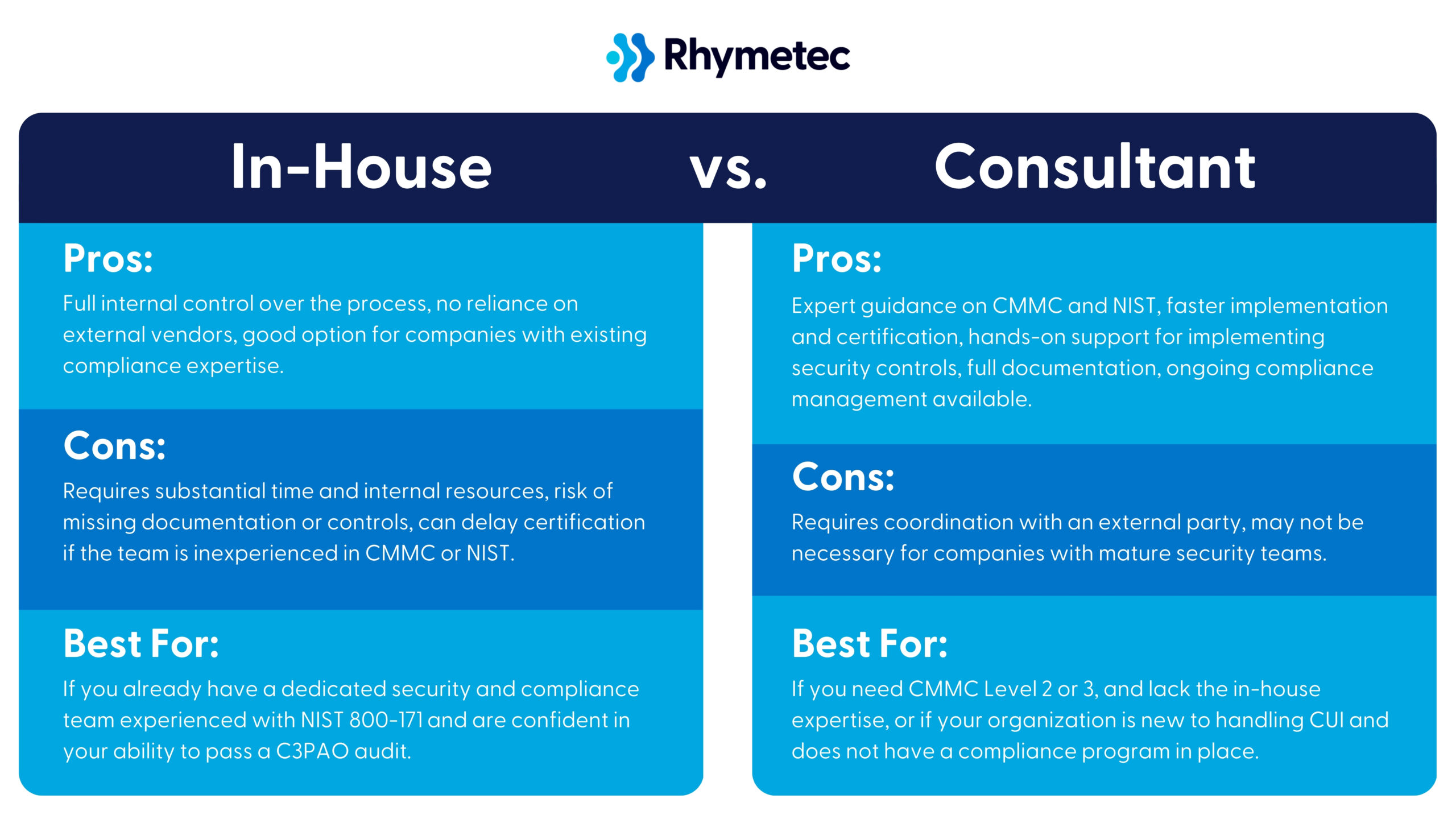
Working with a Managed Security Services Provider that offers CMMC consulting services (like Rhymetec!) can help contractors meet CMMC 2.0 requirements efficiently. MSSPs take the work off your plate and help you meet your goals in the fastest time frame possible. We've helped over 1,000 organizations meet their compliance and security requirements in the fastest time frame possible.
In this article, we go over how CMMC 2.0 works, the options available for achieving compliance, and the potential advantages of working with a CMMC consultant.
What Is A CMMC Consultant, and What Do They Do?
Unless you have a fully built-out in-house cybersecurity and compliance team, CMMC can be a massive project to take on internally—taking a year or longer to meet requirements. This is where a CMMC consultant comes in.
A CMMC consultant is a cybersecurity and compliance expert who helps defense contractors meet the requirements of the Cybersecurity Maturity Model Certification (CMMC) 2.0. Consultants do everything from conducting a gap assessment to see where you are versus where you need to be, developing practical strategies to achieve compliance that will fit seamlessly (and as non-disruptively as possible!) into your operations, and guiding you through the certification process in partnership with an external auditor.
For many businesses, especially small and mid-sized contractors, understanding and implementing CMMC controls can be challenging. A CMMC consultant provides tailored, specialized knowledge to streamline the entire process, reduce your risk of non-compliance, and make big improvements to your overall security if you do not already have certain measures in place.
Do You Need A CMMC Consultant?
The best way to determine if you need a CMMC consultant is to look through the responsibilities and deliverables in the next section and assess whether or not you have the in-house capacity to fulfill all of these items.
If you are a larger organization and already have a security team with personnel that can accomplish the necessary tasks for CMMC (A Chief Information Security Officer, Penetration Tester, Cloud Security Specialist, Vulnerability Management Analyst, etc.), you can probably do most of this on your own or with guidance from a CMMC consultant rather than full support.
However, for smaller organizations or those without a fully developed in-house security program, engaging a CMMC consultant entails multiple benefits.
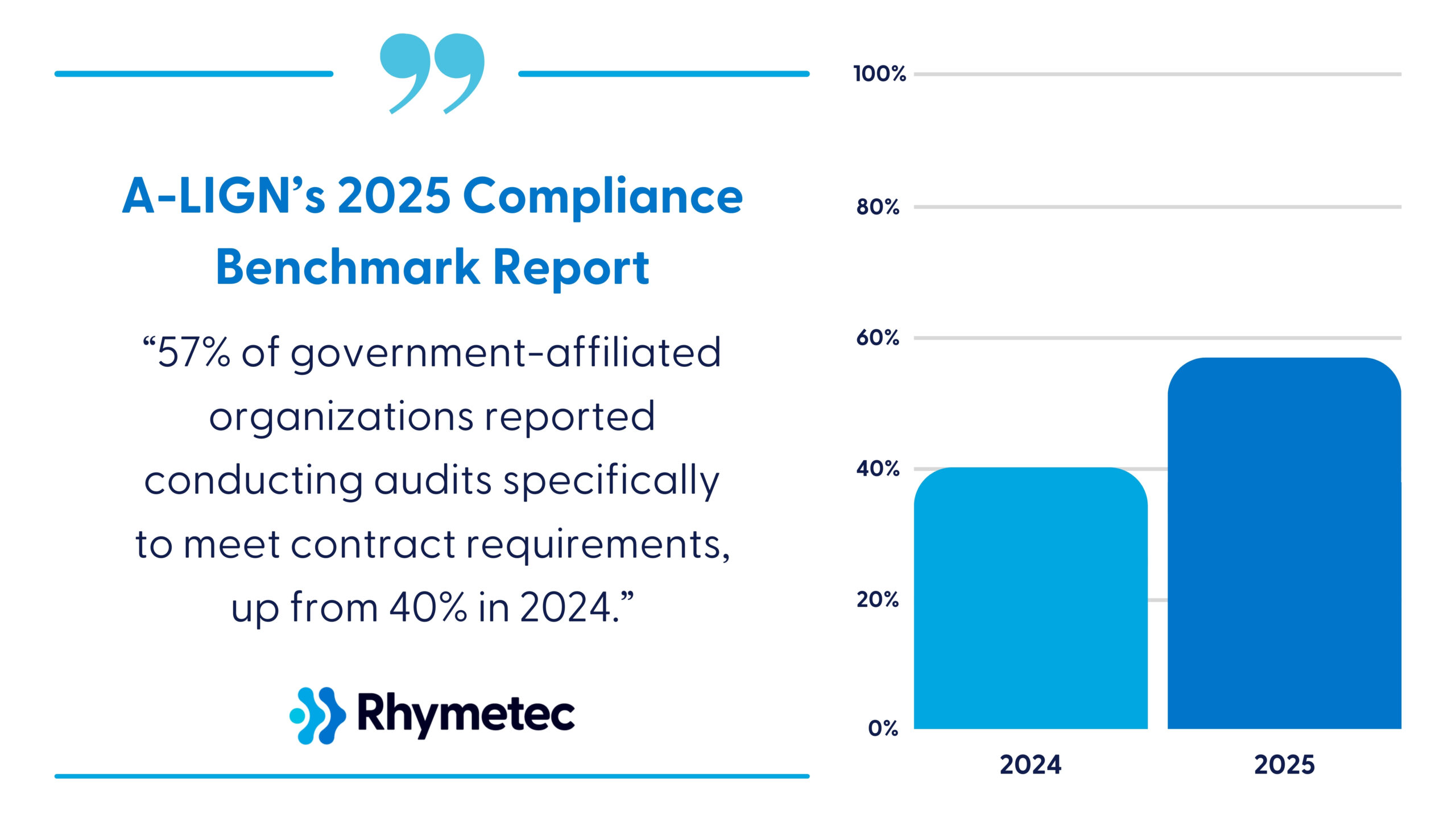
According to A-LIGN’s 2025 Compliance Benchmark Report, 57% of government-affiliated organizations reported conducting audits specifically to meet contract requirements, up from 40% in 2024. DoD contractors and subcontractors will need to obtain certification under one of three trust levels to demonstrate that they have adequately implemented cybersecurity measures.
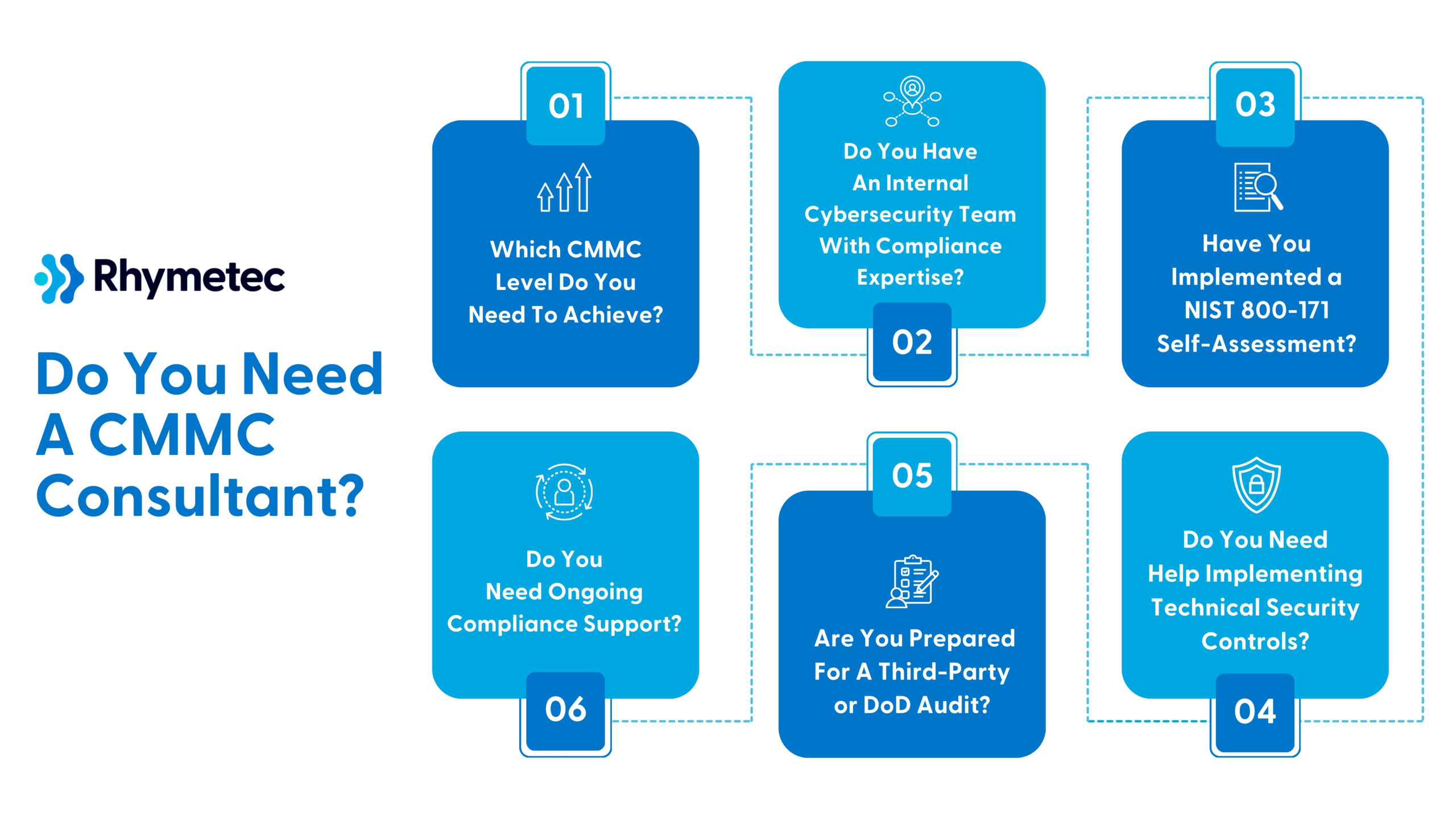
Below are some questions to help you assess whether working with a consultant is the right choice. After you answer these questions and review the responsibilities and deliverables listed below in the next section, you should have a clear picture of whether or not you need a CMMC consultant:
1. Which CMMC Level Do You Need To Achieve?
The CMMC level you need depends on the type of contracts you handle:
CMMC Level 1 (Basic Cyber Hygiene) is required for contractors who only handle Federal Contract Information (FCI). Compliance is self-assessed, but security controls must still be implemented.
CMMC Level 2 (Advanced Cyber Hygiene) is required for contractors who handle Controlled Unclassified Information (CUI). Compliance requires a third-party assessment (C3PAO) every year.
CMMC Level 3 (Expert) is required for contractors who are working on high-security DoD projects. Compliance entails DoD-led audits and adherence to NIST SP 800-171 and portions of NIST SP 800-172.
If you need CMMC Level 2 or Level 3, working with a CMMC consultant can be extremely helpful, given the amount of work involved in the third-party assessment process, implementing missing security controls, and maintaining ongoing compliance.
2. Do You Have An Internal Cybersecurity Team With Compliance Expertise?
If you have a dedicated cybersecurity and compliance team, you may be able to handle CMMC requirements internally. Even if you do have an internal team, however, a CMMC consultant can still be beneficial if:
- Your internal team is unfamiliar with NIST 800-171 and CMMC requirements.
- You need help preparing evidence for a third-party assessment.
- Your security team does not specialize in compliance or lacks the expertise to develop CMMC procedures and policies.
3. Have You Implemented a NIST 800-171 Self-Assessment?
If you need CMMC Level 2 or Level 3, you should already have a NIST 800-171 self-assessment and an SPRS score recorded. If you haven't completed this step, a CMMC consultant can guide you through the process. Additionally, if your SPRS score is low, or if you have many missing security controls, you may need a consultant to develop a remediation strategy before moving forward.
4. Do You Need Help Implementing Technical Security Controls?
There are a range of technical security controls required by CMMC that many organizations may not have adopted yet. If your company lacks the bandwidth to deploy these measures, a CMMC consultant can provide guidance and support (or do it for you, depending on the level of support outlined in the engagement). These types of technical controls include configuring multi-factor authentication, implementing network segmentation, SIEM logging and monitoring, and vulnerability management.
5. Are You Prepared For A Third-Party or DoD Audit?
For Levels 2 and 3, organizations have to pass an official assessment conducted by a Certified Third-Party Assessor Organization (C3PAO) or the DoD. The most common issues contractors face with these assessments are due to insufficient documentation, improperly implemented controls, or lack of audit preparation. A CMMC consultant can remediate these issues and more in advance of your assessment.
6. Do You Need Ongoing Compliance Support?
Lastly, it's important to know that CMMC compliance requires ongoing monitoring and maintenance. You'll need to keep your certification in good standing year-round. If your organization does not have a dedicated team to handle continuous compliance, a CMMC consultant can provide long-term security and compliance management. Ongoing support can include:
- Review of your security controls
- Vulnerability scanning (and remediation as needed)
- Incident response drills
- Log reviews and SIEM tuning.
If the answer is "yes" to multiple questions, partnering with a CMMC consultant may be a good option for your organization.
Next, let's go over what a CMMC consultant typically accomplishes for organizations throughout the engagement. This should help give you a good idea of what to expect:
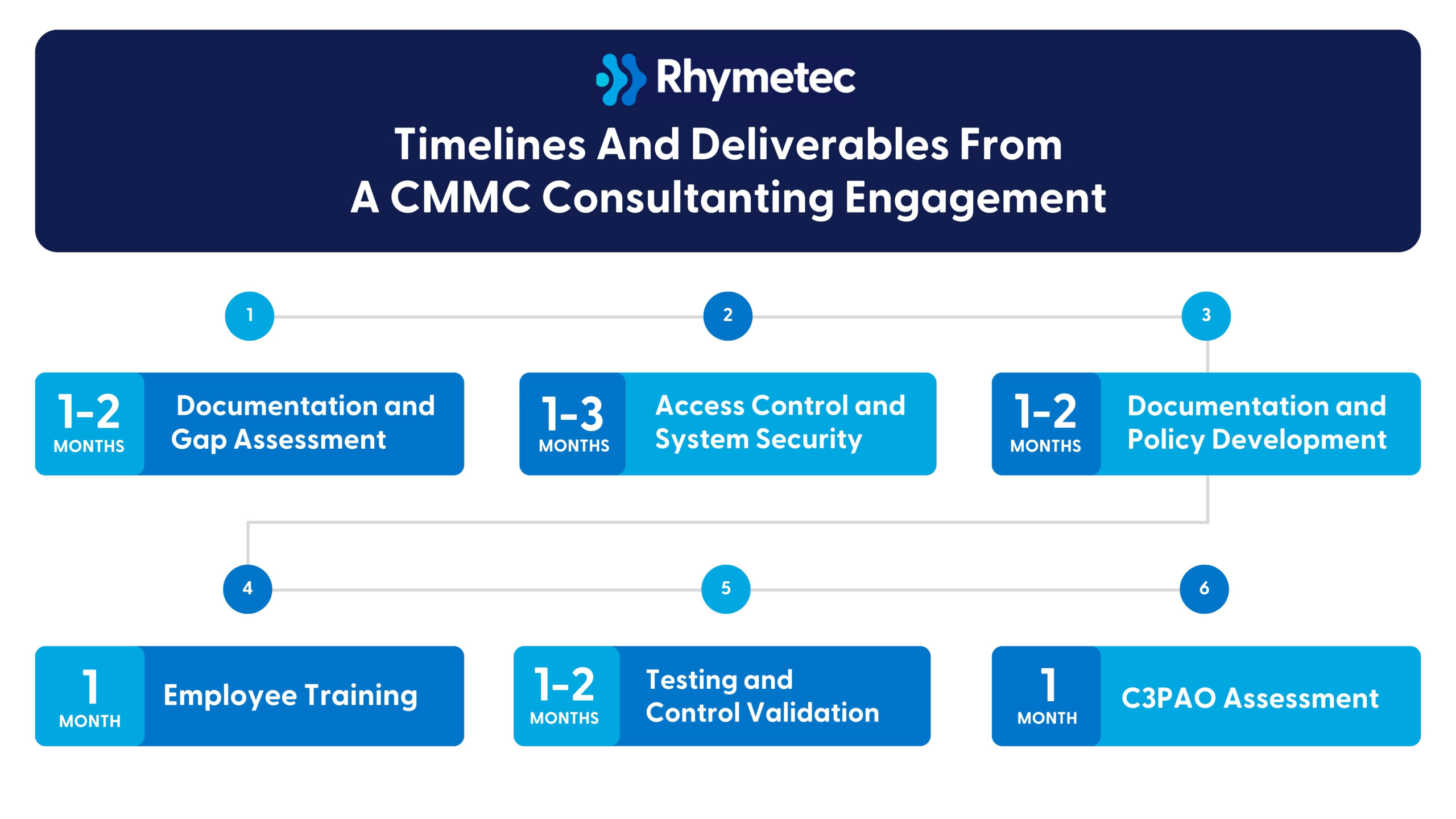
Timelines And Deliverables From A CMMC Consultanting Engagement
A CMMC consultant provides end-to-end support to help defense contractors achieve CMMC compliance. At a high level, this process entails assessing your organization's current security posture, implementing the required controls you don't already have, developing documentation, training personnel, and preparing for the official assessment.
Here is what this process and the deliverables will look like, in general, for an organization starting from a more basic security posture:
1. CMMC Initial Assessment - Documentation and Gap Assessment:
- Conduct a gap assessment to assess your current CMMC maturity level.
- Review existing security documentation to determine alignment with CMMC 2.0. requirements and identify any gaps in your documentation to be addressed before certification.
- Review CUI/FCI data flows to assess how sensitive information is handled.
- Map current security controls to NIST SP 800-171 and CMMC requirements.
- Document your organization's Supplier Performance Risk System (SPRS) score.
- Develop a preliminary Plan of Action & Milestones (POA&M) to address deficiencies.
- Estimate resource requirements for remediation.
Timeline With A CMMC Consultant: 1-2 Months
2. Implementation of Access Control and System Security
- Configure multi-factor authentication (MFA) for all required systems.
- Implement least privilege access principles to restrict user permissions.
- Set up remote access controls and document access control procedures.
- Deploy a Privileged Access Management (PAM) solution for sensitive accounts.
- Implement network segmentation and develop network diagrams.
- Deploy endpoint protection solutions.
- Configure logging and monitoring systems, including SIEM solutions.
- Set up backup solutions and document backup and recovery procedures.
Timeline With A CMMC Consultant: 1-3 Months
3. Documentation and Policy Development
- Develop a System Security Plan (SSP) documenting security controls.
- Create an Incident Response Plan for handling security incidents.
- Establish a Disaster Recovery Plan.
- Create training documentation for security awareness and compliance.
Timeline With A CMMC Consultant: 1-2 Months
4. Training
- Conduct security awareness training for employees.
- Develop role-specific training for personnel handling CUI/FCI.
- Run incident response drills to prepare teams for cyber threats.
- Train employees on documentation procedures.
- Hold policy review sessions.
Timeline With A CMMC Consultant: 1 Month
5. Testing and Control Validation
- Perform internal control testing to verify compliance.
- Conduct vulnerability assessments and penetration testing to evaluate system defenses.
- Review security documentation for accuracy/completion.
- Validate processes and security controls through real-world testing.
Timeline With A CMMC Consultant: 1-2 Months
6. C3PAO Assessment
- Conduct a final documentation review to make sure all requirements have been met.
- Validate security controls against CMMC 2.0 standards.
- Prepare teams for staff interviews conducted during the official assessment.
- Perform technical testing to confirm systems meet all requirements.
Timeline With A CMMC Consultant: 1 Month
Ongoing Maintenance
To maintain compliance and readiness for recertification, a CMMC consultant provides ongoing support through the following:
- Monthly security control reviews to assess compliance status on an ongoing basis.
- Vulnerability scanning to identify and remediate emerging threats.
- Access reviews to ensure permissions remain properly restricted.
- Incident response testing to evaluate security team preparedness.
- Log review to monitor system activity and detect anomalies.
Why Work With A CMMC Consultant?
Achieving compliance is not simple. There is an array of technical and procedural controls and extensive required documentation. A CMMC consultant helps businesses navigate these requirements by providing specialized expertise (at a much lower price point than building out an in-house team would cost) and reducing administrative burdens.
Many defense contractors lack the in-house resources to manage requirements, especially as the DoD increases enforcement of cybersecurity standards. Often, for example, small defense contractors with no formal cybersecurity programs need to achieve CMMC Level 1 to continue bidding on DoD contracts. Having limited IT staff and a lack of security policies and policies can be a significant roadblock.
In this scenario, a CMMC consultant would help by starting with an initial assessment to determine the company's current security posture and documentation and, from there, develop all missing policies, procedures, and documents. Often, this includes a System Security Plan (SSP), access control policies, and an incident response plan.
Many contractors also underestimate the complexity of CMMC and wait too long to start the process. The risk of failing an assessment can lead to contract loss and reputational damage. Working with a CMMC consultant reduces risk, streamlines implementation, strengthens your cybersecurity, and ensures you stay audit-ready year-round.
If your business relies on DoD contracts, CMMC certification isn't optional. Engaging a CMMC consultant early on in the process saves significant time and headaches down the road.
About Rhymetec
Our mission is to make cutting-edge cybersecurity available to SaaS companies and startups. We’ve worked with hundreds of companies to provide practical security solutions tailored to their needs, enabling them to be secure and compliant while balancing security with budget. We enable our clients to outsource the complexity of security and focus on what really matters – their business. Contact us today to get started.
Interested in reading more? Check out more content on our blog.
As an industry leader in cybersecurity and compliance, Rhymetec is proud to partner with Vanta to deliver a complete solution for modern businesses. As Vanta's 1st MSP partner, together, we fast-track compliance, strengthen your security posture, and reduce the time and effort needed to meet regulatory requirements.
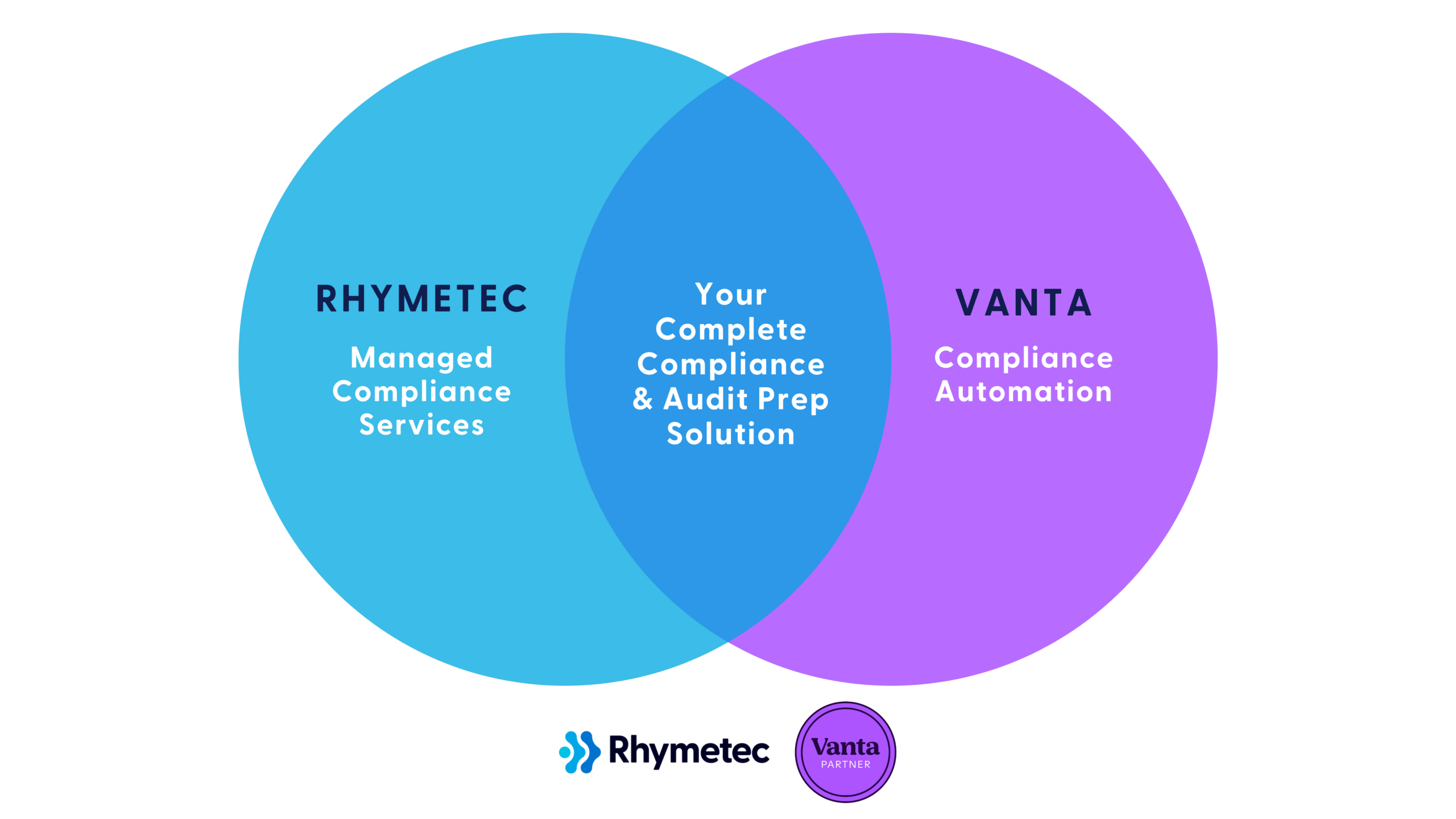
The Rhymetec + Vanta Advantage
Our team at Rhymetec leverages Vanta to transform compliance from a complex challenge into a strategic advantage for your business. Over the last decade, we've helped over 1,000 companies around the world meet their security and compliance goals.
With our joint services, you can:
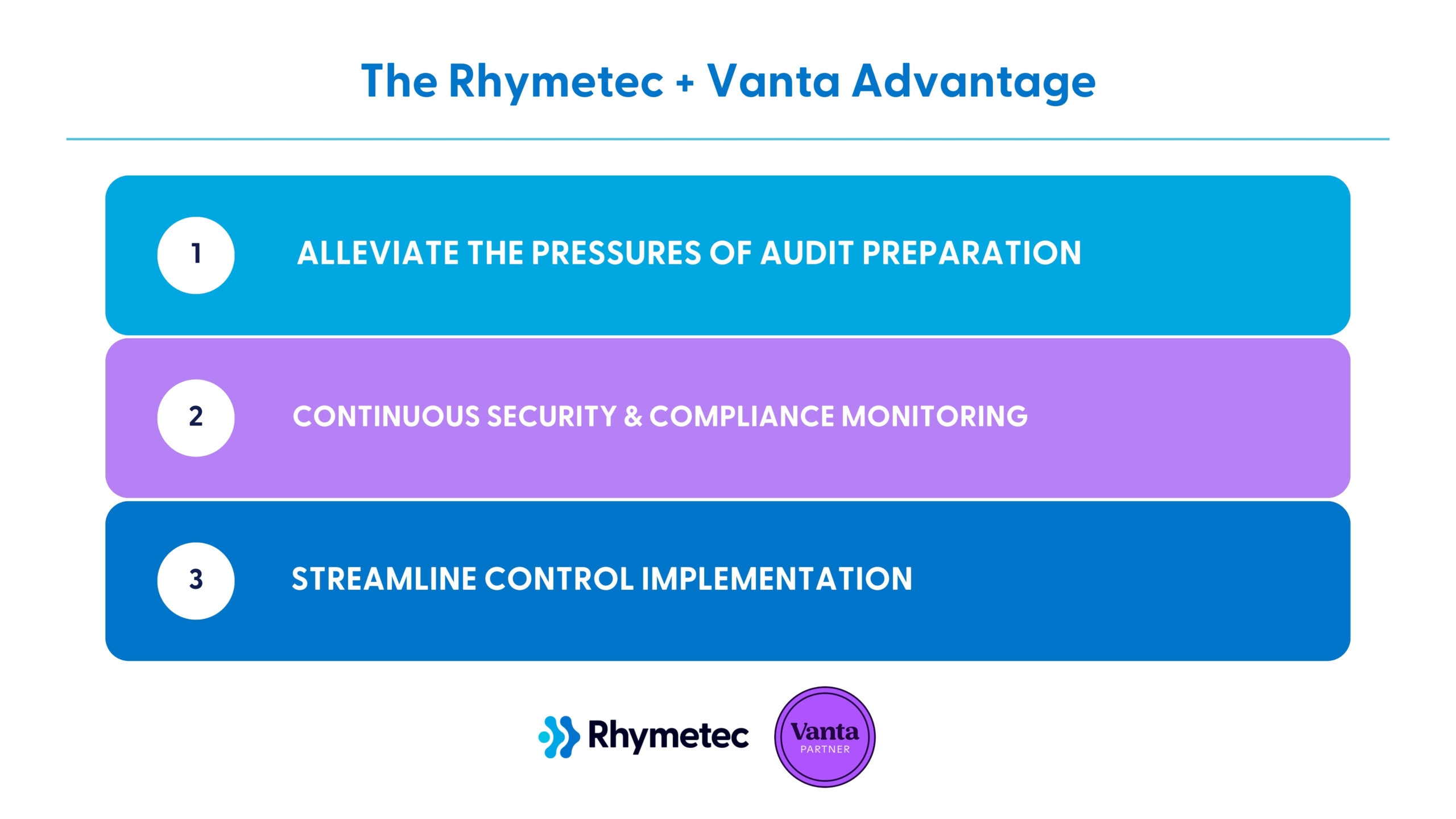
1. Alleviate The Pressures of Audit Preparation
Vanta was built with auditors and the audit process top-of-mind. Rhymetec will ensure you have all the documents and evidence necessary for the audit itself, and manage the audit process using Vanta as a source of truth.
2. Access Continuous Security and Compliance Monitoring and Support
Vanta's automation capabilities help achieve ongoing compliance maintenance and management, while Rhymetec's vCISO services address ongoing security efforts and questionnaires, aiding new phases of growth.
3. Streamline Control Implementation With Vanta Compliance Services
Rhymetec implements controls required by the compliance framework selected by the client. Vanta plays a key role in this process for each control through system integrations and identification of areas for improvement.
Together, we provide a simplified approach to security and the compliance automation process. We work together to provide an automated and comprehensive solution, saving significant time and resources for you.
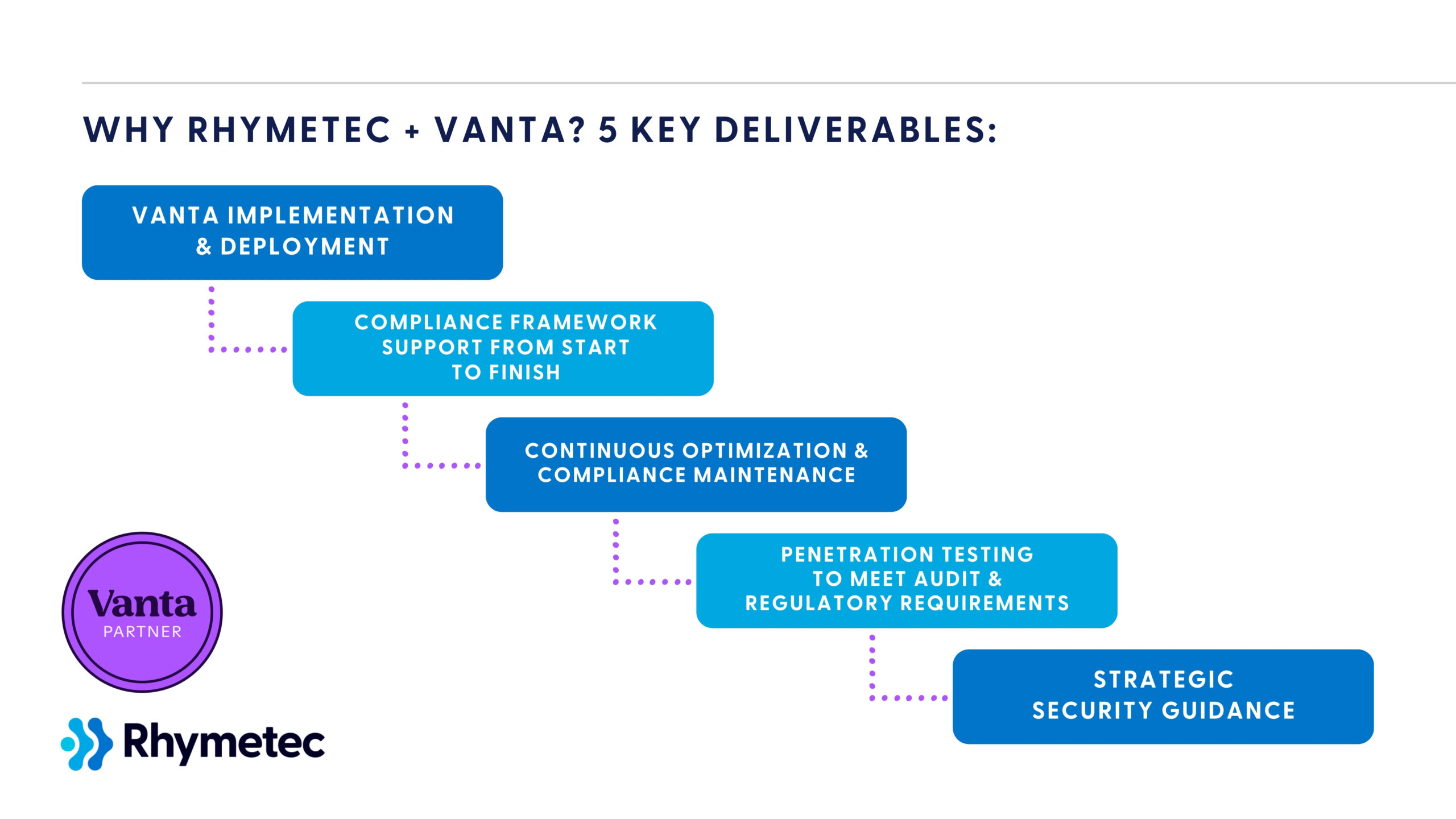
Our Vanta Compliance Services
Vanta Implementation and Deployment
Vanta automates 90% of compliance tasks through integrations with 300+ systems, real-time control monitoring, and automated evidence collection.
The Rhymetec team configures and deploys the platform on your behalf, integrating it with your infrastructure to maximize automation capabilities. We connect relevant systems, set up automated workflows, and customize policies to fit your organization and the selected compliance framework.
With Vanta deployment carried out by our experts, your team avoids the complexity of configuring integrations. From day one, we ensure accurate and reliable compliance monitoring and allow you to dramatically reduce the burden on your internal resources.
Compliance Framework Support From Start To Finish
Vanta provides pre-built controls for 20+ frameworks, including SOC 2, ISO 27001, HIPAA, and GDPR. It automates scoping and document management and provides a foundation for policy creation. The Rhymetec team aligns these automated capabilities with your business needs and your selected compliance framework, performing the tasks required for full compliance such as internal audits, tabletop exercises, and evidence preparation.
Managing compliance without a dedicated team can lead to missed controls or even doing too much and implementing unnecessary requirements. By handling the full compliance process, we eliminate uncertainty, accelerate your audit readiness, and ensure your documentation fully meets auditor expectations.
Continuous Optimization and Compliance Maintenace
Vanta's continuous monitoring identifies failing controls, missing security measures, and real-time compliance risks. Automated notifications provide alerts to potential issues, and remediation workflows drive fast resolution.
Our team at Rhymetec oversees these alerts, interprets risk impacts, and executes the manual corrections on your behalf so you can maintain compliance.
Ongoing compliance management is resource-intensive. Without expert oversight, organizations risk falling out of compliance between audits. With our team handling continuous monitoring and remediation, your organization stays audit-ready, reduces compliance drift, and proactively addresses any security gaps.
Penetration Testing To Meet Audit and Regulatory Requirements
Many voluntary frameworks as well as legal requirements require penetration testing.
SOC 2, PCI DSS, ISO 27001, CMMC, and HIPAA all include requirements to regularly test network and application security. Regulations such as GDPR and CCPA also encourage proactive security measures to identify vulnerabilities before a security incident can occur, and penetration testing can be used to fulfill these requirements.
Rhymetec started as a penetration testing company in 2015, and we offer the highest quality penetration tests to meet your organization's compliance obligations while enhancing its security posture. We provide detailed reports of the findings, along with remediation recommendations, helping your organization address security gaps before an audit.
We offer a range of penetration testing services to fit your security and compliance needs, including mobile application penetration testing and web application penetration testing.
Strategic Security Guidance
Vanta's AI-driven features streamline core compliance areas to include risk management, access reviews, vendor security assessments, and security questionnaires. The platform accelerates compliance workflows, while expert guidance from Rhymetec's team enables you to interpret findings, implement security best practices, and customize controls based on your unique risk profile and risk appetite.
Security and compliance strategies must be tailored to business needs. Without in-house expertise, it can be difficult to implement effective controls. With Rhymetec's team providing ongoing guidance, while leveraging Vanta's cutting-edge integrations and capabilities, you gain a compliance program that meets regulatory requirements while reducing risk to your organization and maintaining operational efficiency.
Why Rhymetec?
Transparency:
We believe our clients deserve complete clarity about what they're getting, how we work, and the results they can expect. Whether it's our methodologies, testing scope, or the tools we use, we provide detailed insights at every step.
Autonomous:
As a self-funded company, we have the freedom to make client-focused decisions quickly and flexibly. This independence allows us to adapt our services to meet your unique needs and help our partners win in competitive scenarios. Our autonomy ensures every decision prioritizes your success.
Team Credentials:
Our team boasts a broad range of industry-recognized certifications, including Burp Suite Certified Practitioner, ISC2 CISSP, EC-Council CHFI, CPENT, Offensive Security: OSE3 OSED OSEP OSWA OSWE OSCP, and CompTIA Security+, PECB Internal Auditor Certifications, and more.
Market Maturity:
Rhymetec was founded in 2015. Our specialized expertise ensures a deeper understanding of your business's unique challenges, providing the most impactful security insights. Don't settle for less experienced competitors when it comes to protecting your business or meeting the needs for compliance requirements.
Frameworks Supported by Rhymetec's Vanta Compliance Services
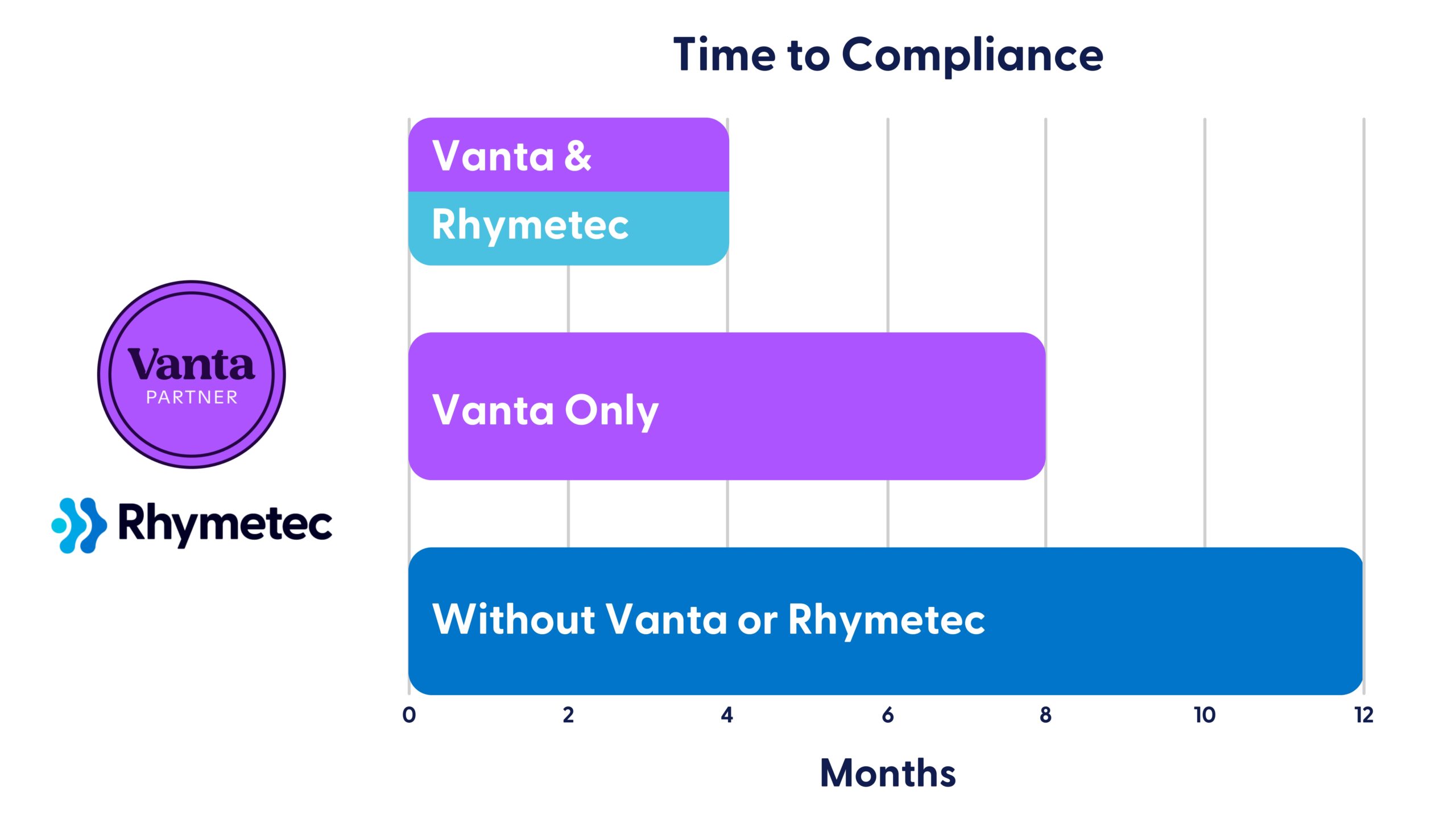
Achieve compliance faster and with greater confidence with Vanta's automation and Rhymetec's hands-on security expertise. Together, we streamline control implementation and tackle every step of the compliance process for you. We fully manage the following frameworks (and more) on your behalf, from start to finish, getting you over the finish line with your audit in the fastest time frame possible:
SOC 2 With Vanta & Rhymetec
Vanta automates control monitoring, policy management, and evidence collection for SOC 2, reducing the time required to prepare for an audit. As SOC 2 allows flexibility in control implementation (which requires interpretation to align with your business operations), the Rhymetec team ensures that automated controls are properly scoped, fills in gaps with manual tasks like risk assessments and penetration testing, and guides your team through audit readiness.
ISO 27001 With Vanta & Rhymetec
Vanta accelerates ISO 27001 certification by automating risk assessments, system inventory, and document management, including the Statement of Applicability. ISO 27001 also requires internal audits and ongoing security improvements. Our team at Rhymetec handles these manual components and others, develops custom policies, and aligns your Information Security Management System (ISMS) to your business risks.
GDPR
Vanta supports GDPR compliance through automated access reviews, vendor risk assessments, and security monitoring. GDPR compliance also entails implementing legal and operational processes, such as data mapping, incident response planning, Data Protection Impact Assessments, and more. At Rhymetec, our vCISOs carry out these actions and ensure that all of your privacy policies, manual risk assessments, and data processing agreements are in full alignment with GDPR requirements.
HIPAA
Vanta automates HIPAA compliance by monitoring technical safeguards, conducting access control reviews, and managing security policies. For the aspects of HIPAA compliance that require administrative safeguards, such as employee training, documented risk management procedures, and business associate agreements, the Rhymetec team bridges the gap by filling in or fine-tuning these items. For example, we implement customized employee training and advise you on regulatory expectations. Leveraging Vanta and our services provides a complete approach to HIPAA compliance.
PCI DSS
Vanta identifies security gaps related to PCI DSS controls, while the Rhymetec team fills pieces such as penetration testing, network segmentation, and quarterly scanning. Our experts ensure that all PCI DSS requirements are met, manages security assessments, and handles auditor interactions for you. By combining Vanta's automation with our technical security expertise, you meet the requirements in the fastest timeframe possible and maintain continuous compliance over time.
CMMC
Vanta helps streamline CMMC compliance by automating areas such as security control monitoring and access review. While working to meet the extensive CMMC requirements under risk management, ongoing assessments, and security controls, a dedicated team of security and compliance experts can greatly reduce the complexity for your organization. While leveraging Vanta, Rhymetec’s team ensures that all necessary security measures (including incident response planning tailored to your organization, system security plans, and third-party risk management) are correctly implemented.
Additional Frameworks Supported By Rhymetec and Vanta
Beyond the frameworks listed above, Vanta and Rhymetec support a range of other compliance frameworks. These include ISO/IEC 42001 for AI risk management, DORA for financial sector resilience, HITRUST CSF for healthcare security, NIST AI RMF for AI governance, The California Consumer Privacy Act (CCPA), and various other global and industry-specific standards.
For any framework(s) you select, using Vanta in conjunction with Rhymetec's guidance streamlines certification, strengthens your security operations, and sets you up for successful long-term compliance.
Ready to Simplify Your Vanta Compliance Journey?
Don't let compliance barriers slow down your growth.
Our experts are ready to transform security from a roadblock to a competitive advantage. We leverage the most cutting-edge tools like Vanta on your behalf and remove the work entirely off your plate so you can get back to what really matters - running your business. Contact us today to learn more.
About Rhymetec
Our mission is to make cutting-edge cybersecurity available to SaaS companies and startups. We've worked with hundreds of companies to provide practical security solutions tailored to their needs, enabling them to be secure and compliant while balancing security with budget. We enable our clients to outsource the complexity of security and focus on what really matters – their business. Contact us today to get started.
Interested in reading more? Check out more content on our blog.
Needing to meet EU AI Act compliance has further complicated regulatory requirements around AI for many companies - even those that are located outside of Europe. The stakes are substantial, with fines of up to €35 million or 7% of global annual revenue for serious violations. For context, that exceeds even GDPR penalties.
The Act imposes significant obligations on companies developing or deploying AI systems. If you're a U.S.-based SaaS company offering AI-powered services in the EU, for example, the law may apply to you. If your product touches high-risk areas like healthcare, recruitment, or finance, you'll have stricter protocols to follow.
Our team at Rhymetec helps organizations understand their compliance requirements, automate the parts of compliance that can be automated, and fast-track your compliance. This article will help you understand whether your AI systems fall within scope and their risk categories, the measures you need to implement, and how to turn compliance into a competitive advantage.

Which Types of Organizations Need EU AI Act Compliance?
The EU AI Act applies to organizations that develop or use AI systems within the European Union (EU), regardless of where they are based. Even companies outside of the EU must comply if their AI systems affect individuals in the EU.
The Act categories AI systems based on risk, with corresponding requirements for each category:
- Prohibited AI Systems: These are AI systems that pose unacceptable risks. An example of this under the EU AI Act would be an AI system being used to predict the risk of an individual committing a crime based solely on personality or profiling traits.
- High-Risk AI Systems: AI used in critical areas such as law enforcement, hiring, credit scoring, infrastructure, and medical devices must meet strict requirements. Both providers and deployers of high-risk AI have to comply with these obligations.
- Limited-Risk AI Systems: AI systems with transparency obligations, such as chatbots or AI-generated content, must disclose that users are interacting with AI.
- Minimal-Risk AI Systems: These are AI applications with low regulatory impact, such as spam filters or recommendation algorithms. These tend to be largely unaffected by the EU AI Act.
Organizations impacted by the AI Act include:
- AI Developers and Providers: Companies building AI models or integrating AI into their products must meet compliance requirements if their systems fall under high-risk or transparency rules.
- Deployers of High-Risk AI: Businesses using AI systems classified as high-risk in hiring, credit decisions, or critical services must comply with risk management and oversight obligations.
- Distributors and Importers: Organizations that place AI systems on the EU market must verify compliance before distribution.
- Non-EU Companies Serving EU Users: Organizations are subject is the Act if they offer AI-driven services or products affecting EU individuals. For example, a software company outside of the EU selling AI-based medical diagnostics to European healthcare providers would need to comply.
Companies must determine which of their AI systems fall under the AI Act's scope and what compliance obligations apply, based on how the technology is being used.
What Are The Requirements, and How Can EU AI Act Compliance Be Achieved?
Compliance with the EU AI Act entails several core requirements (all of which Rhymetec can fulfill on your behalf!). Below are the main requirements and how to meet them. Keep in mind that your organization's requirements will vary based on the risk level of your AI systems, as discussed above.
1. Risk Management
High-risk AI providers are required to extensively document their risk management process. Risk management under the EU AI Act means having a clear process on how you will assess and mitigate AI-related risks, through measures including continuous monitoring and periodic evaluations to address any emerging risks.
2. Incident Response and Business Continuity
Organizations must have mechanisms in place to not only identify AI risks but also to actually respond to incidents.
Your team should know exactly how they would respond and recover from AI-related failures or security incidents. This can be documented in an incident response plan, which is a good idea for every organization to have regardless of their compliance obligations. For your business continuity plans, the goal should be to ensure that AI systems remain operational and safe during disruptions.
3. Data Protection and Recovery
AI systems must use training data that is as high-quality and unbiased as possible. They must also implement corresponding controls to protect data from unauthorized access, corruption, or loss. This set of requirements under the EU AI Act shares heavy overlap with privacy regulations in the EU, such as GDPR.
4. Ongoing Security Controls
AI systems need to include safeguards against cybersecurity threats and vulnerabilities. This can be accomplished by applying security measures, including access controls, logging, and anomaly detection.
5. Compliance Documentation and Reporting
Lastly, AI providers need to keep detailed records of system design, functionality, and decision-making processes. High-risk AI systems require additional technical documentation that can be reviewed by regulators.
How Does The EU AI Act Compare To Voluntary AI Frameworks?
Understanding the differences and overlap between the EU AI Act and voluntary frameworks (like ISO 42001 and the NIST AI Risk Management Framework) can help streamline your compliance efforts. The good news is that these frameworks do overlap quite a bit, and you can leverage existing work you may have already completed and/or use EU AI Act compliance to fill in requirements for future regulations.
The EU AI Act vs. ISO/IEC 42001
ISO 42001 provides an excellent framework for AI governance but does not carry legal obligations. Companies that adopt ISO 42001 must still meet the EU AI Act's legal obligations if their AI system(s) fall under the Act. Fortunately, there is some overlap between the EU AI Act and ISO 42001 controls:
If your organization already has an ISO 42001-compliant risk management framework, it can fairly easily be adapted to fulfill the EU AI Act's risk assessment obligations. Both the EU AI Act and ISO 42001 also include controls for bias mitigation and improving data quality. If you have already documented data governance policies under ISO 42001, they can contribute to meeting these requirements.
Finally, ISO 42001 requires documenting your AI system risks and objectives. The AI Act mandates similar documentation for high-risk AI systems, so an organization that is already ISO 42001 compliant can leverage existing documentation to fulfill the AI Act's record-keeping obligations.
The EU AI Act vs. The NIST AI Risk Management Framework
The NIST AI RMF is a voluntary guideline that provides a framework organizations can use to manage AI risks, but it does not entail enforcement measures or assign risk categories.
However, both heavily emphasize risk management and governance. Companies that have already adopted the NIST AI RMF already have elements in place that align with the AI Act requirements. For example, the NIST AI RMF defines oversight roles that can be mapped onto the AI Act's requirements to designate responsible individuals for compliance and monitoring.
Another area in which the requirements overlap is transparency and documentation. Under the NIST AI RMF, organizations are encouraged to document AI risks and decision-making processes. Likewise, the AI Act requires technical documentation for high-risk AI systems, including explanations of system functionality.
In general, businesses with existing voluntary AI frameworks can accelerate EU AI Act compliance by mapping existing controls to the Act's requirements. Organizations that use the NIST AI RMF or ISO 42001 have a head start in EU AI Act compliance, but must still determine whether their AI system(s) fall under the Act and what additional legal obligations apply.

5 Business Benefits of EU AI Act Compliance
For many organizations, complying with the EU AI Act is a regulatory requirement. However, it can also provide other advantages. Companies that integrate AI Act compliance into their operations reduce their legal risks while strengthening their market position and improving trust. The 5 main benefits are:
1. Broader Access To The EU Market
Compliance allows businesses to sell and deploy AI systems in the EU without facing legal barriers or enforcement actions. Companies that fail to comply, meanwhile, risk facing fines and restrictions on their AI products.
2. Substantial Reduction in Risk To Your Organization
By implementing AI governance, risk management, and transparency measures, you can reduce the likelihood of legal disputes, regulatory penalties, and reputational damage to your organization.
3. An Advantage Over Non-Compliant Competitors
By meeting the requirements under the EU AI Act, your organization can demonstrate a commitment to responsible AI use, which helps differentiate you in the market. Customers, investors, and business partners may prioritize vendors with compliant AI solutions.
4. Stronger AI Governance
A natural byproduct of meeting requirements under the EU AI Act is having clearer AI-related policies and oversight processes. This improves internal decision-making and AI systems' reliability. Companies that comply with the EU AI Act will also find it easier to adapt to other current and/or future AI regulations.
5. Customer and Public Trust
The general public and businesses are increasingly concerned about AI-related risks. Seeing that you are compliant with the EU AI Act creates reassurance that you take the risks seriously, and builds confidence in your AI products and services.
In Conclusion: EU AI Act Compliance Key Takeaways
The EU AI Act introduces an array of requirements impacting AI providers, deployers, and businesses operating in the EU or serving EU users. Compliance includes risk management, incident response plans, documentation, and ongoing security controls. EU AI Act compliance is an entry point to many business advantages, such as expanding your market access in the EU.
Many organizations choose to outsource the work of EU AI Act compliance to a virtual CISO (Chief Information Security Officer). Our virtual CISOs at Rhymetec have helped over 1,000 organizations meet their security and compliance needs in the fastest timeframe possible. Contact us today or check out our information on vCISO pricing to learn more.
Interested in reading more? Check out more content on our blog:
- DORA Compliance Checklist: What The EU's Digital Operational Resilience Act Means For Your Business
- NIS2 Requirements: What You Need To Know For Your Business
- Compliance For Startups: The Definitive Guide to Picking the Right Consultant
Meeting NIS2 requirements can be complex regardless of organizational size, especially the requirements around managing third-party risks and incident response. In this article, we go over what NIS2 requires, how to avoid penalties, and how to leverage the requirements to support business growth and operations.
The NIS2 Directive represents another new requirement in an increasingly strict cybersecurity regulatory ecosystem. The law, which came into force in January of 2023, specifically impacts organizations operating in the European Union (EU). Businesses that provide essential or important services must meet the obligations or face regulatory scrutiny.
What Is NIS2?
NIS2 is the EU's updated cybersecurity Directive, expanding on the scope of the original NIS Directive to cover more sectors and introduce even stricter security, risk management, and reporting requirements. If your business provides services in the EU ranging from transportation, banking, healthcare, manufacturing, food production, and more, you are likely required to comply.
The Directive applies to industries including technology, finance, healthcare, energy, and transportation, as well as many digital service providers. Broadly, it requires organizations to implement risk management measures, report significant incidents within 24 hours, and effectively manage third-party risks.
Non-compliance can result in fines of up to €10 million or 2% of global annual turnover, whichever is higher. Compliance impacts not only your regulatory standing but also your contracts, customer trust, and business continuity. Building a compliance strategy early will help avoid last-minute disruptions and potential penalties.
Who Must Comply With NIS2 Requirements?
NIS2 applies to organizations classified as essential or important entities across a variety of sectors. The Directive expands largely on the scope of the original NIS Directive, covering a broader range of industries and lowering the threshold for organizations that must comply.
Essential entities include large organizations in critical sectors where cybersecurity failures could have widespread and serious impacts, such as:
- Energy - Electricity suppliers, gas providers, oil companies, and district heating operators.
- Transport - Airlines, rail operators, shipping companies, and logistics providers.
- Banking - Credit institutions and financial market infrastructure providers.
- Healthcare - Hospitals, clinics, and pharmaceutical manufacturers.
- Drinking Water & Wastewater - Water supply and treatment facilities.
- Digital Infrastructure - Cloud services providers, data center operators, and domain name system (DNS) service providers.
Important entities are medium and large businesses in sectors that are critical but do not require the same level of regulatory scrutiny. These include:
- Manufacturing - Producers of medical devices and electrical equipment.
- Food Production - Businesses that manufacture food and beverages.
- Postal and Courier Services.
- Waste Management Companies.
- Digital Service Providers - Online search engines, marketplaces, and social networking platforms.
- Managed Security Service Providers (MSSPs) - Businesses providing cybersecurity services to other organizations.
It's important to note that both essential and important entities are generally defined as medium or large enterprises, meaning they have at least 50 employees or an annual turnover of €10 million or more. Smaller organizations, however, may still fall under NIS2 if they are critical to a supply chain or if they operate in a high-risk sector.

NIS2 Requirements: What You Need To Plan For
NIS2 entails a range of security and operational requirements, with a particular emphasis on minimizing cybersecurity risks. Below is an explanation of the 5 overarching requirements and what implementing them may look like for your organization.
1. Risk Management & Security Measures
NIS2 requires organizations to take a proactive approach to mitigate cybersecurity risks.
Security measures across areas, including network security, data protection, and system integrity, are required. Here's what this may look like in practice for your organization, particularly if you are a SaaS company:
- Implementing Access Control Measures: Access control measures such as multi-factor authentication (MFA) for all employees and users accessing your platform are required under NIS2. MFA means both a password and app-based token or another second form of verification are needed to log in.
- Enabling Data Encryption Measures: Encrypt sensitive customer data both at rest and in transit. For NIS2, this includes encrypting databases and using TLS (Transport Layer Security) for all data exchanged between clients and your platform.
- Creating A Patch Management Program: Regularly update software and systems to fix vulnerabilities. Additionally, you'll need to implement an automated patching system that ensures no critical updates are missed.
- Conducting Regular Vulnerability Scanning: This requirement entails using automated tools to regularly scan your applications and infrastructure for vulnerabilities. For instance, using tools like Nessus can identify weaknesses.
2. Incident Reporting Obligations
NIS2 mandates relatively quick reporting of cybersecurity incidents in the event they occur. As an example, if you were to experience a breach where an attacker gained access to customer data, you would be required to notify relevant authorities and affected clients within the prescribed timeframe and provide updates on the breach as it is resolved.
In practice, setting up the incident reporting process from beginning to end will likely entail the following for your organization:
- Creating An Incident Response Plan: Internal incident response policies that outline the exact steps to take when a breach occurs, designate a response team, and describe how you will identify the root causes of the breach are required.
- Setting Up Incident Detection Tools: Set up monitoring systems like SIEM (Security Information and Event Management) to detect unusual activity in real-time. Tools like Splunk or Datalog track suspicious logins or data exfiltration are commonly used for this purpose.
- Making A Plan To Follow Compliance with Reporting Deadlines: Lastly, know what your process would be for reporting incidents in a timely fashion to the appropriate authorities and your affected clients.
3. Governance & Accountability
An increasing emphasis on governance is being seen across historically gold standard cybersecurity frameworks such as the NIST Cybersecurity Framework (NIST CSF) with the addition of the NIST governance function. This shift is being seen in recent laws as well, including in the case of NIS2.
In practice, this means that cybersecurity should not be a function of just IT, but a function of corporate governance and should stem from there. Senior management is responsible for making sure that the organization meets NIS2's cybersecurity requirements and that sufficient resources are allocated. Leadership must:
- Appoint Cybersecurity Leadership: Appoint a Chief Information Security Officer (CISO) or designate a cybersecurity lead who will be accountable for ensuring the organization meets NIS2's requirements.
- Ensure Employee Training is Conducted: Employees, particularly those who handle sensitive data, need to be trained in cybersecurity practices and incident reporting procedures. This often takes the form of having mandatory, recurring cybersecurity awareness sessions, phishing training for employees, and/or tabletop exercises.
- Receive Board-Level Reporting: Senior management should regularly receive reports on cybersecurity risks and incidents, and be involved in decision-making processes related to cybersecurity investment. This can take the form of discussing the current cybersecurity posture and resource allocation at quarterly board meetings, for example.
4. Third-Party Risk Management
NIS2 puts the obligation on businesses to manage risks posed by their third-party vendors, especially if those vendors provide business-critical services or have access to sensitive data. A third-party risk management program entails the following elements:
- Vendor Risk Assessments: A vendor risk assessment evaluates the security and compliance practices of third-party providers. This is especially important for vendors that provide services such as cloud hosting, payment processing, or customer support. These vendors and others need to be able to show they meet NIS2's security standards.
- Third-Party Contracts: Contracts with vendors need to define their security obligations (requiring them to comply with certain security standards, report incidents within specific timeframes, and/or undergo audits of their security practices). Your contract for your cloud provider, for example, should outline measures they need to have in place, such as strong access controls and encryption.
- Ongoing Monitoring: Continuously monitoring your vendors. For instance, regularly review their security certifications, check they are staying compliant with relevant laws or frameworks, or conduct periodic assessments.
5. Compliance & Auditing
NIS2 requires maintaining evidence of your cybersecurity practices, with measures such as:
- Internal Audits: Periodic internal audits of security practices to ensure compliance maintenance with NIS2. Internal audits service to verify that measures like encryption and access control are functioning as intended.
- Risk Assessment & Incident Reports Documentation: Keeping up-to-date records of risk assessments, incident reports, and audits helps meet NIS2's governance and accountability requirements.
- External Audits: In some cases, if an organization falls within the essential or important entity categories and is subject to supervisory measures by national authorities, it may be required to undergo an external audit. Some jurisdictions may also require routine external audits for critical infrastructure or high-risk organizations.
NIS2 Requirements: 5 High-Level Requirements
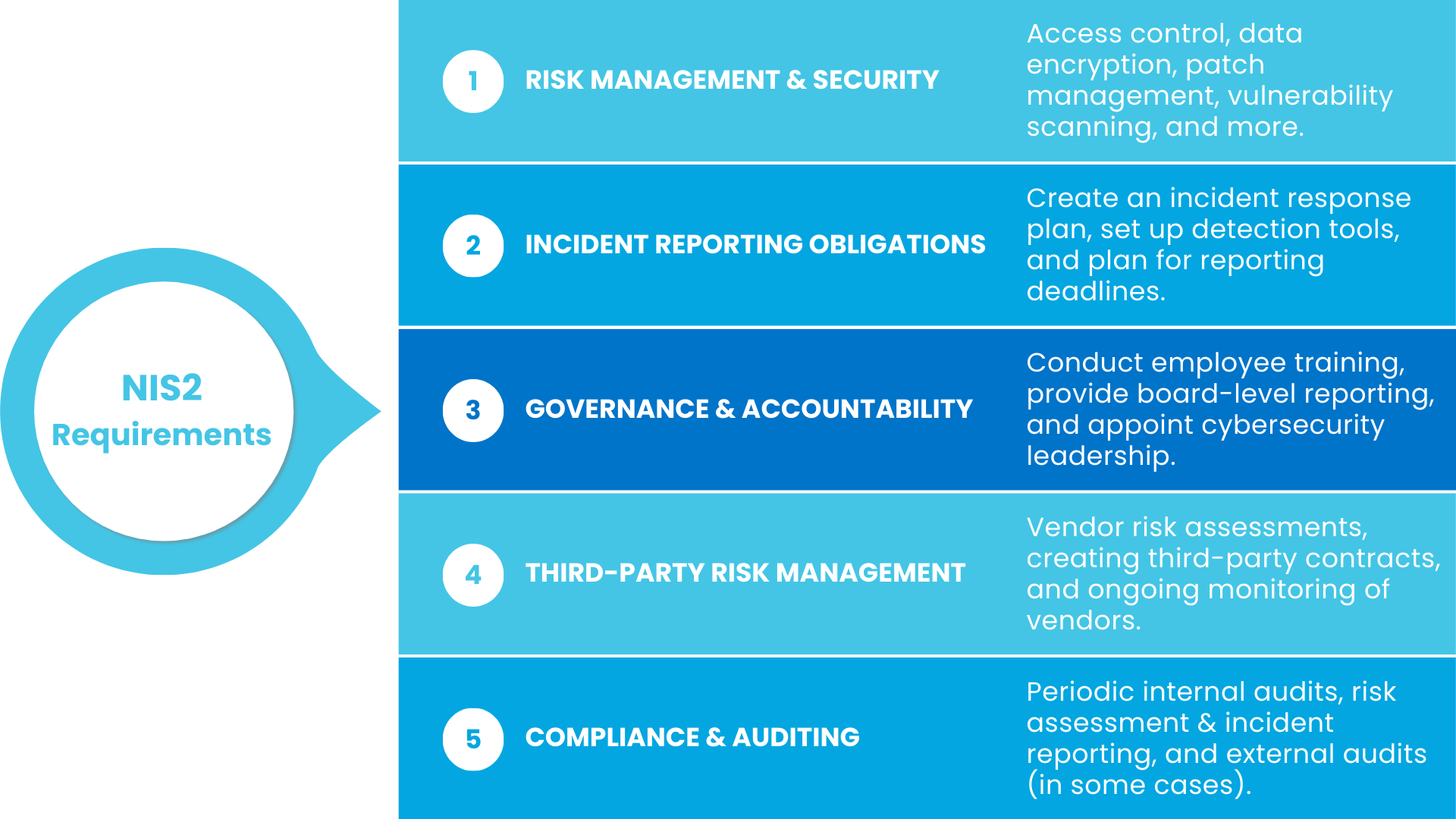
Meeting NIS2's requirements will involve a combination of technical measures, governance practices, and ongoing actions such as continuous monitoring. For organizations like SaaS startups, implementing these requirements ensures you are in compliance with the law and are well-equipped to build a secure platform that protects user data and reduces business risks.
How NIS2 Affects Third-Party Relationships
NIS2 expands security obligations to include third-party vendors and service providers, requiring businesses to manage risks introduced by their supply chain. Practically, this means you must verify that your vendors (including cloud services providers and software vendors) meet security standards and comply with contractual requirements.
With NIS2, due diligence with your vendors' cybersecurity practices is especially important as organizations covered by NIS2 are responsible for security incidents linked to their third parties.
A common way to verify your vendors' security is by requesting to see evidence of their compliance with cybersecurity frameworks and laws relevant to your industry and location. Security questionnaires, audits, and contractual clauses can also be used to clarify your vendors' security practices. However you choose to accomplish this, third-party relationships need to be documented as part of your overall risk management efforts.
Vendor agreements need to set clear security expectations, incident reporting obligations, and liability terms. Due diligence and ongoing monitoring can help identify risks before they lead to regulatory penalties or operational disruptions.

How Do NIS2 Requirements Compare To Other Cybersecurity Regulations In Terms Of Third-Party Risk?
NIS2 places an even stronger emphasis on third-party risk management compared to many other cybersecurity regulations.
Here's how it compares to a few major frameworks:
NIS2 vs. NIS1
The focus on third-party risks is, in fac,t the most substantial change between NIS2 vs. NIS1. NIS1 focused more on internal security measures without expansive supply chain obligations. NIS2, however, expands on the original NIS Directive by explicitly requiring organizations to assess and manage third-party risks.
NIS2 vs. GDPR
GDPR compliance requires third-party risk management in terms of data protection and requires organizations to have contracts with processors handling personal data. NIS2 goes a step further and requires security risk assessments, continuous monitoring, and contractual obligations for security, even for vendors that don't process personal data.
NIS2 vs. ISO 27001
ISO 27001 includes third-party risk management as part of an overall information security management system (ISMS). However, compliance is voluntary. NIS2, meanwhile, mandates risk management practices for third parties and includes enforcement actions for non-compliance.
NIS2 vs. DORA
The Digital Operational Resilience Act (DORA), which applies to financial services organizations, actually has stricter third-party risk requirements than NIS2. DORA requires direct regulatory oversight of critical third-party providers. NIS2 requires strong vendor risk management, but an important distinction is that it does not impose direct regulatory supervision on suppliers.
Where To Start
After you understand whether your organization is in scope and what gaps exist in your current security program, the next step is to develop a compliance plan and begin implementation (see the section above on NIS2 Requirements for what you'll need to plan for).
A popular option for many organizations nowadays is to work with a virtual Chief Information Security Officer (vCISO) at this stage. A vCISO helps translate NIS2 requirements into a plan specifically made for your business. They provide the expertise needed to interpret requirements, assess your risks, and build a compliance roadmap, all without incurring the cost of a full-time security executive or having to build out an in-house team.
Compliance automation tools, which automate risk assessments, track your security controls, and generate documentation, can also vastly simplify the process. Our vCISOs at Rhymetec leverage compliance automation tools on behalf of our clients while also completing all of the manual security work needed to meet requirements.
About Rhymetec
Our mission is to make cutting-edge cybersecurity available to SaaS companies and startups. We've worked with over 700 companies to provide practical security solutions tailored to their needs, enabling them to be secure and compliant while balancing security with budget. We enable our clients to outsource the complexity of security and focus on what really matters – their business. Contact us today to get started.
Interested in reading more? Check out more content on our blog.
In this blog, we'll go over frequently asked questions about conducting a cybersecurity tabletop exercise, including how it works, why it's important for startups and SMBs, which voluntary and legal compliance requirements you need one for, and more.
What Is a Cybersecurity Tabletop Exercise?
You're sitting in a meeting with your leadership team, the IT lead, and a couple of personnel from operations. Someone kicks things off by saying, "Alright, here's the situation: You've just received an email from a threat actor claiming they've gained access to our production environment. They've encrypted customer data and are demanding a $50,000 ransom in the 48 hours. What do we do first?".
That's a cybersecurity tabletop exercise in action. A tabletop exercise allows your team to practice handling a cybersecurity incident without the actual crisis. Your team works through a realistic scenario step by step, discussing who's responsible for what and how decisions will be made. During the exercise, gaps in your existing plan and questions you need to answer going forward will likely surface:
Who decides if the ransom should be paid? What happens if legal or PR resources are tied up? Is your team ready to handle questions from customers or regulators?
These are the types of issues that otherwise may not come up unless you are in the middle of a real incident, but a tabletop exercise allows you to address them before they actually happen.

These exercises enable you to see how your team will react when/if you experience a real threat, based on your specific situation: Maybe your team has a strong technical foundation but hasn't worked out all the details for responding to an attack. Or maybe you're growing quickly, and roles like security and IT are spread across multiple people who wear a lot of hats.
Regardless of your situation, tabletop exercises strengthen your security posture by giving you a chance to run through various scenarios, fine-tune how to respond, and stress-test your existing processes.
They also need to be conducted to meet many voluntary and legal requirements. For this reason, they're especially critical for organizations seeking to land bigger clients or meet compliance requirements like SOC 2 or ISO 27001.
Why Do Startups and SMBs Need Tabletop Exercises?
Let's say your startup just landed a major client. Part of the contract includes a requirement to prove you can handle a security incident without putting their data at risk (or, they simply ask to see your SOC 2 report).
You've got your security policies written up, but when it comes to how your team would respond to a real incident, you need to make sure everyone is on the same page and that you have documented proof of your processes.
Enter the tabletop exercise.
Startups and SMBs often operate with lean teams, where people juggle multiple responsibilities. In a crisis, this reality can often cause confusion over who does what and how to make decisions. A cybersecurity tabletop exercise allows you to clarify responsibilities and builds confidence in your ability to respond to incidents.
Besides disrupting your daily business operations and creating downtime, an incident like ransomware or a data breach can harm the trust of your customers and hurt your ability to grow. Knowing how you'll respond greatly reduces that risk and helps minimize the fallout.
Compliance is another factor. Frameworks like SOC 2 require you to put your incident response policies and plan to the test, and tabletop exercises are an easy way to meet that requirement. Tabletop exercises are just as critical for startups and SMBs as they are for large enterprises.
For startups looking to scale, being able to demonstrate that you've done this makes a big difference when building trust with investors, partners, and customers.
Cybersecurity Tabletop Exercises and Compliance: SOC 2 and More
Under the SOC 2 Trust Services Criteria, tabletop exercises meet the incident response testing requirement of the security criteria (which is not amongst the optional criteria under SOC 2!). Criteria CC7.1 and CC7.2 require organizations to test out an incident response plan. Auditors will therefore ask to see evidence that you've actually put your plans to the test and don't simply have them written down as policies.
ISO 27001, often seen as the baseline for global security standards, also calls for incident response testing. Annex A.16.1.5 requires the periodic testing of information security incident response plans. Tabletop exercises are the simplest, most effective, and industry-standard way to satisfy this requirement.
PCI DSS Version 4.0, which applies to organizations that handle payment card data, also includes a specific requirement for incident response testing. Noncompliance with PCI DSS can lead to fines and additional transaction fees. Requirement 12.10.2 states that companies must "test incident response procedures at least annually". Again, tabletop exercises are the most straightforward and widely accepted way to meet this requirement.
For privacy regulations like GDPR and the California Consumer Privacy Act (CCPA), there are various stipulations around the importance of having processes in place to be ready in the event of a security incident.
For instance, GDPR's Article 32 emphasizes the need for "…a process for regularly testing, assessing and evaluating the effectiveness of technical and organisational measures for ensuring the security of the processing." While tabletop exercises aren't explicitly named, CCPA has similar expectations for businesses handling sensitive consumer information.
Putting your response to a security incident into practice through a tabletop exercise allows you to prove to auditors that you can meet these requirements.
Enterprise clients in particular will want reassurance that you can handle incidents without putting their data at risk. Many enterprise contracts (which can be used as either an alternative or an add-on to compliance by some organizations) also include requirements for incident response testing. This can be especially important if your organization handles sensitive data or will be integrating with an enterprise client's systems.
3 Ways MSSPs Support Tabletop Exercises for Organizations
Organizations often choose to work with a Managed Security Services Provider (MSSP) in order to guide them through tabletop exercises. Here are three ways MSSPs offer valuable support through this process while ensuring you meet compliance requirements:
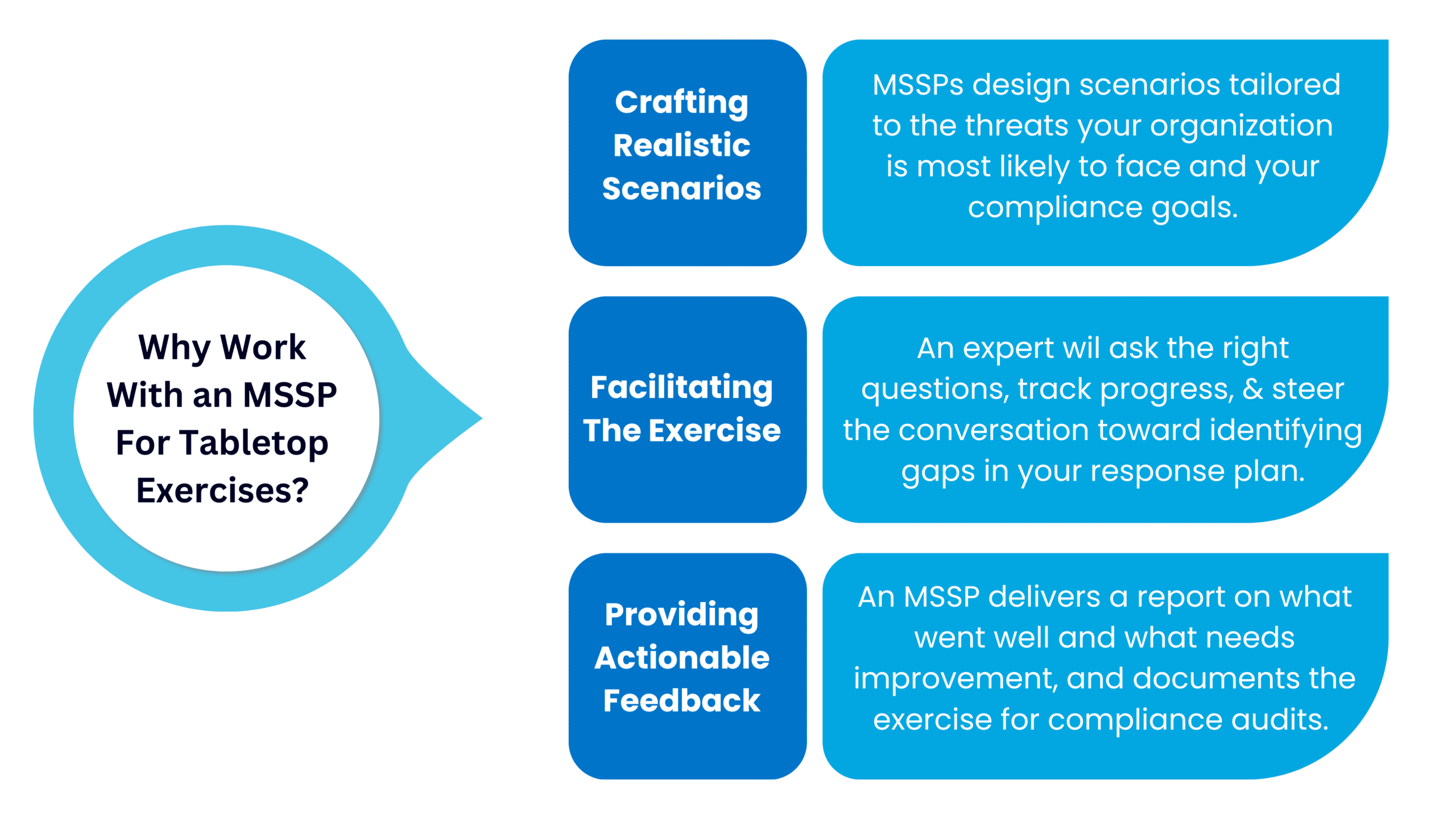
1. Crafting Realistic Scenarios For Your Cybersecurity Tabletop Exercise
Creating a scenario that makes sense for your business is critical. MSSPs can design scenarios tailored to the threats your organization is most likely to face and your compliance goals.
For example, if your company handles customer payment data and you are trying to obtain PCI DSS compliance, the exercise may focus on a ransomware attack targeting your payment processing systems. If you're in SaaS, it could take the form of a simulated compromise of user accounts.
2. Facilitating the Exercise
To conduct tabletop exercises, you need a neutral facilitator to guide the discussion and keep the team on track. A security expert (such as a Virtual CISO, vCISO) at an MSSP can take on this role, asking the right questions, tracking progress, and steering the conversation toward identifying gaps in your response plan.
Working with an outside expert allows your team to engage in the exercise without worrying about having to run it themselves. They bring an outsider's point of view, which can enable you to gain insight into areas your internal team may overlook.
3. Providing Actionable Feedback
After the exercise, an MSSP delivers a report on what went well and what needs improvement. They can help you prioritize updates to your incident response plan and recommend additional security measures based on gaps uncovered during the exercise. They can also document the exercise for compliance audits.
Working with an MSSP provides access to expertise, allows you to strengthen your response capabilities without pulling your internal team away from their day-to-day work, and provides deliverables you can use to demonstrate your security posture to auditors and customers.
Getting Started: Partnering With Experts
Cybersecurity tabletop exercises can be used to meet a vast range of both legal and voluntary requirements, and having conducted them builds trust with your clients and prospects. They provide both the evidence auditors need and the confidence customers expect.
However, startups and smaller organizations may lack the resources or internal expertise needed to effectively run cybersecurity tabletop exercises. An external expert, such as a vCISO, solves this issue and provides specialized knowledge. At Rhymetec, our vCISOs have walked dozens of organizations through their tabletop exercises and provided reports that fulfill compliance requirements.
Check out details on our vCISO services to get started today if you are interested in conducting exercises for your organization.
About Rhymetec
Our mission is to make cutting-edge cybersecurity available to SaaS companies and startups. We've worked with hundreds of companies to provide practical security solutions tailored to their needs, enabling them to be secure and compliant while balancing security with budget. We enable our clients to outsource the complexity of security and focus on what really matters – their business. Contact us today to get started.
About the Author
Metin Kortak has been the Chief Information Security Officer at Rhymetec since 2017. He began his career working in IT security and gained extensive knowledge of compliance and data privacy frameworks such as SOC, ISO 27001, PCI, FEDRAMP, NIST 800-53, GDPR, CCPA, HITRUST and HIPAA. Metin joined Rhymetec to build data privacy and compliance as a service offering. Under his leadership, these offerings have grown to more than 700 customers, and the company is now a leading SaaS security service provider in the industry.
Interested in reading more? Check out more content on our blog.
So, you're a quickly growing startup. One of the last things you want to be thinking about is security and compliance. You want to focus on what really matters - moving your business forward. As a small business ourselves, at Rhymetec, we understand that completely.
But maybe you recently suffered a breach, or maybe a potential client asked you for a security questionnaire, and you realized completing one on the spot was probably not going to cut it.
In any case, you've decided to enter the extremely interesting world of security and compliance for startups. We're going to cover the different types of cybersecurity firms that work with startups, which types of consulting engagements make the most sense for startups, and how to wade through the noise and pick a firm that will act as a partner.

Compliance For Startups: The Maze of Acronyms & Types of Engagements
If you're just getting into looking for a cybersecurity firm that works with startups, be warned in advance - you are going to run into a lot of acronyms. Below are some of the most common acronyms and what they mean:
AV - Anti-virus software that is used on a computer (which is also often referred to as an endpoint because why not complicate everything).
SOC - Security Operations Center, which handles day-to-day alerts aggregated by the SIEM and other systems.
EDR - Endpoint detection and response software that is deployed to an endpoint (since we might as well use a term that acts as both a monitoring tool to detect malicious software and also as a mechanism to contain the device or respond to potential incidents).
SIEM - Security intelligence and event management software that serves as the brain of a security operation, pulling in logs and data from dozens of different systems to act as a single source of truth for a security program.
ISO 27001 - An international standard for information security management systems (ISMS) that provides a framework for managing and securing sensitive information. It focuses on risk management and data protection.
GDPR - Europe's General Data Protection Regulation, enacted in 2016. GDPR requires organizations to safeguard EU consumer data and build governance processes that enable the correct handling of EU citizen data.
SOC 2 - System Organization Controls. A voluntary compliance framework that demonstrates to potential customers that your organization has a security program with standard security controls in place.
HIPAA - The U.S. Health Insurance Portability and Accountability Act. A data privacy law relating to healthcare that also includes a "Security Rule" requiring organizations to take predefined steps to secure patient data.
CISO - The Chief Information Security Officer is the individual responsible for the security of the organization.
vCISO - A virtual Chief Information Security Officer is an outsourced CISO as a service option. This individual (or team) provides strategic security leadership, risk management, and compliance guidance and implementation without the need for a full-time, in-house executive. This option can be ideal for startups and SMBs who may not need to make a full-time hire for this role. vCISO pricing can vary widely depending on the scope of work and level of assistance you need.
MSSP- A Managed Security Services Provider is a company that provides outsourced compliance and security services, such as threat monitoring, incident response, vulnerability management, and more, to protect clients' digital assets.
Some of these terms may be extremely relevant to you, depending on what has sparked your interest in exploring compliance for your startup. Let's take an example:
The Need To Build Security Into The Foundation of Your Business
Imagine your organization has just been the victim of a significant ransomware attack. Many of your sensitive files are now published on a ransomware site, creating enormous disruption to your business.
Many companies that find themselves in this situation panic and immediately engage the first MSSP they can find to help them recover. This is due to the fact that many organizations tend to take a siloed view of information security.
If you are the victim of a breach, you may think you need to work with one firm. If you need compliance, you might think you need to work with a different firm, and you may also think it's only worth seeking out the right firm when there's an issue.
This mindset could not be further from the truth. A good security firm will help with building a program that effectively addresses compliance, governance, technical controls, and incident response in a way that minimizes friction and effectively leverages people, processes, and technology to holistically reduce both the risk of security incidents and the risk of compliance violations.
Choosing the Right Compliance Firm For Your Startup: What Are Common Red Flags To Watch Out For?
Let's start by talking about what to look out for (and be wary of) when evaluating different potential service providers for your organization to work with:
Organizations that promise 100% risk reduction or similar vague and aspirational promises. Unfortunately, we live in a world where 100% security is not possible. These vendors are likely selling snake oil.
Service providers that start by trying to sell you something rather than understanding your needs. Security is a process and needs customization for the end client.
Consultants who have you only speaking to sales without talking directly to the practitioners (like a vCISO) who are doing the work. Good salespeople can be extraordinarily helpful in coordinating engagements but shouldn't take the place of security expertise if you have more technical questions or concerns.
Organizations that plan all communication through email and don't set up regular engagements with you (the customers). Security should be a continuously integrated part of your business. An email a month from your "security team" won't cut it.
Firms that cap hours. MSSPs that set strict hour limits can leave your business vulnerable if issues arise outside of the allotted time. Security needs don't follow a clock, and your provider should be able to respond effectively without arbitrary limitations.
Firms that outsource their services. Some MSSPs may outsource critical functions to third parties, leading to potential inconsistencies in quality and responsiveness. Your security provider should have a clear, direct line of accountability for all services they offer.
Be sure to ask if they outsource any services overseas in particular, and if so, where. Outsourcing overseas can impact a vendor's control and oversight, and certain locations may have different regulations and standards around security.
5 Green Flags To Look For In Firms Providing Security & Compliance Services For Startups
Now, what types of characteristics should you look for in a firm that will help your organization succeed?
Geographically Local Talent
There are incredible security professionals all over the world. However, organizations have dramatically different risk profiles based on their local geography and regulatory environments. A healthcare practice in Italy has an entirely different set of laws and regulations than a medical clinic in New York. Choosing a security provider that has staff and experience in your country helps streamline the process and avoid miscommunication and knowledge gaps that may occur by trying to outsource the work.
Strong Communication
A reputable security services firm should be willing to join a Slack channel with you or establish another near-instant way to communicate directly between security practitioners and corporate staff. Effective communication is absolutely critical to building a great cybersecurity program.

Experience Across Compliance For Startups And Cyber Risk Reduction
Many people view cybersecurity compliance as a tradeoff with risk reduction. You can be compliant, or you can run a "serious" security program focused on reducing risk. This is reductive and untrue. Building an information security program that also reduces risk for an organization should be the goal of every security team.
They Ask Good Questions
What business problem are you trying to solve by working with a firm that specializes in compliance for startups?
This is an important question that all firms should be asking their prospects. When a consultant tries to understand the business problems you are trying to solve, it improves their ability to generate positive outcomes from the engagement.
Transparent Pricing
Security programs are complex, and they can be hard to price. These facts are both true, but that doesn't mean the vendor should put that complexity on you.
Look for a vendor that is willing to provide straightforward, transparent, and honest pricing that makes sense for your organization.
Compliance For Startups: Pricing
So, how do firms price their security offerings? There are a few different methods:
Fixed Price/Project-Based: Using this method, the vendor estimates the work that needs to be done, writes a statement of work (SOW), and quotes a single fixed price for completion of the SOW. This is often the simplest option. In some cases, vendors can split payments into quarterly or monthly.
Flat Monthly Recurring Fee: Many vendors charge a flat monthly recurring fee, particularly for ongoing projects such as compliance maintenance, endpoint detection and response, or security operations center monitoring. This provides simplicity to the end client and avoids surprise billing.
Hourly: Many MSSPs and security consulting vendors charge an hourly rate. While hourly can be valuable in some cases, it can also be quite risky and lead to surprise billing and contractual disagreements.
Check out our blog post on vCISO pricing for more information on standard industry fees for security and compliance for startups.
From here, you should have a good idea of what to look for in a firm specializing in compliance for startups and be ready to start assessing vendors. As you select your MSSP or security consultant, it's important to take the time to thoroughly interview them and pick one that is right for your organization.
Lastly, it's important to work with a firm that stays on top of the latest changes in the regulatory landscape and integrates them into their service offerings. As new regulations like the Digital Operational Resilience Act (DORA) go into effect this year, you need to understand if these requirements impact your business and, if so, partner with a firm that already offers DORA Compliance Services.
If you have more specific questions, please feel free to contact our team:
About Rhymetec
Our mission is to make cutting-edge cybersecurity available to SaaS companies and startups. We’ve worked with hundreds of companies to provide practical security solutions tailored to their needs, enabling them to be secure and compliant while balancing security with budget. We enable our clients to outsource the complexity of security and focus on what really matters – their business. Contact us today to get started.
Interested in reading more? Check out more content on our blog:
- 25 Cybersecurity Memes For 2025: The Ultimate List of Security and Compliance Memes
- Cybersecurity Tabletop Exercise: A Guide For Startups and SMBs
- vCISO Pricing Breakdown: Find The Best Fit For Your Needs
Regular cybersecurity audits are the best way to ensure your business continuously meets security and compliance requirements while reaping the business benefits of investing in security. This post will go over the different types of audits, their benefits for your organization, how to prepare, and common findings to be aware of.
For many fast-growing startups and SMBs, cybersecurity might not feel like a top priority. But with increasingly complex data regulations, rising threats, and growing client expectations, security can no longer be an afterthought, regardless of company size or industry.
The good news is that organizations that invest in improving their security posture and undergo regular cybersecurity audits start to see a wide range of benefits, especially once they have evidence they've successfully completed their audit through a certification or a report:
Barriers are removed in their deal flows, the time spent on filling out onerous security questionnaires is eliminated, and they can get back to what really matters - moving their business forward.
Why Cybersecurity Audits Matter For Your Organization
A cybersecurity audit is a thorough review of an organization's security posture, assessing the adequacy of protections in place to defend against cyber threats and meet regulatory requirements. You can think of an audit as a health check for your security practices, allowing you to identify potential vulnerabilities before they can lead to an actual security incident.
Audit findings provide valuable insight into how secure your organization is and how well you are meeting any relevant requirements. Knowing how well your security practices measure up against industry standards allows you to pinpoint where improvements need to be made, and make only the changes you actually need.
Cybersecurity audits identify vulnerabilities and show where your security measures align with or diverge from relevant frameworks like ISO 27001, SOC 2, and HIPAA. After an audit, as you enact necessary changes to address the audit's findings, you'll reduce the risk of regulatory penalties, reputational damage, and security incidents. Decision-makers can use the results of an audit to prioritize security improvements and guide their compliance efforts.
When clients, investors, regulators, or other stakeholders expect evidence of your security controls, having third-party verification of the strength of your security posture is important. It shows that you've addressed security requirements upfront, creates confidence in your security approach, and helps meet stakeholder expectations.

Types of Cybersecurity Audits Every Startup Should Be Aware Of
Startups should know about a few different types of cybersecurity audits:
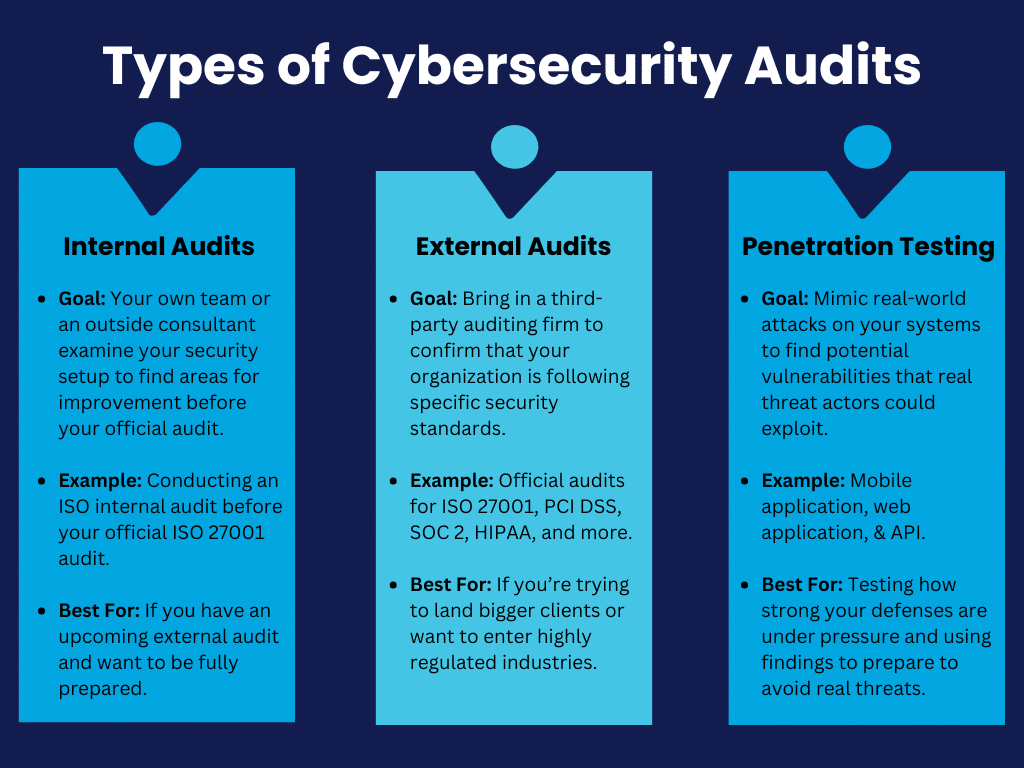
Internal audits are when your own team or an outside consultant examines your security setup. The goal is to conduct a gap assessment and find any areas for improvement to help better prepare you for future external audits. For example, an ISO internal audit provides a way to spot weaknesses early and adjust them before your official audit for frameworks like ISO 27001 and ISO 42001.
External audits bring in a third-party auditing firm to confirm that your organization is following specific security standards such as ISO 27001, PCI DSS, SOC 2, HIPAA, and more. Passing an external audit is vital if you're trying to land bigger clients or want to enter highly regulated industries.
Penetration testing mimics real-world attacks on your systems to find potential vulnerabilities. Penetration tests give you an idea of how strong your defenses really are under pressure, and the findings help prepare you to avoid real threats:
How to Prepare For a Cybersecurity Audit
To prepare for an audit, the first step is to take a close look at your existing policies and procedures: Are they actually being followed?
It's common for companies to write policies that look great on paper but fall short in practice. You'll want to make sure everyone on your team knows their roles, especially around access controls, data handling, and your organization's incident response policies.
Don't neglect the tech side. Run vulnerability scans, review your logging and monitoring, and make sure your backups are up to date. Auditors will likely examine these areas regardless of which type of audit you undergo. Lastly, keep your documentation extremely organized. Auditors appreciate easily accessible and well-organized documentation. Having it ready can be the difference between a smooth audit and a chaotic scramble.
Bonus Tip: A compliance automation tool can come in extremely handy at this stage, as it allows a single place to upload and keep track of all of your documentation. Your auditor will appreciate being able to easily access everything in one place!
Preparing ahead of time as much as possible puts you in control of the process rather than reacting to questions or findings that may come up. Providers like Rhymetec offer internal audits and gap assessment services that are conducted before your audit, leading to fewer surprises during your official audit.
Common Findings in Cybersecurity Audits (And How To Address Them)
Cybersecurity audits often reveal a few common recurring issues that many startups and SMBs face:
One of the most common findings across a variety of different types of audits is weak access controls. Cybersecurity audits frequently find gaps in access control requirements, meaning that too many people have unnecessary access to sensitive data or systems.
The fix here is straightforward:
- Review who has access to what.
- Limit permissions to those who need it.
- Implement multi-factor authentication to add a last additional layer of security to make it harder for unauthorized users to gain access.
Another issue that often comes up is missing or outdated documentation. Auditors will expect to see things like security policies, incident response plans, and training records. If you can't provide these documents or if they're outdated, that's a red flag.
To address this issue, you should:
- Create clear, up-to-date policies that reflect what's actually happening at your organization.
- Make documentation a regular part of your operations, so you're not scrambling to pull everything together before an audit.
- Consider using compliance automation software to organize all of your documentation for auditors in one place.
Another common area where audits also tend to find vulnerabilities is in systems that haven't been patched or updated.
Leaving old software as is is like leaving your door unlocked. You should be regularly updating and patching systems to close off potential entry points for attackers. Simply setting up automated reminders or systems to handle updates can be extremely helpful.
Third-party risk management is another area that is often overlooked by organizations and comes up in audit findings. For PCI DSS audits, for example, this is one of the most common challenges our experts at Rhymetec see that organizations encounter. For many frameworks, you need to make sure your third-party vendors are also compliant.
Finally, many audits reveal a lack of proper employee training. As noted by our experts in Rhymetec's Cybersecurity Awareness Month Tips, your people are often the first line of defense. If they're not aware of basic security practices or don't follow steps to adhere to them on a daily basis, it's a problem.
Ongoing security awareness training and phishing training for employees help everyone in your company recognize and avoid common vectors of attack like phishing attempts.
If possible, address these common issues ahead of time for a smoother audit process.
Cybersecurity Audits and Penetration Testing
Penetration testing is the best way to understand how well your defenses would stand up to real-world attacks.
While not every audit requires a pen test, it's often necessary for audits tied to specific compliance frameworks like PCI DSS and certain SOC 2 reports. These audits don't just ask if you've set up your security controls - they want tangible proof that your system can actually withstand an attack.
Penetration testing is recommended when you need more than a surface-level review of your security and need to go beyond checking boxes to meet compliance requirements; experts simulate actual cyberattacks to try to break through your defenses. Think of it as having someone attempt to lockpick your door, rather than just checking if your door is locked.
Note: If your organization is preparing for a major compliance audit, working with clients that demand high levels of security, or going through rapid growth, a penetration test is highly recommended!
If you incorporate penetration into your regular security checks, you'll get a clear picture of how well you're protected and will be able to tackle weaknesses before they become costly problems down the line. Getting a test done annually or after major changes to your systems helps you stay ahead of emerging threats.
Rhymetec offers a variety of penetration testing services, including:
- Mobile application penetration testing
- API penetration tests
- Web application penetration testing
- External network penetration tests
Choosing The Right Partner for Your Audit
Not all auditors are created equal, so it's important to select a partner who's not only experienced but also a good fit for your company's size, structure, and industry. You need someone who understands both your industry and the specific compliance requirements you're facing.
Audit Partner Factors To Consider
First, check out their track record. Have they worked with startups or SMBs before? It's one thing to know the rules, but another to understand the unique challenges small to midsized companies and startups face regarding security and compliance.
Ask about their previous clients and whether they've helped similar businesses successfully meet their compliance goals. Request to see case studies from their prior engagements with companies with similar profiles as yours.
Another factor to consider is how hands-on you want your audit partner to be. Some partners take a more hands-on approach by choosing to work with select MSSPs to help you improve your security along the way, while others are more focused on just performing the audit and reporting findings.

Audit Report "Red Flags" To Look Out For
A thorough audit report gives you a roadmap for improving your security with clear steps, while a deficient one can leave you with more questions than answers.
Plus, 69% of organizations report that the quality of compliance reports is extremely important. Your clients and stakeholders will want to see evidence of a thorough, high-quality audit.
So, how do you tell the difference between a thorough audit report and a deficient one?
1. First, look at how the findings are communicated:
A high-quality audit report won't just tell you that there's an issue - it will explain where the problem is, why it matters, and how it could impact your business. Look for specifics, like which systems or processes failed, how attackers could exploit weaknesses, and what steps to take next. If your report is filled with vague statements or broad recommendations without context specific to your organization, that's a sign it's not as thorough as it should be.
2. A high-quality report will also show you how issues across different areas are connected:
If weak access controls, for example, show up in multiple places - whether in your cloud setup, employee accounts, or vendor portals - a good report will explain how these issues are linked. A deficient report might mention them individually without showing the bigger picture.
3. Findings on your documentation is another area where a thorough report stands out from a deficient one:
A high-quality report points out exactly where your policies or training records are lacking and provides actionable steps to fix them. If your report glosses over missing documentation or doesn't dig into whether your policies match actual practices, you're likely looking at a surface-level, boilerplate review rather than a meaningful and tailored audit.
4. Finally, a quality report doesn't simply list issues but will categorize them based on their severity and urgency:
This helps guide you on which areas to focus on first. A deficient report may give you a laundry list of issues but won't help you understand which ones pose the most immediate threat.
In short, a thorough audit report provides clarity, context, and a plan. A deficient one leaves you guessing and unsure of how to proceed and may not hold up under scrutiny from your customers and stakeholders.
How Working With An MSSP Simplifies Cybersecurity Audits
Partnering with a Managed Security Services Provider (MSSP) can take a lot of stress out of cybersecurity audits. An MSSP handles much of the ongoing work for you, so when it's time for your audit, you're not rushing to get everything in order.
With continuous monitoring, regular updates, and fully managed compliance services, an MSSP ensures that your security posture stays audit-ready all year round. For example, if your business needs to meet standards like PCI DSS or ISO 27001, an MSSP can keep your policies and security controls aligned with the latest requirements and make sure you're up-to-date on your recurring audits.
Working with an experienced MSSP is the best way to minimize the risk of non-compliance and saves your internal team from having to devote time to it themselves. When you work with an MSSP, you're essentially outsourcing the complex, technical aspects of security to a team that specializes in it, freeing up your business to focus on growth while staying secure and compliant.
About Rhymetec
Our mission is to make cutting-edge cybersecurity available to SaaS companies and startups. We’ve worked with hundreds of companies to provide practical security solutions tailored to their needs, enabling them to be secure and compliant while balancing security with budget. We enable our clients to outsource the complexity of security and focus on what really matters – their business. Contact us today to get started.
Preparing for your PCI audit isn't a matter of simply "checking the boxes" to meet compliance requirements. Ongoing compliance with PCI DSS builds trust with customers and stakeholders, protects your customers' data, and helps with long-term reputation management.
With recent updates in PCI DSS 4.0, there's been an increased focus on compliance maintenance. This article will help you understand the core principles of PCI DSS, how to apply them to your organization, and how to stay compliant over time.
What Is A PCI Audit and How Does It Work At A High Level?
A PCI audit is an assessment of an organization's compliance with the Payment Card Industry Data Security Standard (PCI DSS), a set of security requirements that protect cardholder data. The auditor reviews your organization's security measures, policies, and technical infrastructure to verify that you meet requirements.
In our recent webinar on Compliance to Confidence: Simplifying PCI Security Standards, Rhymetec CISO Metin Kortak discussed frequently asked questions and concerns around PCI DSS Version 4.0 with Kevin Whalen, Head of PCI at Prescient Security.
"The Version 4 standard has a number of new requirements, but I don't think any of the changes are overly difficult. There are a few that are, but a lot of what the update did was simplify and consolidate some of the requirement language. But there are some new enhancements to it to be aware of," noted Kevin Whalen during our webinar.
One such enhancement is the new focus on ensuring organizations maintain compliance over time. As we have seen with other recent updates to cybersecurity and compliance frameworks like NIST CSF Version 2.0, there is a stronger focus in the updated PCI DSS 4.0 on continuous compliance. This means businesses need to show they maintain compliance on an ongoing basis rather than just at the time of the audit.
The PCI compliance readiness process starts with a gap analysis to identify areas that need remediation. Once gaps are addressed, the formal audit is conducted by a Qualified Security Assessor (QSA). This individual reviews documentation, interviews staff, and tests controls to validate compliance. Following your audit, they will provide a report on the findings and note any corrective actions you need to take.
Core Principles and Requirements Under PCI DSS
There are five core principles under PCI DSS. Each of the following requirements is important from a compliance perspective and will also vastly improve your security if you did not have them in place previously.
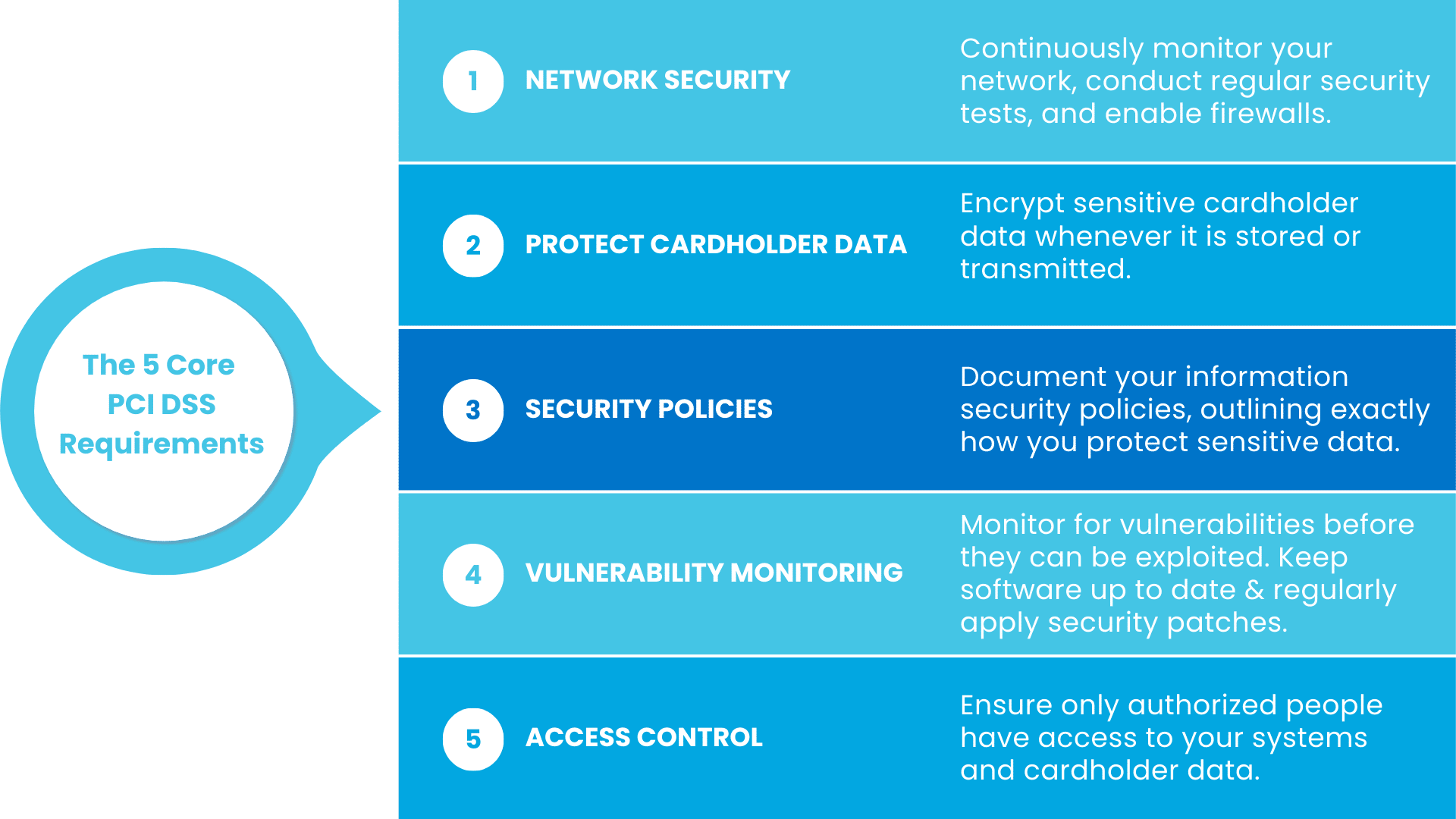
Let's go over each principle in more detail, and explain how they help prevent breaches and keep your customers' data safe:
1. Securing and Monitoring Your Network
PCI DSS requires that you set your network up with security top-of-mind.
This includes measures like firewalls to block unauthorized traffic and making sure your systems are configured securely. You also should set up ways to constantly monitor your network for suspicious activity and conduct regular security tests.
Let's say you run a SaaS platform offering payment processing for small retailers:
If your network isn't secured properly, it's easier for hackers to intercept cardholder data during transactions. By setting up proper firewall measures, you can block unwanted traffic and limit access to only those who really need it.
Regular network monitoring, meanwhile, will alert you to unusual activity, such as an unexpected increase in traffic to your payment systems. Lastly, ASV scans for PCI, vulnerability scans, and penetration tests can help identify weak points and enable you to fix them before they can be exploited.
2. Protecting Cardholder Data
Under PCI DSS, you must encrypt sensitive cardholder data whenever it's stored or transmitted. Encryption makes the data unreadable to anyone without the decryption key, so even if it's intercepted, it's useless to bad actors.
As an example, if a platform offers subscription services and stores credit card information for recurring payments, under PCI DSS they must have encryption enabled to prevent hackers from being able to steal readable credit card data. This is a particularly important measure if your business deals with large volumes of recurring transactions where cardholder data may be stored for longer periods of time.
3. Updating Security Policies For Your PCI Audit
Under PCI DSS, organizations must have a set of documented information security policies. Your policies should outline precisely how you protect sensitive data, and how different members of your teams play a role in this.
For example, your policies may require that all developers at your company use secure coding practices, or that support staff avoid accessing customer payment data directly.
*Note: Having strong security policies in place is critical regardless of organization size, but small businesses or those without designated security members on staff often struggle to set up clear and usable policies. Check out our blog on crafting security policies for small businesses for guidance on how to not only write, but how to effectively communicate your security policies so they are followed by employees.

4. Vulnerability Monitoring
Vulnerability monitoring entails common sense security measures like keeping antivirus software up to date and regularly applying security patches to your systems. The idea is to address security vulnerabilities before they can be exploited.
If a known vulnerability exists in one of the software components your project management tool relies on to work, for example, threat actors could use that to access your customers' data. Continuously monitoring for potential vulnerabilities and having a plan to address them is critical not only for your PCI audit but also from a baseline security perspective.
5. Access Control
Access control measures need to be implemented to ensure only the right people can get into your systems and access sensitive cardholder data. Baseline security measures that all organizations should ideally be doing, like multi-factor authentication (MFA), also help with access control.
You never want everyone internally to have full access to cardholder data. By limiting access to only the employees who absolutely need it - and by also adding MFA to verify their identity - you reduce the risk of unauthorized access enormously.
Why Is PCI DSS Compliance Important For Your Business?
Businesses that handle cardholder data are required to obtain PCI DSS compliance. Non-compliance can result in fines, legal penalties, and damage to your organization's reputation. Breaches can lead to financial losses, erode customer trust, and cause disruptions to your business operations.
Compliance also reduces the risk of fraud and theft of payment data, which can result in financial harm to both your business and your customers. With the introduction of PCI DSS 4.0, businesses are expected to demonstrate continuous compliance and show that they are taking a proactive approach to managing security risks.
Types of PCI DSS Audits and Their Scope
The type of PCI audit your business requires depends on your merchant level and the volume of transactions you process annually. Each audit type covers all of the requirements in the PCI DSS standard, but may vary in depth based on the size of your business and the sensitivity of the cardholder data you process:
Self-Assessment Questionnaire (SAQ)
This is a self-evaluation tool used by smaller businesses that don't handle large volumes of cardholder data. The SAQ is basically a checklist where you answer a series of questions about your security practices, and is broken down into different versions depending on how you process payments. There are specific versions for businesses that process payments online, through a physical point-of-sale system, or over the phone.
As an example, if you run a SaaS business that provides a billing platform for freelancers, and you rely on a third-party payment processor like Stripe to handle the actual transactions, you wouldn't be storing or processing cardholder data directly. Therefore, you'd likely fall under the SAQ version that applies to businesses that outsource their payment processing, and it would serve to validate that your company never stores or has access to that data.
Report on Compliance (RoC)
For larger organizations or those processing a large volume of transactions, a PCI audit conducted by a Qualified Security Assessor (QSA) is required.
This audit is more extensive and includes on-site assessments of your security controls, and is generally required for larger businesses or those processing a significant number of transactions. If your company processes more than 6 million transactions per year, you'll likely need an RoC.
5 Steps To Prepare For Your PCI Audit
At a high level, the following 5 steps illustrate the process leading up to your PCI DSS audit.
At any one of these steps, it can be helpful to consult an outside expert, such as a Managed Security Services Provider (MSSP), with ample prior experience helping organizations achieve PCI DSS compliance.
1. Understand your scope.
Mapping out the scope of your audit is the first step. You'll need to determine which of your systems, networks, and processes handle cardholder data. Merchants have to request additional information from customers under certain circumstances:
"When we start our scoping process, what we usually try to understand in the beginning is how the payments are being processed…Where it gets complex is when the physical card is not present when you're making a purchase. Because the physical card is not present, PCI has certain requirements in place so that when you make a purchase online, for example, you have to provide some additional information like your billing address," said Rhymetec CISO Metin Kortak on this topic during our webinar.

You also need to define your Cardholder Data Environment (CDE).
"What that means is we need to understand exactly where the card information is being processed. Is it only processed by the customer's hosting provider? Or does the card information also reside in other third-party applications or physical servers? It's important to understand the entire scope so that when we go through an audit, we can give them the proper scope and make sure that the PCI security controls are implemented on all of those hosting providers and other vendors," said Metin.
2. Conduct a gap analysis leading up to your official PCI audit.
Perform an internal assessment to pinpoint areas where your organization does not meet PCI DSS audit requirements. This is important to do before your formal audit, as it will give you a chance to address any deficiencies beforehand. MSSPs that are experienced in compliance and offer one-off gap assessment services can be a great resource during this step.
3. Remediate any identified gaps.
Next, address any gaps found during your internal assessment. Common security measures that may need to be addressed at this stage include updating your firewalls, strengthening encryption protocols, or further formalizing your access controls.
4. Update your documentation.
Prior to your audit, make sure all of your policies and security measures are well-documented in a format that will make it easy for your auditor to keep track of. Using a compliance automation tool can be extremely helpful with this, as they provide a single, easily accessible place to upload all of your documentation for your auditors to see.
5. Perform ongoing monitoring for your next PCI audit.
This element is one of the heaviest lifts of the current version of PCI DSS.
Compliance maintenance under PCI DSS 4.0 is expected, and ongoing monitoring will help you stay compliant throughout the year. You should be regularly monitoring security systems and processes to detect any potential misconfigurations or vulnerabilities. This includes automated monitoring of various controls, such as payment page script security:
"The most significant change of 4.0 is the payment page script security, where they've added some new requirements in the software development controls as well as automated security controls around monitoring for changes to the construction of your pages that contain input fields for cardholder data." - Kevin Whalen, Prescient Security
Common Challenges and What To Do
Some common challenges businesses face when preparing for PCI DSS audits include:
Defining the Scope of Your PCI Audit
Many businesses struggle with understanding the full scope of systems that must be in compliance with requirements under PCI DSS. To address this, perform an inventory of systems handling cardholder data. As an example, you will have more strict requirements that apply to your scope if you take payments over the phone instead of in person.
"Depending on how the payments are being processed, how the credit card information is being collected by the buyers - that impacts the level of work that we're going to do for our customer," Metin Kortak, Rhymetec
Maintaining Compliance Over Time After Your PCI Audit
Maintaining an effective compliance maintenance program that scales with your business can be a challenge. Using automated monitoring and logging tools to track compliance in real-time can be helpful, as can working with an outside expert like a Managed Security Services Provider with specific expertise in enabling organizations to stay compliant over time.
Documentation
Many organizations lack adequate documentation of their security policies and controls.
You need this documentation not only for compliance purposes but also as a common-sense security measure: All of your employees should be aware of your security policies and procedures, such as your policy on measures like multi-factor authentication (MFA).
Bonus Tip: For your PCI DSS audit, a compliance automation platform can be incredilby helpful with documentation. Compliance automation tools provide a single location with all of your documentation clearly laid out, so that you and your auditors can easily access and keep track of it.
Third-Party Risk
Third-party risk management plays an important role in PCI compliance. If you're using a third party to process or store credit card information, you generally need to obtain that company's own attestation or certification document to include in your own PCI audit.
"Collecting your third parties' PCI certifications is important, especially if the vendor is processing or transmitting credit card information. Aside from that, you still need to conduct vendor assessments on all of your vendors. And that needs to go beyond just collecting the PCI certifications. That might mean checking that those vendors have proper information security policies in place, if they have conducted their own business continuity tabletop exercises, if they conduct access reviews…Just really conducting a thorough due diligence." - Metin Kortak, Rhymetec
In sum, you need to make sure your third-party vendors that process or store your cardholder data in any way are also PCI DSS compliant.

Post PCI Audit Action Items: How To Stay Compliant
After your audit, there are several steps to help maintain compliance:
Address audit findings.
The first step post-audit is to thoroughly review the auditor's report and remediate any identified deficiencies as needed.
Be sure you've implemented continuous monitoring measures.
Set up monitoring systems to track your compliance with key PCI DSS controls discussed previously, including encryption, access management, and vulnerability scanning. As noted above, a compliance automation tool can be incredibly helpful with this.
Update your policies as needed.
It can help to schedule regular intervals to review your security policies going forward. This will enable you to change your policies as needed to reflect any changes in your organization's operations, your risk profile, or the PCI DSS standard.
Have regular internal audits.
Schedule periodic reviews to assess your compliance posture between your annual PCI DSS audits.
Vendor management.
Lastly, remaining in compliance with PCI DSS requires ongoing monitoring of your third-party vendors to confirm their continued compliance, especially if they are involved in how you handle cardholder data.
In Conclusion
Although it may seem daunting to prepare for your PCI audit, by following the steps outlined in this article, you can feel confident that you are well prepared for your audit and that your customers' data is protected.
PCI DSS compliance is not just a one-time effort - compliance requires ongoing attention, especially with the updates introduced in PCI DSS 4.0. After your PCI audit, be sure to continue monitoring your network, confirming third-party due diligence, and updating your policies as needed. Staying proactive will help your business stay secure, remain in compliance, and build long-term trust with your customers and stakeholders.
About Rhymetec
Our mission is to make cutting-edge cybersecurity available to SaaS companies and startups. We’ve worked with hundreds of companies to provide practical security solutions tailored to their needs, enabling them to be secure and compliant while balancing security with budget. We enable our clients to outsource the complexity of security and focus on what really matters – their business. Contact us today to get started.
Interested in reading more? Check out more content on our blog:
- Generative AI Security Risks For Businesses: Practical Advice For The Concerned
- vCISO Pricing Breakdown: Find The Best Fit For Your Needs
- Cybersecurity for SMBs: 10 Key Measures and Statistics
This article goes over vCISO pricing models and services, how to choose the right option for your business, and how to make sure you receive the guidance and services you need without unnecessary expenditure.
For startups and SMBs, cybersecurity and regulatory compliance are challenges that demand expert attention. However, many organizations either lack the resources or don't need to hire a full-time Chief Information Security Officer (CISO) to meet their needs. A Virtual CISO (vCISO) offers a practical alternative, delivering high-level security leadership on a flexible, cost-effective basis.
Today, vCISO services are used not only by startups but also by enterprises that need executive-level security leadership without the full-time salary overhead. By partnering with an MSSP like Rhymetec, organizations of all sizes gain access to compliance expertise across SOC 2, ISO 27001, HIPAA, GDPR, and CMMC, plus global regulations like NIS2 and GDPR for European expansion.
vCISO Pricing Structures
Let's go over the three main vCISO pricing structures and their average costs right off the bat:
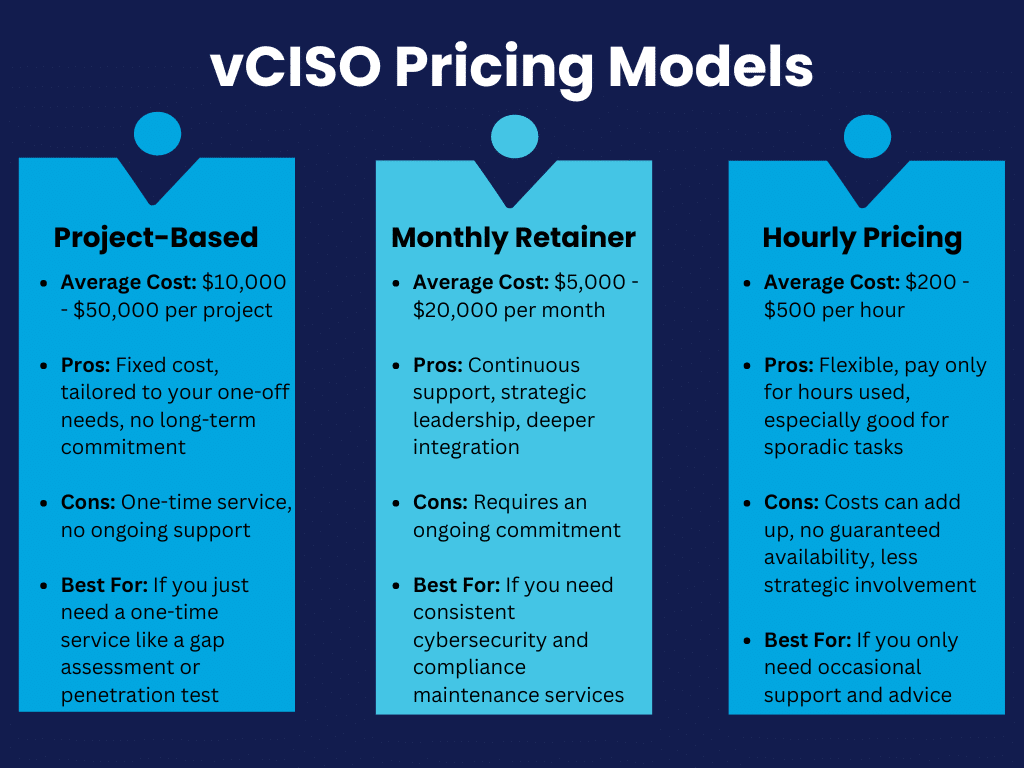
Project-Based Pricing
Businesses often select this option if they need one-time tasks like security audits, risk assessments, or gap assessments. As you can probably imagine, the cost varies widely depending on the specific project.
As an estimate, project-based vCISO pricing ranges from $10,000 (for services like gap & risk assessments) - to $50,000 (prices can go up this high for things like penetration testing and compliance certifications).
This option is best for companies tackling immediate needs, such as preparing for a SOC 2 or HIPAA readiness assessment, or validating new cloud infrastructure security controls.
Hourly vCISO Pricing
Hourly vCISO pricing typically falls between $200 - $500 per hour. This option may be suitable for companies that need occasional expert input or are looking to address specific tasks without a long-term contract.
However, a major con of hourly pricing is that your hours may be capped on a weekly or monthly basis. This means that if you need extra support if something comes up, you may not be able to receive it on demand.
For example, Rhymetec’s Executive Tier provides what is essentially a full-time vCISO, fully integrated into your systems, offering audit preparation, vendor management, and direct collaboration with trusted auditors and partners such as A-LIGN.
Monthly Retainers
Monthly retainer fees typically range from $5,000 - $20,000 per month, depending on the level of service and the vCISO's involvement.
This pricing model allows you to have continuous access to a vCISO, offering the most comprehensive support. This benefits businesses that need ongoing direction and hands-on management of their infosec programs.
What Does The vCISO Role Entail?
A Virtual Chief Information Security Officer (vCISO) is a seasoned cybersecurity professional who provides the strategic leadership and services of a traditional CISO, but operates remotely and often on a part-time basis.
vCISOs work with businesses to develop and manage their security programs, maintain overall good security hygiene, and protect the company's data and systems. This role is particularly appealing to startups and SMBs that need expert guidance and support but without the full-time commitment or cost of an in-house CISO.
vCISOs assist with a wide range of services, including risk management, compliance with regulatory standards, incident response, and security policy development. Some Managed Security Services Providers (MSSPs), such as Rhymetec, offer comprehensive vCISO services that provide an elegant solution for businesses aiming to improve their security posture without the overhead of a full-time CISO.
In practice, a vCISO helps organizations evaluate risk, implement security frameworks, maintain audit readiness, and navigate changing regulatory environments. They often work hand-in-hand with compliance automation platforms for evidence collection and reporting, setting them up and leveraging them on your behalf.
What Are The Advantages of a vCISO vs. In-House Security?
For SMBs and startups, the choice between a vCISO and an in-house security team often comes down to three main considerations:
- Cost
- Expertise
- Flexibility
Hiring a full-time CISO can be prohibitively expensive, with salaries often exceeding six figures. Not to mention, there are the additional costs of benefits, training, and other resources required to support the role.
A vCISO, on the other hand, offers the expertise of a seasoned CISO at a fraction of the cost, often working part-time or on a retainer basis. vCISOs bring a breadth of experience from working with multiple clients across various industries, which can be particularly beneficial for smaller companies that may not have the resources to stay on top of the latest threats and regulatory changes.
For instance, Rhymetec's Executive Tier vCISO Service provides not just a dedicated vCISO, but also full integration with the client's systems, providing a level of support that rivals that of an in-house team. This allow startups and scaling enterprises to achieve enterprise-grade security without building costly in-house departments.
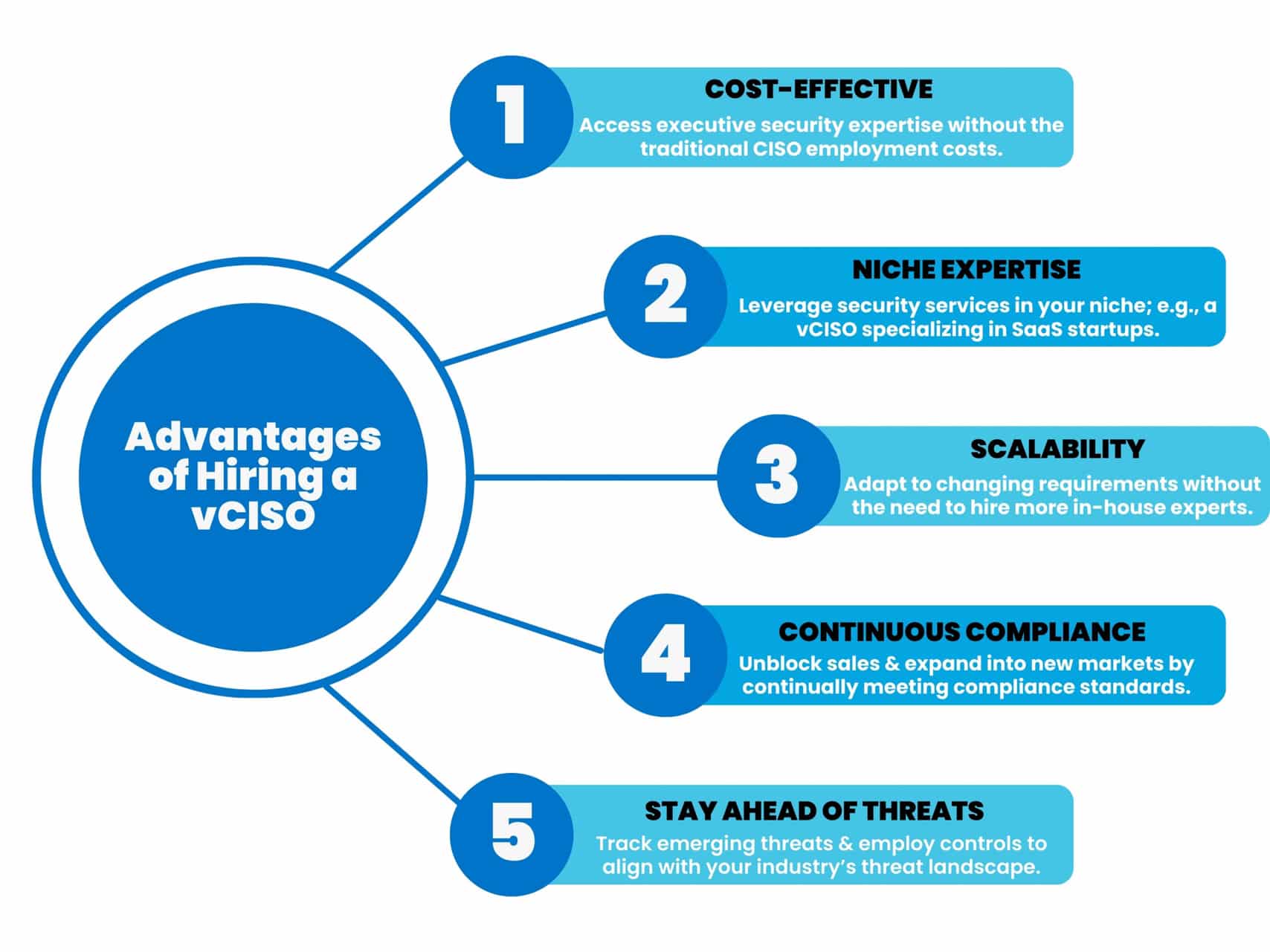
Factors Impacting vCISO Pricing
vCISO pricing can vary substantially depending on the scope of services, the requirements specific to your location and industry, and the complexity of your existing infrastructure. The broader the scope of services - such as adding compliance frameworks or expanding to full-time support - the higher the cost.
For example, Rhymetec's pricing structure adjusts based on the level of service required. Our Mentor Tier starts at $2,500 per month, which covers essential advisory services and assistance in maximizing your use of a compliance automation platform.
However, if a client needs additional services, such as manual security services to meet requirements under a framework like SOC 2 or align with new NIST governance requirements, the monthly fee increases by a minimum of $500. Companies in highly regulated industries may face higher costs due to the need for specialized expertise and more comprehensive services.
For instance, a vCISO can act as a CMMC consultant and help defense contractors navigate the requirements by determining which certification level applies to them and how to reach compliance efficiently. Many organizations begin by reviewing a CMMC Level 1 Checklist, but a vCISO builds on that by mapping the right controls and managing implementation. They help also clarify higher-level common doubts such as when CMMC versus FedRAMP is the right framework to pursue, since both can impact federal contracts.
Pricing Models for vCISO Services
As discussed previously at a high level, there are several common pricing models for vCISO services:
The most straightforward and popular option is a flat monthly fee. Businesses often find that this option allows them to budget more effectively and provides predictability. This model is often tiered, with different levels of service available depending on the company's needs.
Rhymetec, for instance, offers three tiers of service on a monthly basis: Mentor, Manager, and Executive. The Mentor Tier is ideal for startups and SMBs needing strategic guidance, while the Manager Tier adds more hands-on management of security and compliance.
The Executive Tier, with custom scoping, offers the equivalent of a full-time vCISO, including advanced services like penetration testing and vendor risk management:
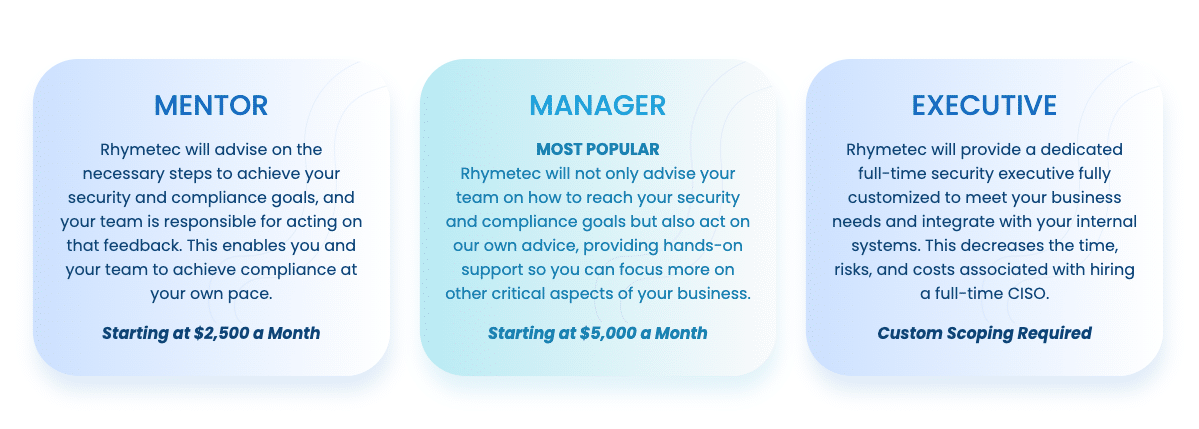
Another model is an hourly-based arrangement, where the vCISO is available for a set number of hours per month. This model offers flexibility but can lead to variable costs depending on how much time is used.
Some providers also offer project-based vCISO pricing for specific initiatives, such as phishing training for employees, a security audit, gap assessments, penetration testing, or compliance certification.
vCISO Pricing Compared To In-House Options
Taking a look at the differences in vCISO pricing and in-house options reveals substantial cost savings:
The average salary for a full-time CISO can exceed $200,000 per year, not including bonuses, benefits, and investing in necessary resources. Companies often need to invest in ongoing training and potentially expand their IT team to support the CISO's initiatives.
In contrast, a vCISO from Rhymetec's Mentor Tier, as an example, costs a total average of $30,000 per year, with options to scale services as needed. Even the top-tier Executive service, which provides comprehensive, full-time support, is more cost-effective than hiring an in-house CISO, particularly when considering the added value of expert-level services that might otherwise require multiple hires!
Consider the average cost of the following positions:
Job Title (Salary range for an in-house full-time hire in 2024):
- CISO ($215,000 – $275,000 per year)
- Cloud Security Specialist ($110,000 – $150,000 per year)
- Application Security Specialist ($130,000 – $180,000 per year)
- Penetration Tester ($110,000 – $150,000 per year)
- Security Operations Analyst ($110,000 – $160,000 per year)
- Threat Intelligence Analyst ($80,000 – $140,000 per year)
- Governance, Risk and Compliance Specialist ($65,000 – $100,000 per year)
- Vulnerability Management Analyst ($100,000 – $165,000 per year)
SMBs and startups need the same level of expertise but not necessarily the same amount of work as large enterprises that spend millions of dollars on a security team with many highly specialized individuals.
Small businesses need the same level of experience but not necessarily the same amount of work. Many organizations choose to work with a Managed Security Services Provider with vCISO support precisely for this reason, as they fill this gap perfectly. At Rhymetec, our vCISO pricing model centralizes all of these skillsets under a single engagement, giving SMBs access to the same expertise as large enterprises without the payroll overhead.
vCISO Pricing & Scope of Work
When considering working with a vCISO, understanding the scope of work and exactly what will be delivered is crucial.
A typical vCISO proposal will outline the specific services offered, the frequency of engagements (such as weekly meetings or monthly reports), and the expected outcomes. Rhymetec's Mentor Tier includes weekly virtual meetings, gap assessments, and policy development, while the Manager and Executive Tiers expand the scope to include incident management, vendor management, and even penetration testing upon request.
The proposal will also detail if and how the vCISO will integrate with your existing team. In Rhymetec's Executive Tier, this includes not just virtual support but also on-site meetings and close collaboration with the client's internal IT team. This helps align your tailored vCISO services with your business objectives and cybersecurity needs.
Case Studies: SMBs and Startups Leveraging vCISOs
In our experience with clients, particularly with B2B startups, the vCISO program enables companies to meet their security and compliance goals in a much shorter timeframe than other options would have allowed for:
In our cybersecurity case studies, we've found that the vCISO pricing model and services provide several key advantages for companies. First and foremost, when working with a vCISO, specifically through an MSSP, it allows access to a vast set of skills:
"You can rely on a single individual, or you can have the benefit of a whole team of deep expertise and process knowledge. It's a small investment when you're considering in-house resources versus an entire team available on call at a fractional need – the ROI is really compelling."
– Harry Karamitopoulos, President, Modicum
Customers leveraging a vCISO program also find that it enables them to stay on track with their security and compliance goals, while being able to move their business forward and eliminating the need to build out expensive in-house teams:
"It kind of is like my 'security blanket.' I am a team of one for security and I need support. Having the Rhymetec team to lean on, help me consider options, weigh the pros and cons for different assets around security, and have someone else to bounce ideas off of has been helpful. Also, helping me stay on track and act as a copilot to help manage and navigate those decisions are all things that are essential to me. Without it, I would have to go out and hire more people, and the vCISO essentially cuts out the workforce I would need to hire full-time."
– Rolland Miller, Vice President of Security and Compliance, Orum
Lastly, we often hear from clients that working with their vCISO provides the level of experience and knowledge they need to meet their goals, and their vCISO's established relationships with auditors and compliance automation companies are a critical resource during the audit process:
Maximize The Value of Your vCISO Investment
To get the most value from a vCISO, businesses should do the following:
- Make sure your objectives from working with a vCISO are clearly defined
- Communicate regularly with your vCISO
- Establish metrics for success and periodic reviews of your security posture as it evolves
Rhymetec's vCISO services are designed with flexibility in mind, allowing businesses to begin with basic services and scale up as their needs grow. For example, a startup might begin with the Mentor Tier to establish a security foundation and achieve security advisement, then transition to the Manager or Executive Tier as their operations and the marketplaces they sell to expand. This not only helps manage costs but also ensures that the vCISO's services evolve in tandem with the business.
An effective engagement with a vCISO enables you to vastly improve your company's overall security posture over time, and serves as a business enabler as you break into new marketplaces and grow your business.
At Rhymetec, we act as both strategic advisors and hands-on operators, making advanced security and compliance attainable for companies of any size through our vCISO pricing options.
Concluding Thoughts: A Model for vCISO Pricing & Services With Busy Technology Executives Top of Mind
Whether you're looking to start out with basic advisory services or invest in full-time support, the right vCISO can provide the expertise required to protect your business and take security off your plate so you can focus on what really matters - your business.
Rhymetec's vCISO pricing tiers and vCISO services were created with busy technology executives and their workflows in mind. Our goal is to help you shorten your timelines, reduce your team's level of effort, and successfully guide your company through all of your cybersecurity and compliance needs so you can continue to move your business forward. Contact us today to learn more:
FAQs - vCISO Pricing & Services
What is a vCISO and how is it different from a full-time CISO?
A vCISO provides the same strategic leadership as a Chief Information Security Officer but works on a part-time or flexible basis. This makes it far more cost-effective while still delivering deep expertise.
How much does a vCISO cost?
Costs vary depending on scope and pricing model. Project-based engagements can range from $10K–$50K, hourly rates run $200–$500, and monthly retainers average $5K–$20K. Rhymetec offers tiered services beginning at $2,500/month.
Why would a company choose a vCISO over hiring in-house?
Hiring in-house requires salaries exceeding $200K annually plus benefits. A vCISO gives access to equivalent expertise at a fraction of the cost, with the flexibility to scale services as needed.
Can a vCISO help with compliance certifications?
Yes. vCISOs often lead compliance readiness efforts for SOC 2, ISO 27001, HIPAA, GDPR, CMMC, and other frameworks. They manage everything from gap assessments to evidence collection to audit prep.
Do vCISOs work with partners or tools?
Many vCISOs, including Rhymetec’s team, collaborate with audit partners like A-LIGN and leverage compliance automation platforms such as Drata and Anecdotes to streamline readiness.
What industries benefit most from vCISO services?
Startups, SaaS companies, healthcare, fintech, and government contractors all benefit. Any organization that needs to prove compliance to customers, investors, or regulators can use a vCISO to reduce cost and complexity.
About Rhymetec
Our mission is to make cutting-edge cybersecurity available to SaaS companies and startups. We've worked with thousands of organizations to provide practical security solutions tailored to their needs, enabling them to be secure and compliant while balancing security with budget. We enable our clients to outsource the complexity of security and focus on what really matters – their business.
Interested in reading more? Check out more content on our blog:
- Managed Compliance: An Updated Approach For The Cyber Regulatory World
- Why Managed Security Services? In-House vs External Security
- AI Frameworks: What They Are & Why We Need Them
When evaluating vendors to build and audit your information security (infosec) program, there are many important questions to ask: Who exactly will be handling your data? What are the team's credentials and prior experience? Will the vendor be outsourcing services internationally, and if so, how will their control and oversight of the process be impacted?
Is the vendor claiming to be able to both build your infosec program AND conduct your official audit?
Some MSSPs and "compliance as a service" providers are now advertising that they can help organizations meet required controls and conduct their certification audit. In this article, we'll go over the potential issues with this from a legal, reputational, and ethical perspective.
Let's be clear about a few of the potential pitfalls of this approach right off the bat:
Potential Pitfalls Of Engaging "All In One" Vendors
Having the same entity create and assess your infosec controls introduces a blatant conflict of interest. This presents clear ethical issues, as it's essentially like having a restaurant conduct its own health inspection.
They may not provide a fully objective assessment and could be inclined to overlook issues to hand you a more favorable report. Your audit may not hold up under scrutiny from stakeholders in the future, especially if you were to experience a security incident.
Another red flag is if an "all in one" vendor is claiming to be able to implement your security controls and conduct your audit at a suspiciously cheap price tag. Meeting requirements such as SOC 2, HIPAA, GDPR, and dozens of others can be fairly economically efficient and not break the bank. However, compliance isn't incredibly cheap either. As in many cases in life, when something seems too good to be true, it probably is.
Meeting information security compliance requirements isn't always an easy process. It often takes making many complex decisions involving business outcomes, processes, technologies, and acceptable risk. In other cases, it means fundamentally reworking a core business process to meet a requirement.
When done correctly, meeting requirements provides regulators and potential customers the assurance that your organization takes security seriously.
When done poorly, it can result in expensive boondoggles that cost your organization legal fees and valuable customer relationships. Engaging separate entities to develop and audit your infosec program is a safeguard against bias and helps you uphold the integrity of your compliance efforts.

So, what are the actual requirements and guidelines from which the robustness of your compliance can be judged?
Let's take a look at what a few entities and guidelines have to say on audit independence:
Guidelines and Best Practices To Ensure Audit Independence
Sarbanes-Oxley (SOX) is a U.S. federal law aiming to protect investors by improving the reliability of corporate disclosures. Although it primarily applies to publicly traded companies, it can indirectly impact privately held SaaS companies, for example, that may plan to go public in the future or those that provide services to public companies.
For instance, a SaaS company that handles financial data or provides financial reporting services to public companies may need to make sure its controls align with SOX requirements.
Section 404 of Sarbanes-Oxley requires that companies have an independent audit of internal controls over financial reporting.
The Public Company Accounting and Oversight Board (PCAOB) states the following:
A registered public accounting firm and its associated persons must be independent of the firm's audit client throughout the audit and professional engagement period.
Note 1: Under Rule 3520, a registered public accounting firm or associated person's independence obligation with respect to an audit client encompasses not only an obligation to satisfy the independence criteria applicable to the engagement set out in the rules and standards of the PCAOB, but also an obligation to satisfy all other independence criteria applicable to the engagement, including the independence criteria set out in the rules and regulations of the Commission under the federal securities laws.
Note 2: Rule 3520 applies only to those associated persons of a registered public accounting firm required to be independent of the firm's audit client by standards, rules or regulations of the Board or Commission or other applicable independence criteria.
Now that description is a bit heavy on jargon, so we can consult another source. SOC 2 is overseen by the American Institute of Certified Public Accountants (AICPA). AICPA has (fortunately for the non-accountants and lawyers among us) published a "Plain English Guide to Independence," which provides the following guidance:
Independence of mind is the state of mind that permits a member to perform an attest service without being affected by influences that compromise professional judgment, thereby allowing an individual to act with integrity and exercise objectivity and professional skepticism.
Independence in appearance is the avoidance of circumstances that would cause a reasonable and informed third party, who has knowledge of all relevant information, including safeguards applied, to reasonably conclude that the integrity, objectivity or professional skepticism of a firm or member of the attest engagement team is compromised.
Image Source: AICPA
In even plainer English, AICPA is saying that auditors should avoid any conflicts of interest that could impair their objectivity. This includes scenarios where they might audit their own work or the work of close colleagues, which would naturally apply to building and then auditing the same infosec program.
The AICPA's guidance, particularly under the SOC standards, prohibits organizations from auditing their own services, stating that:
"The auditor's responsibility is to provide an independent assessment of the service organization's controls that may affect user entities' financial reporting."
AICPA's emphasis on independence effectively makes it clear that an organization both implementing security controls for compliance and conducting the audit would risk impairing the auditor's independence and objectivity, thus not aligning with best practices. It's clear from their guidance that auditors should avoid any conflicts of interest that could impair their objectivity.
Lastly, many standards and frameworks, such as ISO/IEC 27001 and NIST, emphasize the importance of independence in the auditing process. They recommend that audits be conducted by individuals who are not involved in the day-to-day operations or implementation of the security program.
Assessing Audit Independence and Quality
Now, let's imagine a SOC 2 audit. Say you've hired an accounting firm with a security branch to help implement controls pursuant to SOC 2. Now imagine that the very same firm is going to audit your organization for compliance. Could a reasonable and informed observer conclude that the firm auditing the controls may be biased as a result of the fact that they were the ones who also implemented the controls?
To recall an earlier analogy, it's as if a restaurant were to perform its own health inspection. What are the odds that they are going to find major violations? Probably pretty low. When the same person who designed and implemented the infosec program also audits it, there is a significant risk of bias. They may inadvertently overlook issues or be less critical of their own work.
Even if this "all in one firm" issues a SOC 2 report without findings, your organization could still be at substantial risk. Imagine you have a major cyber event in the future, and customers find out that your SOC 2 report wasn't entirely accurate and that the firm you hired took shortcuts through the process. Information security isn't just a legal risk; it's a business and reputational risk.
A reputable information security compliance provider (whether an accounting firm or a managed security services provider) should do the following:
- Be able to provide reference customers, either publicly or privately, who have worked with the firm in the past to implement controls.
- Work with a reputable outside auditing firm that conducts independent audits of control implementation.
- Ensure that all employees adhere to industry standards, guidelines, and best practices such as those set by the AICPA.

Some firms, such as Rhymetec, have identified specific high-quality third-party firms that we often recommend to our clients to complete the audit process. But if clients prefer a different audit partner, that is okay too.
Information security compliance requirements shouldn't be considered a burden to businesses. Implementing requirements such as SOC 2, GDPR, HIPAA, and others should help organizations be assured that they are meeting relevant legal and ethical requirements while taking adequate and appropriate measures to safeguard customer data.
When conducted by ethical providers, standards like SOC 2 can substantially enhance a business's confidence and security protocols without disruption and without massive cost. Independent audits provide greater credibility to your stakeholders, including management, customers, and regulatory bodies. You can be confident that the audit findings are impartial and accurate.
About Rhymetec
Our mission is to make cutting-edge cybersecurity available to SaaS companies and startups. We've worked with hundreds of companies to provide practical security solutions tailored to their needs, enabling them to be secure and compliant while balancing security with budget. We enable our clients to outsource the complexity of security and focus on what really matters – their business.
Interested in reading more? Check out more content on our blog: